

In today’s digital environment, organizations are focusing more on governance, risk and compliance. Whether you are preparing for a role in cybersecurity or compliance, it is important to master the concepts of risk assessment and have better knowledge of risk assessment interview questions. The role of GRC is not dependent only on theory but also on testing your practical understanding and analytical thinking for responding to real-world risks.
This blog will help you to prepare the most important risk assessment interview questions, with expert answers to help you to stand out in an interview. Whether you are preparing for cybersecurity courses, converting from data analyst courses or want to prepare for certifications like certified information systems auditor, this will help you to succeed.
Why Risk Assessments Matter in Interviews?
Employers are judging the candidates on the basis of their ability to implement concepts of these assessment in practical situations.
Interviewers want to know:
- Are you able to identify potential risks?
- Do you know about risk prioritization?
- Are you able to align risks with business objectives?
- Are you ready to handle real-world challenges?
Your way of answering risk assessment interview questions gives clarity about your knowledge and practical skills to handle the risks.
Top Risk Assessment Interview Questions
Both theoretical and practical knowledge are necessary for the preparation of risk assessment interview questions. Here are some of the most important risk assessment interview questions with structured answers to help you in your GRC interviews.
1. What is Risk Assessment?
Answer: Risk assessment is referred to as the process of identifying, analyzing and evaluating every possible risk that can impact an organization. It involves the understanding of threats, evaluating their probability and impact, and the use of tools like key risk indicators to make them a priority.
This concept is mostly used in cybersecurity courses, data analyst courses, and certifications like certified information systems auditor. In short, risk assessment is basically the process of identifying and evaluating risks to reduce the possible impact.
2. What are the key steps in Risk Assessment?
Answer: Assessment of risks is the process used by organizations to protect them from any kind of risk.
The key steps in risk assessment include: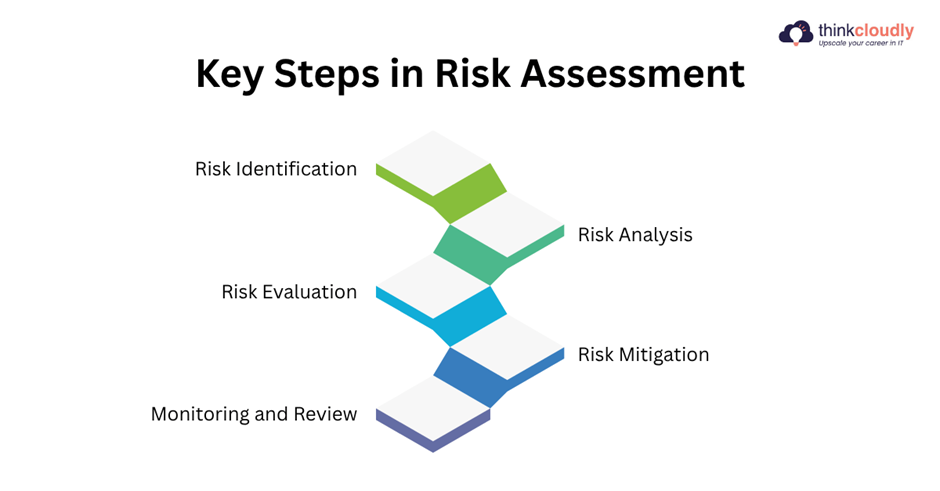
- Risk Identification: Organization must identify the possible threats or risks that could affect the system or data of the company.
- Risk Analysis: After identifying the threat, each risk is analyzed properly using the methods and key risk indicators.
- Risk Evaluation: Each risk should be analyzed, and prioritize them on the basis of their severity. This is important so that you can decide which one needs immediate attention.
- Risk Mitigation: Proper actions are taken by the organization to reduce or control risks (mainly available in cybersecurity courses and data analyst courses).
- Monitoring and Review: The risks are continuously tracked, and the risk assessment process is updated. It is also required for roles like certified information systems auditor.
3. What are Key Risk Indicators (KRIs)?
Answer: Key risk indicators are used in risk assessment to identify and monitor the possible risks before they can become a serious problem. They mainly work as an early warning signal and help the organization to track the risk levels and take actions to prevent them.
Key risk indicators are mainly used in domains covered by cybersecurity courses, data analyst courses and certifications like certified information systems auditor.
4. How do you perform risk assessment in cybersecurity?
Answer: Risk assessment is performed in cybersecurity by using a proper method. The steps followed to perform this assessment are: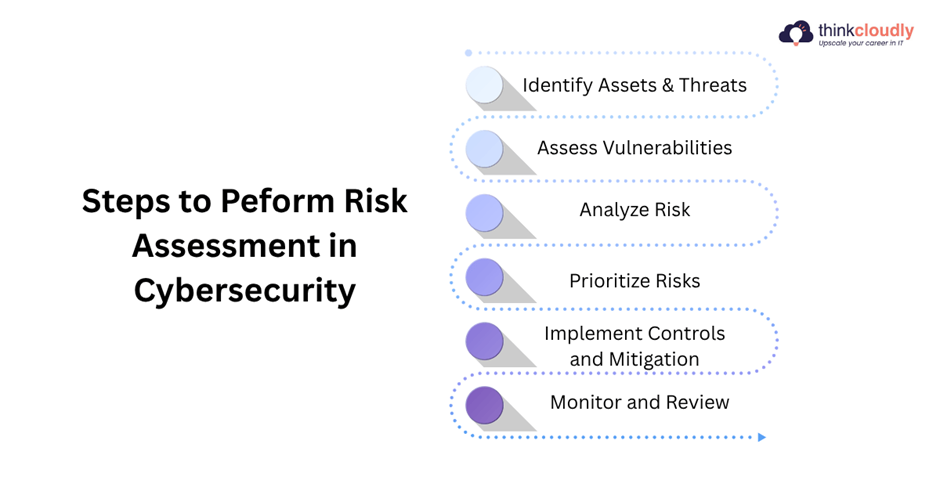
- Identify Assets & Threats: Identify the critical systems, data and possible cyber threats (like malware, phishing, etc.)
- Assess Vulnerabilities: Analyze the weaknesses of the systems, networks, or processes that attackers used to attack the data.
- Analyze Risk: The probability and impact of the risk are evaluated by using the methods to analyze key risk indicators.
- Prioritize Risks: The priority of the risk is decided on the basis of its severity level, and the focus must be on the critical ones.
- Implement Controls and Mitigation: Some security measures are used (like firewalls, encryption, and policies). These concepts are covered in cybersecurity courses and are required for roles like a certified information systems auditor.
- Monitor and Review: The risks are continuously tracked and updated as part of the ongoing risk assessment.
5. What is the difference between risk and threat?
Answer: Risk and threat are different but can be used in the same place in some ways. Here is the difference between risk and threat in tabular form:
|
Feature |
Threat |
Risk |
|
Definition |
A possible act that can be a harm for an asset |
The possibility of loss, damage or destruction of an asset |
|
Nature |
For external or internal danger (like a hacker or malware) |
This is the result of a threat using a vulnerability |
|
Measurement |
Not measured directly |
Measured by using key risk indicators |
|
Role in Process |
This is the starting point of risk assessment |
This is the result of the risk assessment |
|
Calculation |
Identified with the help of threat modelling |
Identified by using the probability or impact |
|
Example |
Phishing attack |
Data breach by phishing |
These concepts are mostly covered in data analyst courses, cybersecurity courses, or certifications like certified information systems auditor.
6. How do you prioritize risks?
Answer: The prioritization of risks is done by focusing on their probability and impact. The steps followed to prioritize risks are:
- Assess Likelihood: Identify the probability of the risk occurring.
- Assess Impact: Analyze the possible damage that can happen due to that risk (like financial, operational, or security).
- Use a Risk Matrix: Put the risks on the matrix of probability vs. impact to rank them according to their priority.
- Apply Key Risk Indicators: You can use key risk indicators to measure and monitor the high-risk areas continuously.
- Rank and Act: The high-priority risks are ranked first, and then from medium to low.
7. Which tools are used in risk assessment?
Answer: Some common tools used for the assessment of risks are:
- Risk Matrix: This tool is used to prioritize the risks based on their probability and impact.
- SWOT Analysis: This is used to identify the strengths, weaknesses, opportunities, and threats.
- Risk Register: This is the document used to track and manage the risks that have already been identified.
- Key Risk Indicators (KRIs): These are the metrics used to monitor the risk levels and provide early warnings before it can harm the system.
- Vulnerability Scanners: Some tools, like Nessus or OpenVAS, are used in cybersecurity (mainly in cybersecurity courses).
- Data Analysis Tools: Some tools, like Excel, Python, or Power BI (mainly in data analyst courses), are used for risk analysis.
- Audit Frameworks: This is used by professionals like certified information systems auditors for the proper evaluation.
8. What is Qualitative vs Quantitative Risk Assessment?
Answer: Here is the tabular representation of the difference between qualitative and quantitative assessment of risk.
|
Feature |
Qualitative |
Quantitative |
|
Approach |
Mainly based on the judgment and experience |
It is based on the numerical data and calculations |
|
Data Type |
Descriptive (High/Medium/Low) |
Numerical (Probabilities, Financial, Values) |
|
Complexity |
Simple and quick process |
Detailed and complex process |
|
Tools Used |
Risk matrix and expert opinion |
Statistical models and simulations |
|
Accuracy |
Less accurate |
More accurate |
|
Usage |
Early stage of assessment |
Advanced analysis (used in data analyst courses) |
9. What is Residual Risk?
Answer: This refers to the remaining risk after the risk control methods have been used during the assessment of the risk. Even after using the measure to reduce risks with the help of security controls, some level of risk is still present, which is called residual risk.
It is monitored by using key risk indicators and managed according to the process available in cybersecurity courses, data analyst courses, and roles like certified information systems auditor.
10. What frameworks are used in risk assessment?
Answer: The most common frameworks used in the assessment of risks are: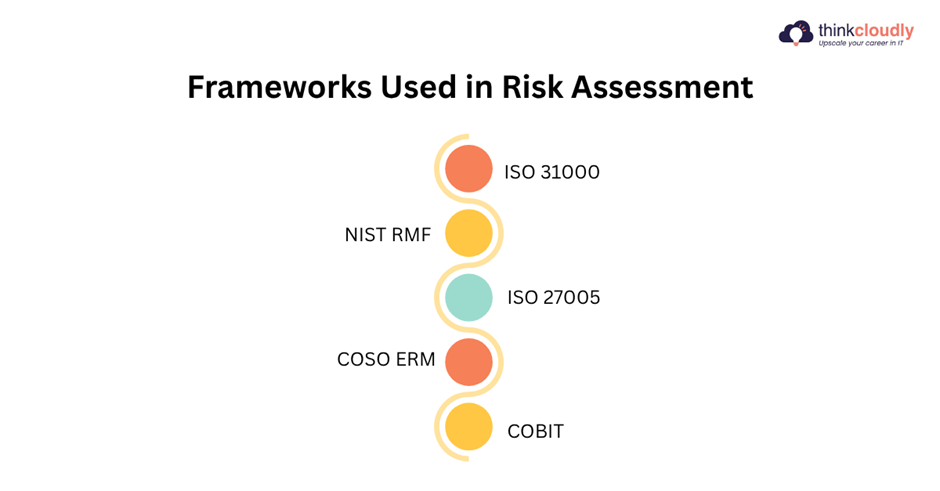
- ISO 31000: This is the international standard used for managing risks across organizations.
- NIST Risk Management Framework (RMF): This is mostly used in cybersecurity for the purpose of structured risk management (covered in cybersecurity courses).
- ISO 27005: Mainly focuses on information security assessment.
- COSO ERM: This is an enterprise risk management framework used for identifying and reducing risks.
- COBIT: This is the IT governance framework used by professionals like certified information systems auditors.
Conclusion
Mastering these risk assessment interview questions is important for anyone who wants to develop their career in GRC. A strong foundation in assessment with practical knowledge and certifications like certified information systems auditor can make you stand out in front of other candidates.
Interviews are not just about giving answers, it is about defining your way of thinking and analyzing and responding to the risks. Your focus on developing the skills, understanding of key risk indicators and improving your knowledge continuously can help you in making a successful career in the field of GRC.

