
Did You Know That 74% of Organizations Now Run Hybrid Agile Models Instead of a Single Framework?
That single number from the 18th State of Agile Report quietly tells you everything you need to know about the SAFe vs. Scrum debate in 2026. Neither framework is winning outright. They are evolving side by side — and most serious organizations are borrowing from both. But that does not mean they are the same thing or that the choice between them is irrelevant. Far from it. When Agile project management is done well, it can cut delivery times, align teams faster, and produce software that people actually want to use. When you pick the wrong framework for your context, you get bureaucracy dressed up as agility. This guide is about helping you avoid that second outcome. Whether you lead a startup team of seven or sit inside an enterprise coordinating fifty-plus people, understanding SAFe vs. Scrum properly is one of the most valuable decisions you can make this year.
What Is the Scrum Methodology — and Why Is It Still the World’s Most Used Agile Framework?
Scrum is the top choice among Agile frameworks, used by approximately 87% of organizations that practice some form of Agile. That is a remarkable stat, and it is worth pausing on before we go any further.
Scrum methodology is a lightweight framework for delivering work in short, focused cycles called sprints—usually two to four weeks long. At the core of it are three roles: the Product Owner (who owns the vision and the backlog), the Scrum Master (who removes obstacles and coaches the team), and the developers (who do the actual building). Ceremonies keep the rhythm: Sprint Planning, Daily Standup, Sprint Review, and Sprint Retrospective. The reason Scrum methodology has stayed dominant for over a decade is that it is genuinely hard to argue with the fundamentals. Small, self-organizing cross-functional teams that inspect their work every two weeks and adapt accordingly simply outperform larger, slower-moving structures. Projects managed with Agile methodologies report a success rate of 75%, compared to roughly 56% for traditional project management approaches.
Scrum does one thing exceptionally well: it gives a team of five to nine people a delivery rhythm that is fast, transparent, and self-correcting. What it does not do especially well is coordinate fifty people across ten interdependent teams working toward the same release. That is where the Scaled Agile Framework enters the conversation.
What Is the Scaled Agile Framework (SAFe) — and Who Is It Really For?
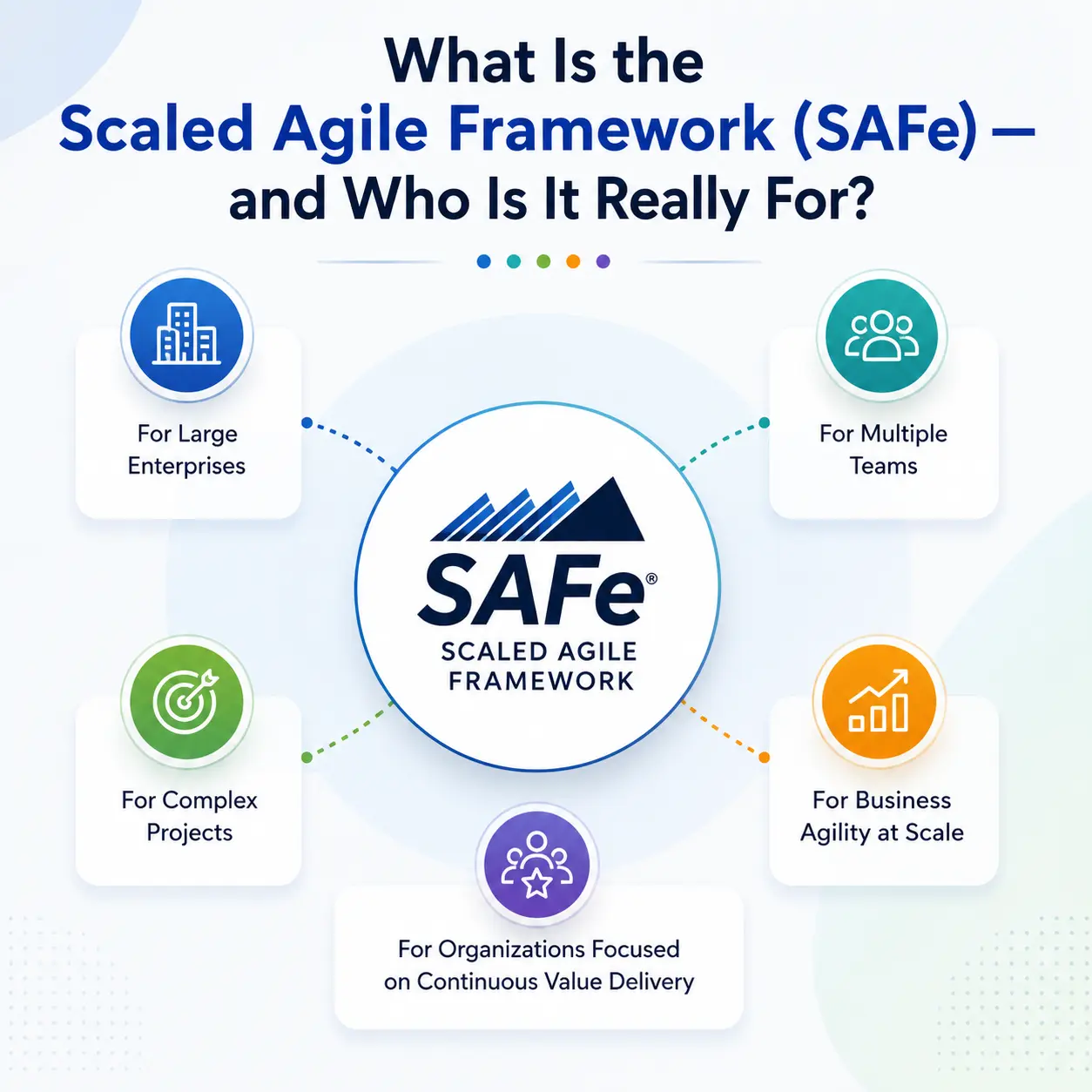
The Scaled Agile Framework—SAFe—is an enterprise operating model that takes the core ideas of Scrum methodology, Agile project management, Lean, and DevOps and builds a coordinated structure around them. SAFe is the most widely adopted scaling framework, used by over 50% of large enterprises practicing Agile at scale, and its emphasis on aligning strategy with execution has made it especially appealing to industries that require governance, compliance, and cross-functional coordination.
Where Scrum keeps things deliberately simple—three roles, five ceremonies, one backlog—the Scaled Agile Framework introduces layers. Teams still do their work in Scrum sprints at the team level. But above that sits an Agile Release Train (ART): a group of five to twelve teams (typically 50–125 people) who plan, execute, and deliver together on a shared cadence called a Program Increment (PI). The PI Planning event, where all teams in an ART spend two days planning together, is SAFe’s most powerful practice — it surfaces dependencies early, builds shared understanding, and creates collective ownership of the plan. PI Planning and the Program Increment structure are what genuinely differentiate SAFe from simply running multiple Scrum teams in parallel. Without this coordinated planning layer, what you get is Scrum at the team level and chaos at the program level.
SAFe vs Scrum: A Direct Comparison at a Glance
The table below gives you a clean side-by-side of how the two frameworks differ across the dimensions that matter most when making a real organizational decision.
|
Dimension |
Scrum Methodology |
Scaled Agile Framework (SAFe) |
|
Team size |
5–9 people |
50–125+ people (Agile Release Train) |
|
Best suited for |
Small, independent teams |
Large enterprises with multiple teams |
|
Roles |
Product Owner, Scrum Master, Developers |
Adds RTE, Product Manager, System Architect |
|
Planning cycle |
Sprint (2–4 weeks) |
PI Planning every 8–12 weeks |
|
Documentation |
Lightweight — user stories, backlog |
More formal—portfolio, program, team layers |
|
Agile project management level |
Team level |
Portfolio to team level |
|
Implementation cost |
Low — minimal overhead |
High — training, tooling, role changes |
|
Learning curve |
Moderate |
Steep |
|
Cross-functional teams |
Within one team |
Across multiple teams via ARTs |
|
Best industries |
Startups, SaaS, product companies |
Finance, healthcare, government, manufacturing |
|
Framework rigidity |
Flexible and adaptable |
Structured and prescriptive |
|
Agile transformation |
Fast to start |
Requires sustained org-wide commitment |
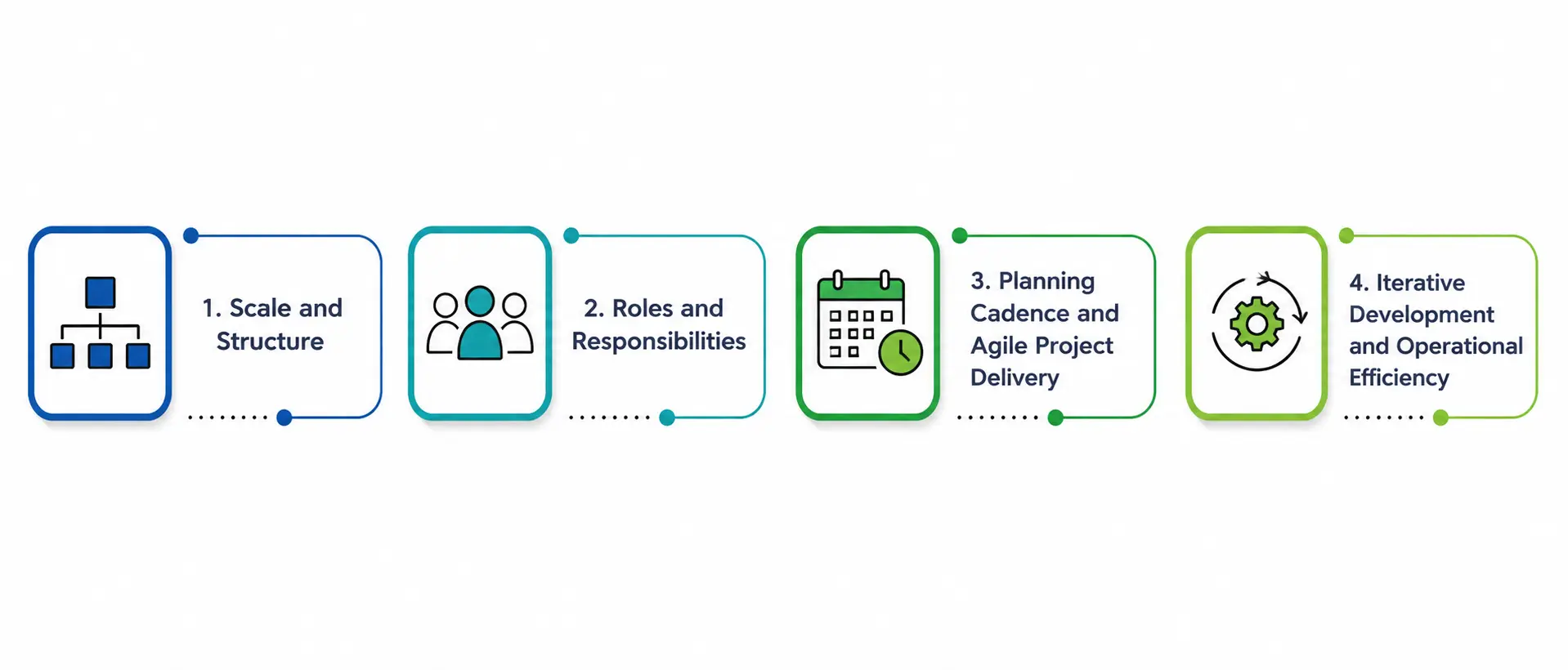
SAFe vs Scrum: Four Key Areas Where the Frameworks Diverge
1. Scale and Structure
This is the most fundamental difference, and it is not close. Scrum was designed for one team. It says so explicitly in the Scrum Guide. Scrum gives a small team of five to nine people a rhythm of planning, building, reviewing, and adapting, while SAFe aligns 50+ people across multiple teams toward shared outcomes. Trying to run ten Scrum teams independently without a coordination layer is where most scaling failures originate. Teams duplicate work, build conflicting dependencies into their sprints, and end up with integration nightmares at release time. The Scaled Agile Framework was designed to solve precisely that problem, and when it is implemented well, it does.
The Agile framework you choose should match the number of teams you need to coordinate, not the number of people in your favourite framework’s success stories.
2. Roles and Responsibilities
In Scrum, the Scrum Master is a servant leader focused entirely on one team—facilitating ceremonies, removing blockers, and coaching Agile practices. In the Scaled Agile Framework, that role exists at the team level but is augmented by a Release Train Engineer (RTE) who effectively acts as the Scrum Master for the entire ART. The RTE coordinates across multiple teams at the program level and facilitates events such as PI Planning, Scrum of Scrums, and ART syncs. This means SAFe introduces new roles—Product Manager, System Architect, and Business Owners—that have no direct equivalent in standard Scrum implementation.
3. Planning Cadence and Agile Project Delivery
Scrum implementation keeps planning at the sprint level. Every two weeks, the team re-plans. This is what makes Scrum so responsive to change — the window between decisions is never longer than two weeks. SAFe takes a different approach to Agile project delivery. Critics argue that the PI commitment reduces the responsiveness that makes Agile valuable. Advocates argue that without that committed window, enterprise-level planning becomes impossible. Both are right, depending on what problem you are trying to solve.
4. Iterative Development and Operational Efficiency
The idea that you build in small increments, get feedback, and adjust both the frameworks embraces iterative development. But the feedback loops operate at different scales. In Scrum, the loop is the sprint. In SAFe, the loop is the Program Increment. The main goals of agile transformations include improving overall performance (83% prioritize faster customer deliveries), productivity gains (76%), predictability and transparency (70%), efficiency improvements (69%), and better work organization methods (68%). These goals are achievable with either framework, but operational efficiency at scale almost always points toward SAFe, while operational efficiency for small or mid-size teams almost always points toward Scrum.
Agile Transformation: Which Framework Makes the Transition Easier
This is a question that does not get asked enough. Most companies considering either framework are not starting from zero — they already have processes, teams, and organizational habits in place. The transition matters as much as the destination. Starting with Scrum implementation is almost always easier. The framework is lightweight, the roles are simple, and the ceremonies can begin within a week. Teams feel the benefits—faster delivery, better collaboration, and clearer priorities—within the first few sprints. That early momentum is genuinely valuable. Agile transformation using SAFe is a different proposition. Implementing SAFe requires investment in training, tooling, and additional roles.
Scrum in Business: The Real-World Adoption Picture in 2026
Understanding where Scrum in business actually lives — who uses it, for what, and with what results — matters far more than any theoretical framework comparison. Around 94–95% of organizations report using Agile practices to some extent, and the global Agile development tools market is estimated to reach $9.2 billion by the end of 2026, up from $5.7 billion in 2020. Scrum in business has gone from a niche software practice to a mainstream operational model, and that trajectory is not slowing down.
Where does Scrum in business shine most? Technology companies (27% of hybrid Agile adopters), financial services (18%), professional services (8%), and healthcare (8%) are the sectors where Agile is most embedded. Fully Agile teams in 2026 are six times faster than their non-Agile counterparts, and team satisfaction, engagement, and psychological safety have all become crucial indicators of long-term success. Scrum in business tends to outperform SAFe on speed-to-value for organizations with fewer than four teams. For organizations with more than four teams, the coordination overhead of running multiple independent Scrum teams starts to outweigh the simplicity benefits—and something like SAFe becomes the more rational choice.
The critical point: Scrum in business and SAFe are not competitors for the same market. It solves different problems at various scales. The real conversation in 2026 is not SAFe vs. Scrum—they are not competitors; the simple difference is that they operate at different scales.
SAFe vs Scrum: How to Choose the Right Framework for Your Organisation
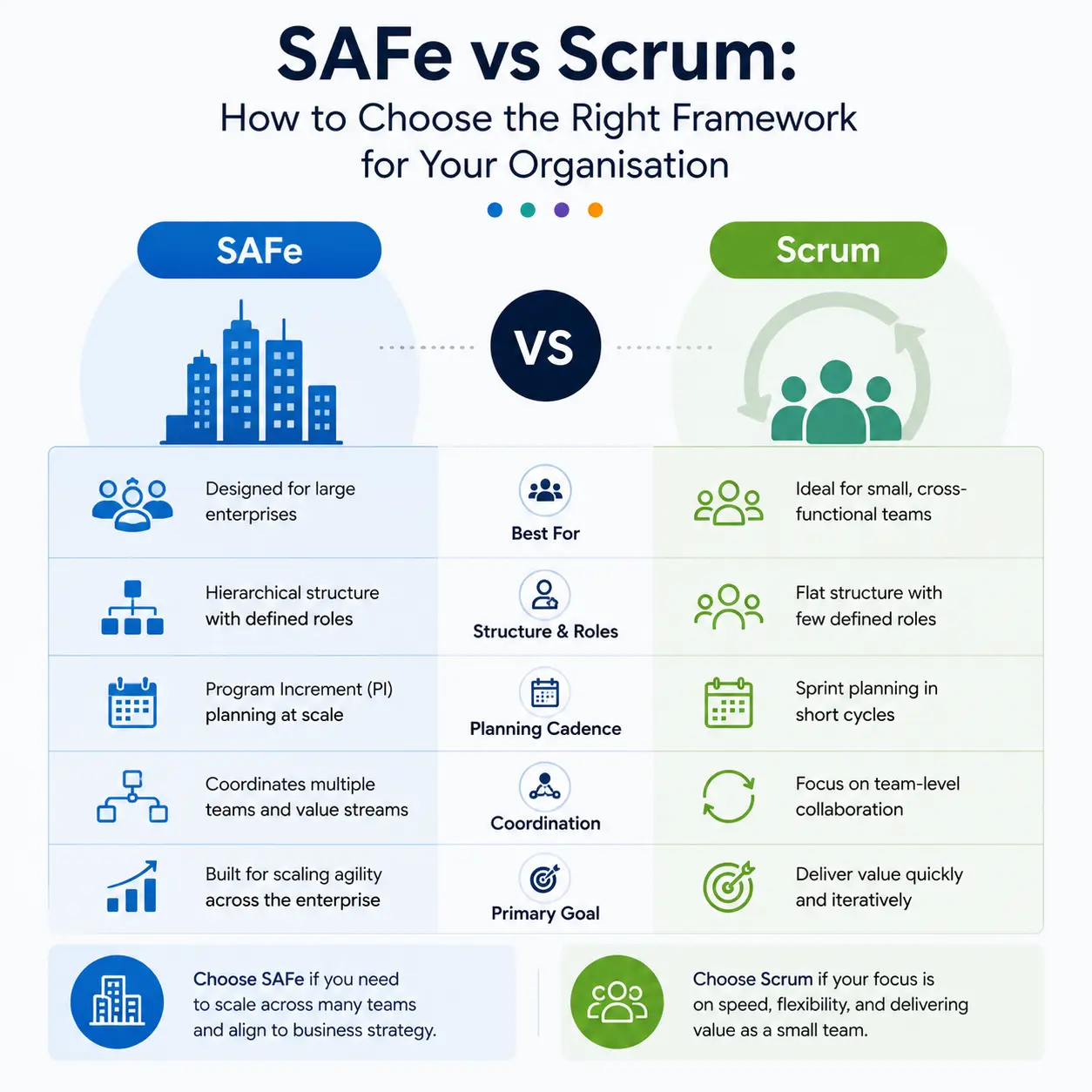
If you have made it this far and still are not sure which framework applies to your situation, here is a practical decision guide grounded in the 2026 data.
Choose Scrum if:
- Your team has five to nine people working on a single product
- You need to start delivering value within weeks, not months
- Your organization is new to Agile and needs early wins to build momentum
- You have one product owner and a clear product backlog without major dependencies
- The budget for training and tooling is limited
Choose SAFe if:
- You have four or more teams that need to coordinate their work
- You are building a large, integrated system with shared components and dependencies
- Your industry requires compliance, governance, or audit trails
- Leadership needs portfoviewvisibility into what is being built and when
- You are running a formal Agile transformation and need a structured roadmap
Consider a hybrid if:
- 74% of organizations now use hybrid or blended Agile models, combining Scrum, SAFe, Kanban, and others, rather than committing to a single framework.
- Your teams are at different maturity levels
- You want to start with Scrum and expand to SAFe as complexity grows
Conclusion: SAFe vs Scrum Is the Wrong Question—Ask This Instead
After reviewing the evidence, the honest conclusion is this: SAFe vs. Scrum is a false choice for most organizations.
The better question is, “What problem are you actually trying to solve?”
If the problem is one team moving too slowly, Scrum implementation is your answer. If the problem is fifty people across ten teams building something together without stepping on each other’s feet, the Scaled Agile Framework is closer to what you need. The 2026 data is clear. Scrum continues to dominate as the most implemented Agile framework, used by approximately 70% of Agile practitioners. SAFe leads at the enterprise level, with adoption climbing steadily. And Agile project management as a whole — regardless of which framework you run — produces better outcomes than traditional methods at a rate that is no longer disputed. The winner of SAFe vs. Scrum is not a framework. It is the organization that picks the right tool for the right job, invests in the people to run it properly, and does not use framework labels as a substitute for genuine Agile project delivery discipline. Start with Scrum if you are small and moving fast. Scale to SAFe when you need to. And revisit the choice every time your team count doubles.
Sources
- monday.com Blog — SAFe vs Scrum Key Differences 2026
- Lucid.co — SAFe vs Scrum Differences, April 2026
- Leadership Tribe—SAFe vs Scrum: Scaling Agile or Starting Simple, March 2026
- Zaigo Infotech—SAFe vs Scrum 2026 Comparison
- PremierAgile — Scrum vs SAFe Frameworks
- PTC Blog — SAFe vs Scrum, February 2026
- Toptal — Agile Scaling Frameworks Compared, May 2026
- StarAgile — State of Agile 2026