
Here is a number that puts everything in perspective. The global Agile services market is projected to reach $28.6 billion by 2027, up from $14.6 billion in 2023, according to MarketsandMarkets research published in 2025. At the center of that growth sits one of the most consistently in-demand professional roles of the decade, the Scrum Master. And at the center of the Scrum Master career conversation sits one unavoidable question: which Scrum Master certification is actually worth your time and money in 2026?
The answer is not the same for everyone. The right Scrum Master certification depends on your learning style, your career background, the industry you are targeting, and how much you are willing to invest upfront. What this guide does is lay out every meaningful option clearly, compare them honestly, and help you make a confident decision without wading through marketing language from certification bodies.
Scrum Master Certifications in 2026: Why They Matter More Than Ever
The Scrum Master role has changed significantly over the past three years. It is no longer viewed exclusively as a technical role sitting inside software development teams. According to the 2025 State of Agile Report by Digital.ai, Agile adoption has expanded into financial services, healthcare, marketing, government, and manufacturing at a pace that has created genuine talent shortages in every one of those sectors.
For professionals entering this field, a recognized Scrum Master certification serves three distinct purposes. It validates that you understand the Scrum framework and Agile principles at a testable level. It signals to employers that you have invested in the discipline seriously enough to pass a structured assessment. And it gives you a shared professional language with the teams and organizations you will be serving.
Without certification, breaking into a competitive Scrum Master role in 2026 is possible but significantly harder. With the right credential, the door opens. What you do with the opportunity once you are inside determines how far you go.
The Four Certifications That Actually Matter in 2026
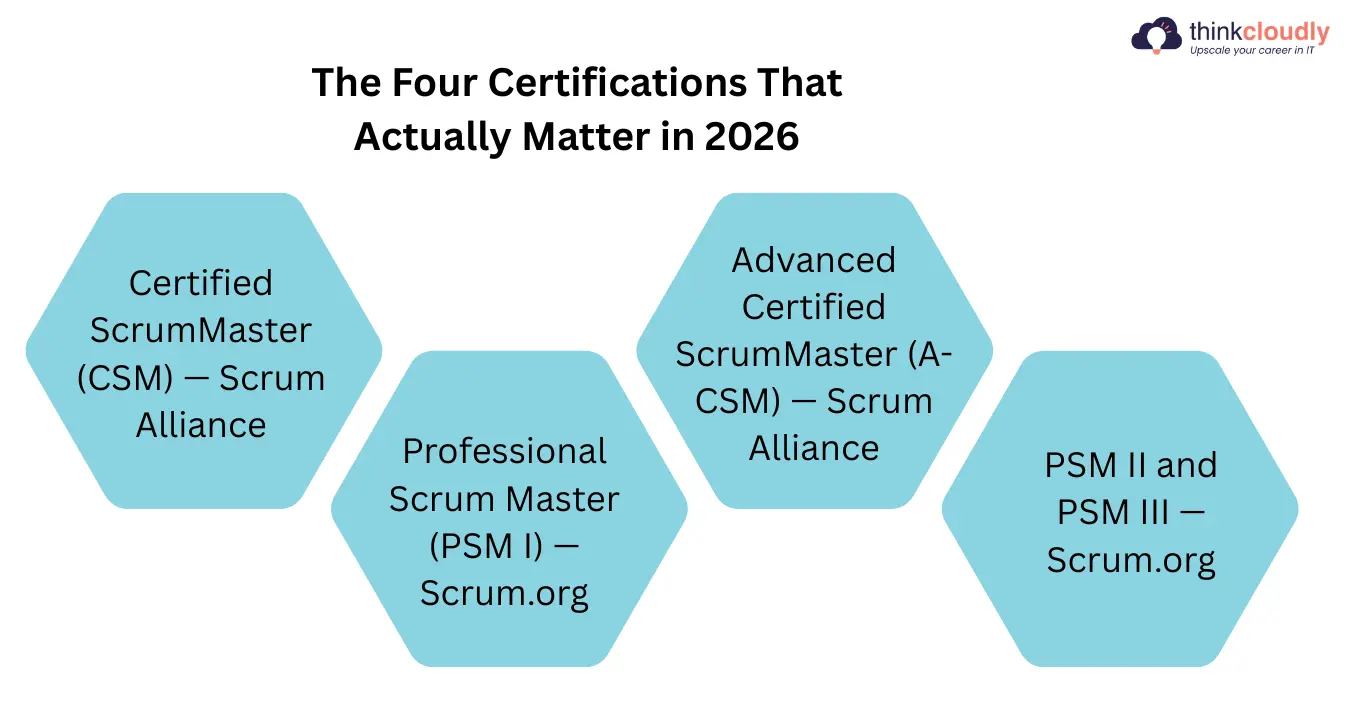
There are dozens of certifications in the Agile space, but only a handful appear consistently in job postings, are recognized by hiring managers across industries, and carry genuine weight on a resume. Here are the four that matter.
Certified ScrumMaster (CSM) — Scrum Alliance
The Certified ScrumMaster credential, commonly written as CSM certification, is issued by the Scrum Alliance and has been in circulation since 2001. It is the most widely recognized Scrum certification in the world in terms of sheer community size, with millions of holders across virtually every industry.
To obtain the CSM, candidates must complete a two-day training course led by a certified Scrum trainer. The course can be taken in person or through a live online format. After the training, candidates sit a 50-question exam with a passing score of 74%. Two exam attempts are included within the training fee.
The total cost, including the mandatory training, typically falls between $1,000 and $1,500 depending on the trainer and delivery format. The certification expires every two years and requires 20 Scrum Education Units and a renewal fee to maintain.
CSM is particularly strong for professionals transitioning into Agile delivery from non-technical backgrounds, career changers who benefit from instructor-led learning, and candidates targeting organizations where HR departments and non-technical hiring managers are involved in the screening process. The Scrum Alliance name is broadly recognized even by people who do not work in technology, which gives it an edge in sectors new to Agile.
Professional Scrum Master (PSM I) — Scrum.org
The Professional Scrum Master certification at level one, known as PSM I, is issued by Scrum.org, the organization co-founded by Ken Schwaber, one of the two original creators of Scrum. The PSM pathway carries a level of foundational credibility that many practitioners and technical hiring managers recognize and respect.
PSM I requires no mandatory training. Candidates study independently using free resources available at Scrum.org, pay a $200 exam fee, and sit the assessment when ready. The exam consists of 80 questions to be completed in 60 minutes, with a passing threshold of 85%. That threshold is deliberately higher than most comparable certifications and directly contributes to the PSM’s reputation for rigor.
Once passed, PSM I does not expire. There are no renewal fees, no continuing education requirements, and no annual maintenance costs. For a credential of this recognized standing, the $200 price point is genuinely exceptional value.
PSM I is the stronger choice for self-directed learners, professionals targeting technology companies and consultancies, and anyone who wants a credential that does not require ongoing renewal investment.
Advanced Certified ScrumMaster (A-CSM) — Scrum Alliance
The Advanced Certified ScrumMaster is the natural next step for CSM holders who want to deepen their coaching capability and broaden their organizational influence. The A-CSM requires completion of the CSM first, along with 12 months of documented Scrum Master work experience before applying.
The A-CSM focuses on deeper facilitation skills, coaching agile teams through complex organizational challenges, and developing the leadership presence required to influence beyond a single team. It is the certification that begins to bridge the gap between Scrum Master and agile coach.
The cost for A-CSM training and certification typically falls between $1,200 and $1,800 depending on the trainer.
PSM II and PSM III — Scrum.org
For PSM I holders who want to progress further within the Scrum.org pathway, PSM II targets practitioners applying Scrum in complex environments and working across multiple teams. PSM III is the most advanced level, designed for professionals coaching organizations through enterprise Agile adoption.
PSM II costs $250 per attempt, and PSM III costs $500 per attempt. Both are respected heavily in technical and consultancy environments as signals of deep, practiced expertise.
Scrum Master Certifications
|
Factor |
CSM | PSM I | A-CSM |
PSM II |
|
Issuing Body |
Scrum Alliance | Scrum.org | Scrum Alliance |
Scrum.org |
|
Training Required |
Yes, two days | No | Yes, advanced |
No |
|
Exam Questions |
50 | 80 | No standalone exam |
30 |
|
Passing Score |
74% | 85% | Competency based |
85% |
|
Cost |
$1,000 to $1,500 | $200 | $1,200 to $1,800 |
$250 |
|
Expiry |
Every two years | Never | Every two years |
Never |
|
Best For |
Career changers, non-tech sectors | Self-directed tech environments | Experienced Scrum Masters |
Senior practitioners |
|
Level |
Foundation | Foundation | Intermediate |
Advanced |
|
Employer Recognition |
Very broad | Strong in tech | Growing |
Specialist |
How to Choose: Four Questions That Point to the Right Answer
Choosing between PSM and CSM becomes much easier when you focus on your personal goals, learning preferences, and career plans. These four questions will help you identify which Scrum Master certification aligns best with your situation.
What is your learning style, and how much structure do you need?
If you genuinely learn better in a guided environment with a live instructor, group exercises, and direct feedback, the CSM pathway is built for you. The mandatory two-day training is not just a formality. A skilled Certified Scrum Trainer brings real-world scenarios and facilitated discussions that self-study alone cannot replicate.
If you are a disciplined self-directed learner who prefers to study at your own pace and test your knowledge independently, PSM I is the more cost-efficient and arguably more rigorous choice among Scrum Master certification options. The free practice assessments at Scrum.org are genuinely excellent preparation tools.
What industry are you targeting?
In sectors where Agile is newer, such as healthcare, government, and financial services, the Certified ScrumMaster name tends to carry more immediate recognition with hiring managers who did not grow up in technology environments. The Scrum Alliance’s longer history of community building means CSM is simply more familiar across a wider range of industries.
In technology companies, consultancies, and organizations with mature Agile practices, PSM I carries equal or greater weight precisely because of its reputation for higher standards. Engineering managers who understand what an 85% passing threshold requires tend to view PSM I as the more credible signal of genuine readiness for a Scrum Master role.
What is your budget?
This is a legitimate factor and one that career content rarely addresses directly. PSM I costs $200. CSM costs five to seven times more once mandatory training is factored in. For someone self-funding their professional development, that gap is real and meaningful.
The money saved by pursuing PSM I first could fund additional scrum master courses for skill development, cover the cost of complementary certifications, or simply reduce the financial risk of a career transition. Many practitioners pursue PSM I first and add CSM later when an employer is covering the cost.
Where are you in your Scrum Master career path?
If you are just starting out and have no prior exposure to Scrum or Agile delivery, CSM is the more accessible entry point because the mandatory training provides foundational knowledge before the exam. PSM I is also achievable from a standing start but requires more self-discipline to prepare effectively without formal instruction.
If you already hold a foundation Scrum Master certification and are working actively in the role, A-CSM or PSM II represents the logical next investment for deepening your practice and expanding your career options
What the Scrum Master Role Actually Requires Beyond Certification
Understanding Agile principles and passing a Scrum Master certification exam are the starting conditions for a Scrum Master career, not the destination. The professionals who build the most durable and well-compensated careers in this space develop a set of capabilities that no exam can fully assess.
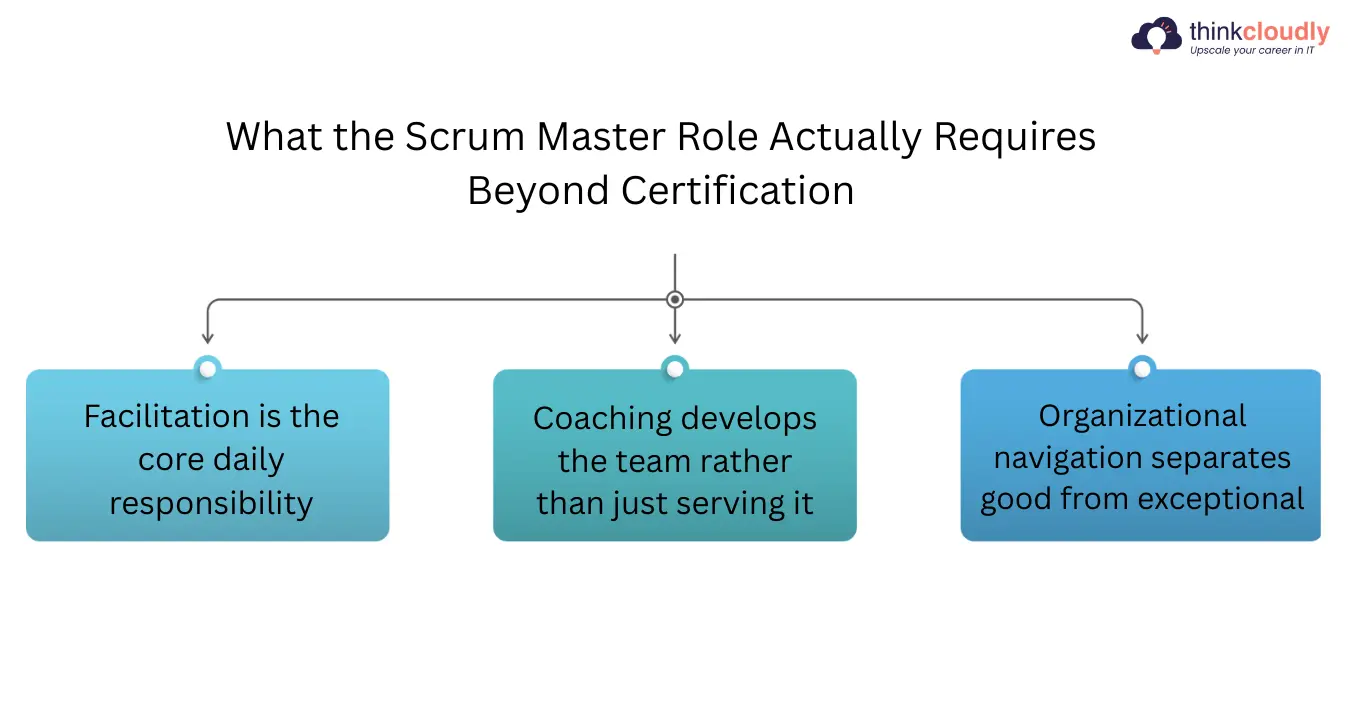
Facilitation is not just a soft skill that rounds out a resume. It is the primary work a Scrum Master performs every single day. Running a sprint retrospective that surfaces real insights rather than polite non-answers, facilitating a sprint planning session where the team genuinely commits rather than simply agreeing, and holding a productive daily standup that stays within 15 minutes all require practiced skill that develops through repetition and honest reflection over time.
There is a meaningful difference between a Scrum Master who serves the team and one who develops the team. Coaching is what creates that difference. The ability to ask powerful questions rather than providing answers, to help team members discover solutions rather than handing them over, is what gradually shifts agile teams from dependency on the Scrum Master toward genuine self-organization. That shift is one of the clearest signs of a high-performing Scrum Master.
Organizational navigation is the least-taught and most practically important skill at the senior level. Scrum Masters who understand how to work within organizational politics without being consumed by them, how to advocate for the team’s needs with data rather than opinion, and how to build trust with stakeholders who are openly skeptical of agile delivery are the ones who create lasting impact well beyond their immediate team.
According to LinkedIn Talent Insights 2025, job postings for senior Scrum Masters consistently list coaching, facilitation, and stakeholder management as the top three required competencies. These three skills appear more frequently in hiring requirements than any specific technical skills or certifications, which tells you exactly where to focus your professional development once your Scrum Master certification is in hand.
Conclusion
Choosing the right Scrum Master certification in 2026 comes down to your learning style, budget, and target sector. The Certified ScrumMaster and Professional Scrum Master credentials are both legitimate and both recognized by employers.
CSM suits structured learners and career changers. PSM I suits self-directed learners targeting technical environments at a fraction of the cost.
What both share is a foundation in the same Agile principles and Agile delivery philosophy. A Scrum Master who genuinely lives those principles will always outperform one who simply holds the credential.
Pick your Scrum Master certification. Prepare seriously. Build real experience. The 2026 market rewards all three.
Sources and References
- Digital.ai. 17th Annual State of Agile Report 2025: Agile Adoption, Certifications, and Workforce Trends.
- Scrum Alliance. Certified ScrumMaster and Advanced CSM Certification Requirements 2026.
- Scrum.org. Professional Scrum Master PSM I, PSM II, and PSM III: Official Exam Details and Pricing 2026.
- MarketsandMarkets. Agile Services Market Size, Share, and Growth Forecast 2023 to 2027.
- LinkedIn Talent Insights. Scrum Master Hiring Demand, Top Competencies, and Salary Benchmarks 2025.
- Glassdoor. Scrum Master Salary Report by Certification Level and Industry 2025.
- Coursera. Global Skills Report 2025: Agile and Scrum Learning Trends and Enrollment Data.