

Only theoretical knowledge isn’t enough if you are preparing for a modern cybersecurity role. The employers evaluate practical thinking skills by asking scenario-driven interview questions and answers to every SOC analyst candidate. If you want to stand out as a security operations center analyst, you must be ready to demonstrate how will you protect the business systems under pressure. This guide contains practical job interview questions and answers based on real situations that shows how a SOC analyst works in operational environment.
Organizations hiring a SOC analyst wants someone skilled who can detect the treats early, responds towards it on time and align actions with compliance risk governance requirements. These scenario-based job interview questions and answers helps the recruiters to check how a security operations center analyst thinks and acts at the time of real security events.
Top Scenario-Based Job Interview Questions and Answers
Only theory-based job interview questions and answers are not enough as a SOC analyst mainly works in the environment filled with alerts, logs and cyber threats. Employers mostly prefer scenario-driven job interview questions and answers because they help in testing the practical skills of the candidate. A SOC analyst must have the skill to balance detection speed with accuracy while maintaining proper documentation for compliance risk governance. Here are some scenario-based job interview questions and answers for a SOC analyst job:
1. You notice multiple failed login attempts followed by a successful login from an unusual location. What would you do?
Answer: A SOC analyst professional with skills will begin with validating the alert in the SIEM dashboard and tally the log details from authentication systems. The process follows by checking the reputation of an IP address and history of the user behavior with the device fingerprints. If it feels to be compromised then the SOC analyst escalates to incident response, resets of passwords and enables the multi-factor authentication.
A skilled analyst also believes in documenting every detail and action for audit trails aligned with compliance risk governance standards. This is the usual process followed by the SOC analyst to prevent any kind of cyber threat before it can impact the systems and data of an organization.
2. How do you respond if an endpoint detection tool flags malware activity on a production database server?
Answer: A SOC analyst must check the severity of the alert upon receiving it and isolates the impacted host for limiting the further movement across the environment. The security operations center analyst will obtain information regarding file hashes, steps of process and network connections to assist in determining the severity of the incident. If the incident is considered as malicious then the SOC analyst will work with the incident response team to control and get rid of the threat.
Due to the nature of an organization’s operations, a professional SOC analyst must balance the needs of the organization against the need for evidence preservation when reporting incidents to have sufficient documentation supporting compliance risk governance and future audits.
3. What steps would you take if multiple employees report suspicious emails requesting credentials verification?
Answer: An expert security operation center analyst can contain threats rapidly and have limited impacts on users. A SOC analyst will also keep accurate and complete records with relevant compliance risk governance standards.
The steps followed by a security operations center analyst to reduce the risk of a suspicious email are: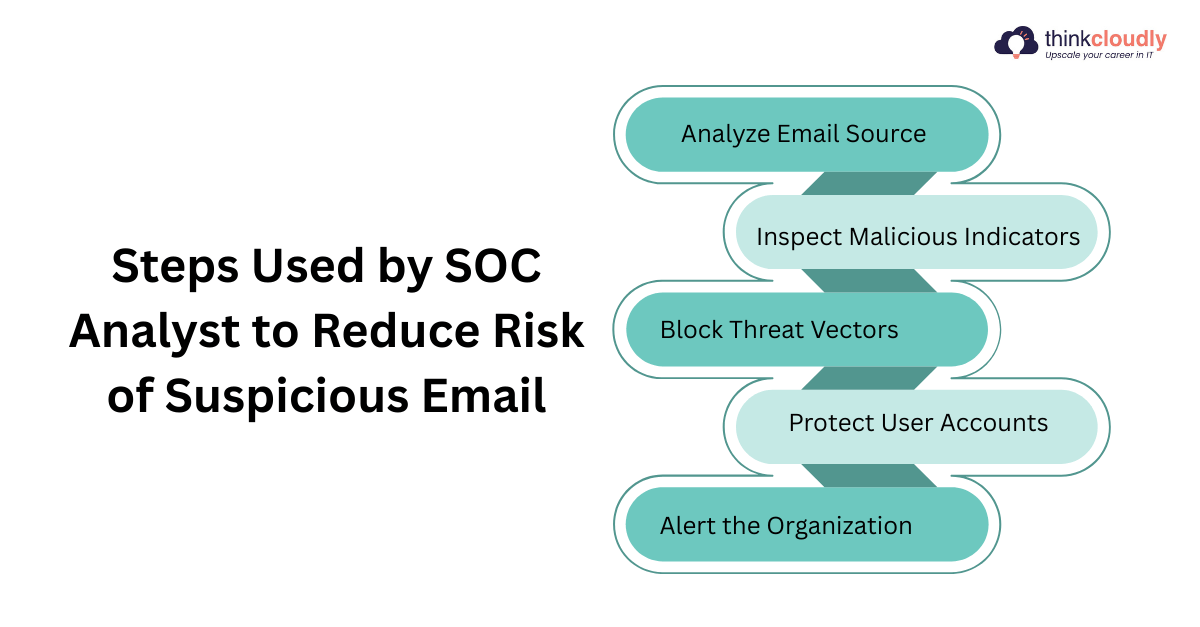
- Analyze Email Source: A SOC analyst must examine the IP address of the sender, reply paths and authenticity of the domain used.
- Inspect Malicious Indicators: A SOC analyst will check the links and attachments embedded in the email.
- Block Threat Vectors: A security operations center analyst will add the malicious domains, IPs and hashes to the email gateway and block list of firewall.
- Protect User Accounts: Affected users must reset the passwords and enable multi-factor authentication to protect their systems.
- Alert the Organization: A security operations center analyst will ensure that everyone is aware about this threat so that no one else clicks on that email.
4. How will you manage when your dashboard shows thousands of alerts and many of them are false positives?
Answer: A SOC analyst provides strategic support by improving detection rules and eliminating false positives. They also use alert prioritization to determine the importance of an alert based on the criticality of an asset and have the ability to automate many manual tasks within their operations.
A SOC analyst works to make sure that only valid threats are identified and that their operational efficiencies continue to grow. When operational efficiency is improved through optimized workflows, there will be greater accuracy within the compliance risk governance process of reporting.
5. A user access sensitive files outside their job role repeatedly. What would you do?
Answer: A SOC analyst review the access logs and behavioral baselines. The analyst collaborates with the management while maintaining the confidentiality of personal data. If misuse is confirmed after the investigation, then the analyst assists in containment and cooperating with other departments.
An experienced security operations center analyst ensures that their actions comply with organizational policies as well as compliance risk governance guidelines. Ethical behavior is evaluated by using scenario-based job interview questions and answers.
6. How will you handle the situation if you suspect sensitive customer data may have been exposed due to unusual database activity?
Answer: In order to manage risk, identify the impact and assure compliance with regulations, a skilled SOC analyst use a process for responding to events.
The process can be structured in following steps shown in the table:
|
Steps used by a SOC analyst |
Actions by a SOC Analyst |
Purpose |
|
Detection |
Verify alerts by using SIEM dashboards and database logs |
Confirm whether the breach is genuine or not |
|
Containment |
Isolate the affected systems and limit the access of databases |
Prevent further exposure of the data |
|
Investigation |
Examine the access logs, user activity and query history |
Determine the attack vector and scope |
|
Evidence Preservation |
Secure and create forensic copies of the logs |
Maintain integrity for legal review |
|
Communication |
Notify to incident response team and stakeholders |
Ensure coordinated response |
|
Eradication |
Remove the malicious artifacts and unauthorized access |
Eliminate threat presence |
|
Recovery |
Restore systems and verify integrity |
Resume normal operations safely |
|
Documentation |
Record timeline, actions taken and impact |
Support compliance risk governance |
|
Reporting |
Prepare the incident report for leadership and regulators |
Meet legal and regulatory obligations |
7. A new critical vulnerability is being actively exploited globally. How do you respond?
Answer: A SOC analyst with prior experience uses vulnerability scanners and asset inventories to assess exposure. The security operations center analyst works with IT to coordinate the priorities of patching and deploy temporary mitigation solutions. Utilizing threat intelligence feeds to help improve detection processes.
With a focus on risk posture and mitigation timelines for compliance risk governance review, a forward-thinking SOC analyst will use timely response as a theme.
8. What do you do if your primary monitoring platform goes offline during an active investigation?
Answer: A resourceful SOC analyst will start using alternative methods of monitoring such as backup monitoring tools and gathering logs manually. An security operations center analyst works with engineering teams to restore visibility. SOC Analyst manually prioritizes critical alerts until systems have been stabilized.
A security operations center analyst ensures incident continuity and maintains an incident downtime log for compliance risk governance audits.
9. A standard user account has been granted administrative access and executing high-risk commands. How would you handle this situation?
Answer: An experienced SOC analyst checks the identity and access management logs to verify the changes were made appropriately or not. After conducting the investigation, they check if the change was made using an approved change request or if it was due to suspicious activity. If the elevation was not made according to the rules of the organization, a SOC analyst will revoke the access and disconnect the affected account from the network.
After that a security operations center analyst will conduct an investigation of command history, session logs and related endpoints to identify the scope of the unethical behavior. If found, an security operations center analyst will escalate the issue to the incident response team and assist in the execution of any containment procedures.
10. An admin account logs in at midnight from a new location. What would you do as a SOC analyst?
Answer: A SOC analyst would begin investigating a potential compromise of a user account by verifying the legitimacy of the user’s login. This could be accomplished by looking at the authentication logs, IP address of the user and device identification details of the user. After confirming that the login attempt is valid, the security operations center analyst will review account activities to identify any irregularities as part of the review process.
The security operations center analyst will also compare these activities against SIEM alerts, endpoint logs and network logs to identify possible compromises. If the behavior displayed is suspicious or unauthorized, the analyst will take remedial actions like temporary restriction of access and implementing strong levels of authentication after resetting credentials to safeguard account.
After this the security operations center analyst will escalate the incident to the incident response team and document all the details. This documentation could then be used to support compliance risk governance.
Conclusion
Every SOC analyst should employ regularly practiced scenario-based interviewing techniques as part of their interview preparation. Employers are looking for candidates that exhibit critical and clear thought, effective communication and ability to align action with compliance risk governance policies.
By developing an understanding of and mastering how to prepare for scenarios, candidates can demonstrate to employers by answering SOC analyst job interview questions and answers that they have the capabilities required for success in real-world information security operational environment.

