
The layoff headlines make it easy to assume tech careers are falling apart. The data tells a more complicated, and far more useful, story.
If you have been watching the news over the past year, you would be forgiven for thinking that a career in technology has become a genuinely risky choice. Google reduced thousands of positions. Microsoft restructured multiple divisions. Meta cut roles it had filled just two years earlier. For anyone outside the industry trying to make sense of it all, the picture looks worrying.
But a series of alarming headlines and a collapsing industry are two very different things. When you actually look at the numbers, not the layoff announcements, but the hiring data, the salary trends, and the long-term projections, a very different picture comes into focus. The technology sector is not shrinking. It is undergoing a significant reorganization, and that reorganization is creating clear winners and clear losers at the same time.
This piece is for anyone trying to understand whether a career connected to technology is still worth pursuing. No assumed background. No jargon. Just what the data actually shows, explained plainly.
Two stories happening inside the same industry
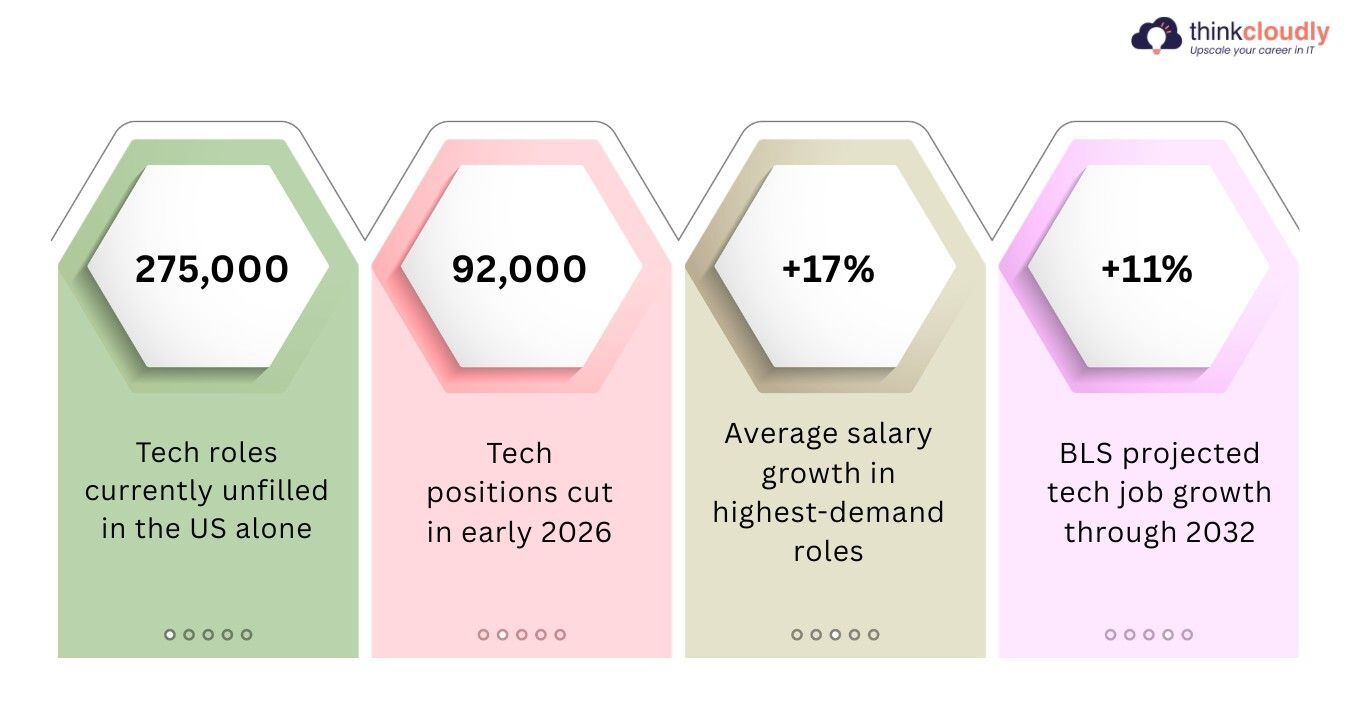
The thing that makes the current technology job market so difficult to read from the outside is that the layoff story and the talent shortage story are both true at the same time. According to Challenger, Gray and Christmas’s 2026 Job Cuts Report, roughly 92,000 technology positions were eliminated in the first half of 2026. At exactly the same moment, CompTIA’s State of the Tech Workforce 2026 documents over 275,000 open roles in the United States that employers are actively struggling to fill.
Both numbers are genuine. They are simply describing two completely different populations of jobs. The positions being cut are mostly those built around repetitive, predictable work that AI tools have become capable of handling. The positions sitting open are in areas where human judgment, specialist expertise, and the ability to work across disciplines are in short supply and, for now, genuinely irreplaceable.
The clearest way to understand it: the technology industry is not contracting. It is swapping one set of valued skills for demand around a different set entirely. People in the first category are facing real difficulty. People building the second set of skills are being actively competed over by employers who cannot find enough of them.
What the long-term numbers actually show?
Pull back further than the 2026 headlines and the picture becomes considerably less alarming. The US Bureau of Labor Statistics projects employment in computer and information technology occupations will grow roughly 11 percent through 2032, which is meaningfully faster than the average across all occupations. That projection was made before the current wave of AI adoption accelerated demand in cybersecurity and cloud architecture even further.
The World Economic Forum’s Future of Jobs Report 2025 puts it plainly: technology roles are among the fastest-growing job categories globally. The report notes carefully that this growth is not spread evenly across all technology jobs. It is concentrated in roles that require people to operate at the intersection of technology and at least one other domain, whether that is law, finance, healthcare, or security.
Robert Half’s 2026 Technology Salary Guide provides the most telling signal of where genuine demand is sitting. Roles in AI engineering, cloud architecture, and cybersecurity averaged salary growth of 12 to 18 percent in 2025 alone, during the same year that tens of thousands of other technology positions were being cut. Salaries do not move at that pace in categories where there are enough qualified people to fill the available seats.
Which roles are growing and which are under pressure?
The table below lays out the current picture by category. The direction of travel varies considerably depending on which part of the field you are looking at, and understanding those differences is more useful than a blanket view in either direction.
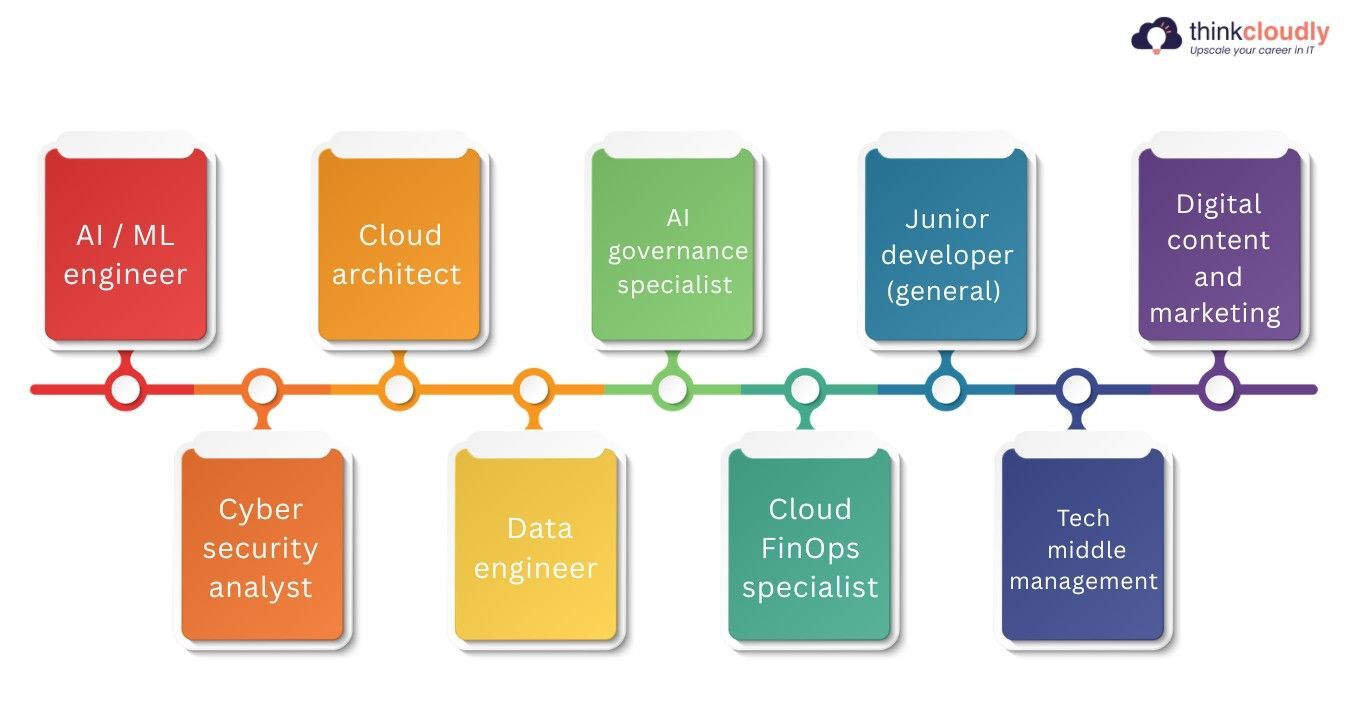
|
Role category |
Direction | Salary range (US) |
What is driving it |
|
AI / ML engineer |
Growing |
$115k to $160k |
Demand far outpacing supply; most organizations cannot hire fast enough |
|
Cybersecurity analyst |
Growing |
$85k to $120k |
Legally required across most sectors; threats are increasing, not decreasing |
| Cloud architect |
Growing |
$120k to $165k |
Every organization is migrating infrastructure; shortage of people who understand it |
| Data engineer |
Growing |
$95k to $135k |
AI systems need clean data pipelines; this is the work that makes AI actually usable |
|
AI governance specialist |
Growing |
$95k to $145k |
New global regulations requiring human oversight of AI decisions |
|
Cloud FinOps specialist |
Growing |
$90k to $125k |
Organizations overspending on cloud with no one actively managing the costs |
|
Junior developer (general) |
Pressured | $55k to $85k |
AI coding tools reduce routine work volume; entry-level is most directly affected |
|
Tech middle management |
Contracting | $90k to $130k |
Companies flattening structures; layers added during growth years now being removed |
| Digital content and marketing (tech) | Contracting | $50k to $80k |
Significant AI handling of routine content production and campaign management |
The part that surprises most people
One of the most counterintuitive findings in the current data is that several of the fastest-growing technology roles do not require a computer science degree or a heavily technical background to enter. Stanford HAI’s 2026 AI Index Report notes that the AI governance field, one of the most in-demand categories in the current market, is actively hiring people from legal, compliance, and policy backgrounds. The technology context is something those professionals can learn. The regulatory thinking and institutional awareness they already carry is the genuinely rare ingredient.
The FinOps Foundation’s State of FinOps 2026 makes a similar observation about cloud cost management. The professionals moving into that space most successfully are often coming from finance and accounting backgrounds rather than engineering. They understand how money flows through an organization. The cloud infrastructure knowledge can be built through certification programms in a matter of months. That combination of financial fluency and cloud literacy is exactly what companies are struggling to find.
ISC2’s Cybersecurity Workforce Study puts the global shortfall of cybersecurity professionals at approximately 4 million people. That figure has grown every year for several consecutive years, despite sustained investment in training programms across multiple countries.
Gartner’s Technology Workforce Trends 2026 report describes the gap between the skills organizations need and the qualified people available to provide them as one of the most significant workforce challenges in a generation.
What this means if you are thinking about a tech career
The clear-eyed answer is that a career connected to technology remains a strong long-term choice, but the specific direction chosen matters far more than it did five years ago. Pursuing general software development with no additional specialization is harder than it was. Developing real competence in the areas the market is genuinely short of, specifically security, governance, cloud architecture, and data engineering, puts a person in a category that employers are actively competing for rather than selecting from a comfortable pool.
The most durable career position in this market, according to both the LinkedIn Economic Graph data and the WEF Future of Jobs analysis, is not being the most technically advanced person available. It is being someone who can work fluently across technology and at least one other domain. The person who understands how a data system works and how the privacy regulations governing it apply in practice. The person who understands cloud infrastructure and where the organization’s money is actually going. That combination is rare, the market reflects it clearly in salary levels, and it is unlikely to change as AI continues to reshape which tasks require human involvement and which do not.
The technology industry is not done changing. But the data does not describe an industry in decline. It describes one in a significant, fast-moving transition, with a clear set of opportunities on the other side for people who understand where the demand is actually sitting.
Sources and references
- CompTIA — State of the Tech Workforce 2026
- Challenger, Gray and Christmas — 2026 Job Cuts Report
- World Economic Forum — Future of Jobs Report 2025
- US Bureau of Labor Statistics — Computer and Information Technology Occupations Outlook
- Robert Half — 2026 Technology Salary Guide
- Stanford HAI — AI Index Report 2026
- ISC2 — Cybersecurity Workforce Study
- IAPP — Privacy Workforce Study 2025
- FinOps Foundation — State of FinOps 2026
- LinkedIn Economic Graph — Jobs on the Rise 2026
- Gartner — Technology Workforce Trends 2026
- McKinsey Global Institute — The Future of Work After AI 2025