

What if the biggest security threat is not inside your organization but is hidden inside your vendor list? In today’s digital environment, businesses depend mostly on external vendors, partners, service providers, and vendor risk management. These relationships affect the growth, efficiency and open ways for different vulnerabilities. Third-Party risk failures are no longer considered incidents, they are one of the reasons for operational disruptions and data breaches.
Learning the ways to prevent risk failures is important for organizations to maintain flexibility, protect sensitive data and ensure regulatory compliance. In this blog, you will explore the root causes of these failures and provide useful strategies to reduce them effectively.
Understanding Third-Party Risk Failures
These failures occur mostly when the external vendors put your organization at risk because of their weak security practices, poor compliance, or disorganization of the operations. These risk failures can cause financial losses, reputational damage, and legal consequences. It also supports the initiatives of GRC risk compliance.
Due to the increasing complexity of third-party risk management (TPRM), organizations are facing a struggle to maintain visibility and control over the vendor ecosystem. Whether it is a lack of investigation or continuous monitoring, the cause of third-party risk failures can be prevented, and organizations can control risks.
Common Causes of Third-Party Risk Failures
The basic understanding of the root causes of third-party risk failures is important for developing a strong risk management strategy. Most of the organizations suffer from risk failure because they overlook the gaps at the time of execution. Here are some common causes that lead to third-party risk failures: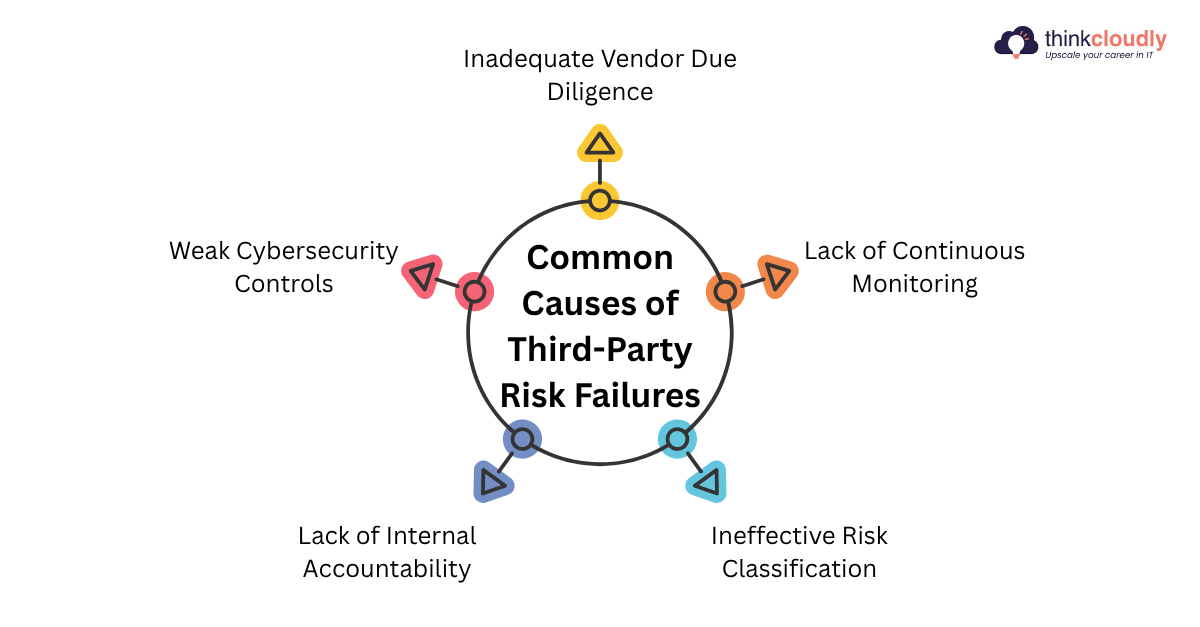
1. Inadequate Vendor Due Diligence
One of the main reasons for third-party risk failures is insufficient evaluation of vendors before merging them with the organization. Many organizations depend upon surface-level checks instead of deep-level evaluation of the security position of the vendor, compliance status, and operational capability.
With the lack of strong vendor risk management, the companies may merge with vendors who have hidden vulnerabilities. These gaps can result in risk failures and align with GRC risk compliance.
2. Lack of Continuous Monitoring
Risks are evolving day by day. If a vendor looks secure today, it can become vulnerable tomorrow. Organizations that fail to apply continuous monitoring can result in exposing them to third-party risk failures.
A successful third-party risk management (TPRM) approach includes immediate alerts and proper reviews. This makes sure that organizations can control risks before they grow into major issues. This can be done by strong vendor risk management.
3. Ineffective Risk Classification
Not all vendors cause the same level of risk, but many organizations deal with them equally. This misidentification can result in ineffective allotment of resources that can increase the chances of third-party risk failures.
A proper TPRM categorizes vendors that are based on access of data and operational impact.
4. Lack of Internal Accountability
The best frameworks can also fail without any ownership. If the roles and responsibilities are not clear, the efforts of risk management become uncertain and result in third-party risk failures.
Clear structure of governance, which is supported by GRC risk compliance practices, ensures accountability and consistent execution.
5. Weak Cybersecurity Controls
Vendors mostly function as the entry point for cyberattacks. If the security measures applied by them are weak, then your organization becomes vulnerable. Poor arrangement with the standards of GRC cybersecurity increases the chances of third-party risk failures.
This includes old and outdated systems, a lack of encrypted codes, and insufficient implementation of incident response.
Strategies to Prevent Third-Party Risk Failures
An active, structured, and continuous approach is required for preventing these risk failures. Organizations should adopt various strategies to strengthen their overall vendor risk management. Here are some effective strategies to reduce risk failures and develop a strong vendor ecosystem.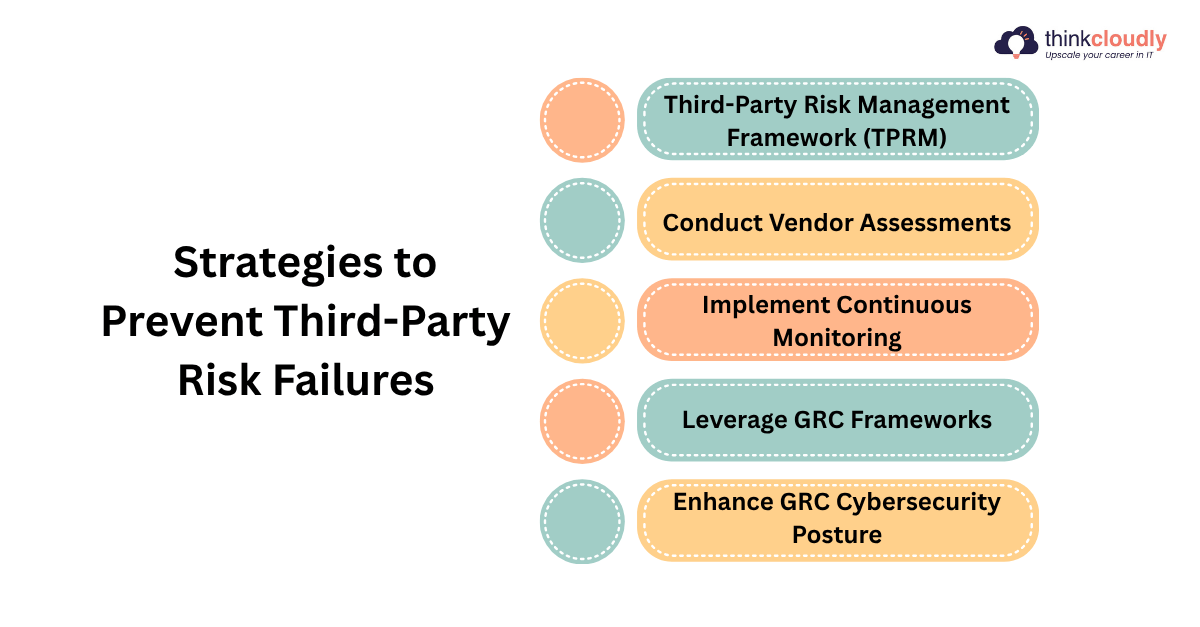
1. Third-Party Risk Management Framework (TPRM)
Organizations must adopt a structured third-party risk management (TPRM) framework to prevent third-party risk failures.
This framework usually includes:
- Methods for risk management
- Classification of vendors based on risk levels
- Standard procedure for onboarding
- Merging TPRM) into overall governance strategy
This makes sure that consistency and accountability are maintained.
2. Conduct Vendor Assessments
Before merging, organizations must evaluate the vendors based on:
- Security Practices
- Compliance certifications
- Financial stability
- Operational flexibility
Proper vendor risk management reduces the chances of merging with high-risk vendors and ensures third-party risk management (TPRM).
3. Implement Continuous Monitoring
Continuous monitoring is important to detect the changes that occur in vendor risk profiles.
Organizations can use automated tools and dashboards to track:
- Security incidents
- Status of compliance
- Performance metrics
- Control risks
This approach helps organizations to prevent these failures and control risks effectively.
4. Leverage GRC Frameworks
Adopting the practices of GRC risk compliance allows the organizations to align risk management with regulatory requirements.
A combined GRC approach ensures:
- Better visibility of risk
- Decision-making is improved
- Accountability is enhanced
- Reducing risk
This arrangement is important for reducing third-party risk failures.
5. Enhance GRC Cybersecurity Posture
Make sure that vendors are following industry-standard GRC cybersecurity protocols.
This process includes:
- Regular security audits
- Penetration testing
- Planning of incident response
- Implement third-party risk management (TPRM)
A strong process of cybersecurity helps to reduce the chances of third-party risk failures and control risks. This strengthens the accessibility of GRC cybersecurity.
Causes vs Prevention Strategies for Third-Party Risk Management (TPRM)
There are many causes for third-party risk failures which should be prevented by using risk management strategies. Here is the tabular representation which helps you to understand causes and strategies both.
|
Common Causes |
Impact on Business |
Prevention Strategies |
|
Inadequate Vendor Due Diligence |
Merging with high-risk vendors which results in risk failures |
Detailed assessment should be done to ensure vendor risk management |
|
Lack of Continuous Monitoring |
Vulnerabilities cannot be detected on time |
Automated monitoring should be applied with the help of TPRM tools |
|
Limited Visibility |
Facing problem in tracking risks that affects vendor risk management |
Use dashboards align with GRC risk compliance |
|
Weak Cybersecurity Controls |
Increase risk of cyber attacks |
Implement strong standard of GRC cybersecurity |
|
Lack of Internal Accountability |
Handling of risk is inconsistent |
Ownership and governance should be defined by using GRC risk compliance |
|
Manual Processes |
Identification of risk is delayed |
Automate the workflows in third-party risk management (TPRM) systems to control risks |
These strategies arrange properly with the goals of GRC risk compliance and showcase the importance of GRC cybersecurity.
Benefits of Preventing Third-Party Risk Failures
Organizations that work properly on third-party risk failures gain many advantages. These advantages are achieved after the organizations control risks.
Some of these advantages are:
- Data security is enhanced
- Regulatory compliance is improved
- Strong relationship with vendors
- Financial losses are reduced
- Increase the trust of customers
A proper strategy for vendor risk management ensures long-term flexibility and sustainability. The improvement in GRC cybersecurity can result in stronger protection.
Conclusion
Preventing third-party risk failures requires continuous effort, planning with strategy, collaboration, strong third-party risk management (TPRM) practices, and alignment with GRC risk compliance frameworks. All these things combine and help the organizations to control risks effectively and secure their operations.
External partnerships are not very trustworthy, the real competition is how well you can manage them and keep your organization secure. Creating a strong vendor risk management is a necessary approach to turn vulnerabilities into strength.

