
Did You Know That 41% of Jira Users Were Actively Considering Switching—Even Before 2026?
That number, pulled from Atlassian’s own internal customer research presented at their Team ’24 event, was a quiet alarm bell. And in 2026, that alarm has turned into a full-blown trend. Some of the sharpest, fastest-moving agile teams in the world — the ones shipping consistently, iterating quickly, and building software people actually use — have started walking away from Jira. Not loudly. Not with big public announcements. But steadily, one team at a time, in favor of tools that get out of their way.
This isn’t about Jira being broken. Jira still works. The real question is whether it works for you — or whether your team is spending more time managing the tool than managing the work. In 2026, the answer to that question is driving a quiet but significant migration away from one of the most established project tracking software platforms in the world. Understanding why helps you make smarter decisions about how your own agile teams operate and what tools genuinely serve them.
Why Are Agile Teams Rethinking Their Jira Workflow?
To understand the shift, you first have to understand what the Jira workflow was actually built for. Jira launched in 2002, built by Atlassian for enterprise software teams that needed extreme configurability. You could model virtually any workflow imaginable inside it—custom issue types, configurable transitions, complex permission schemes, and multi-team roadmaps. For large organizations running regulated software environments, that depth was genuinely valuable.
But here is the problem. Most agile teams are not large enterprises running regulated software environments with dedicated Jira administrators. Most teams are smaller, faster-moving, and increasingly aware that their Jira workflow has become a source of friction rather than a source of clarity. Research in 2026 found that 68% of enterprise leaders reported administrative overhead as their primary barrier to agility—and when developers spend over 15% of their sprint cycle on manual status updates, the tool designed to support speed is actively undermining it. That is not a small inefficiency. That is a structural drag on delivery. According to G2 user sentiment reports, the “Jira Admin” has become a necessary, full-time role for many enterprises just to keep the workflows from collapsing under their own complexity. For smaller teams without that dedicated resource, the weight becomes unbearable fast.
The result: teams that care more about flow efficiency than configuration options are voting with their feet.
The Four Real Reasons the Best Agile Teams Are Moving On
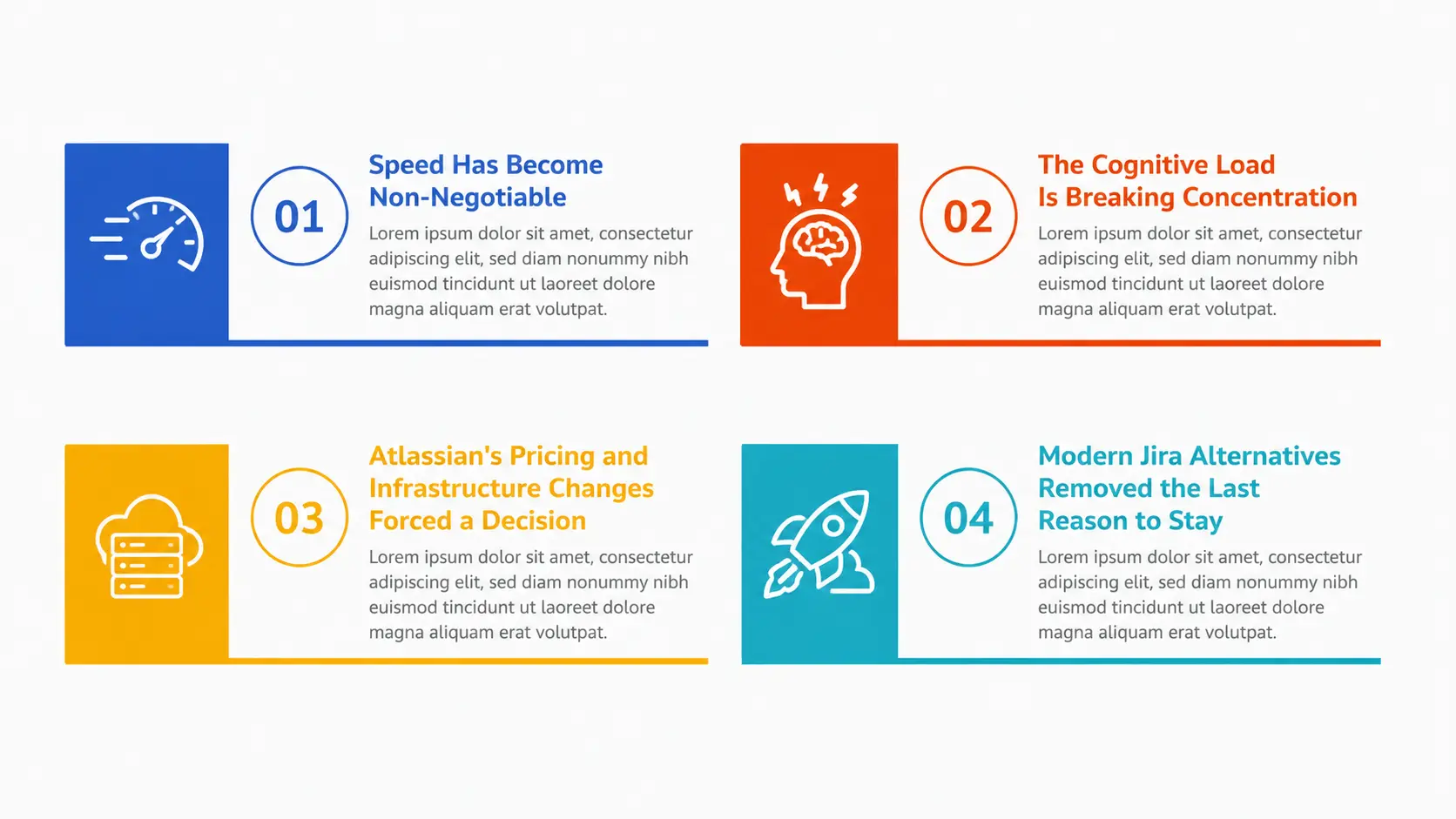
1. Speed Has Become Non-Negotiable
The performance gap between Jira and its modern competitors is not a matter of opinion — it is measurable. In a real timing exercise conducted across two customer teams, Linear’s “new issue” flow took a median 2.4 seconds for a trained user, while Jira Cloud’s took 9.1 seconds. Across a team of 20 engineers creating 200 issues per week, that translates to roughly 22 hours per year of measurable friction.
Twenty-two hours is almost three full working days, lost every year to the act of logging work rather than doing it. For agile teams optimizing for flow efficiency, that is an unacceptable tax on delivery. Even with the significant performance patches, Jira’s “Time to Interactive” (TTI) often hovers around 1.5 to 3 seconds, compared to Linear’s local-first architecture that handles most actions in under 50 milliseconds. Speed is not a luxury. It is a team productivity tool differentiator that compounds every single day.
2. The Cognitive Load Is Breaking Concentration
High-performing agile collaboration depends on focus. It depends on a team’s ability to stay in a state of deep work, make fast decisions, and move between tasks without losing momentum. Jira’s screen routinely shows epics, sprints, story points, custom fields, dependencies, and swimlanes simultaneously—and for an engineering team trained on it, the load is absorbed. For a brand team, an ops team, or a small founder-led team, that same load shows up as avoidance.
Avoidance is a productivity crisis in slow motion. When people avoid updating the tool, the tool stops reflecting reality. When the tool stops reflecting reality, no one trusts it. When no one trusts it, they build shadow systems—spreadsheets, Slack threads, sticky notes on physical walls—and the project tracking software becomes an expensive formality rather than a genuine source of truth.
3. Atlassian’s Pricing and Infrastructure Changes Forced a Decision
Atlassian killed Jira Server on February 15, 2024, and new Data Center subscriptions for new customers ended on March 30, 2026. For teams that relied on running Jira on their own infrastructure, both options are either dead or dying—and the alternative Atlassian wants teams to pick, Jira Cloud, comes with aggressive price increases and a maximum quantity billing policy that charges peak user counts with no mid-cycle refunds.
That pricing shift forced a real conversation in hundreds of organizations. If teams are going to re-evaluate their contract anyway, they are also re-evaluating whether the product itself still fits their needs. Many are deciding it does not.
4. Modern Jira Alternatives Removed the Last Reason to Stay
The final nail was the quality of the alternatives. In 2026, modern tools like Linear, ClickUp, Asana, and monday.com deliver agile features, including sprint planning, burndown charts, velocity tracking, and backlog management, out of the box—without requiring a dedicated administrator or weeks of configuration.
The gap that once kept teams locked into Jira has closed. A real-world example: a 25-person software startup was paying $500 per month for Jira, Confluence, and Tempo combined. After switching to ClickUp, they consolidated three tools into one at $300 per month — saving $2,400 per year while maintaining full agile functionality. When the alternative is better, faster, and cheaper, the switching calculus changes entirely.
The Tools Winning Over Agile Teams in 2026
Not all Jira alternatives are created equal. The right replacement depends on team size, workflow type, and what kind of friction you are actually trying to remove.
|
Tool |
Best For | Key Strength | Starting Price (per user/month) |
Agile Support |
|
Linear |
Startups, engineering teams | Speed, keyboard-first, zero config | $8 |
Cycles, roadmaps, triage |
|
ClickUp |
Cross-functional teams | All-in-one: docs, tasks, goals, chat | $7 |
Scrum, Kanban, hybrid |
|
monday dev |
Mixed technical/business teams | Visual workflow, no-code automation | $9 |
Scrum, Kanban, custom |
|
Asana |
Marketing, creative, ops teams | Readability, timeline view, portfolios | $10.99 |
Kanban, task tracking |
|
Shortcut |
Agile software development | Clean sprint UI, developer-focused | $8.50 |
Scrum, Kanban |
|
Azure DevOps |
Microsoft-ecosystem teams | CI/CD, code + issues in one place | $6 |
Scrum, Kanban, reporting |
|
YouTrack |
Power users needing automation | Workflow automation, built-in helpdesk | Free up to 10 users |
Scrum, Kanban, Gantt |
|
Zoho Sprints |
Budget-conscious agile teams | Affordable, burn charts, timesheets | $1 |
Scrum, Kanban |
Source: The Digital Project Manager, 2026; Titanapps, May 2026; DevRev Blog, 2026
What the Workflow Automation Revolution Is Actually Doing to Team Productivity?
One of the most important shifts of 2026 is not just which tool teams are using—it is what they expect those tools to do automatically. Workflow automation is no longer a premium add-on. It is a baseline expectation.
Modern agile teams have moved beyond the “status “trap”—workflows with ten or more columns capturing every micro-action. This complexity forces constant context-switching and manual updates that eat into actual delivery time. The teams pulling ahead have eliminated manual status updates through automation, allowing developers to stay in the work rather than reporting on it.
Workflow automation in tools like ClickUp and monday.com now handles sprint rollover, status transitions triggered by code commits, automatic assignment based on capacity, and deadline reminders—all without human input. Teams using these native automation layers report measurable gains in team productivity tool adoption because the tool does more and demands less. Gartner predicts that by the end of 2026, task-specific AI agents will be integrated into 40% of enterprise applications. The teams already building their workflow automation muscle now will be the ones best positioned to absorb that shift without disruption.
What Strong Agile Collaboration Actually Looks Like Without Jira?
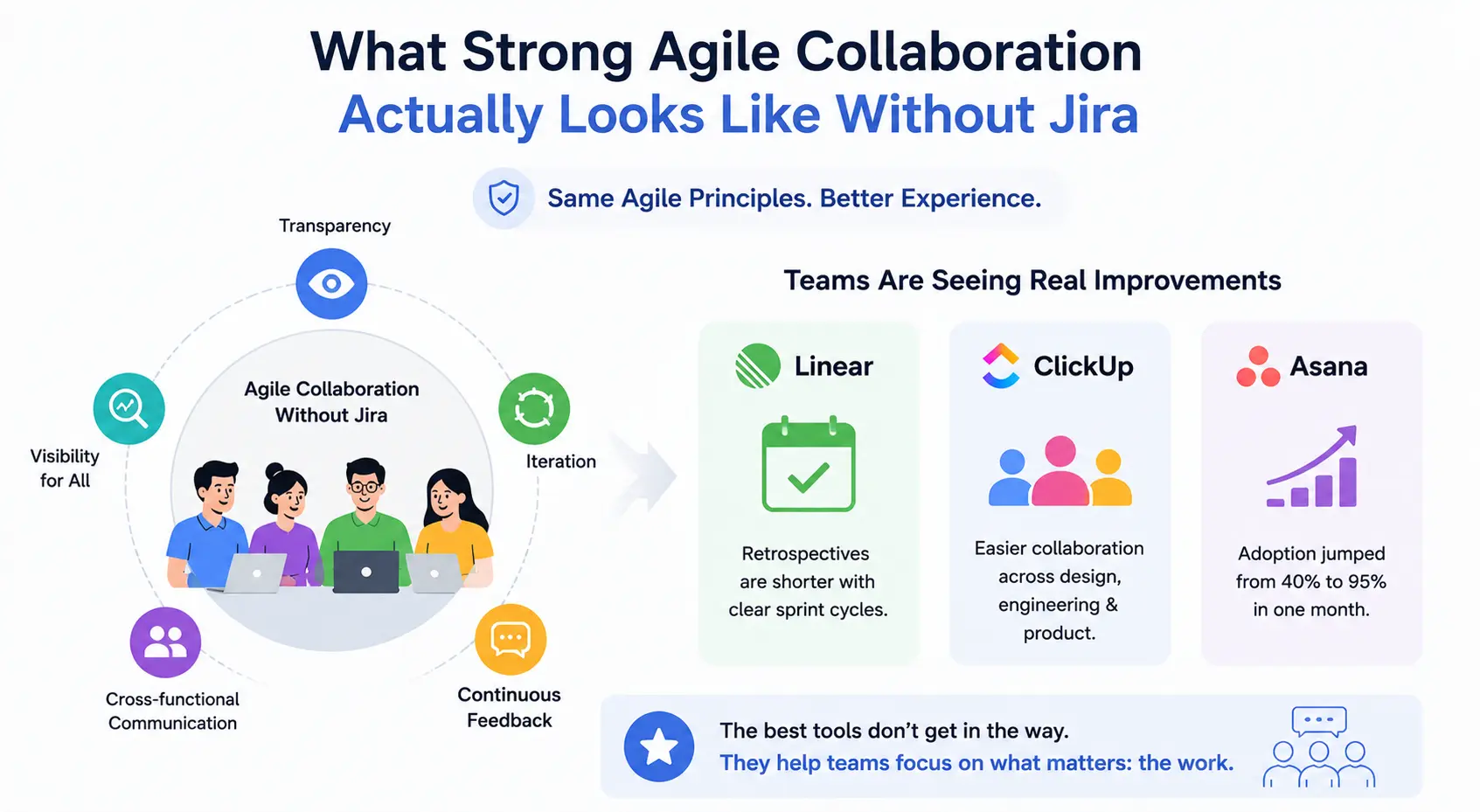
Here is something worth naming clearly: the agile teams moving away from Jira are not moving away from Agile collaboration. They are moving toward better versions of it. The principles—transparency, iteration, continuous feedback, and cross-functional communication—are completely intact. What changes is the surface they live on.
Teams using Linear report that their retrospectives have become shorter because the tool’s cycle view makes the sprint story self-evident. Teams using ClickUp report that agile collaboration across design, engineering, and product has improved because non-technical team members can actually navigate the platform without training. A 30-person creative agency switched from Jira to Asana after designers complained that Jira’s interface felt like “navigating a spaceship.” With Asana, adoption jumped from 40% to 95% within a month. That is not a Jira problem. That is a team-fit problem. And getting the tool fit right is one of the most important decisions a team leader makes.
Agile collaboration is healthiest when the tool disappears into the background — when the team talks about the work, not the software. The best Jira alternatives in 2026 are the ones that make themselves invisible.
When Jira Still Makes Sense (And When It Doesn’t)?
To be fair, this is not an argument that every team should leave Jira. Jira is purpose-built for specific teams—software development, DevOps, QA, and scrum environments. If you run sprints, estimate with story points, and review velocity, Jira remains the right choice. But for marketing, HR, operations, and sales teams, forcing Jira creates friction rather than productivity. The pattern is clear. Most teams use less than 20% of the Jira feature set—and those teams tend to be happier on alternatives. Teams that hit real regulated or multi-domain complexity use the configurability Jira offers, and switching away costs them.
The question every team leader should be asking is not “is Jira good?” but “is Jira good for us, at this stage, for this kind of work?” If the honest answer is no, 2026 has never offered a better range of alternatives to choose from.
The Conclusion: Tool Fit Is a Competitive Advantage
The best agile teams in 2026 are not defined by which tools they use. They are defined by how clearly they understand what they need — and how ruthlessly they eliminate everything that gets in the way of doing the actual work. The quiet migration away from Jira is not a verdict on Atlassian. It is a signal that the nature of agile teams has evolved. Smaller, faster, more cross-functional, more expectant of workflow automation and native agile collaboration — these teams need tools built to their rhythm, not the rhythm of a 2002 enterprise IT department.
If your project tracking software is costing your team 22 hours a year in loading screens, multiple more in administrative overhead, and a significant chunk in adoption resistance, the case for change is not emotional—it is mathematical. The Jira alternatives available in 2026 are mature, affordable, and genuinely purpose-fit for the way modern agile teams actually operate.
Choose the tool that disappears. That is the one helping your team win.