
Models are becoming smarter and more efficient in modern machine learning and deep learning. New model approaches like zero shot learning and few shot learning allow AI models to perform tasks with no previous experience.
These techniques of learning are widely used in generative AI, especially with the rise of large language models and prompt engineering. They help systems to understand the tasks quickly and generate accurate output without heavy training or previous experience.
In this blog, we will learn what is the difference between zero-shot learning and few shot learning, how they work, and why they are important in AI systems.
What is Zero-Shot Learning?
Zero shot learning is a technique where a model can perform a task without being trained on specific examples of that task. In simple terms, the model uses its previous experience and understanding to predict output for completely new situations.
Here are some key points:
- It does not require specific training data to perform task.
- It relies on the general knowledge you have learned during training.
- It works well with advanced AI models like large language models.
Let’s take an example to understand this context of learning:
“Is this review positive or negative: ‘The quality of food was disappointing.’”
Even if the model was never trained specifically on this exact sentence, it will still understand the meaning of your sentence and answer you based on your disappointment negatively.
So, this is zero-shot learning because the AI performs the task without seeing any emotions and examples.
What is Few-Shot Learning?
Few-shot learning is a technique in machine learning where a model learns to perform a task using only a small number of examples. It uses pre-trained AI models to understand patterns and apply previous knowledge and experience to new data. This approach is widely used in prompt engineering to improve the accuracy of the output without the demand of large datasets.
Key Points:
- It Requires only a few examples to perform the task and give you accurate output.
- It provides more accurate data than Zero-shot learning.
- It is commonly used in prompt engineering
Let’s take an example to understand this learning:
You give the AI a few examples first:
- “Translate English to French: Hello → Bonjour”
- “Translate English to French: Thank you → Merci.”
Then you ask, “Translate English to French: Good morning?”
AI understands the pattern from the given examples and then will give you correct answers based on the previous examples: “Bonjour.”
Zero-Shot Learning vs Few-Shot Learning
|
Features |
Zero-shot learning |
Few-shot learning |
|
Training Data |
There is no need for examples to generate output |
This requires examples to provide more accurate results. |
|
Accuracy |
It provides moderate accuracy. |
It provides more accurate data in comparison to zero shot learning. |
|
Flexibility |
It is highly flexible, as it can handle new tasks without any training. |
It is also flexible, but it performs when some examples are provided for understanding. |
|
Use Case |
It is best for new tasks, as no training data is required. |
Helpful for tasks where you have a few examples and give you better results. |
|
Role in AI Models |
This helps in providing quick output without specific training. |
It improves performance by guidance and examples to provide quality output. |
Role of Prompt Engineering
Prompt engineering plays a key role in both zero-shot learning and few-shot learning. It helps you to guide the model by providing clear instructions or examples to get accurate data without any errors.
Why It matters:
- It Improves the quality of output.
- It helps models to understand the context better.
- Prompt engineering helps to reduce errors in predictions
Relation with Reinforcement Learning
In modern machine learning and AI models, different deep learning techniques often work together to improve the performance and accuracy of the output. While zero shot learning and few shot learning focus on understanding tasks with no or one example, reinforcement learning follows a completely different approach based on their interaction and feedback.
Reinforcement learning allows AI systems to learn by trial and error. The model takes actions in an environment and receives rewards or penalties based on its performance. Over time, it understands the process which actions lead to better outcomes. This makes reinforcement learning highly effective for tasks that require decision-making, such as gaming, robotics, and autonomous systems.
While on the other hand, zero shot learning helps models to perform tasks without any previous examples. However, few shot learning improves performance by providing a small number of similar examples. These techniques are commonly used in prompt engineering, where giving minimal instructions or samples can guide the model to produce the accurate output.
Let’s explore how They work together
- Zero-shot learning provides quick task execution without training data.
- Few-shot learning improves the input understanding by giving a few or similar examples to get better output.
- Reinforcement learning refines the model further by using rewards and feedback.
When we combine both the deep learnings, these approaches create more intelligent and adaptive AI systems. For example, a model can first understand a task using few-shot learning with some examples to create the output and then continuously improve its responses using reinforcement learning feedback.
Key Difference of these approaches
- Zero-shot / Few-shot learning → Allows you to generate output from no or small examples
- Reinforcement learning → Learn from rewards, feedback, and experience
Challenges of Zero-Shot Learning and Few-Shot Learning
While zero shot learning and few shot learning are strong techniques in modern machine learning and have various benefits to generate data, they also come with certain challenges.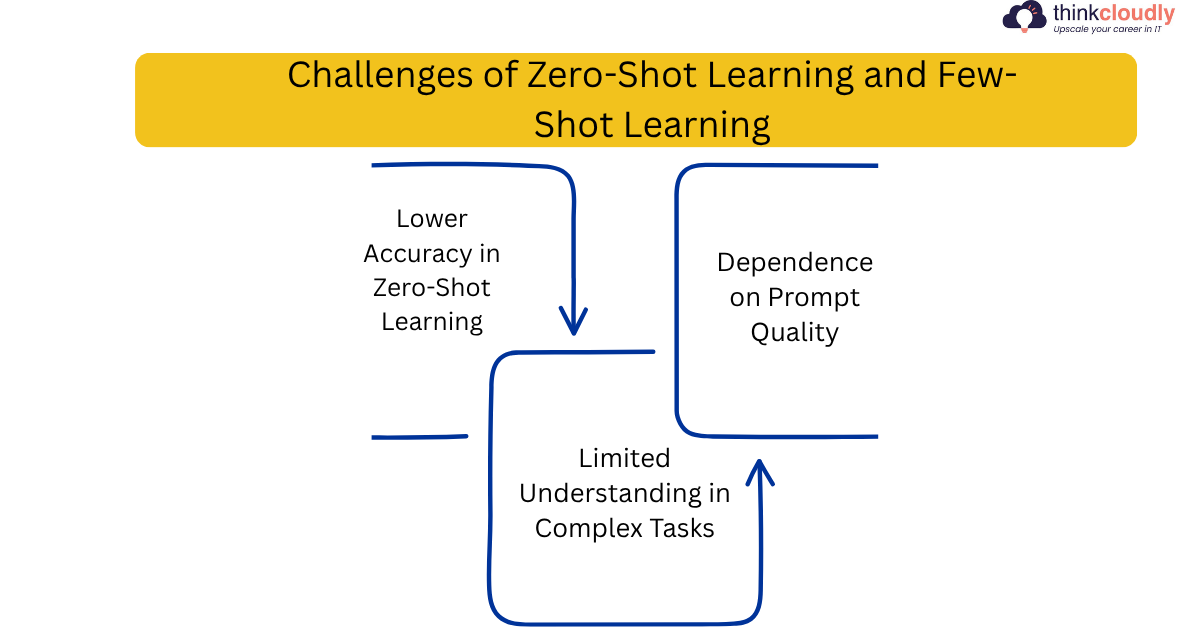
Lower Accuracy in Zero-Shot Learning
In the zero shot learning approach, the model does not provide any previous knowledge to generate data. Because of this challenge, it mostly relies only on its previous knowledge, which may not always match the task requirement. As a result, the output can be less accurate and doesn’t match with the expected result.
Dependence on Prompt Quality
Both zero shot learning and few shot learning majorly depend on instructions that are given to them to generate output. If the prompt is a little bit confusing or not explained correctly, the model may misunderstand the task. Good prompt engineering is important to get correct and accurate results.
Limited Understanding in Complex Tasks
For easy tasks, few shot learning works well with some examples. However, if the problem is problems, a few examples may not be enough for the model to understand the pattern fully. In such cases, the model might need more data or advanced techniques to improve the accuracy of data.
Benefits of Zero-Shot Learning and Few-Shot Learning
Zero shot learning and few shot learning have significantly improved the efficiency of modern AI models by reducing the dependency on large-scale labelled dataset assets. These approaches use training knowledge and advanced deep learning architectures to deliver high-performance output with minimal input data.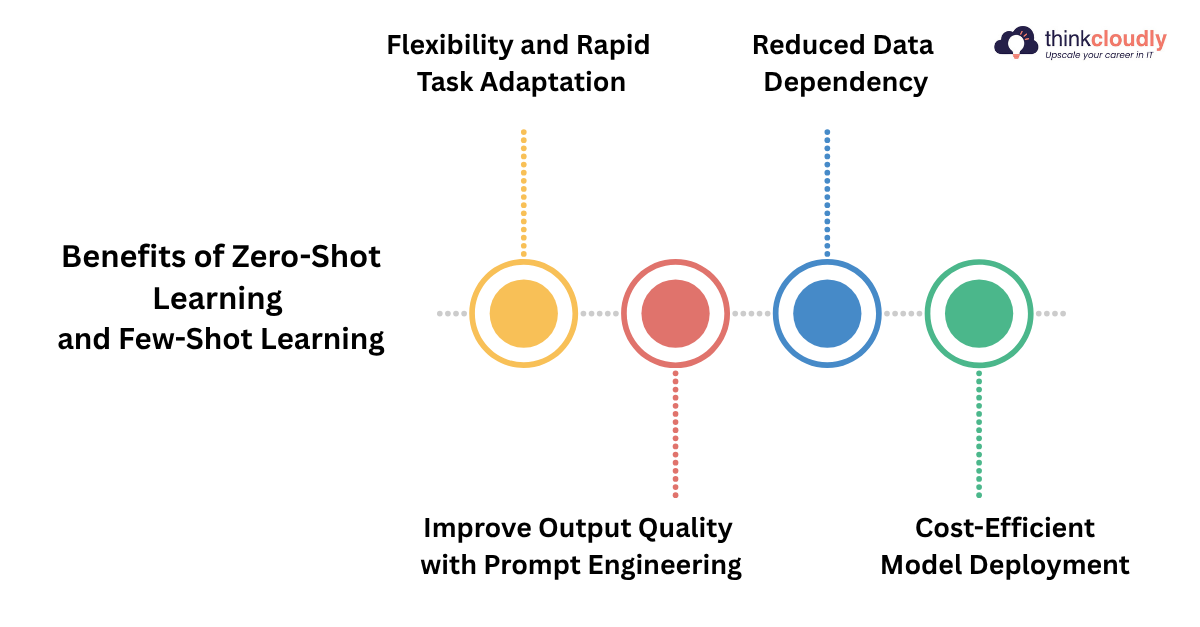
Flexibility and Rapid Task Adaptation
Zero shot learning allows models to generalize across unexpected tasks without additional training by making them highly adaptable. Few shot learning further improves this by providing minimal examples to fine-tune task understanding. This allows machine learning systems to quickly respond to dynamic use cases without undergoing full retraining cycles.
Reduced Data Dependency
Traditional deep learning models require large amounts of data, which can be expensive and time-consuming to create the output. In contrast, few shot learning uses prior knowledge from training AI models to perform tasks with a limited amount of data. This makes it highly effective in domains where labelled data is scarce or difficult to find or obtain.
Cost-Efficient Model Deployment
These techniques significantly reduce the computational overhead by minimizing the need for extensive training and large datasets. Organizations can deploy AI models with lower infrastructure requirements by optimizing both training time and resource utilization. This leads to more flexible and cost-effective machine learning solutions.
Improve Output Quality with Prompt Engineering
The integration of prompt engineering and deep learning allows models to produce more aware context and provide accurate outputs. Few-shot learning improves the response precision by guiding the model with explanations or giving examples. As a result, generative AI systems can easily provide high-quality and accurate outputs across various applications such as content generation and automation.
Conclusion
Zero shot learning and few-shot learning are transforming how AI models work in modern machine learning. These techniques allow systems to perform tasks with few or no example data, making AI work faster, smarter, and more efficient.
With the help of deep learning and prompt engineering, businesses and professionals can create powerful AI solutions. Here we have learned about the actual difference between both the approaches and also about reinforcement learning.

