

Information security management is now the third most difficult role for organizations to fill globally, according to ISACA’s 2025 State of Cybersecurity Report. That one statistic tells you most of what you need to know about the opportunity behind the CISM certification right now.
Unlike general cybersecurity credentials, CISM is built specifically for professionals who manage and oversee information security programs at the organizational level. Employers are not just looking for technical knowledge anymore. They need people who can lead security strategy, build governance frameworks, and speak about risk in business language that boards actually understand.
This guide covers exam structure, cost, salary data, and how CISM sits within the broader ISACA certifications landscape.
CISM Certification in 2026: What It Is and Why It Matters
ISACA has been issuing the CISM certification since 2002, and it has held its position as the benchmark credential for information security management professionals consistently ever since. Where technical certifications focus on tools and systems, CISM is built around strategy, leadership, and organizational security management, making it the natural next step for professionals moving from hands-on security work into management roles.
The credential covers four areas that define what security management actually involves in practice. Building and maintaining a security governance model that aligns with business objectives. Identifying and managing information risk in a structured, measurable way. Designing and overseeing information security controls and broader security program capabilities. And preparing for, detecting, and responding to security incidents effectively.
According to ISACA’s 2025 workforce data, CISM is the second most widely held credential in the ISACA certifications portfolio, with over 50,000 active holders across more than 140 countries. That kind of reach reflects genuine, sustained market relevance.
The CISM Examination: Structure, Difficulty, and What to Expect
The CISM examination is a 150-question multiple-choice assessment completed in four hours. It is available at authorized testing centres and through remote online proctoring in most regions. The exam is offered in multiple languages, including English, Chinese Simplified, Japanese, Korean, and Spanish.
The exam is scored on a scale of 200 to 800, with a passing score of 450. ISACA uses a scaled scoring methodology rather than a simple percentage, which means raw correct answers are converted to a scale that accounts for item difficulty variation across different exam versions.
The four exam domains and their respective weightings are:
|
Domain |
Topic |
Exam Weighting |
|
Domain 1 |
Information Security Governance | 17% |
| Domain 2 | Information Risk Management |
20% |
|
Domain 3 |
Information Security Program | 33% |
| Domain 4 | Incident Management |
30% |
Domain 3 and Domain 4 together represent 63% of the exam, which means candidates who underinvest in information security program development and security incident management will struggle regardless of how strong their governance and risk knowledge is. Most experienced candidates who pass on their first attempt report allocating their study time proportionally to these weightings rather than treating all four domains equally.
The CISM examination is widely considered moderately to highly difficult. The primary challenge is not technical complexity but the management-oriented framing of the questions. ISACA consistently asks candidates to choose the best answer from multiple plausible options, each of which may be technically correct in isolation. The ability to think like a security manager rather than a security engineer is what separates candidates who pass from those who need to retake.
CISM Certification Cost in 2026
Before committing to any certification, knowing the full financial picture matters. Here is what CISM actually costs when you add everything up honestly.
Exam registration: ISACA members pay $575 to sit the exam. Non-members pay $760. Given that annual ISACA membership runs approximately $135, most candidates find it worth joining before registering. The membership discount on the exam alone covers most of the membership fee, and you get access to study materials, publications, and a professional community on top of that.
Rescheduling: If something comes up and you need to move your exam date, a $50 fee applies as long as you give more than 48 hours’ notice. Shorter notice than that and the fee goes up.
Annual maintenance: Once certified, keeping your CISM active costs $45 per year as an ISACA member or $85 as a non-member. It is a modest ongoing cost relative to what the credential returns in earning potential.
Continuing Professional Education: CISM requires 120 CPE hours across every three-year window, with at least 20 hours completed each year. Some CPE activities are free. Others, like conferences or structured courses, carry their own costs depending on the provider and format.
Preparation courses: ISACA’s own review course sits between $895 for members and $1,095 for non-members. Third-party providers, including Simplilearn, Infosec Institute, and SANS offer alternatives ranging from $500 to $2,000 depending on how structured and intensive the program is.
When you add up exam registration, preparation, and first-year maintenance, most candidates spend somewhere between $1,500 and $3,000 from start to certification. For a credential that consistently delivers a 30-plus percent salary premium, that investment tends to pay for itself quickly.
What the CISM Certification Does for Your Career
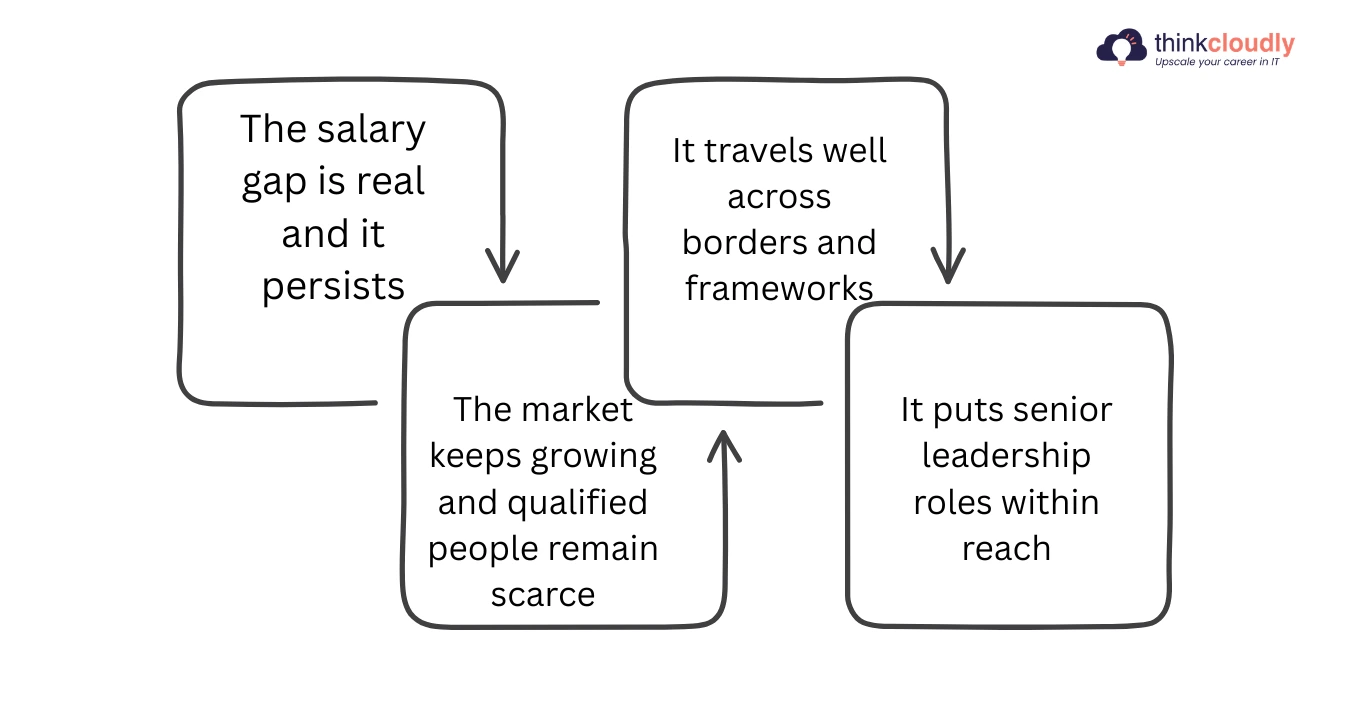
The career case for CISM in 2026 is genuinely strong, and the data behind it is specific enough to be worth taking seriously.
The salary gap is real and it persists
ISACA’s 2025 Global Salary Survey puts the median US salary for CISM-certified professionals at $149,000 annually. Comparable professionals in information security management roles without the credential earn around $112,000. That is a 33% premium, and it has remained consistent across multiple years of ISACA data. When a salary gap holds that steady over time, it is not a market quirk. It reflects what employers genuinely believe the credential is worth.
The market keeps growing and qualified people remain scarce
The Bureau of Labour Statistics projects 32% growth in information security analyst roles through 2032, well above the average across all occupations. CISM sits specifically at the management layer of that growth, which is where the shortage is sharpest. Organizations have always been able to develop technical security talent over time. What they consistently cannot find is someone who can run a security governance model with strategic clarity, oversee a security program end to end, and translate risk into language that resonates with a board. That combination is what CISM validates, and it remains genuinely rare.
It travels well across borders and frameworks
CISM is recognized by employers in more than 140 countries and aligns with compliance frameworks, including ISO 27001, NIST, and SOC 2. For professionals working across multiple geographies or targeting multinational organizations, that cross-border and cross-framework recognition is a practical advantage that credentials with narrower geographic footprints simply cannot offer.
It puts senior leadership roles within reach
Chief Information Security Officer, VP of Information Security, Director of Security Governance. These roles appear with CISM listed as preferred or required more consistently than most other credentials in this space. LinkedIn Talent Insights 2025 data confirms that CISM appears in CISO-track job postings more frequently than any other single certification, including CISSP when the category is narrowed specifically to security management rather than security broadly. If senior leadership is where you are heading, CISM is the credential most directly aligned with getting you there.
How to Prepare for the CISM Examination
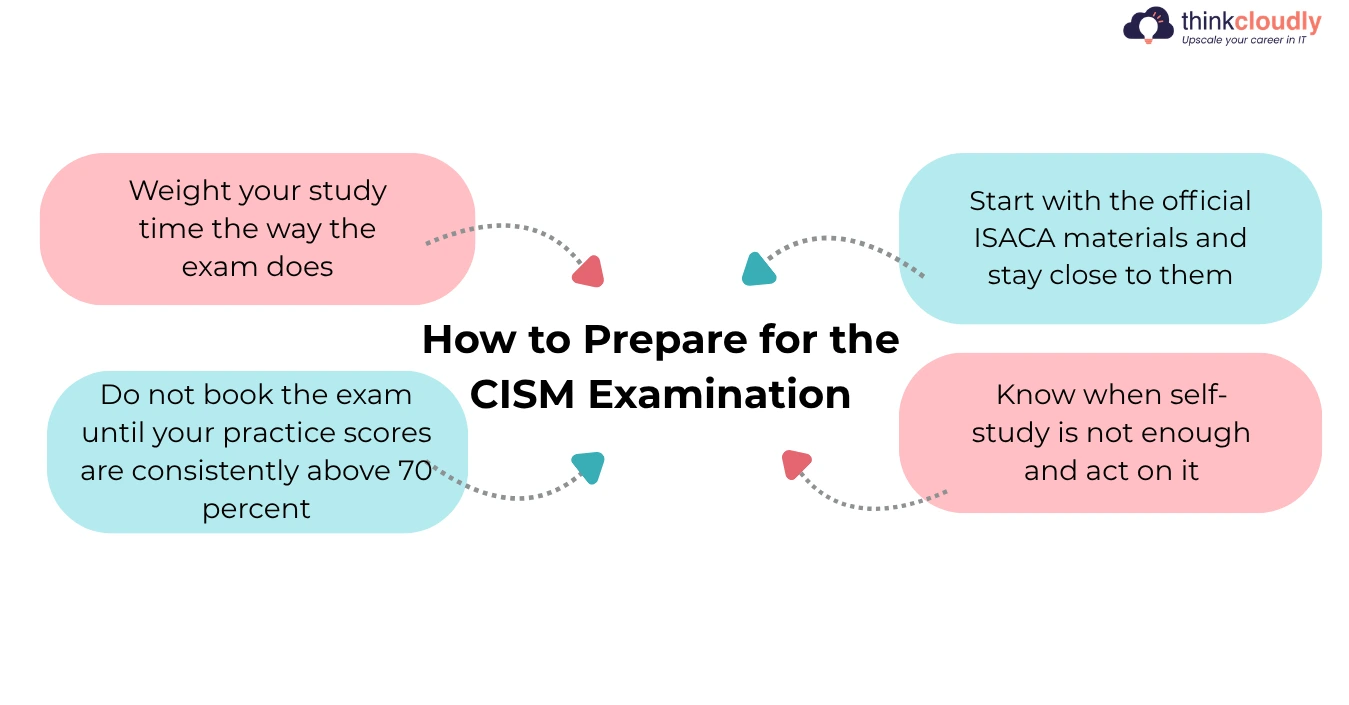
Weight your study time the way the exam does
Most candidates who struggle on the CISM examination do not fail because they did not study enough. They fail because they studied the wrong things in the wrong proportions. Domains 3 and 4, covering information security program development and security incident management, together account for 63% of the exam. That is not a minor weighting difference. It means that if you split your preparation equally across all four domains, you are significantly under-preparing for the sections that matter most. Build your study schedule to reflect those weightings from day one rather than discovering the imbalance halfway through.
Start with the official ISACA materials and stay close to them
The ISACA CISM Review Manual is the most reliable foundation you can build your preparation on. It covers all four domains at the depth the exam actually tests, and it reflects how ISACA thinks about information security management, which is the perspective the questions are written from. The CISM Question, Answer and Explanation database is equally important and genuinely not optional. The QAE trains you in the specific logic and framing of ISACA’s scenario-based questions, which is different enough from other certification styles that candidates who skip it often find the real exam harder than their practice scores suggested.
Do not book the exam until your practice scores are consistently above 70 percent
Practice assessments do two things that passive reading cannot. They build the stamina and time management skills needed to work through 150 questions in four hours without losing focus, and they force you to apply management-oriented thinking under pressure rather than simply recognizing correct answers from memory. Aim to score above 70 percent consistently on full-length practice exams before booking your real exam date. One strong score is not enough. Consistent scores across multiple attempts mean your preparation has genuinely landed rather than having a lucky run.
Know when self-study is not enough and act on it
Some candidates move through the CISM examination material comfortably on their own. Others find that certain domains, particularly information security program development or incident management, do not fully click through reading alone. If that is where you find yourself, a structured professional certification course is worth the investment. ISACA’s own review course is the most directly aligned with exam content and the way questions are framed. Simplilearn and Infosec Institute both offer well-regarded alternatives at different price points and delivery formats for candidates who prefer instructor-led or video-based learning over self-directed study.
CISM vs CISSP
This is one of the most common questions among professionals evaluating their options in the security management space.
|
Factor |
CISM | CISSP |
| Issuing Body | ISACA |
ISC2 |
|
Primary Focus |
Security management and governance | Security architecture and engineering |
| Experience Required | 5 years in information security, 3 in management |
5 years in two or more security domains |
|
Exam Questions |
150 questions, 4 hours | 125 to 175 adaptive, 4 hours |
| Passing Score | 450 on 200 to 800 scale |
700 on 1,000 scale |
|
Average US Salary |
$149,000 median (2025) | $141,000 median (2025) |
| Best Suited For | Security managers, CISOs, governance leads |
Security architects, engineers, consultants |
|
CPE Requirement |
120 hours over 3 years | 120 hours over 3 years |
| Global Recognition | 140 plus countries |
170 plus countries |
The clearest distinction is this. CISM is the credential for professionals whose primary work involves managing people, programs, and strategy in information security. CISSP is the credential for professionals whose primary work involves designing and implementing security architectures and systems. Many senior security leaders hold both, particularly those in CISO roles where both strategic leadership and deep technical credibility are expected.
Conclusion
The CISM certification in 2026 makes a genuinely compelling case for itself. It sits at the intersection of security governance, risk management, information security program leadership, and incident management, which is exactly the combination organizations cannot find enough of right now.
The CISM examination is demanding, but the right preparation makes it manageable. The credential signals something specific to employers: that you can lead security strategy at an organizational level, not just execute it on the ground. Within the broader ISACA certifications landscape, CISM is the most directly aligned professional certification for professionals moving toward senior security management.
The talent shortage is real. The salary premium is consistent. Whether you are a security analyst, a risk professional, or a compliance specialist building toward a CISO track, 2026 is a strong time to move.
Sources and References
- ISACA. CISM Certification: Official Exam Requirements, Structure, and Pricing 2026. (2026)
- ISACA. Global Salary Survey 2025: Information Security Management Compensation Data. (2025)
- ISACA. State of Cybersecurity 2025: Workforce Gaps, Demand, and Skills Shortage Analysis. (2025)
- ISC2. CISSP Certification: Official Requirements and Salary Benchmarks 2025. (2025)
- Bureau of Labour Statistics. Occupational Outlook Handbook: Information Security Analysts 2025. (2025)
- LinkedIn Talent Insights. CISO Track Hiring Demand and Certification Preferences 2025. (2025)
- Glassdoor. Information Security Manager Salary Report by Certification Level 2025. (2025)
- Forbes. Most Valuable Cybersecurity and Security Management Certifications in 2025. (2025)
- Burning Glass Technologies. Labor Market Analytics: CISM Certification Frequency in Security Management Job Postings 2025. (2025)
- Coursera. Global Skills Report 2025: Cybersecurity and Security Management Learning Trends. (2025)
- CompTIA. IT Industry Outlook 2026: Security Management, Governance, and Workforce Demand Trends. (2026)