
Did you know that only 37% of Agile transformations actually deliver on their stated goals?
For years, pure Scrum was treated as the gold standard of project delivery. Sprint by sprint, standup by standup, teams stuck rigidly to the playbook. But in 2026, that playbook is getting rewritten. Hybrid Agile—the practice of blending Scrum with other frameworks like Kanban, Waterfall, SAFe, or OKRs—has quietly become the dominant Agile delivery model across most industries. The shift is not happening because Scrum is broken. It’s happening because organizations have grown more complex than a single framework can handle, and the data from 2026 is making that undeniable.
Why Pure Scrum No Longer Fits Most Organizations in 2026
The honest truth is that pure Scrum was designed for small, co-located software teams working on a single product. It was never built to coordinate 50 departments, three geographies, a hardware line, and a marketing team simultaneously. According to iCert Global’s January 2026 analysis:
“The debate between Scrum, Kanban, and Waterfall has largely been settled by a pragmatic middle ground“—and that middle ground is Hybrid Agile.
Consider the numbers. Businessmap’s 2026 Agile statistics report reveals that large and medium-sized organizations are increasingly opting for tailored approaches rather than standardized frameworks, with 34% now describing their approach as a self-created enterprise framework. That figure has grown steadily since 2023, precisely because no off-the-shelf framework—Scrum included—fits every team’s reality anymore. The rise of enterprise Agile transformation efforts has pushed this further. When a business is rolling out Agile across finance, HR, operations, and marketing — not just engineering — the structure of a two-week sprint simply cannot govern all of it. This is why frameworks designed for Agile at scale, like the safe agile framework and Disciplined Agile, have gained so much traction. They acknowledge that complexity cannot be solved with simplicity alone.
The Rise of Hybrid Agile — What the 2026 Data Actually Shows
The numbers behind Hybrid Agile adoption are striking. According to eSpark Info’s 2026 Agile statistics report, 81% of Agile teams now use Scrum in some hybrid or variation format — meaning very few teams are running pure, textbook Scrum anymore. This data reflects a broader pivot in how organizations think about the Agile delivery model. APMIC’s March 2026 State of Agile Project Management report puts it plainly:
“The biggest change is the shift from framework loyalty to system effectiveness. Teams are judged less by whether they ‘do Scrum correctly’ and more by whether they improve prioritization, decision speed, transparency, and business outcomes.”
What Industries Are Driving the Hybrid Shift?
The migration to hybrid agile is not just happening in software development. According to ProProfsProject’s 2026 Scrum statistics report, 86% of marketing organizations planned to transition some or all of their teams to Agile ways of working. That movement, when it collides with the structured governance requirements of marketing, legal, and finance departments, almost always produces a hybrid rather than a pure Scrum outcome.
Healthcare, banking, and government sectors are particularly strong drivers of enterprise Agile transformation because they operate under regulatory frameworks that demand documentation, traceability, and predictability—none of which sit naturally inside a pure Scrum setup. For these environments, blending Scrum’s iteration rhythm with Waterfall’s governance scaffolding (and sometimes with Lean Portfolio Management to manage investment decisions) has become standard operating procedure, not an experiment.
The Key Frameworks Powering Hybrid Agile in 2026
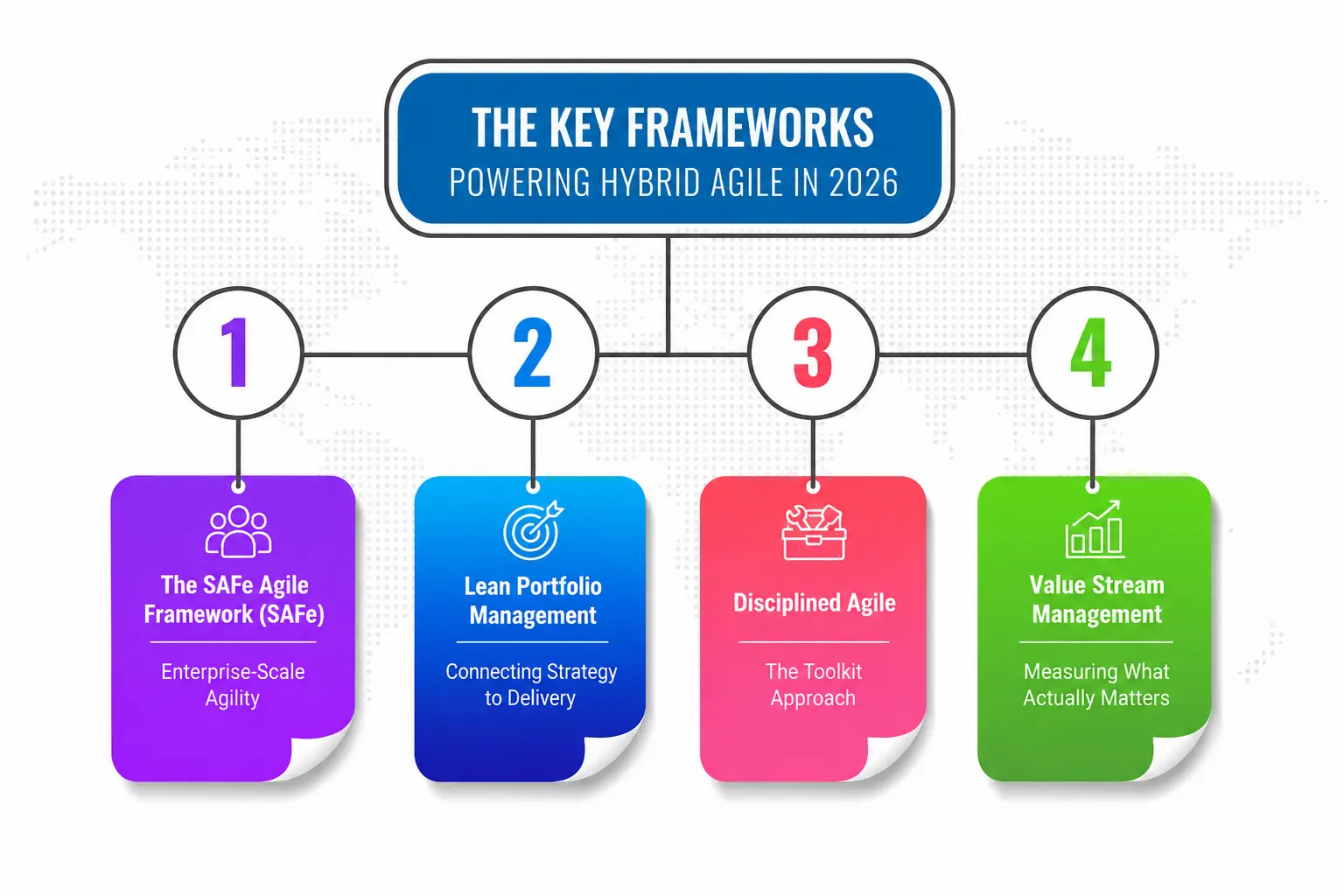
1. The Safe Agile Framework (SAFe) — Enterprise-Scale Agility
The Safe agile framework is the clearest expression of hybrid agile at enterprise scale. Rather than replacing Scrum, SAFe places it inside a larger structure that coordinates multiple teams, aligns delivery with strategy, and connects team-level work to portfolio-level investment decisions. The SAFe Agile Framework provides four configurations—Essential SAFe, Large Solution SAFe, Portfolio SAFe, and Full SAFe—to accommodate organizations at different stages of scale. This configurability is precisely why it works as a hybrid tool: organizations don’t adopt all of SAFe at once. They layer it onto existing Scrum practices gradually, which is the definition of hybrid thinking.
What makes SAFe a true enabler of hybrid agile is its Program Increment (PI) Planning process—a structured quarterly alignment event that combines the strategic predictability of traditional planning with the iterative execution of Agile sprints. As Atlassian explains in their SAFe overview, SAFe promotes the following:
“alignment, collaboration, and delivery across large numbers of Agile teams”,
drawing on Agile software development, Lean product development, and systems thinking simultaneously. The SAFe Agile Framework has also evolved to include Value Stream Management as a core discipline, recognizing that delivering value—not just delivery speed—must be the measure of enterprise agility.
2. Lean Portfolio Management — Connecting Strategy to Delivery
One of the most impactful components of the SAFe ecosystem is Lean Portfolio Management (LPM). In a pure Scrum world, the link between sprint output and organizational strategy is often informal, assumed, or missing entirely. Lean Portfolio Management formalizes that link by aligning strategy, investment funding, and Agile execution at the portfolio level. According to the Scaled Agile Framework’s official LPM discipline page, Lean Portfolio Management
“Aligns strategy and execution by applying Lean and systems thinking approaches to strategy and investment funding, Agile portfolio operations, and governance.”
This means it does something pure Scrum cannot: it tells the business which things to build, not just how to build them quickly. The practical impact of lean portfolio management is that it transforms product backlog decisions from team-level gut calls into portfolio-level investment choices, backed by data and tied to measurable business outcomes. For organisations undergoing enterprise Agile transformation, this is often the missing link that causes pure Scrum implementations to stall—teams get good at sprinting but bad at choosing which direction to sprint in. Lean Portfolio Management is also a critical tool for Value Stream Management since it provides the funding mechanism that enables value streams to operate and evolve continuously rather than on a project-by-project basis.
3. Disciplined Agile — The Toolkit Approach
Where SAFe provides a structured framework and LPM provides strategic governance, Disciplined Agile (DA) offers something different: a toolkit that enables organizations to choose their own way of working. As IBM’s explainer on scaled Agile frameworks describes it, Disciplined Agile
“is considered a set of principles, promises, and guidelines rather than a full methodology.”
which is precisely what makes it suited to hybrid environments. Disciplined Agile is particularly valuable for organizations that have tried SAFe and found it too rigid, or that are starting from a base of Kanban or Lean rather than Scrum. Rather than prescribing a single delivery rhythm, Disciplined Agile offers multiple process goals and asks teams to select the practices most appropriate for their current context. This situational awareness is baked into the framework by design.
Atlassian’s Agile coaching resources on SAFe note that Disciplined Agile:
“involves situationally employing different levels of scale for each project and places an emphasis on decision-making enablement to help guide strategic direction.”
— a description that reads less like a framework and more like a philosophy of hybrid agile thinking.
4. Value Stream Management — Measuring What Actually Matters
Perhaps the most important concept underpinning the shift to hybrid agile is value stream management. Pure Scrum measures velocity — how much work a team completes in a sprint. Value stream management measures something more meaningful: how long it takes for an idea to reach a customer and generate value and where the bottlenecks in that journey live. According to iCert Global’s 2026 Agile trends analysis, Value Stream Management
“focuses on visualizing and optimizing the flow of value from the start of a project to its final delivery” and “helps identify systemic bottlenecks that slow down the entire organization.”
This is a strategic capability, not a team-level one, which is why it belongs in the Hybrid Agile toolkit rather than inside pure Scrum. Value Stream Management pairs particularly well with Lean Portfolio Management, since understanding where value flows slowly is the first step toward deciding where to invest next. Together, they give organizations the visibility that pure Scrum’s sprint-by-sprint focus cannot provide.
Hybrid Agile vs Pure Scrum — A Data-Driven Comparison
|
Factor |
Pure Scrum |
Hybrid Agile |
|
Team size |
Small (5–9 people) |
Small to enterprise-wide |
|
Methodology |
Single (Scrum only) |
Blended (Scrum + Kanban, SAFe, Lean, Waterfall etc.) |
|
Planning horizon |
Sprint (2 weeks) |
Sprint + PI Planning (quarterly + sprint) |
|
Governance |
Minimal by design |
Built-in via LPM or safe agile framework |
|
Best suited for |
Single-product software teams |
Cross-functional, multi-team, regulated environments |
|
Strategy alignment |
Informal |
Formal (via Lean Portfolio Management) |
|
Agile at scale capability |
Limited |
Core feature |
|
Adoption trend (2026) |
Declining as pure model |
Growing—81% now use hybrid variant |
|
Framework flexibility |
Low |
High (Disciplined Agile especially) |
|
Value stream visibility |
Low |
High (via Value Stream Management) |
Sources: eSpark Info 2026 | APMIC 2026 | iCert Global 2026
How to Make the Transition—Practical Steps for Teams Considering Hybrid Agile
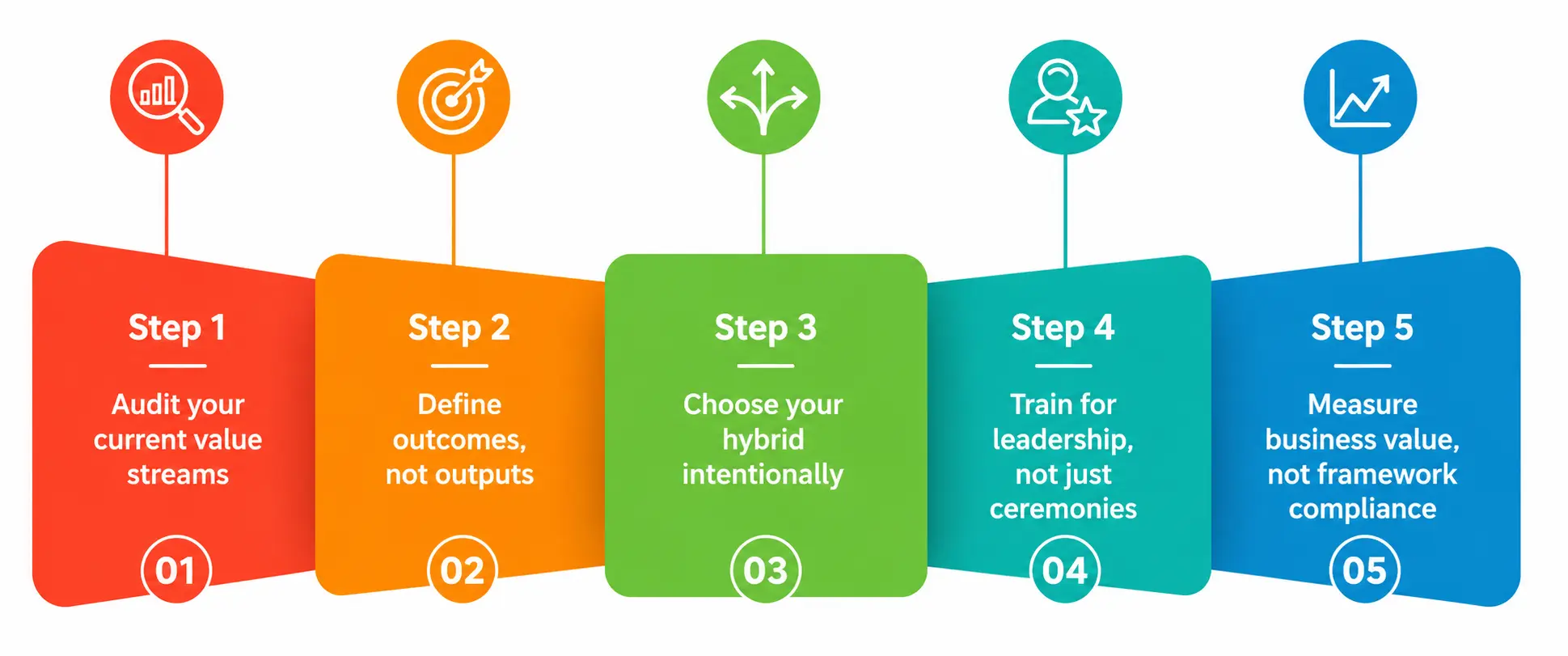
The shift from pure Scrum to a hybrid agile model does not require throwing everything out and starting over. Most organizations that make this transition successfully do it incrementally, which is fitting for an Agile context. Here is a practical approach:
Step 1—Audit your current value streams
Before layering on any new framework, map where work actually flows in your organization—and where it stalls. This is the foundation of value stream management thinking and the starting point recommended by iCert Global’s 2026 transformation guide.
Step 2—Define outcomes, not outputs
The Agile delivery model you choose should be driven by what your business is trying to achieve, not by what framework is currently fashionable. Connect team-level sprint goals to portfolio-level objectives using Lean Portfolio Management principles.
Step 3—Choose your hybrid intentionally
There is no universal recipe. Some organizations need the structured governance of the safe agile framework. Others need the flexibility of Disciplined Agile. The wrong choice is choosing a framework because it sounds impressive, rather than because it solves a real problem.
Step 4 — Train for leadership, not just ceremonies
Agile trends note that the shift toward Agile at scale requires “coaching leaders to develop new Agile mindsets and capabilities”—not just training teams to run standups correctly.
Step 5—Measure business value, not framework compliance
The defining characteristic of a successful hybrid agile implementation is that the organization measures outcomes—not whether teams followed the Scrum Guide to the letter.
The Challenges of Hybrid Agile That Nobody Talks About
The transition to hybrid agile is not without friction. According to ProProfsProject’s 2026 Scrum statistics, 46% of organizations cite general organizational resistance to change as their top Agile scaling challenge. The cultural element of enterprise Agile transformation is consistently underestimated—particularly at the leadership level, where traditional command-and-control management styles clash directly with Agile principles of autonomy and self-organization. The safe agile framework itself has attracted criticism for this reason. Planview’s SAFe resource guide notes that critics cite
“frustration with its overly complicated and hierarchical approach”
— a legitimate concern for organizations that adopt it too rigidly rather than as a starting point for genuine Agile delivery model evolution. Disciplined Agile, by contrast, sidesteps some of this by refusing to prescribe a single path. But that flexibility requires strong internal decision-making capability—something many organizations underinvest in when they focus exclusively on framework mechanics instead of leadership development.
The bottom line: Hybrid Agile works best when it is treated as a way of thinking, not a collection of processes to install. The data, the frameworks, and the experience of organizations that have successfully scaled their Agile at scale efforts all point in the same direction—start with the problem, choose the tools that solve it, and never mistake the framework for the goal.
Conclusion
The era of pure Scrum orthodoxy is giving way to something more pragmatic, more scalable, and—frankly—more honest about what most organizations actually need. Hybrid Agile is not a compromise. It is a maturation. The frameworks driving this shift — the safe agile framework, Lean Portfolio Management, Disciplined Agile, and Value Stream Management — are not replacements for Scrum. They are the scaffolding that allows Scrum’s best ideas to function inside the complex, cross-functional realities that most teams face in 2026. The organizations winning in this environment are not those that picked the right framework once and stuck with it. They are the ones that kept asking whether their Agile delivery model was actually delivering value—and had the courage to change it when the answer was no.
Sources
- iCert Global — Top 5 Agile Trends for 2026 and Beyond (January 2026)
- Businessmap — 17 Agile Statistics You Need to Know in 2026
- APMIC — State of Agile Project Management: Original 2026–27 Industry Trends & Insights (March 2026)
- eSpark Info — Dive into 60+ Agile Statistics for 2026 (January 2026)
- ProProfsProject — 50+ Scrum Statistics for 2026: Adoption, ROI & Trends (January 2026)
- Scaled Agile Framework — Lean Portfolio Management Discipline (March 2026)
- Atlassian — Scaled Agile Framework (SAFe) Values & Principles (February 2026)
- IBM — What Is a Scaled Agile Framework (SAFe)? (May 2026)