
Here’s a number that stopped me in my tracks: global regulators handed out roughly $542 million in fines in just the first three months of 2026, and data privacy plus operational control failures made up the biggest share of it. If that sounds like a “big bank problem,” think again—mid-sized firms, healthcare providers, and even mid-market lenders are getting caught in the same net.
So the real question isn’t whether your organization needs GRC risk management. It’s whether your current approach can survive what regulators, boards, and customers are now expecting. This guide breaks down the topic in plain, human language—no jargon, no fluff—and walks through the frameworks, trends, and mistakes that matter most this year.
What Is GRC Risk Management, Really?
The term itself stands for governance, risk, and compliance—three functions that used to sit in separate departments and now, in most healthy organizations, work as one connected system. Governance is about who makes decisions and how accountability flows. Risk is about spotting what could go wrong before it does. Compliance is about proving, with evidence, that you’re meeting the regulatory compliance obligations that apply to your business.
A solid risk management framework ties these three together instead of treating them as separate checklists. Without that connection, you end up with duplicated work: the legal team tracking regulatory compliance in one spreadsheet, IT tracking cyber risk in another, and the board getting a different story from each. This connected approach exists specifically to close that gap.
The Three Pillars, Explained Simply
Think of it like running a household budget, a home security system, and a tax filing—separately, each one is manageable. But if you don’t coordinate them, you might overspend on security while missing a tax deadline. GRC frameworks exist to make sure your organization’s “governance, risk, and compliance budgets” talk to each other.
- Governance sets the tone: who decides, who’s accountable, and how risk appetite is defined at the top.
- Risk identifies and measures threats — financial, operational, cyber, reputational — before they turn into losses.
- Compliance keeps you aligned with laws, industry standards, and internal policies and documents that alignment for auditors and regulators.
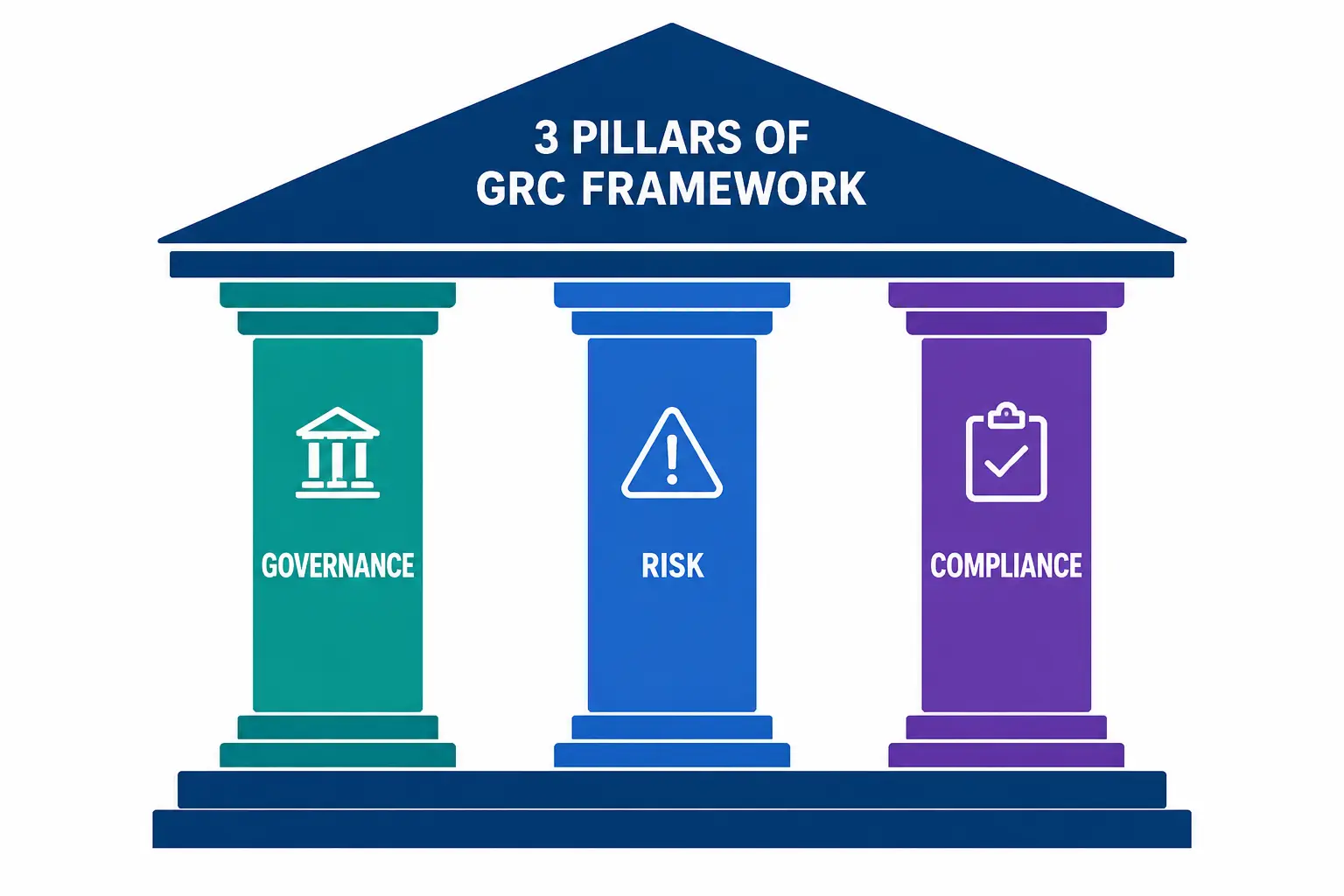
These GRC frameworks aren’t competing systems — they’re meant to reinforce each other, so a gap in one rarely stays isolated for long.
Why GRC Risk Management Matters More in 2026 Than Ever?
A few years ago, GRC was mostly a back-office function. That’s no longer true. According to Riskonnect’s 2026 industry outlook, GRC leaders are now managing a level of complexity their programs were never originally built for, driven largely by AI-related risk and deep third-party dependencies. Cloud vendors, SaaS providers, and AI tools aren’t just supporting the business anymore — in many cases, they are the business, and when one fails, the impact lands immediately.
The market reflects this shift. The global GRC software market was valued at roughly $23.3 billion in 2026 and is projected to nearly double by 2031, growing at a compound annual rate of close to 11%. That growth isn’t happening because companies enjoy paperwork — it’s happening because integrated risk management has become a board-level priority, not a compliance afterthought.
Regulatory pressure adds urgency. The EU AI Act’s high-risk obligations became fully enforceable in August 2026, with penalties reaching up to €35 million or 7% of global turnover for serious violations. GDPR enforcement isn’t slowing down either — cumulative fines since 2018 have now crossed €7.1 billion, with 2025 alone accounting for roughly €1.2 billion. These aren’t hypothetical numbers. They’re the reason regulatory compliance now sits permanently on the board agenda, rather than surfacing once a year during an audit cycle.
Key GRC Frameworks and Compliance Frameworks You Should Know
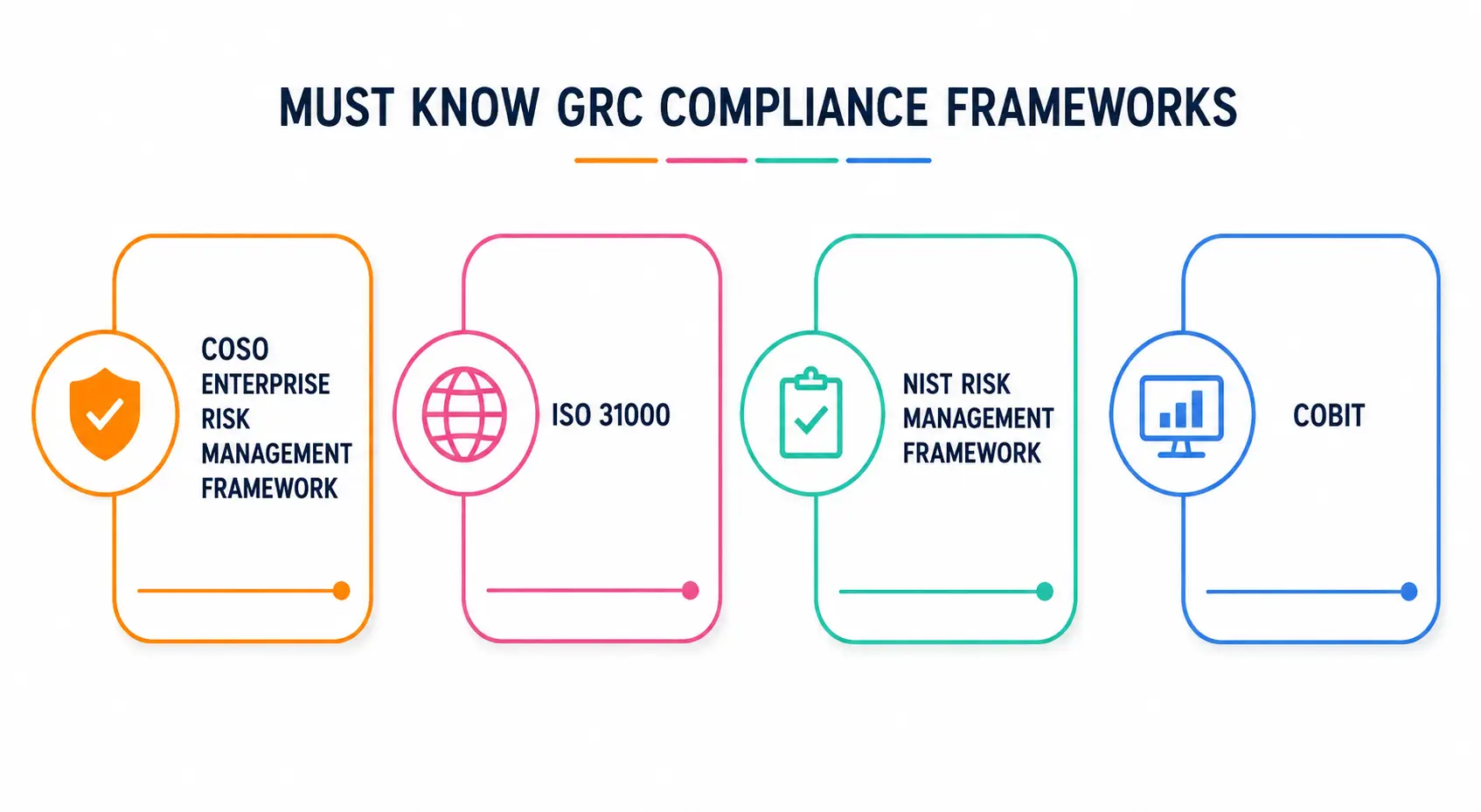
Not every organization needs every framework, but understanding the major ones helps you choose intelligently. Here are four that show up again and again in mature GRC programs:
1. COSO Enterprise Risk Management Framework
Originally built for financial reporting risk, COSO’s ERM framework has grown into a broad model that connects strategy, performance, and risk. It’s a favorite starting point for organizations building their first formal risk management framework.
2. ISO 31000
This is a principles-based international standard rather than a certification. It’s flexible enough to apply to any industry and is often used as the “common language” that unifies other, more specific compliance frameworks.
3. NIST Risk Management Framework
Popular with government contractors and technology companies, NIST’s framework focuses heavily on cybersecurity and information system risk, pairing well with operational risk management programs that already handle IT controls.
4. COBIT
Focused on IT Governance: COBIT helps bridge the gap between technology decisions and business objectives—increasingly important as AI systems become embedded in day-to-day operations.
|
Framework |
Primary Focus | Best Suited For |
Typical Adoption Driver |
|
COSO ERM |
Enterprise-wide risk and strategy | Public companies, financial services |
Financial reporting and board oversight |
|
ISO 31000 |
General risk principles | Any industry, especially multinational firms |
Need for a shared risk language |
|
NIST RMF |
Cybersecurity and IT risk | Government, tech, critical infrastructure |
Data protection and system security |
|
COBIT |
IT governance and control | Organizations with heavy AI/IT dependency |
Aligning technology with business goals |
Choosing among GRC frameworks isn’t about picking the “best” one—it’s about picking the one that matches your regulatory footprint, industry, and risk appetite, then layering others in as you mature.
Operational Risk Management and Risk Governance in Practice
Operational risk management deals with the everyday things that can quietly sink an organization: a failed vendor, a manual process nobody documented, a system outage during peak hours. Unlike strategic risk, operational risk often hides in plain sight until something breaks.
Strong risk governance means someone senior actually owns these risks—not just a policy document sitting in a shared drive. According to MetricStream’s 2026 Cyber GRC trends report, organizations are increasingly required to unify strategies across both digital and physical operations because siloed operational risk management no longer reflects how modern businesses actually run. Boards are expected to take a far more active role in overseeing risk response and recovery plans rather than simply reviewing quarterly summaries.
I’ve sat through more than one post-incident review where the root cause wasn’t a lack of tools—it was a lack of clear risk governance. Everyone technically “owned” a piece of the risk, which in practice meant nobody owned the whole picture. That single lesson has shaped how I now advise teams building out their GRC risk management programs: assign one accountable owner per major risk category, even if multiple teams contribute to managing it.
2026 Trends Shaping GRC Risk Management
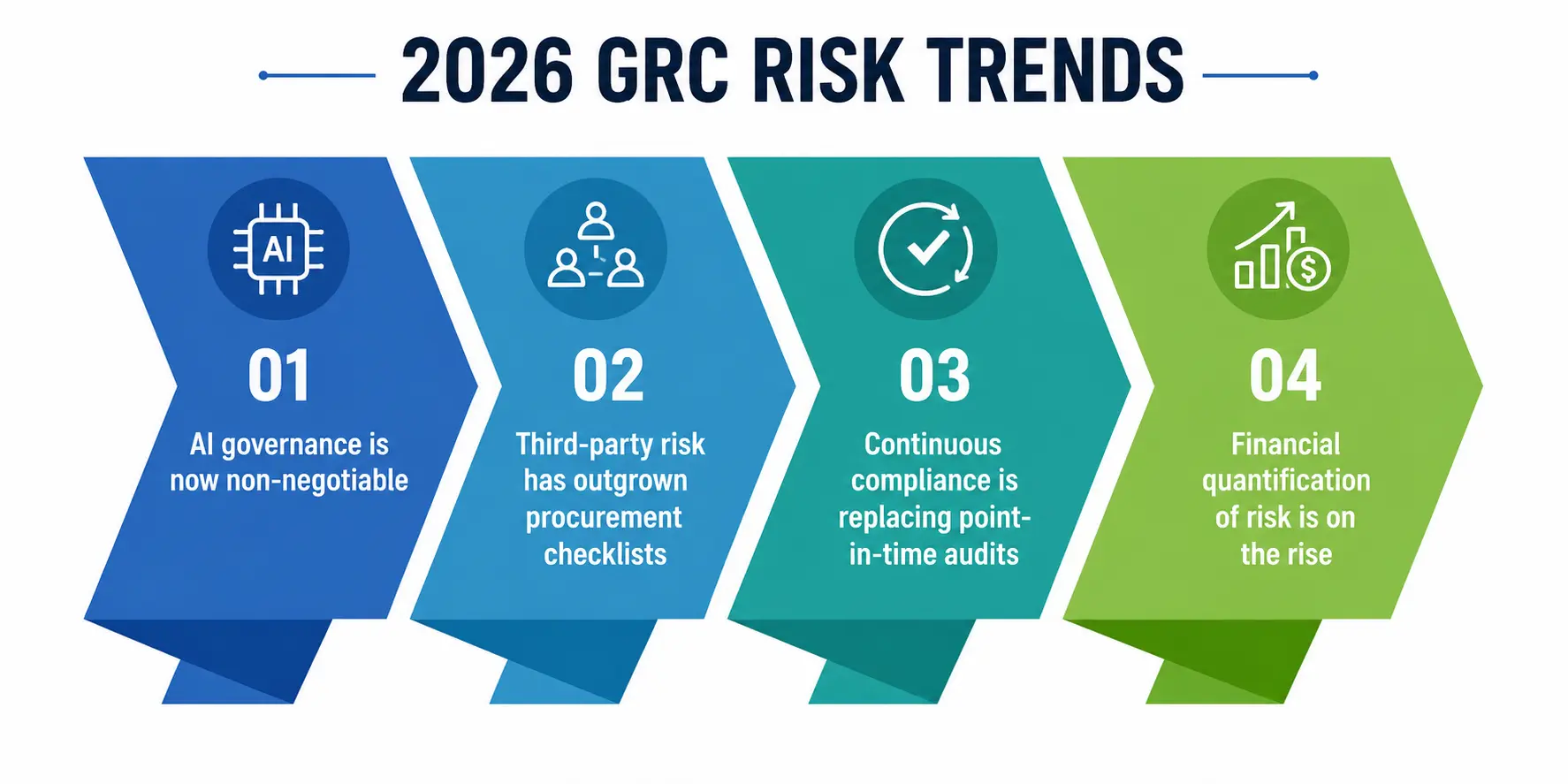
A few shifts are defining how organizations approach GRC risk management this year:
- AI governance is now non-negotiable. With AI embedded in vendor products, hiring tools, and customer service, governance frameworks are racing to keep pace with real-world use, and many GRC frameworks simply haven’t caught up yet. [^2]
- Third-party risk has outgrown procurement checklists. Cloud platforms and managed services are now core infrastructure, so vendor oversight has to be based on business criticality, not a fixed annual review cycle.
- Continuous compliance is replacing point-in-time audits. Real-time monitoring and automated evidence collection are becoming standard rather than optional, reducing both audit fatigue and blind spots.
- Financial quantification of risk is on the rise. Boards increasingly want risk expressed in dollar terms, not color-coded heat maps, which is pushing GRC teams toward more rigorous risk modeling.
Meanwhile, according to Mid-Market Budget Data 2026 the cost of getting it wrong keeps climbing. A single anti-money-laundering enforcement action can cost a mid-market bank between $5 million and $150 million once fines, remediation, and reputational damage are added up. On the flip side, firms that invested early in AI-driven risk functions report compliance efficiency gains of 25% to 40% compared with peers still running manual-heavy processes.
Building an Integrated Risk Management Program: Step by Step
If you’re starting from scratch—or fixing a fragmented setup—here’s a practical sequence that works for most mid-sized organizations:
- Map your regulatory footprint. List every law, standard, and contractual obligation that applies to your industry and geography before choosing any compliance frameworks.
- Pick a lead risk management framework. Choose one (COSO, ISO 31000, or similar) as your organizing structure, then integrate others as needed rather than running parallel systems.
- Centralize risk data. Get governance, IT, legal, and operational risk data into one shared view — this is the core of true integrated risk management.
- Assign clear ownership. Every major risk needs a named, accountable owner, not a committee.
- Automate evidence collection where possible. Manual tracking doesn’t scale, and it’s often where audit findings originate.
- Report risk in business terms. Translate technical findings into financial and operational impact so leadership can act on them quickly.
Done well, this sequence is what integrated risk management looks like in practice — not a slogan on a slide, but a repeatable operating rhythm.
Common Mistakes in Risk Governance and Compliance Frameworks
Even well-resourced teams fall into predictable traps:
- Treating regulatory compliance as a once-a-year event instead of an ongoing discipline.
- Buying GRC software before defining the underlying governance structure it’s meant to support.
- Choosing compliance frameworks based on what competitors use, rather than actual regulatory exposure.
- Letting third-party risk assessments expire without follow-up, especially for “critical” vendors.
- Failing to connect frontline risk data with board-level reporting, leaving leadership several steps behind reality.
Conclusion
This approach in 2026 isn’t about ticking boxes anymore — it’s about proving, with real evidence and real ownership, that your organization can absorb shocks without falling apart. The frameworks, the automation, and the board attention all point in one direction: risk and compliance are now core business functions, not support functions. Start with a clear risk management framework, build honest risk governance around it, and treat regulatory compliance as a habit rather than a deadline. Do that consistently, and GRC risk management stops being a burden and starts becoming a genuine competitive advantage.