

Here’s a number that stopped me mid-scroll last month: over 1.42 million AWS certifications are now active worldwide, held by more than 1.05 million individuals, according to AWS’s own certification page. That’s a global professional language, not a niche credential. So if you’ve been staring at the AWS Certification Roadmap wondering which of the twelve exams deserves your evenings and weekends, you’re asking the right question. I’ve sat six of these exams over the past four years, failed one badly, and rebuilt my study approach from scratch—this guide is the roadmap I wish someone had handed me on day one.
Why Does the AWS Certification Roadmap Matters More in 2026?
Cloud spending hasn’t slowed down, and neither has the confusion over which certificate to chase first. Amazon Web Services still commands roughly 30 to 32 percent of the global cloud infrastructure market, per a recent AWS careers analysis, which means AWS skills remain the default language of cloud infrastructure engineering teams from Berlin to Singapore.
AWS has also expanded its catalog this year, adding the Generative AI Developer – Professional exam and the CloudOps Engineer – Associate credential, per AWS’s March 2026 training update. A well-planned certification path now has to account for AI-adjacent exams too, which is why so many candidates feel overwhelmed before booking a single exam.
The Four Tiers: Building Your Certification Path Step by Step
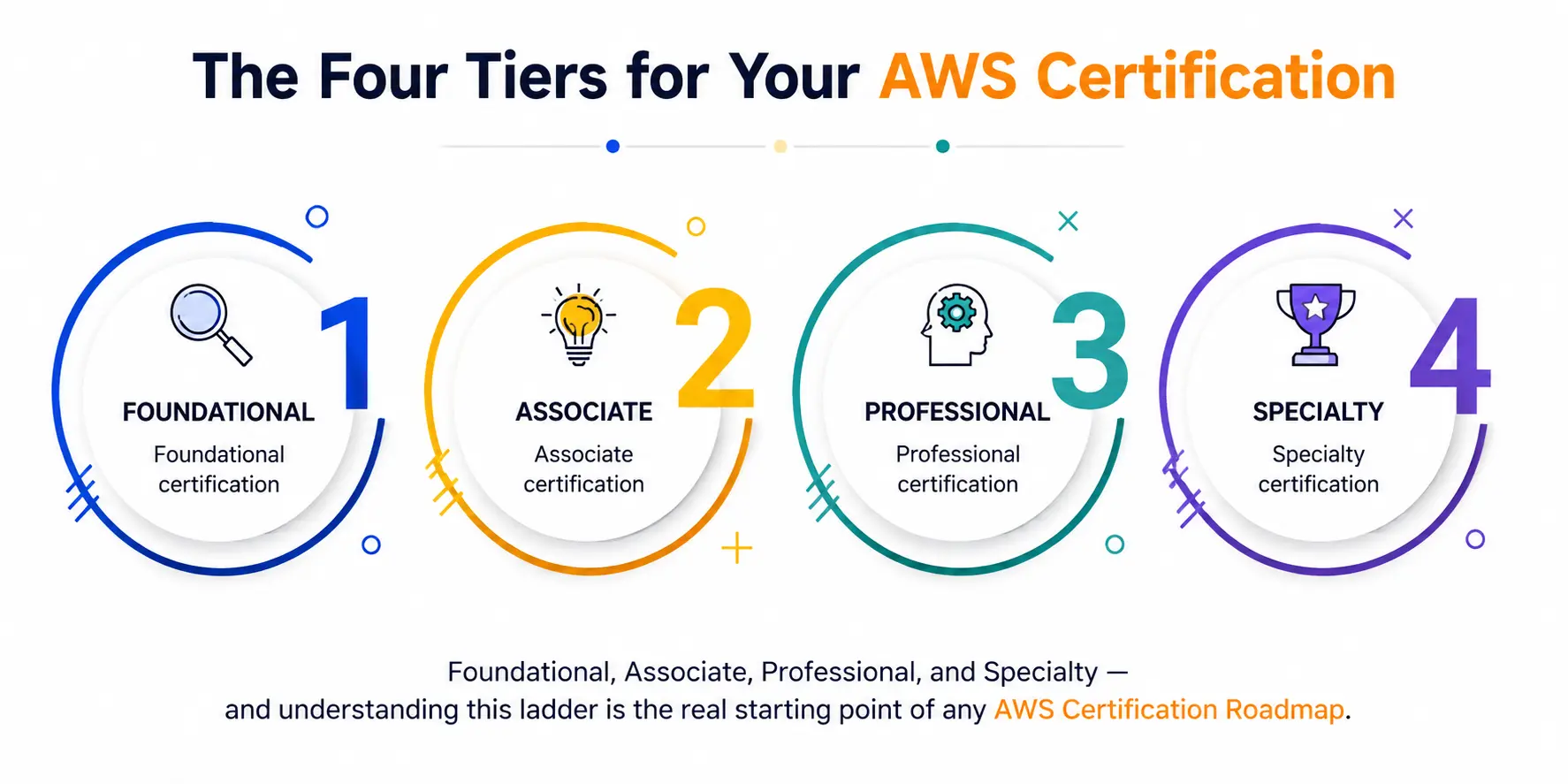
As of 2026, the catalog totals roughly a dozen active credentials across four tiers, a count Netcomlearning confirms. AWS groups its certifications into four tiers—Foundational, Associate, Professional, and Specialty—and understanding this ladder is the real starting point of any AWS Certification Roadmap. The foundational tier, the Cloud Practitioner exam, is optional for anyone already in tech but useful for people moving into cloud-adjacent roles from sales, finance, or project management.
From there, most candidates move to an associate exam matched to their target job: Solutions Architect Associate for generalists; Developer Associate for coders; SysOps Administrator or the newer CloudOps Engineer Associate for operations folks; and Data Engineer Associate for anyone leaning toward data engineering.
The Professional tier is demanding. Solutions Architect Professional and DevOps Engineer Professionals both assume hands-on exposure to production environments, not just flashcards. A 2026 roadmap breakdown notes Professional exams have no formal prerequisites, but SAP-C02 and DOP-C02 assume deep operational experience with distributed systems already deployed at scale—the same experience Cloud Security Engineering and Machine Learning Engineering specialists build before their own specialty exams.
Passing multiple-choice questions is possible without that experience; retaining it under real production pressure is not.
Four Career Tracks Inside This Roadmap
Rather than listing exams in isolation, it helps to see how this certification path maps onto actual job families. Here’s how I’d group the four tracks I get asked about most often:
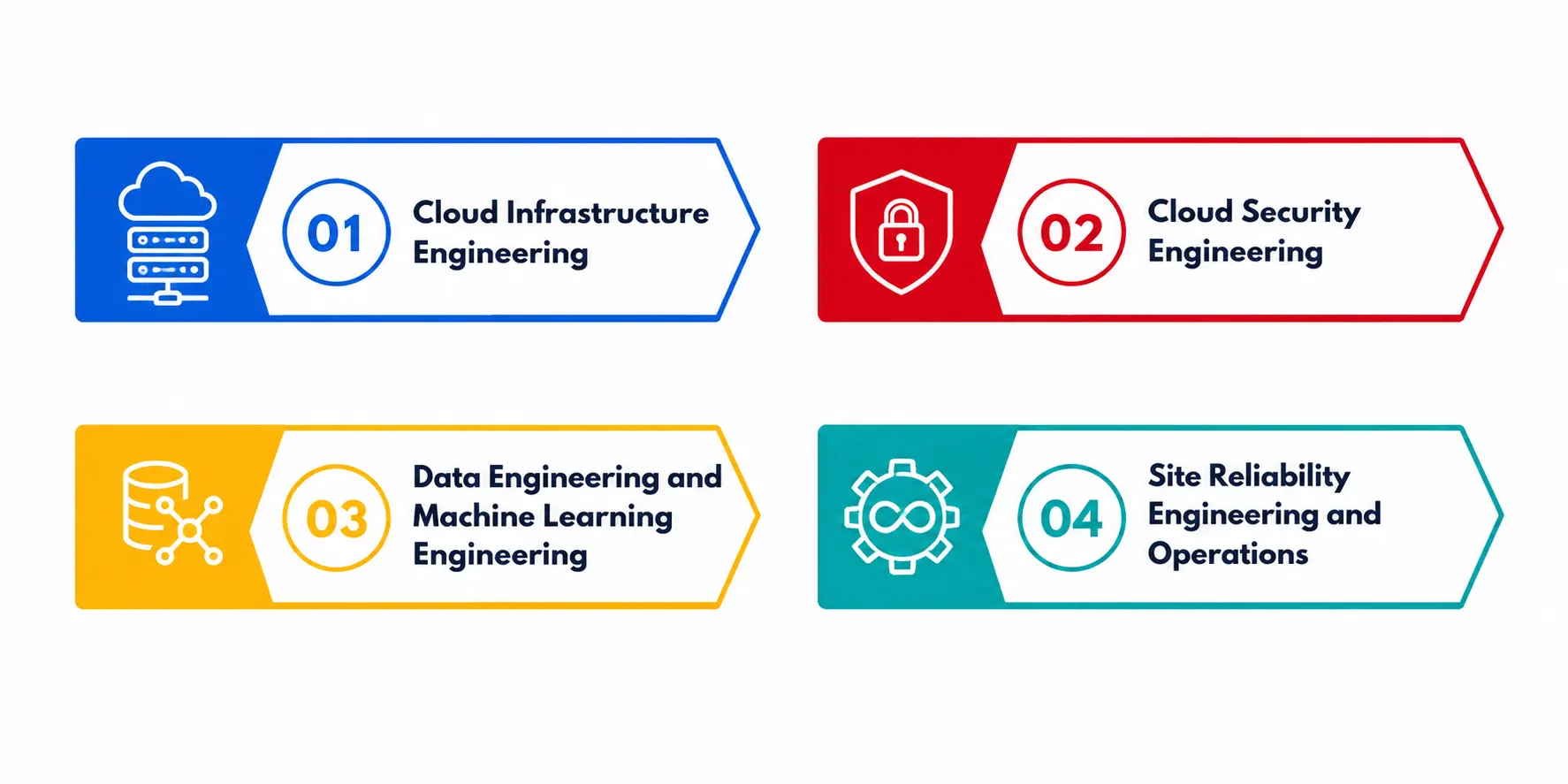
1. Cloud Infrastructure Engineering
- Core path: Cloud Practitioner → Solutions Architect Associate → Solutions Architect Professional
- Best for engineers who provision, scale, and cost-optimize distributed systems across accounts
- This is the highest-volume path in job postings, and it anchors most multi-cloud strategy conversations because architecture patterns transfer across providers
- Typical study time: 4 to 8 weeks per Associate exam, 10 to 16 weeks for the Professional tier
2. Cloud Security Engineering
- Core path: Solutions Architect Associate → Security Specialty
- Best for engineers hardening identity, network boundaries, and encryption across distributed systems
- Employers increasingly pair this track with a documented multi-cloud strategy, since breach exposure rarely stays inside one provider anymore
- Typical study time: 6 to 10 weeks after the Associate foundation is in place
3. Data Engineering and Machine Learning Engineering
- Core path: Data Engineer Associate → Machine Learning Engineer Associate → (optionally) Generative AI Developer Professional
- Best for professionals building ingestion pipelines, feature stores, and production ML systems
- Machine Learning Engineering has become the fastest-growing branch of this certification ladder as generative AI workloads scale
- Typical study time: 6 to 12 weeks per exam, longer if you’re new to data pipelines
4. Site Reliability Engineering and Operations
- Core path: CloudOps Engineer Associate or SysOps Administrator → DevOps Engineer Professional
- Best for engineers running on-call rotations, automating recovery, and keeping distributed systems available under load
- Site Reliability Engineering roles increasingly expect familiarity with a multi-cloud strategy, since incident response often spans more than one platform
- Typical study time: 8 to 14 weeks, factoring in hands-on lab practice
What Each Level Actually Pays in 2026
Salary is usually the real reason people commit to an AWS certification roadmap in the first place—especially in data engineering and machine learning engineering, where pay has climbed fastest. These figures are pulled from multiple 2026 sources rather than a single survey, since salary reporting varies by region.
|
Certification Level |
Example Exam | Typical Global Salary (USD) |
Approx. Study Time |
|
Foundational |
Cloud Practitioner | $85,000 – $110,000 |
3–4 weeks |
|
Associate |
Solutions Architect Associate | $99,000 – $125,000 |
4–8 weeks |
|
Associate |
Data Engineer Associate | $110,000 – $135,000 |
6–10 weeks |
|
Professional |
Solutions Architect Professional | $150,000 – $175,000 |
10–16 weeks |
|
Professional |
DevOps Engineer Professional | $155,000 – $164,000 |
10–16 weeks |
|
Specialty |
Machine Learning Specialty | $160,000 – $172,000 |
8–12 weeks |
|
Specialty |
Security Specialty | $150,000 – $159,000 |
6–10 weeks |
Numbers compiled from Skillsoft’s IT Skills and Salary survey, a 2026 salary breakdown from StudyTech, and DiviTrain’s Cloud Practitioner salary report. One pattern holds across every source: certified professionals report a 20 to 30 percent salary increase over non-certified peers, an effect that sharpens at the Professional and Specialty tiers.
Picking Your Starting Point on the AWS Certification Roadmap
I get some version of “where do I start” almost every week, so here’s the honest breakdown I give people:
- No IT background at all — start with Cloud Practitioner. It’s not required, but it builds vocabulary you’ll learn later and earns a 50 percent discount voucher toward your next attempt.
- Already working in tech — skip Cloud Practitioner and go straight to Solutions Architect Associate. It carries far more weight with hiring managers and still covers the fundamentals along the way.
- You write production code—Developer Associate maps more directly to your daily work than Solutions Architect Associate does.
- You’re aiming at operations or reliability work—CloudOps Engineer Associate or SysOps Administrator, then DevOps Engineer Professional once you’ve got real incident-response hours logged; this is the standard on-ramp into site reliability engineering.
- You want security or compliance work—Solutions Architect Associate for the architecture foundation, then Security Specialty; this path leads directly into cloud security engineering roles.
- You’re drawn to pipelines and models—Data Engineer Associate builds the base for data engineering, while Machine Learning Engineer Associate is the more direct route into machine learning engineering.
A 2026 roadmap guide from Pass4Sure puts it bluntly: certifications are a job-search tool, not a collection hobby, and stacking five credentials before your first cloud role usually wastes months better spent gaining hands-on experience with distributed systems in a real environment.
Multi-Cloud Strategy and Where AWS Fits
No certification path exists in isolation anymore. Most mid-size and large organizations now run some form of multi-cloud strategy, whether by design or acquisition history, and hiring managers value candidates who understand how AWS services interoperate with other providers. That doesn’t mean parallel certifications from every vendor — a documented cross-provider architecture matters more than a stack of badges.
It means Cloud Infrastructure Engineering and Site Reliability Engineering professionals should treat AWS depth as the anchor skill, then layer cross-platform networking and identity concepts on top, since coherent cross-cloud planning is now standard in senior cloud job descriptions, per a 2026 careers report.
What Did I Learn Sitting for Six of These Exams?
A personal note, since it matters more than another bullet list: my first attempt was the old Machine Learning Specialty, and I failed because I studied services instead of scenarios. AWS exams rarely ask, “What does this service do?” They ask, “Which services solve this oddly-worded business problem?”
Once I switched to reading whitepapers and rebuilding small distributed systems in a sandbox account instead of memorizing service lists, my pass rate went from one failure to five straight passes, including Solutions Architect Professional on the first try. If there’s one thing I’d tell anyone starting their own AWS certification roadmap today, it’s this: build something small and break it on purpose.
Common Mistakes That Derail a Certification Path
A few patterns show up again and again among people I’ve mentored through this process:
- Chasing every specialty exam before landing a first cloud job, which burns budget without payoff—a Security Specialty exam adds little if your target is Data Engineering, and skipping hands-on labs weakens Cloud Security Engineering and Cloud Infrastructure Engineering credibility alike
- Ignoring the employer’s stack—Azure shops won’t reward AWS badges the way an AWS shop will
- Attempting Professional exams without real operational scars, which a 2026 candidate analysis flags as the top cause of first-attempt failure
- Treating recertification as an afterthought, even though every AWS credential expires after three years and a higher exam automatically renews the lower ones, per EITT’s 2026 roadmap; ROI modeling from StudyTech shows the payoff compounds fastest when credentials stay current rather than lapsing
Conclusion: Your Next Move
The AWS Certification Roadmap isn’t about collecting twelve badges—it’s about choosing two or three that compound toward a role you want, whether that’s cloud infrastructure engineering, cloud security engineering, data engineering, machine learning engineering, or site reliability engineering.
Start with the tier matching your current experience, build real projects alongside your study plan, and let your multi-cloud strategy awareness grow as you gain seniority. The exams reward people who’ve broken things and fixed them—not people who memorized the fastest.