

If you have ever scrolled through job portals and felt lost looking at postings that ask for “Kubernetes,” “Terraform,” “CI/CD,” and “cloud automation” all in one line, you are not alone. I get messages every week from students and career-switchers asking the same question:
Where do I even start with a DevOps engineer certification, and which one actually matters?
This guide is my honest attempt to answer that question properly — not with a random list of exam names, but with a real, sequenced roadmap you can follow from your very first month of learning to the point where you are confident enough to sit for advanced, expert-level exams.
Whether you are a fresher, a system admin looking to switch tracks, or a developer wanting to move into infrastructure, this roadmap is built to work for you.
Why Does a DevOps Engineer Certification Actually Matter?
Let’s be direct about this. A DevOps engineer certification alone will not get you hired. But it does three things that matter a lot in a competitive job market:
- It proves to a recruiter that you have structured knowledge, not just scattered YouTube-tutorial familiarity.
- It forces you to learn topics in depth that you might otherwise skip while self-studying.
- It gives your resume a filter-friendly keyword that gets you past applicant tracking systems.
According to the DevOps Roadmap, successful DevOps professionals typically combine hands-on project work with certified knowledge in automation, containerization, and cloud infrastructure — not certifications in isolation. That’s the mindset this roadmap follows too.
Who Should Follow This DevOps Certification Roadmap?
- College students planning a career in cloud and infrastructure
- Linux or network administrators wanting to move into automation-heavy roles
- Software developers who want to understand deployment pipelines
- QA or support engineers aiming for a cloud engineer role
- Anyone restarting their IT career after a break
If you fall into any of these buckets, this devops engineer certification path is written specifically with you in mind.
Stage 1: Beginner Foundations (Months 1–3)
Every strong DevOps career is built on two boring but non-negotiable skills: Linux and networking. Skip these, and every advanced tool you learn later will feel harder than it should.
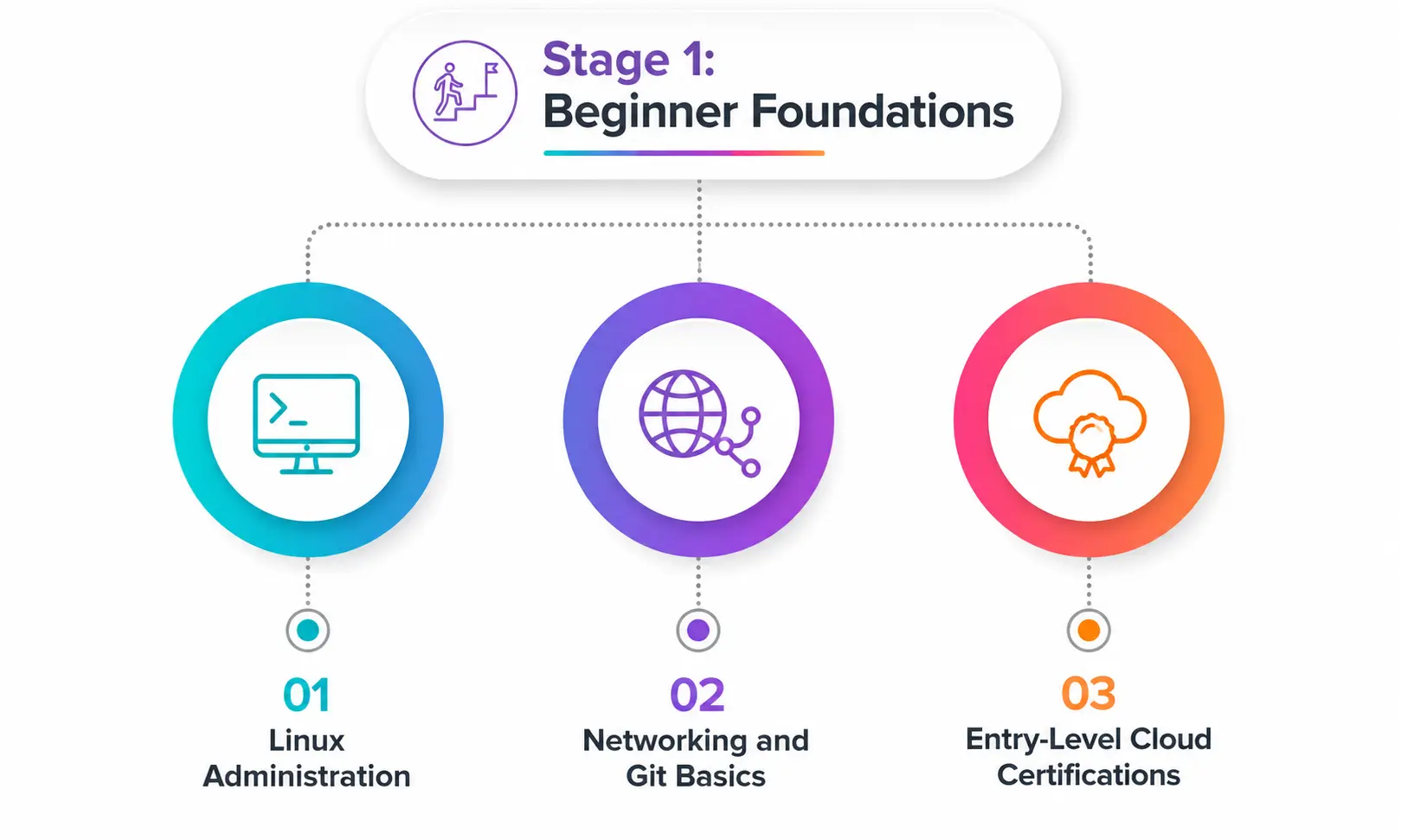
1. Linux Administration
Nearly every production server, container, and pipeline in the DevOps world runs on Linux. You need to be comfortable with the shell, file permissions, process management, package managers, and basic shell scripting before you touch anything else. This is where Linux administration becomes your first real skill, not an afterthought.
Recommended starting point:
- Practice with a free VM or WSL setup
- Learn user permissions, cron jobs, systemd services, and log inspection
- Try the Linux Foundation’s introductory training to build a proper base
2. Networking and Git Basics
Understand DNS, HTTP/HTTPS, load balancing concepts, and basic firewall rules. Alongside this, get fluent in Git — branching, merging, pull requests, and resolving conflicts. You will use Git every single day once you’re working.
3. Entry-Level Cloud Certifications
Once you’re comfortable with Linux and networking, pick one cloud platform and stick with it initially. Don’t jump between AWS, Azure, and GCP at this stage — it splits your focus.
Good entry points include the following:
These aren’t heavy technical exams, but they build the vocabulary you’ll need for every serious devops training program that follows.
Stage 2: Intermediate Skills (Months 4–8)
This is where things get genuinely interesting and where most learners either build real momentum or get overwhelmed by too many tools at once. Go step by step.
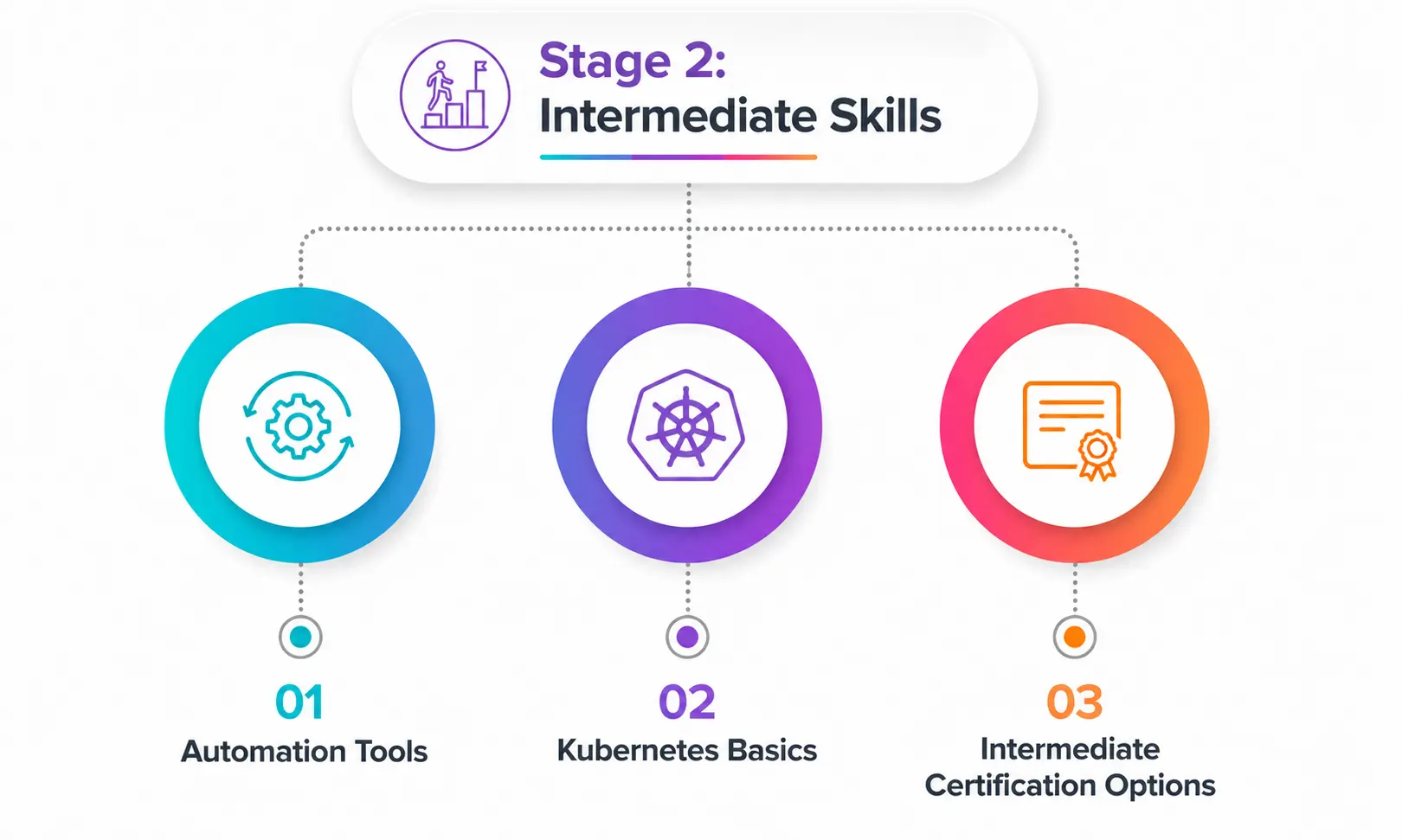
1. Automation Tools
DevOps is fundamentally about removing manual, repetitive work. That’s why automation tools sit at the center of this stage. Start with:
- Ansible for configuration management
- Terraform for Infrastructure as Code
- Jenkins or GitHub Actions for CI/CD pipelines
You don’t need to master all of them immediately. Pick one configuration tool and one CI/CD tool, build two or three small projects (like automating a server setup or deploying a sample app), and only then move to certification-level depth.
2. Kubernetes Basics
Containers changed how applications are shipped, and Kubernetes is now the industry standard for managing them at scale. Before attempting any advanced Kubernetes exam, spend real time on Kubernetes basics — pods, deployments, services, and namespaces.
A structured starting point is Docker first, then Kubernetes. The DevOps roadmap guide states that Docker should be learned before Kubernetes because containerization concepts form the foundation that orchestration builds on top of.
3. Intermediate Certification Options
At this stage, a proper DevOps engineer certification starts making a visible difference on your resume:
- Certified Kubernetes Administrator (CKA) — offered by CNCF and the Linux Foundation, this is a hands-on, performance-based exam where you solve real cluster problems on the command line, not multiple-choice questions.
- Docker Certified Associate — validates your container fundamentals.
- HashiCorp Certified: Terraform Associate — strong proof of Infrastructure as Code skills.
Stage 3: Advanced / Professional Level (Months 9–14)
By now you should have hands-on project experience, a working knowledge of at least one cloud platform, and comfort with core automation tools. This stage is about depth and specialization.
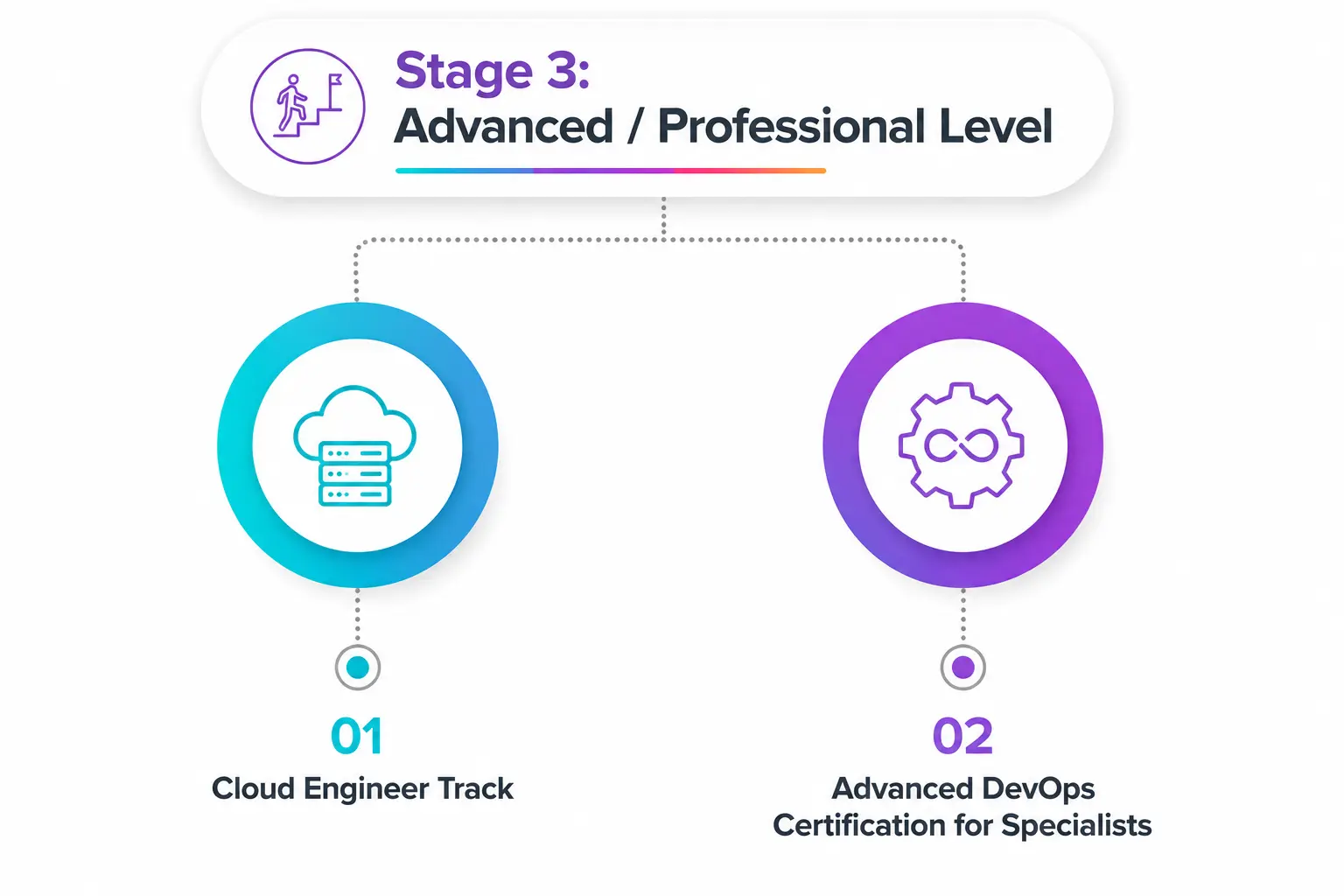
1. Cloud Engineer Track
If your goal is a dedicated cloud engineer role rather than a generalist DevOps position, this is where you double down on one platform:
- AWS Certified DevOps Engineer – Professional
- Microsoft Certified: DevOps Engineer Expert (AZ-400)
- Google Cloud Professional Cloud DevOps Engineer
These exams assume you already know the fundamentals — they test your ability to design resilient, automated, monitored systems in production-like scenarios.
2. Advanced DevOps Certification for Specialists
If you’re aiming higher, consider the following:
- Certified Kubernetes Security Specialist (CKS) — for those moving into DevSecOps
- Site Reliability Engineering (SRE)-focused courses—for monitoring, incident response, and reliability engineering
Pairing CKA with a cloud provider’s professional-level DevOps certification is considered one of the strongest, most in-demand combinations for senior engineering and SRE roles today.
Stage 4: Expert Level (Year 2 Onward)
Certifications at this point stop being about passing exams and start being about proving specialization. This is where platform engineering, multi-cloud architecture, and security-first automation come in. Many experienced engineers at this stage stop chasing every new badge and instead focus on writing technical blogs, contributing to open-source DevOps tools, speaking at meetups, and mentoring—because real-world credibility starts to matter more than another certificate.
A Simple Table: DevOps Certification Roadmap at a Glance
|
Stage |
Focus Area | Recommended Certification |
Approx. Timeline |
|
Beginner |
Linux, networking, Git, cloud basics | AWS Cloud Practitioner / Azure Fundamentals (AZ-900) |
Months 1–3 |
|
Intermediate |
Containers, automation tools, Kubernetes basics | CKA, Docker Certified Associate, Terraform Associate |
Months 4–8 |
|
Advanced |
Cloud-native DevOps, CI/CD at scale | AWS DevOps Engineer – Professional / AZ-400 |
Months 9–14 |
|
Expert |
Security, SRE, platform engineering | CKS, specialized SRE/security tracks |
Year 2 onward |
A Few Honest Tips Before You Start
- Don’t collect certifications for the sake of collecting them. Each one should map to a skill gap you actually have.
- Build a public GitHub with real projects—a working CI/CD pipeline or a Terraform-provisioned cloud setup speaks louder than a badge.
- Any solid DevOps training plan should mix reading, hands-on labs, and mock exams—not just video lectures.
- Give yourself permission to repeat a stage. Rushing into Kubernetes without solid Linux administration skills usually backfires during interviews.
My Personal Note
I’ll be honest with you — when I started learning DevOps, I made the mistake of jumping straight into Kubernetes without properly understanding Linux internals or networking. I passed a mock test once and thought I was ready, but the moment an interviewer asked me to debug a failing pod using only kubectl and no documentation, I froze.
It took me going back to basics—relearning Linux administration and rebuilding my confidence with small automation scripts—before things actually clicked. My advice to anyone reading this: don’t skip stages just because a certification looks impressive on paper. Build the fundamentals first. The rest becomes so much easier, and honestly, more enjoyable too.