




A friend of mine who runs vendor relationships for a mid-sized logistics company once told me she was terrified of a one-line email from her CTO that said, “Let’s move the warehouse tracking system to GCP.” She pictured command lines, Python scripts, and a crash course in computer science she had no time for.
Eighteen months later, she holds a foundational Google Cloud credential, sits in on every cloud architecture review her company runs, and has never written a line of code in her life. That contradiction—a cloud certification with no coding requirement—is exactly what this blog is about, and in 2026 it’s more real than it has ever been.
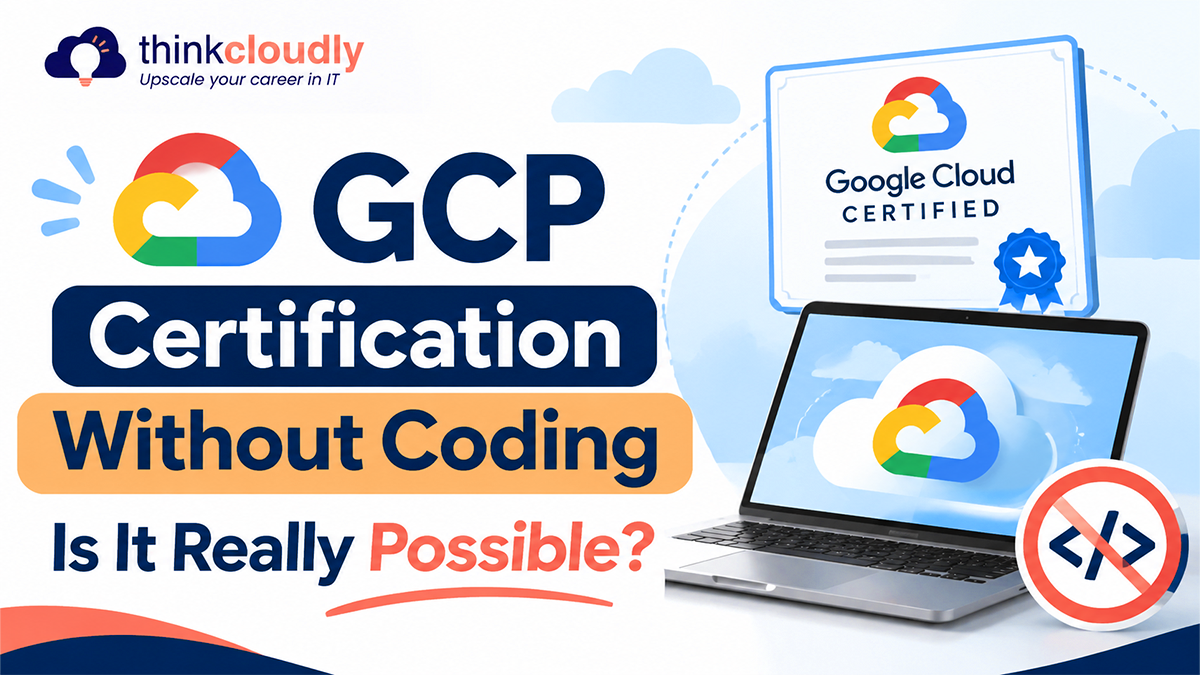
So let’s answer the question directly: yes, earning a GCP certification without coding is genuinely possible, but it depends entirely on which certification you’re chasing. Google Cloud didn’t build its credential ladder as one monolithic technical gate. It built it in tiers, and the bottom tier exists specifically for people who will never touch a terminal.
What Does a No-Code Google Cloud Credential Mean?
Google Cloud organizes its credentials into three levels: foundational, associate, and professional. According to Google Cloud’s official certification page, foundational certifications are built around broad knowledge with no technical prerequisites, associate certifications test fundamental skills to deploy and maintain cloud projects, and professional certifications demand advanced, in-depth technical expertise.
That structure is the entire answer to whether a no-code path exists. A credential at the foundational level—think Cloud Digital Leader or the AI-focused option, Generative AI Leader—tests your grasp of cloud computing fundamentals, not your ability to write a deployment script. You’re being assessed on concepts: what a cloud service model is, how Google Cloud products solve business problems, and how an organization scales its operations responsibly.
Contrast that with the associate tier, where the Associate Cloud Engineer exam states the role “performs common platform-based tasks to maintain and scale deployed solutions.” No programming language is named as a requirement there either, but the expectation of 6+ months of hands-on platform experience makes it a harder sell for someone with zero technical exposure.
The professional tier, reserved for architects, developers, and ML engineers, is where coding knowledge becomes unavoidable, and no amount of conceptual reading substitutes for that hands-on depth.
This is also why coverage of Google’s credential system reads so differently depending on the level it’s describing. The overview of Google Cloud certification programs focuses almost entirely on technical, hands-on tracks that help professionals stand out in a crowded job market—it barely touches the foundational tier, because that tier solves a different problem: proving cloud literacy, not platform operation.
5 Google Cloud Certifications You Can Pursue With Little to No Coding
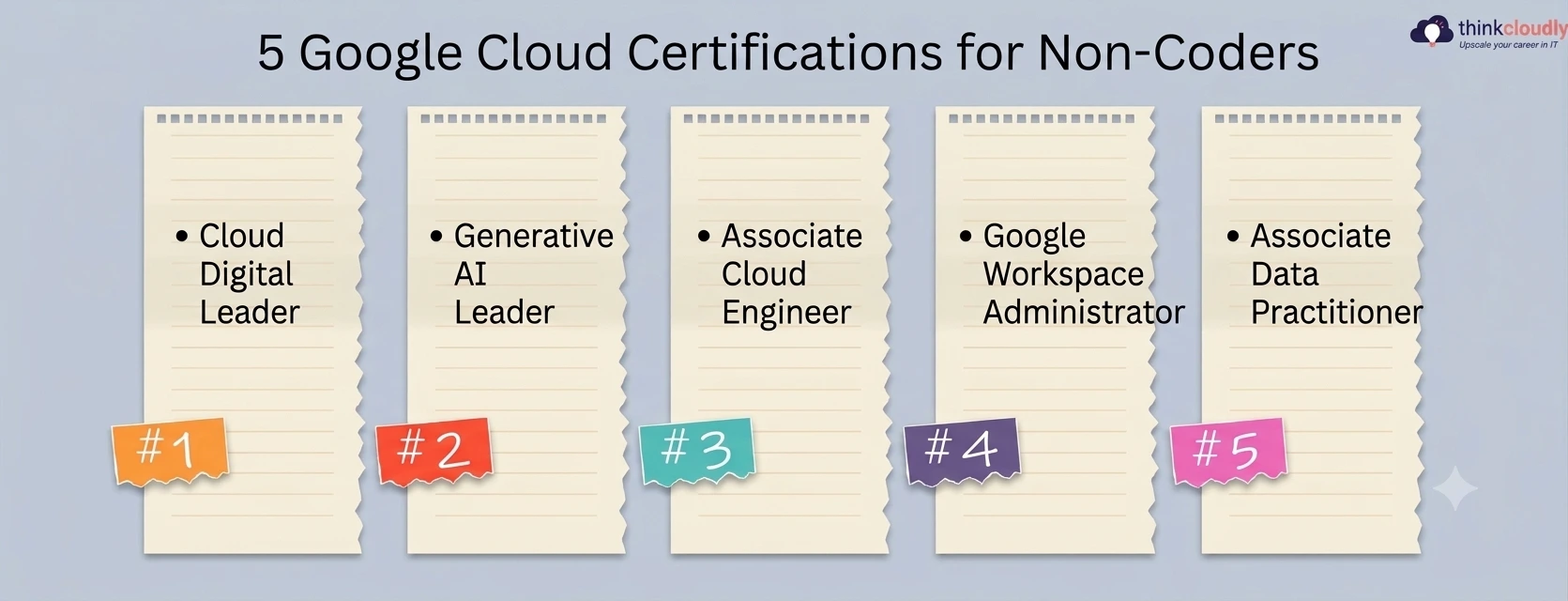
- Cloud Digital Leader—the flagship no-code credential, built entirely around conceptual and business knowledge
- Generative AI Leader—the GCP AI Certification for non-technical professionals who need to speak intelligently about AI strategy
- Associate Cloud Engineer—technically coding-free on paper, but expects real hands-on exposure to the console and command-line tools
- Google Workspace Administrator—associate-level, focused on managing collaboration tools rather than writing software
- Associate Data Practitioner—leans on data literacy and platform navigation more than scripting ability
Notice the pattern: the first two are genuinely built for non-coders from the ground up. The next three are “no coding required” in the strictest sense of the exam guide, but each one rewards practical, hands-on comfort with the platform that a pure business professional usually doesn’t have without some deliberate Google Cloud Platform training first.
Cloud Digital Leader: The Real No-Code GCP Certification
If you want one credential that proves the no-code path isn’t a myth, this is it. The Cloud Digital Leader exam page lists no prerequisites at all and describes the ideal candidate as someone who collaborates with technical teams rather than builds the infrastructure themselves.
|
Detail |
Cloud Digital Leader |
Associate Cloud Engineer |
|
Coding required |
No | Not listed, but hands-on exposure expected |
| Prerequisites | None |
None |
|
Duration |
90 minutes | 2 hours |
| Format | 50–60 multiple-choice/select |
50–60 multiple-choice/select |
|
Cost (standard exam) |
$99 USD | $125 USD |
| Validity | 3 years |
3 years |
|
Recommended background |
Works alongside technical teams | 6+ months hands-on GCP use |
| Best for | Non-technical professionals, managers |
Early-career technical staff |
This is where cloud computing fundamentals get tested in plain business language: digital transformation, data strategy, AI innovation, infrastructure modernization, trust and security, and operational scaling.
None of the six exam domains asks you to write, debug, or deploy a single script. It’s a credential built for people who need to influence cloud decisions, not execute them line by line, and it’s exactly the outcome structured Google Cloud Platform training is designed to produce for non-engineers.
It’s worth sitting with how unusual that design choice is. Most legacy IT certifications assumed a technical baseline by default, quietly excluding entire departments from earning anything resembling a cloud credential.
A six-domain, script-free exam built around business literacy instead of lab tasks reflects how cloud adoption actually works now: decisions get made in finance meetings and vendor calls long before anyone opens a terminal.
The GCP AI Certification Path for Non-Technical Learners
Every conversation about cloud in 2026 eventually turns into a conversation about AI, and Google Cloud built a credential specifically for people who need to hold that conversation without an engineering background. The Generative AI Leader certification sits at the same foundational level as Cloud Digital Leader, which means it follows the identical no-prerequisite, concept-first design.
This GCP AI Certification doesn’t test prompt engineering syntax or model fine-tuning code. It tests whether you understand generative AI use cases, responsible AI principles, and how Google’s AI tooling fits into a broader cloud service model framework.
For marketing leads evaluating an AI vendor, HR professionals rolling out AI-assisted hiring tools, or operations managers asked to justify an AI budget line, this credential does for artificial intelligence what Cloud Digital Leader does for cloud computing in general—it builds literacy, not engineering capability.
That matters more in 2026 than it did even a year earlier, because so many non-technical teams are now expected to have an opinion on AI tooling without any path to developing one. A legal team reviewing a vendor’s AI clause, a marketing director approving a generative content pipeline, or an HR lead vetting an AI screening tool are all making calls that used to default to “ask engineering.” This credential exists so those calls can be made with real understanding instead of borrowed confidence from a single briefing deck.
That distinction matters because plenty of people assume anything with “AI” in the title must involve coding. It doesn’t have to, and Google Cloud deliberately designed this GCP certification program tier to prove that.
What You’ll Actually Learn in a No-Code GCP Certification Program?
- Core cloud service models—public, private, and hybrid deployment, and when organizations choose each one
- How compute, storage, and networking work together without needing to configure any of it yourself
- Pricing structures and cost-control levers that let you sanity-check a vendor’s cloud migration estimate
- Security and governance basics, including who should have access to what and why that matters to auditors
- How generative AI tools get adopted responsibly inside a business, from the Generative AI Leader syllabus
- How to speak the same language as engineers on your team without needing their job title
Every one of those bullet points comes from the same source: deliberate, structured cloud computing fundamentals training rather than hands-on scripting. That’s the entire design philosophy behind Google’s foundational tier, and it’s why recruiters increasingly treat a foundational credential like this one as a legitimate signal of cloud literacy rather than a watered-down afterthought.
Where the “No Coding” Promise Gets Complicated?
I’d be doing you a disservice if I pretended every credential on this ladder stayed coding-free. The moment you move into associate-level credentials like Associate Cloud Engineer or Associate Data Practitioner, the exam guides stop requiring code but start assuming comfort with the Cloud Console, command-line basics, and configuration tasks that feel technical even if they’re not “programming” in the traditional sense.
Professional certifications—Cloud Architect, Cloud Developer, and Machine Learning Engineer—are a different conversation entirely; they assume you can already build and deploy, and no amount of conceptual study replaces that experience.
There’s also a quieter trap worth naming: treating the foundational tier as a shortcut into a technical job title. Cloud Digital Leader and Generative AI Leader are excellent at building fluency, but neither one qualifies you to configure a virtual machine, write an IAM policy, or deploy a model pipeline.
Hiring managers for engineering roles know the difference between these credentials immediately, so presenting a foundational badge as equivalent to hands-on platform experience tends to backfire in an interview faster than having no credential at all. Used honestly—as a literacy layer, not a disguise—it does exactly what it’s designed to do.
So the honest framing is this: a GCP certification without coding is absolutely achievable if your goal is Cloud Digital Leader or the Generative AI Leader option. If your ambition is to eventually sit for an associate or professional exam, those two foundational credentials are an excellent on-ramp, but they won’t be your final stop.
Most learners who start with structured google cloud platform training at the foundational level either stay there intentionally — because their job doesn’t need more — or use it as the first rung toward technical certifications later.
Career Value: Who Actually Benefits From This GCP Certification Program
Non-technical professionals holding a foundational credential like this tend to show up in roles like:
- Cloud vendor and procurement management, where understanding cloud service models prevents vague contract language from going unchallenged
- Product and program management, coordinating cloud migrations without needing to write the migration scripts
- Compliance and risk analysis, where governance literacy from the certification syllabus directly supports audit readiness
- Sales engineering and customer success, supporting technical conversations about Google Cloud products without a computer science degree
- Executive and strategy roles, where fluency in AI and cloud trends — straight out of the Generative AI Leader material — shapes budget and planning decisions
None of these roles ask for a pull request. They ask for someone who understands what’s happening well enough to make good decisions about it, and that’s precisely the gap a foundational credential like this closes.
It’s also worth being realistic about limits: this won’t get a non-technical candidate hired into an engineering seat, and it isn’t meant to. Its value shows up in how fast you can contribute to a cloud conversation that’s already happening around you, not in a career pivot into a coding role overnight.
A Realistic 2026 Study Plan for Non-Coders
You don’t need months of preparation for the foundational tier, and treating it like a professional-level exam will just waste your time. The skill isn’t memorization — it’s building a mental model of how pricing, infrastructure, and AI tooling connect, since the exam leans on applied scenarios rather than rote definitions. A workable four-week plan looks like this:
- Week 1: Work through Google’s official learning path on Google Cloud Skills Boost to build your cloud computing fundamentals before touching practice questions. Take notes in your own words rather than copying definitions — that’s what actually sticks for non-technical learners.
- Week 2: Focus on cloud service models, pricing, and core infrastructure concepts — enough to explain them to a non-technical colleague in your own words. Spend at least one session inside the pricing calculator so cost estimation stops feeling abstract.
- Week 3: If you’re aiming for the GCP AI Certification, dedicate this week entirely to generative AI use cases and responsible AI principles rather than mixing topics. Read a couple of real-world case studies from Google’s own customer stories so the concepts attach to concrete business outcomes instead of staying theoretical.
- Week 4: Take official practice assessments, review weak domains, and book the exam once you’re consistently scoring above the passing threshold. Treat a missed practice question as a signal to revisit that specific domain, not as proof you need another full month of study.
Because foundational exams carry no prerequisites and a reasonable retake policy, there’s little reason to delay booking once you feel ready. Most candidates who commit to structured google cloud platform training rather than random YouTube videos finish this entire GCP certification program within four to six weeks, even while working full-time, and the ones who stall usually do so by over-preparing for an exam that was never designed to be a technical gatekeeper in the first place.
A Personal Note
Here’s something I’ve noticed after watching several non-technical colleagues go through this exact process: the biggest obstacle was never the material. It was the assumption that anything with “Google Cloud” in the name must be someone else’s job to learn. It isn’t.
The entire foundational tier of this GCP certification program exists because Google recognized that cloud decisions are made by far more people than the ones writing the deployment code — finance approves the budget, legal signs the contract, leadership sets the strategy.
If you’ve been telling yourself you’re “not technical enough” for a credential like this, that’s precisely the assumption the exam was built to dismantle. Start with Cloud Digital Leader, give yourself four honest weeks, and you’ll likely find the hardest part was deciding to start.