







A student messaged me last month asking if she should drop her plan to study cybersecurity because she’d just failed her second attempt at a Python course. That’s the question underneath almost every version of “Does cybersecurity require coding?” I get asked: not genuine curiosity about the industry, but a fear that one bad grade in a programming class has already closed a door. It hasn’t. The honest answer is “sometimes, depending entirely on which part of the field you’re walking into,” and most people asking the question have never been shown the map that would tell them which part that is.
This guide is that map. We’ll go role by role, separate the jobs that genuinely need scripting from the ones that never will, look at where Python for cybersecurity actually earns its keep, and be specific about how much scripting for SOC analyst work really means in practice rather than in internet folklore.
Does Cybersecurity Require Coding?
No, not universally, and that’s the part most beginner guides get wrong by treating the field as one job instead of dozens. Does a cybersecurity training program require coding for a penetration tester or a security engineer building detection tooling? Yes, meaningfully. For a compliance analyst mapping controls to a framework, or a security awareness coordinator running phishing simulations? No, not in any way that affects their day-to-day work or their hiring odds.
The field splits cleanly into two lanes once you stop treating “cybersecurity” as a single job title. One lane builds, breaks, and automates technical systems, and coding is load-bearing there. The other lane governs, assesses, documents, and trains around those systems, and it runs almost entirely on frameworks, writing, and judgment. Both lanes are full-time, well-paid, legitimate careers, and neither one is a watered-down version of the other.
Why “Does Cybersecurity Require Coding” Keeps Getting Asked?
Part of the confusion comes from how cybersecurity gets portrayed online, where every tutorial seems to open with a terminal window and a scripting language. The study found that 59% of organizations report a meaningful skills shortage, and a large share of that gap sits in governance, audit, and awareness work rather than in scripting-heavy technical roles. In other words, the market isn’t desperate for more coders nearly as often as outsiders assume.
The NIST NICE Cybersecurity Workforce Framework backs this up structurally. It organizes the entire field into distinct categories, and governance, risk management, and oversight sit as their own formally recognized specialty areas, separate from the categories built around secure software development or systems analysis. That framework alone settles the question more precisely than any single blog post can: it depends which of those categories you’re reading.
Cybersecurity Roles That Genuinely Require Coding
These roles sit in the technical lane, and treating them as approachable without any scripting ability sets candidates up to struggle in interviews.
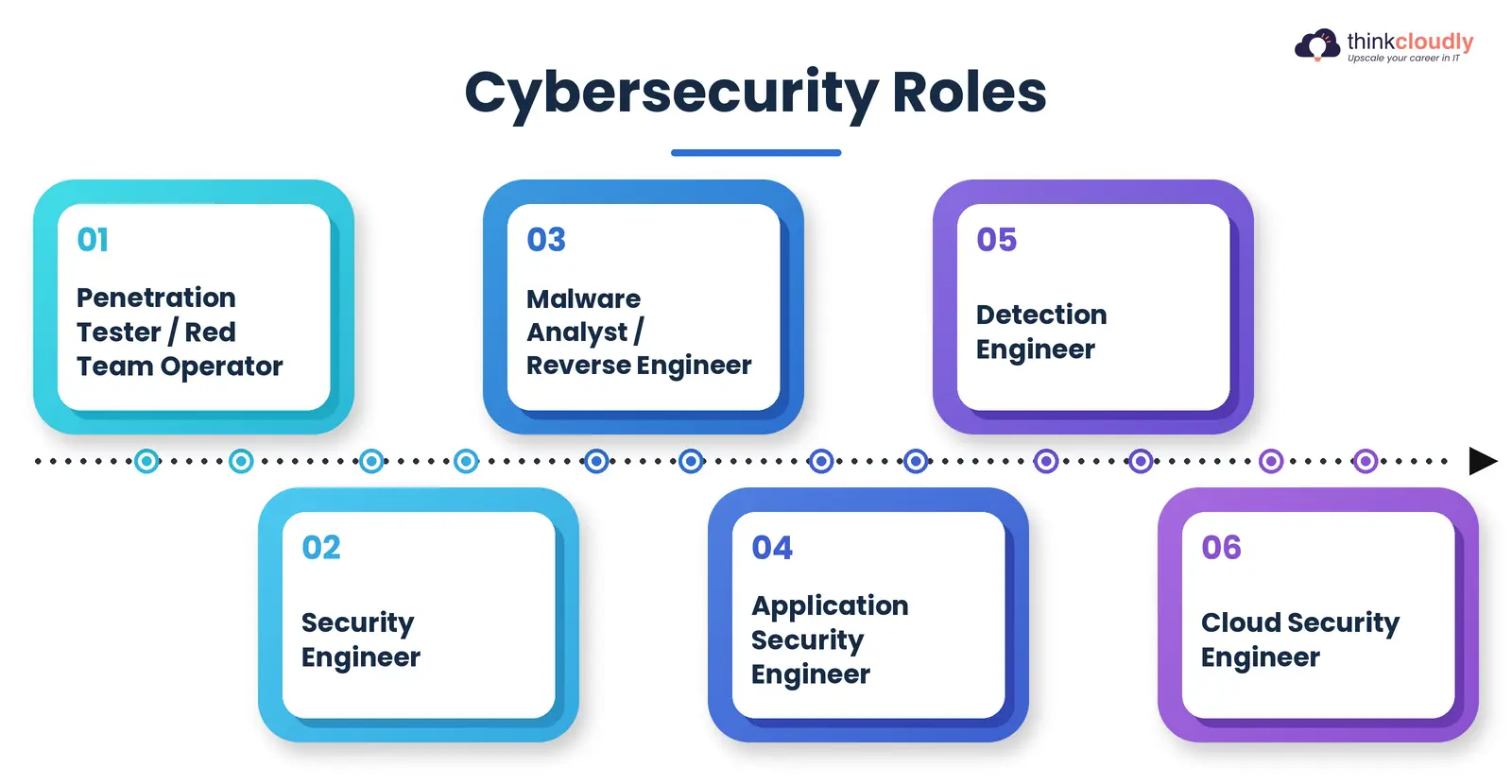
- Penetration Tester / Red Team Operator—writes and modifies exploit code, automates reconnaissance, and scripts custom payloads; Python and Bash are close to non-negotiable here.
- Security Engineer—builds and maintains detection rules, automation pipelines, and infrastructure-as-code; expects daily use of Python, PowerShell, or Go depending on the stack.
- Malware Analyst / Reverse Engineer—reads disassembled code and often writes scripts to automate sample triage; this is one of the most code-heavy corners of the entire field.
- Application Security Engineer—reviews source code for vulnerabilities and frequently writes remediation patches directly, requiring fluency in whatever language the product is built in.
- Detection Engineer—writes correlation logic and automation scripts inside a SIEM, which blurs into genuine software development over time.
- Cloud Security Engineer—automates policy enforcement and remediation across cloud environments using Python or infrastructure-as-code tools like Terraform.
Anyone aiming at one of these six should treat python for cybersecurity as a core requirement, not an optional add-on picked up later. A background in even basic scripting dramatically shortens the runway into any of them.
Cybersecurity Without Coding: Roles That Don’t Need It
This is the lane most career switchers don’t realize exists, and it’s exactly where cybersecurity without coding becomes a legitimate, well-paid career rather than a compromise.
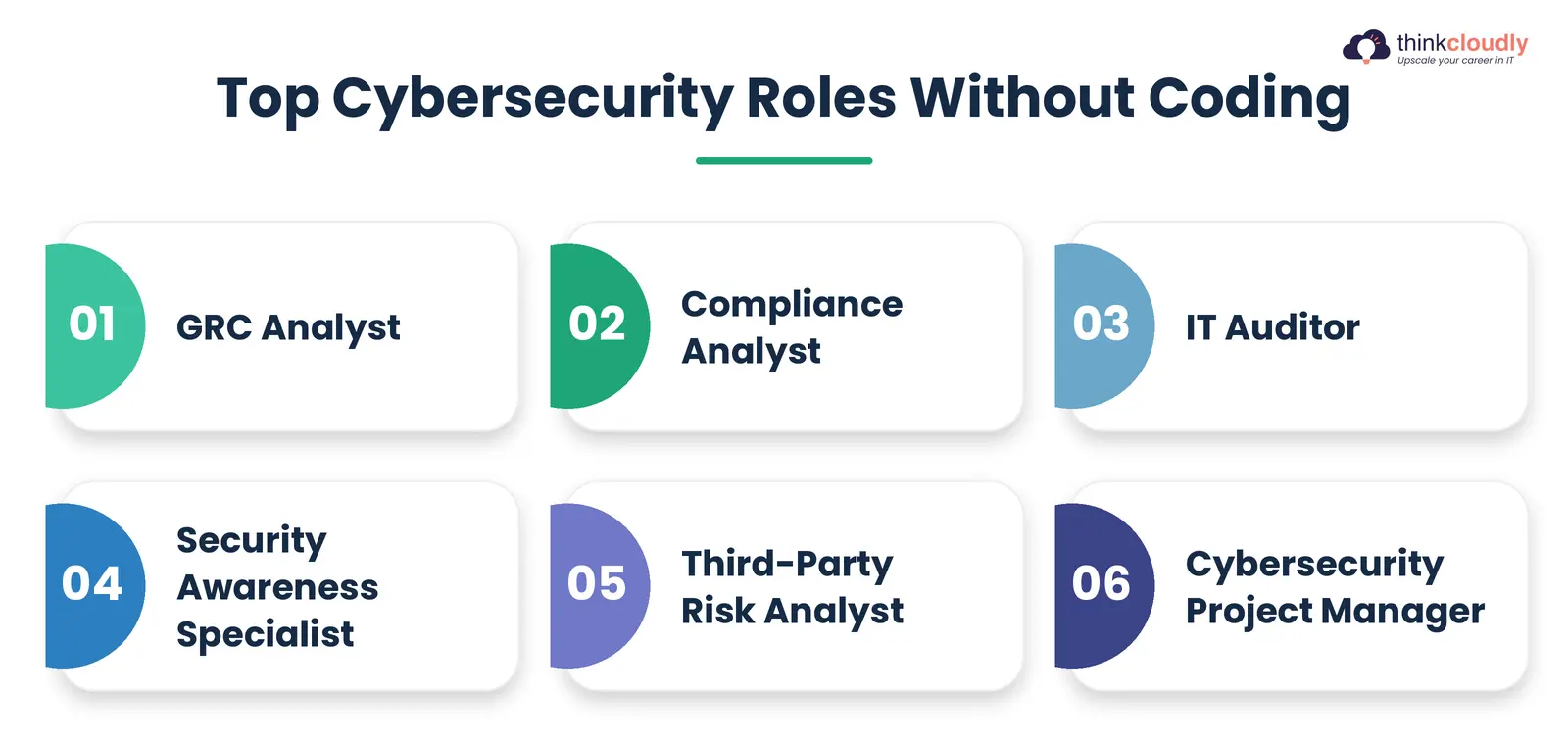
- GRC Analyst—maps security controls to frameworks like ISO 27001 or SOC 2 and tracks whether policy matches practice, one of the clearest GRC jobs available to someone without a technical background.
- Compliance Analyst—handles regulatory obligations such as GDPR, HIPAA, or PCI DSS, working closely with legal rather than with a codebase.
- IT Auditor—independently tests whether controls function as documented and writes findings reports for leadership.
- Security Awareness Specialist—designs phishing simulations and training campaigns aimed at reducing human error, still the leading cause of breaches industry-wide.
- Third-Party Risk Analyst—assesses vendor security posture through questionnaires and documentation review rather than technical testing.
- Cybersecurity Project Manager—coordinates audits and remediation timelines across technical teams without writing the code those teams produce.
None of these six are cybersecurity jobs with no coding because they’re “lesser.” They exist because large organizations need people who can translate a technical finding into a decision a board member can act on, and that translation skill has nothing to do with a programming language.
Does Cybersecurity Require Coding? A Side-by-Side Comparison
|
Role Type |
Coding Required | Core Skill Instead |
Typical Entry Path |
|
Penetration Tester |
Yes, heavily (Python, Bash) | Exploit development, automation |
CS degree or hands-on labs |
|
Security Engineer |
Yes, daily | Infrastructure automation |
Technical IT background |
|
SOC Analyst (Tier 1) |
Minimal | Log analysis, triage |
Security+ or SOC training |
|
GRC Analyst |
None | Framework mapping |
Audit, legal, or compliance background |
|
Security Awareness Specialist |
None | Training design, communication |
Education or L&D background |
|
Vendor Risk Analyst |
None | Documentation, interviewing |
Procurement or risk background |
|
Compliance Analyst |
None | Regulatory literacy |
Legal or finance background |
This table is the single clearest answer available: it depends entirely on which row you’re reading, not on the industry as a whole.
Python for Cybersecurity: Where It Actually Gets Used
Python for cybersecurity shows up constantly in technical roles, but rarely in the dramatic “hacker typing furiously” way the media portrays it. In practice, it usually means automating repetitive log parsing, writing small scripts to pull data from an API, or building a quick tool that checks a list of IP addresses against a threat feed. It’s closer to practical automation than to traditional software engineering, which is exactly why it’s learnable in months rather than years.
Security engineers and detection engineers lean on this kind of scripting daily, but even here, depth matters more than breadth. Knowing how to read someone else’s script, modify a few lines, and understand what a loop or an API call is doing covers the overwhelming majority of real on-the-job needs. Very few security roles require writing complex software from scratch; most require comfortable, functional scripting.
Scripting for SOC Analyst Roles: How Much Is Really Needed
This is where a lot of the fear around coding requirements gets misplaced, because SOC analyst job postings often list “scripting” as a nice-to-have rather than a requirement. Scripting for SOC analyst work at the Tier 1 level usually means recognizing a script when you see one in an alert, not writing one from scratch under pressure.
A SANS Institute survey on SOC team skills consistently finds that analytical thinking, alert triage speed, and familiarity with SIEM queries matter more for entry-level SOC hiring than raw programming ability.
That changes as someone moves toward Tier 2 or Tier 3, where scripting for SOC analyst responsibilities expands into writing small automation scripts that cut down repetitive manual work, such as auto-enriching an alert with threat-intel data.
Even then, it’s usually basic Python or PowerShell rather than anything resembling software engineering. Treating this as an entry requirement scares off plenty of capable beginners who would otherwise thrive in the role.
Cybersecurity Jobs: No Coding Can Actually Launch a Real Career
The myth that cybersecurity jobs without coding are somehow temporary or entry-only doesn’t survive contact with actual career data. The U.S. Bureau of Labor Statistics projects information security roles to grow 21% between 2025 and 2035, a rate it classifies as much faster than average, and a meaningful share of that growth sits in governance, audit, and risk functions rather than purely technical ones.
Someone chasing cybersecurity jobs with no coding on purpose, rather than as a fallback, can build a complete career ladder: junior GRC analyst to GRC manager to director of governance and risk, or audit associate to audit manager to director of internal audit. Neither ladder requires a late-career pivot into scripting to keep climbing. What moves pay and title in this lane is depth of judgment and documented experience, not a sudden interest in Python.
Non-Technical Cybersecurity Jobs and GRC Jobs: Where the Growth Really Is
Non-technical cybersecurity jobs have quietly become one of the fastest-growing corners of the entire industry, largely because every regulated company now needs people who can prove compliance on paper, not just defend a network technically. GRC jobs sit at the center of this growth, since nearly every audit, certification renewal, and regulatory review runs through a GRC function first.
What makes this track attractive to career-switchers is how directly it rewards experience people already have. Someone coming from financial audit, legal compliance, healthcare administration, or project coordination usually transfers in faster than someone starting from zero, because the discipline is built on structured documentation and risk judgment rather than infrastructure knowledge.
Non-technical cybersecurity jobs aren’t a workaround for people who “couldn’t learn to code” — they’re a distinct professional track with their own certifications, career ladder, and growing demand.
How to Decide Which Lane Fits You?
Rather than asking if cybersecurity requires coding in the abstract, it’s more useful to ask a narrower question: do you enjoy building and automating things, or do you enjoy investigating, documenting, and explaining things? People who light up at the idea of writing a script that solves a repetitive problem usually belong in the technical lane, where scripting is simply part of the job. People who’d rather interview a system owner, map a control, or write a clear report belong in the governance and audit lane, where cybersecurity without coding is not just possible but normal.
A practical first step either way is picking one foundational certification that matches the chosen lane rather than collecting several that overlap, then finding one real project — a home lab for the technical lane, a mock audit or framework-mapping exercise for the GRC lane — to put on a resume. The CompTIA 2027 State of Cybersecurity report is worth reading at this stage too, since it breaks down which entry-level roles employers are actually hiring for this year rather than which ones sound impressive on paper.
Conclusion
Does cybersecurity require coding? Only if you choose a corner of the field where coding is the actual job. Penetration testers, security engineers, and detection engineers live and breathe daily scripting and automation. GRC analysts, compliance officers, auditors, and awareness specialists build entire careers on cybersecurity without coding, and non-technical cybersecurity jobs in that lane are growing at least as fast as the technical side.
SOC analyst work sits somewhere in between, light at entry level and heavier only as seniority increases. The question was never whether cybersecurity requires coding everywhere. It’s which lane you’re choosing, and that choice is yours to make deliberately instead of by assumption.
A Personal Note
I used to assume the people who ended up in GRC roles had simply failed to break into “real” technical security work. I was wrong, and I found that out directly from a former student who spent four years in financial audit before moving into a compliance analyst role at a healthcare company. She has never written a line of Python, has no plans to, and outearns several technical peers she graduated alongside.
What changed her trajectory wasn’t learning to code. It was realizing the question she’d been asking, does cybersecurity require coding, had been pointing her toward the wrong half of the field the entire time. If you’re stuck on that same question right now, stop trying to force yourself into the technical lane out of guilt. Go find out which lane actually fits how you think, then commit to that one properly.