






If you’ve typed “AWS security specialty vs AZ-500” into a search bar recently, you’re about to get an answer that most comparison pages from the last two years won’t give you straight: one half of that comparison doesn’t exist anymore. AZ-500 was retired by Microsoft on August 31, 2026, and nobody rolled over automatically into a replacement.
That single fact changes how you should read every AWS security specialty vs. AZ-500 article still floating around course catalogs and old forum threads, including, frankly, most of the ones ranking on page one right now.
That doesn’t mean the underlying question is dead. Students, career switchers, and working admins still need to decide between deepening AWS security skills or building out a Microsoft-centric security practice, and the real AWS security specialty vs. AZ-500 question in 2027 isn’t which exam is harder—it’s whether you’re even comparing the right two things anymore.
This piece walks through what each credential actually covers today, what replaced the one that disappeared, and how to decide where to put your study hours if you’re weighing a cloud security certification path right now.
A quick note before we go further: this comparison matters because the stakes of getting it wrong are real. Enrolling in a course built around a retired exam blueprint wastes months, and a cloud security certification is only as valuable as its currency in the job market. So treat everything below as the 2027 baseline, not a recap of what used to be true.
AWS Security Specialty vs. AZ-500: What Changed Going Into 2027?
Here’s the part most people miss. The AWS Certified Security Specialty didn’t vanish—it got a significant overhaul. AWS retired the older SCS-C02 version and rolled out SCS-C03 on December 2, 2025, restructuring the domain weighting and adding generative AI security content for the first time, according to AWS’s own exam guide for the updated exam. If your study material still references SCS-C02 exam objectives, it’s already out of date, even though a lot of practice-test vendors haven’t caught up.
AZ-500, on the other hand, is genuinely gone. Microsoft confirmed that AZ-500 “Microsoft Azure Security Technologies,” along with its associated renewal assessment, was retired on August 31, 2026, and the credential can no longer be earned or renewed by anyone. There’s no AZ-500 exam left to book, which is why any AWS security specialty vs. AZ-500 search you run today needs an asterisk next to it—you’re really comparing a refreshed AWS certification against a brand-new Microsoft one that took AZ-500’s place.
That replacement is SC-500, officially titled “Implementing End-to-End Security Controls for Cloud and AI Workloads,” which earns the credential Microsoft Certified: Cloud and AI Security Engineer Associate. Microsoft has been explicit that this is a separate certification, not an automatic upgrade—there’s no free conversion and no equivalency claim for people who already hold AZ-500.
If you earned AZ-500 before it retired, it stays on your Microsoft Learn profile until it naturally expires, then moves into historical certifications—it doesn’t get revoked, but it also doesn’t get renewed.
Choosing between AWS Security Specialty and AZ-500 depends on your preferred cloud platform and career goals. AWS Security Specialty focuses on securing AWS workloads, identity management, data protection, and incident response, while AZ-500 covers Microsoft Azure security technologies. If you’re interested in expanding your cloud expertise beyond security, an AWS Data Engineering Training Program can help you develop skills in data pipelines, storage, and analytics. Consider your current experience, target roles, and preferred cloud ecosystem before selecting your certification.
AWS Certified Security Specialty: What You’re Actually Tested On
The current AWS certified security specialty exam (SCS-C03) runs 65 questions over 170 minutes, costs $300 USD, and requires a scaled score of 750 out of 1,000 to pass. There’s no hard prerequisite, but AWS recommends five years of general IT security experience plus at least two years of hands-on experience securing AWS workloads specifically. Most candidates who pass comfortably already hold an associate-level AWS certification first.
The domain structure changed meaningfully from the old SCS-C02 version. Identity and Access Management now carries the single largest weight on the exam, up from 16% under SCS-C02 to 20% under SCS-C03—a signal that AWS cares more about IAM misconfiguration than almost anything else on the platform.
The old “Incident Response” and “Logging and Monitoring” domains from SCS-C02 were restructured into separate Detection and Incident Response domains, and generative AI security content—covering services like Amazon Bedrock and SageMaker AI—was folded into Infrastructure Security rather than given its own domain.
For anyone comparing study plans, this is the detail that matters most: a cloud security certification built around SCS-C02’s objectives will leave real gaps if you sit the exam today. The restructuring wasn’t cosmetic—new question formats (ordering and matching, alongside the usual multiple choice and multiple response) were introduced specifically to test applied reasoning rather than recall, and several foundational topics that used to be tested directly, like basic TLS configuration, are now assumed background knowledge instead.
AWS Security Specialty vs. AZ-500
Here’s the breakdown broken into points, so you can scan it fast or pull it straight into a slide or infographic:
- Exam code (AWS): SCS-C03, replacing SCS-C02 as of December 2025
- Exam code (Microsoft): SC-500, since AZ-500 was retired August 31, 2026
- Questions and duration (AWS): 65 questions, 170 minutes
- Questions and duration (Microsoft): Timed at 120 minutes for SC-500
- Cost (AWS): $300 USD, same fee structure AWS has been used for specialty-level exams
- Cost (Microsoft): Roughly $165 USD in the United States for role-based associate exams, varying by country
- Passing score (AWS): 750 out of 1,000
- Passing score (Microsoft): 700 out of 1,000
- Prerequisites: Neither exam has a hard prerequisite, but both assume real hands-on platform experience
- Validity period: AWS certifications run three years; Microsoft’s role-based associate certifications typically run one year with a free online renewal assessment
AWS Certified Security Specialty vs SC-500: The Side-by-Side Table
|
Factor |
AWS Certified Security Specialty (SCS-C03) |
SC-500 (replacing AZ-500) |
|
Issuing body |
Amazon Web Services |
Microsoft |
|
Credential name |
AWS Certified Security – Specialty |
Microsoft Certified: Cloud and AI Security Engineer Associate |
|
Core domains |
Detection, Incident Response, Infrastructure Security, IAM, Data Protection, Security Foundations & Governance |
Identity/access/governance, storage/database/network security, compute security (incl. AI), security posture management |
|
Heaviest domain |
Identity and Access Management (20%) |
Secure storage, databases, networking (25–30%) |
|
AI/ML coverage |
Folded into Infrastructure Security |
Explicit compute security objectives for AI workloads |
|
Exam length |
170 minutes |
120 minutes |
|
Cost (US) |
$300 |
~$165 |
|
Best suited for |
Teams running AWS-native or multi-account environments |
Teams standardized on Microsoft 365, Entra ID, and Azure-native defenses. |
A table like this is useful shorthand, but it flattens a genuinely important point: these two exams are no longer twins separated by vendor logos. SC-500 was built with AI workload security baked in from day one, while SCS-C03 added AI content onto an existing structure. Neither approach is wrong, but they reflect different design philosophies, not just different vendors.
Cloud Security Architect Career Paths: Where Each Credential Leads
Thinking about this as two tracks toward the same destination—a cloud security architect role—makes the decision less abstract than staring at domain percentages.
The AWS certified security specialty track typically runs: cloud security analyst → AWS security engineer → senior security engineer → cloud security architect focused on AWS-native environments, often reporting into a platform or infrastructure security team. This path rewards people comfortable reading IAM policies, VPC security groups, and KMS key policies at a granular level, because that granularity is exactly what SCS-C03 tests.
The SC-500 track runs similarly but inside the Microsoft ecosystem: security analyst → Azure security engineer → security posture lead → cloud security architect specializing in hybrid Microsoft 365 and Azure environments.
This path leans harder on identity governance through Entra ID and on orchestrating Defender and Sentinel together, since SC-500 explicitly tests managing and monitoring security posture as its own domain.
Neither track is a dead end, and the AWS security specialty vs. AZ-500 framing (now really an AWS vs. SC-500 framing) was never really about which badge looks better on a resume—it’s about which stack you’ll be defending five years from now.
A genuine cloud security architect role increasingly expects familiarity with both anyway, and multi-cloud security fluency is quickly becoming the baseline expectation rather than a bonus line on a job posting, which is where the next section matters more than either exam alone.
Why Is Multi-Cloud Security Changing the Whole Comparison?
Here’s the trend that makes a strict either/or comparison less useful than it used to be. According to Fortinet’s 2026 Cloud Security Report, 88% of organizations now operate in hybrid or multi-cloud environments, up from 82% the year before, and 81% rely on two or more cloud providers for critical workloads. Nearly a third run more than three providers at once.
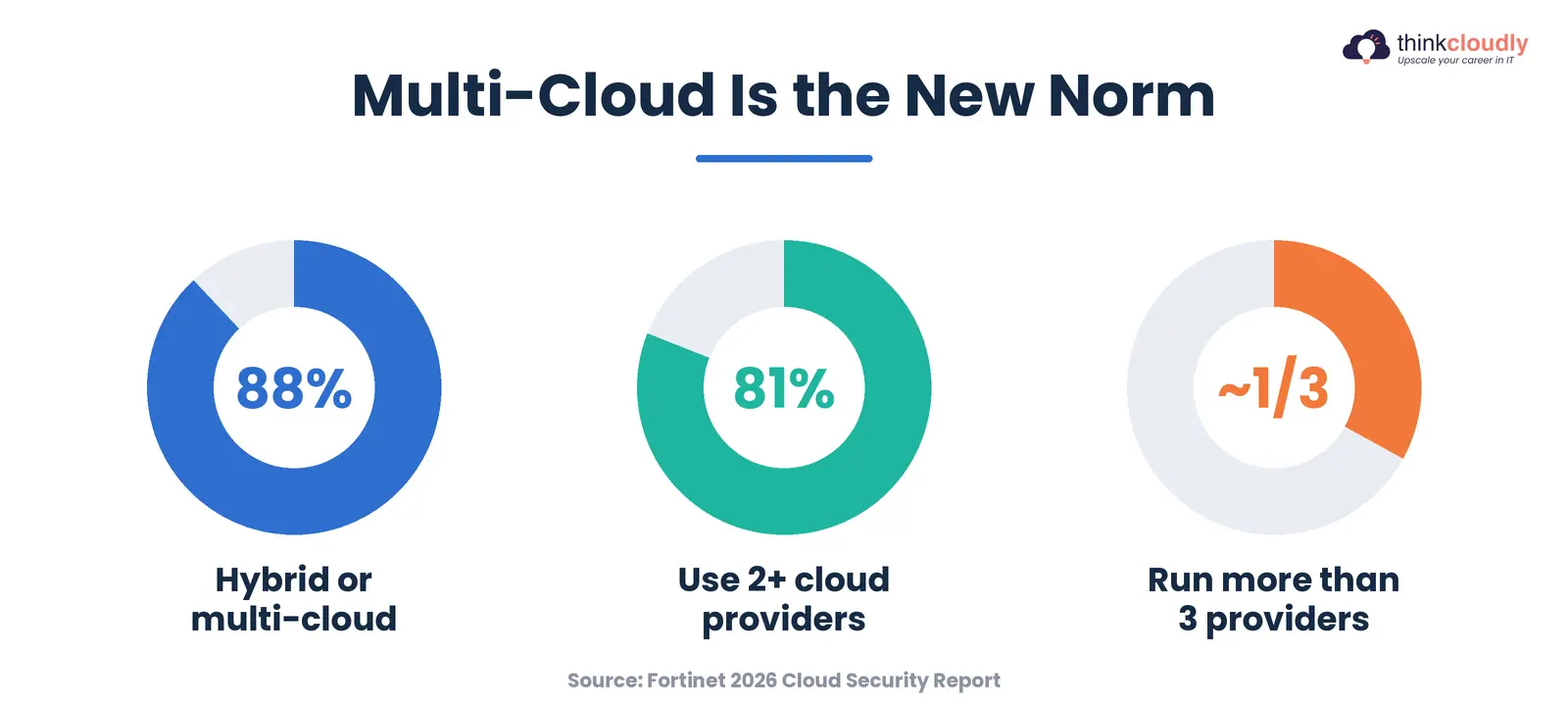
That same report found 74% of security professionals reporting an active shortage of qualified staff—which is exactly the gap a single-vendor certification, however well updated, can’t fully close on its own.
Practically, that means fewer security teams are hiring purely for AWS security skills or purely for Microsoft security skills in isolation. A job posting for a cloud security architect increasingly lists both AWS and Azure experience as “nice to have” even when the core infrastructure sits on one platform, because incident response, logging, and identity governance concepts transfer across clouds faster than the specific console screens do. Multi-cloud security has stopped being a specialist niche and started being the default expectation for anyone past the junior level.
That’s also why pairing credentials — rather than treating this as a permanent either/or choice — has become the more common path. An AWS certified security specialty holder who adds SC-500 later isn’t a duplicating effort; they’re covering the two ecosystems that, between them, host the overwhelming majority of enterprise workloads. If you’re building a long-term cloud security certification roadmap rather than chasing a single exam, budgeting for both is a more realistic plan than it would have been five years ago, when most organizations still ran a single dominant cloud provider.
Which One Should You Study First?
Before picking a side in the AWS security specialty vs AZ-500 debate, remember that the comparison itself has shifted from a straight exam-versus-exam question into a multi-cloud security planning question. The checklist below assumes you still need to prioritize one exam first, even if your long-term plan includes both.
Choose AWS Certified Security Specialty if:
- Your current job, or the job you’re targeting, runs primarily on AWS infrastructure
- You already hold an AWS Associate-level certification and want the natural next step
- You’re comfortable with a steeper exam built around IAM, KMS, detection services like GuardDuty, and infrastructure-level controls
- You want a credential with a long, established track record among AWS security specialty holders in hiring pipelines
Choose SC-500 if:
- Your organization runs on Microsoft 365, Entra ID, and Azure-native tooling
- You were planning to sit AZ-500 and need the current, bookable equivalent
- You want built-in AI workload security objectives rather than content folded in elsewhere
- You’re starting fresh and have no sunk cost in older AZ-500 study material
If you genuinely can’t tell which stack your next five years will run on, default to whichever platform your target employer’s job postings mention most often. Checking real listings beats guessing from general popularity every time.
A Personal Note
I still get emails asking me to settle the AWS security specialty vs AZ-500 debate as if it’s a boxing match with one winner. It isn’t, and honestly, the framing was always a little outdated even before AZ-500 retired — vendors don’t build their security certifications to compete directly with each other; they build them to match their own platform’s architecture.
My honest advice hasn’t changed much over the years: stop treating certification choice as an identity decision and start treating it as a skills-acquisition decision. Look at the job descriptions you actually want, not the ones a forum thread told you were “better,” and let that tell you which exam blueprint to open first.
The badge matters a lot less than whether you can explain, under pressure, why a misconfigured S3 bucket policy or an over-permissioned Entra ID role is a problem. That skill transfers between vendors. The exam code on your certificate doesn’t need to.
Note: Certification exam formats, costs, and domain weightings change periodically. Always confirm current exam details directly on AWS’s certification page and Microsoft Learn’s credentials site before registering.