






I’ll say this upfront because it’s the honest version: most “last chance” emails lie, with the same discount reappearing in January under a different subject line. That’s not what’s happening this week. Cyber Week IT course deals genuinely close once this stretch ends, and the reason isn’t a marketing trick — ThinkCloudly builds their entire year’s promotional calendar around this one window, and pricing reverts the moment it closes.
Last year’s five-day Cyber Week — Thanksgiving through Cyber Monday — pulled in $44.2 billion in U.S. online spending alone, and every signal points to this year’s number landing higher. Training catalogs ride that same current of buyer attention, which is exactly why a serious IT course sale shows up now instead of being spread evenly across the calendar.
ThinkCloudly’s version this year gives learners a straightforward choice: 30% off any course in the catalog, or Buy 1 Get 1 Free across the board — with security, cloud, governance, and data tracks all included at full strength. Before the window shuts, it’s worth understanding why this exact stretch matters more than a random Tuesday in March, what the offer actually covers, and where people typically go wrong with a last chance offer like this one.
Why Do Cyber Week IT Course Deals Feel Different This Year?
Every November produces discount noise, but the backdrop behind this year’s Cyber Week IT course deals is sharper than usual. CompTIA’s analysis of Lightcast job-posting data found that active U.S. IT job postings hit 625,633 in September — the highest total in more than three years, up 22.4% year over year. That’s not a slow-building trend tucked away in a quarterly report; it’s hiring demand accelerating in real time, right as this year’s training discounts go live.
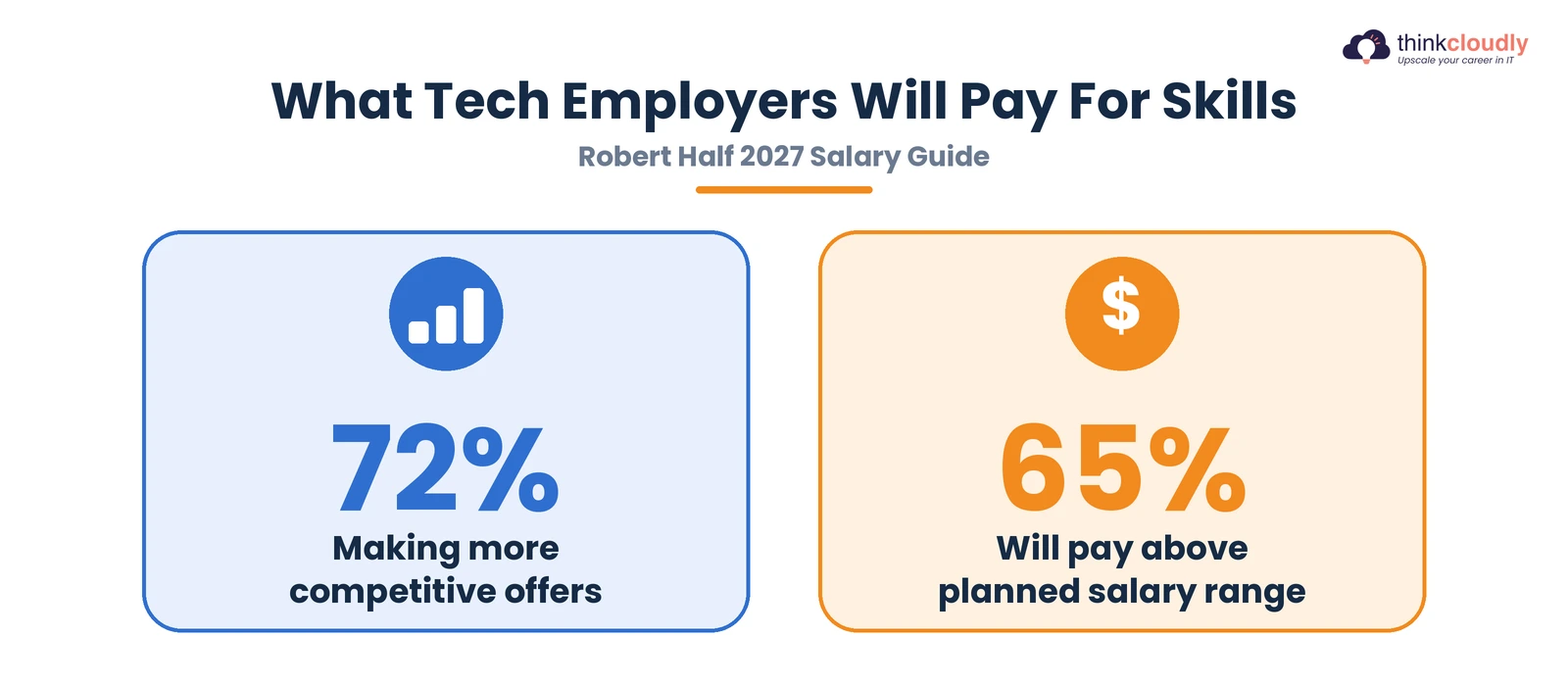
Employers aren’t just posting more roles — they’re paying more to fill them with qualified people. Robert Half’s 2027 Salary Guide found that 72% of tech leaders are making more competitive offers to land specialized talent, with 65% willing to pay above their planned salary range specifically to secure candidates who already have the skills a job requires. A certification bought through a cyber monday deals window this week is a direct answer to that exact willingness to pay.
Then there’s the part employers themselves are funding. Fortinet’s Cybersecurity Skills Gap Report found that 92% of organizations would now pay for an employee to get certified, up sharply from 73% just a year earlier. Put those three numbers together — job postings at a three-year high, employers paying above-range for skilled hires, and a near-universal willingness to fund certification — and a discounted course bought this week stops looking like a shopping impulse. It starts looking like timing a purchase to match exactly what the job market is already doing.
What “Last Chance” Means for This Year’s IT Course Sale?
The phrase “last chance” gets thrown around so often in retail marketing that it’s lost most of its meaning. Here, it means something specific: once Cyber Week IT course deals close, ThinkCloudly’s pricing reverts to standard catalog rates, typically in the first week of December, and the next window this wide doesn’t reopen until next November. There’s no quiet extension, no secret code that keeps working into January.
That matters because an IT course sale like this one isn’t really selling a lower number — it’s selling a shorter runway to a decision you were probably going to make anyway. If a Security+ course, a cloud certification, or a governance credential has been sitting on your to-do list for months, the cost of waiting isn’t abstract.
It’s the difference between paying catalog price in December and paying 30% less (or getting a second course free) this week. A genuine deadline like this one removes the option to keep deciding indefinitely — which, for anyone who’s been stuck in research mode since summer, is arguably the more useful part of the deal.
Inside ThinkCloudly’s Cyber Monday Deals
Two structures are live right now, and ThinkCloudly isn’t hiding either one behind a separate coupon code that mysteriously only applies to courses nobody wanted. Here’s what each actually includes:
- 30% off any single course — applied automatically at checkout, across cybersecurity, cloud, GRC, and data tracks alike, with no track quietly excluded from the discount.
- Buy 1 Get 1 Free across the full catalog — pick any course, add a second of equal or lesser value, and the second one costs nothing.
- Full exam-mapped curriculum on every course, covering the current blueprint rather than a condensed highlight reel.
- A complete practice-question bank, deep enough to sit a full mock exam more than once before the real attempt.
- The exam voucher bundled in, not sold back separately once you’re already past checkout.
- Direct instructor access on both offer structures, so a confusing scenario-based question doesn’t sit unanswered for a week.
Picking between the two comes down to your actual plan, not which number sounds bigger. If one certification covers your immediate goal, the flat discount keeps things simple. If a second credential is already on your radar for next year, the BOGO structure effectively lets two certifications cost what one normally would — which is where most of the real value in this round of savings actually sits.
Which Structure Fits Your Situation?
|
Your Situation |
Better Structure |
Why It Works |
|
One certification covers your current job goal |
30% off |
No second course to track or finish |
|
You’ll need a second credential within 1–2 years |
Buy 1 Get 1 Free |
Second course costs nothing instead of full price later |
|
You’re pairing a technical skill with a leadership one |
Buy 1 Get 1 Free |
Lets you combine, e.g., a cloud course with a GRC course |
|
You’re not sure which track fits your role yet |
Neither — wait | A discount on the wrong course isn’t a deal |
| A team of two is splitting one enrollment | Buy 1 Get 1 Free |
Each person walks away with one certification |
Every row above reflects the same underlying pricing — the real test of whether a seasonal discount like this is trustworthy isn’t the size of the banner, it’s whether the terms hold steady across every track instead of steering buyers toward whatever happens to be overstocked.
What Every Genuine Last Chance Offer Must Actually Include?
A steep discount banner means nothing if the course behind it has been quietly stripped down to make the number look bigger. Before trusting any cyber monday deals promotion this week, confirm it includes:
- Full domain coverage mapped to the exam blueprint currently in effect, not a shortened highlight reel
- A practice-question bank large enough for more than one full mock exam
- The exam voucher included in the discounted price, not billed separately afterward
- Continued access past a single exam attempt, in case a retake is ever needed
- A real instructor you can actually reach with a question
- Confirmed accreditation with the certifying body, checked independently rather than taken on faith
Skip any one of those checks and a seemingly great discount can quietly turn into a course that closes before you finish it, or a voucher you end up buying twice.
Signs You Should Act Before Cyber Week IT Course Deals Close
Not every learner needs to rush, but a few situations make waiting genuinely costly:
- You’ve already compared providers earlier this year and were simply waiting for the price to drop
- A specific job posting already lists the certification you’d be buying as a requirement
- You know a second course is coming within the next year and BOGO would cover it for free
- Your employer has a training budget that resets or expires at year-end
- You’ve failed an exam attempt before and need a voucher plus a fresh practice bank to try again properly
If two or more of these describe you, the cost of waiting until next November is real — not because the course disappears, but because the discounted window does.
Who This IT Course Sale Actually Fits — And Who Should Wait?
This round of Cyber Week IT course deals tends to make genuine sense for people already working adjacent to the role they’re certifying for: help-desk staff eyeing a Security+ course, cloud engineers missing only the credential that unlocks a promotion, or risk analysts whose employer now requires a formal certification as a condition of the job.
It also fits anyone who already knows, with reasonable confidence, that a second certification is coming within the next year or two — that’s exactly the profile the Buy 1 Get 1 structure was built around.
It doesn’t fit as well for someone who hasn’t yet decided which track actually matches their career goal. A discounted course purchased before that decision is made doesn’t save money — it just moves the spending earlier on the calendar while the course itself sits untouched.
If that’s your situation, the smarter move is spending this week figuring out the target role, not the discount. This exact sale tends to repeat in roughly the same shape every year, so there’s little real cost to wait if the plan behind it isn’t solid yet.
Three Mistakes People Make When a Last Chance Offer Feels Too Good
The same handful of errors show up every single year during this exact stretch of cyber monday deals, and each one is avoidable once you know to look for it.
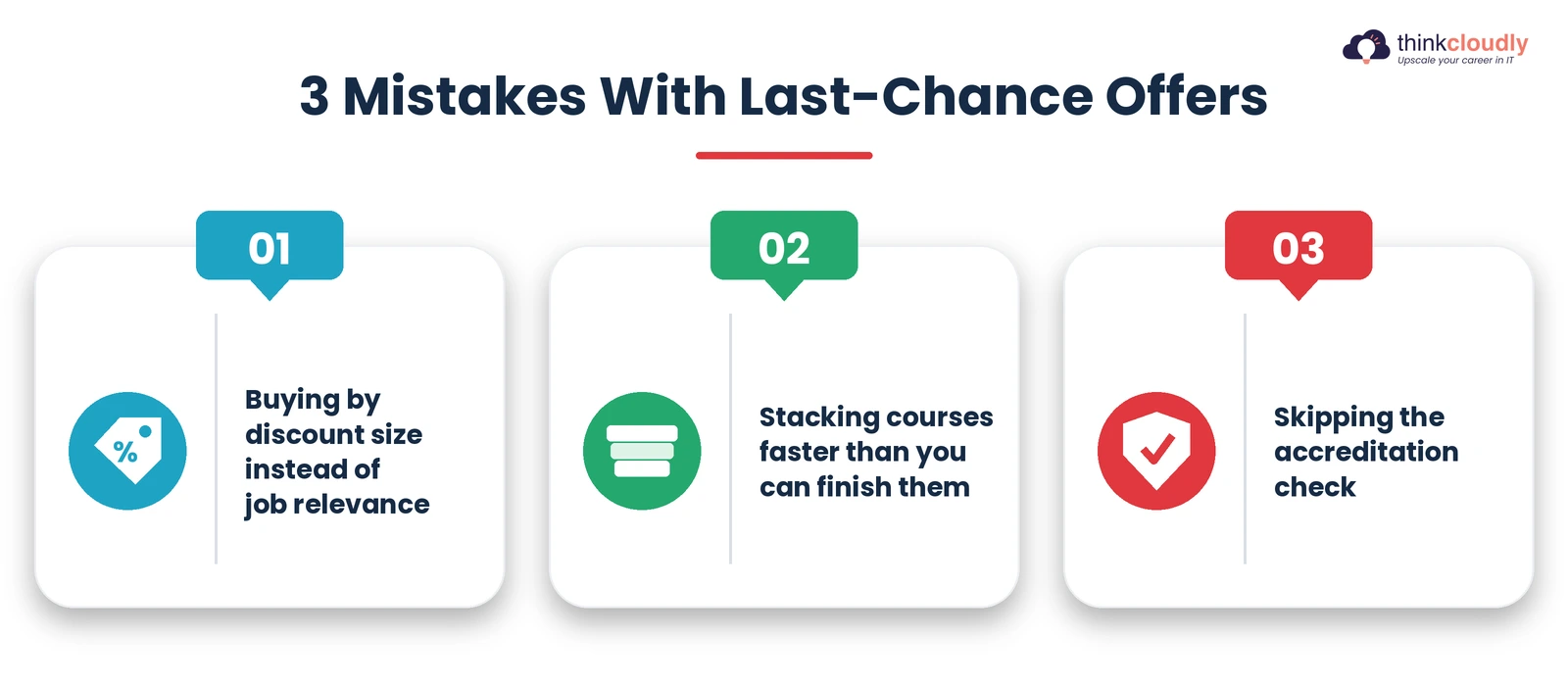
- Buying by discount size instead of job relevance. Picking whichever course has the loudest banner, rather than the one that actually maps to a current or target role, wastes the lower price entirely. A cloud-heavy certification helps very little in a role that’s mostly governance work, and the reverse holds just as true.
- Stacking courses faster than you can finish them. Grabbing two or three certifications at once because this week’s pricing feels too good to pass up, then finishing none of them before access narrows, is one of the most common and most avoidable traps. One completed certification does more for a resume than three half-started ones.
- Skipping the accreditation check. Assuming any provider running a Cyber Week IT course deals promotion automatically to an authorized training partner is an easy mistake to avoid — a two-minute check with the certifying body directly is worth doing before any payment details go in.
After the Timer Runs Out: What Happens When Cyber Week Ends
Once this window closes, pricing reverts to the standard catalog rate, and the next discount of this size won’t reappear until next year’s equivalent sale. That reframes the decision: a certification’s worth isn’t in question here — the job-market data above already answers that — it’s whether it’s worth having at 30% off or two-for-one now, versus full price in December.
For a course you were already planning to take eventually, there’s no real argument for paying more later just because the calendar flipped a page. For a course you’re still not sure about, there’s no shame in waiting either — just know that the next version of this same last chance offer is roughly twelve months away.
A Personal Note
I’ve spent enough Novembers watching this exact week play out from the training side to notice a pattern that repeats almost exactly every year. The people who email in January asking whether the sale is “really over” are almost never asking about money.
They’re asking because they’d already decided, back in October, that they needed the certification — they just let the decision sit until the discount vanished along with it. The deal didn’t disappoint them. Their own hesitation did.
The opposite group is smaller but far less regretful: people who used this exact week, with a clear target role already in mind, to turn a vague someday into a scheduled exam date. The discount didn’t make their decision for them — it just removed the excuse to keep postponing one they’d already made.
If you’re reading this with a specific role already in mind, this week is simply the cheapest version of a decision you’ve already settled. If you’re not there yet, that’s fine too — just don’t let a shrinking countdown timer make the decision for you instead.
Note :- Pricing, offer structure, and course inclusions above reflect typical ranges for this sale season and are subject to change without notice — confirm the exact terms, voucher inclusion, and access window directly with ThinkCloudly before enrolling.