







“I’m interested in security, but I can’t code” is one of the most common messages I get from people weighing a move into this field, and it’s almost always followed by an apology, as if not knowing Python is some kind of disqualifying confession. It isn’t.
Cybersecurity jobs without coding make up a large, well-paid, and genuinely essential slice of this industry, and most people filling them came from auditing, project management, policy, customer support, or operations rather than a computer science classroom.
This guide walks through eight real, hireable non-coding security roles, what each one actually pays, which skills matter more than a programming language, and how to plan a realistic cybersecurity career path if coding was never going to be your strength in the first place.
Why Are Cybersecurity Jobs Without Coding a Real Career Option in 2027?
The idea that every security job requires scripting ability is one of the most persistent myths keeping qualified people out of the field. In reality, the discipline has split into two broad lanes: one that builds and breaks technical systems, and one that governs, documents, assesses, and communicates risk around those systems. The second lane is where most cybersecurity jobs without coding live, and it is not a shrinking corner of the industry—it is one of the fastest-growing parts of it.
The U.S. Bureau of Labor Statistics projects information security roles to grow 21% between 2025 and 2035, a rate the agency classifies as “much faster than average” for any occupation, with a median annual wage above $129,000 reported in 2025. That growth isn’t limited to penetration testers and security engineers.
A large share of it sits in governance, risk, compliance, audit, and awareness functions—precisely the non-technical cybersecurity roles that keep organizations compliant, trained, and audit-ready.
The Cybersecurity Workforce Study found that 59% of organizations report a critical or significant skills shortage, and much of that gap sits in roles that never touch a line of code—risk analysis, policy writing, third-party vendor assessment, and security training.
Employers aren’t short on coders nearly as often as they’re short on people who can translate a technical finding into a decision a board member will understand. That translation work is the backbone of nearly every entry-level security job listing you’ll find once you start looking past “analyst” titles that assume a scripting background.
You don’t need advanced programming skills to build a successful cybersecurity career. Many roles focus on risk, compliance, governance, auditing, security awareness, and incident coordination rather than coding. A Complete Cyber Security Course can help you understand essential security concepts, industry frameworks, and common tools while preparing you for these career paths. From GRC analyst to security auditor, exploring non-coding cybersecurity roles can help beginners identify opportunities that match their existing skills and professional goals.
8 Cybersecurity Jobs Without Coding You Can Actually Get Hired For
Here are eight roles that consistently show up in real job postings, hire people without programming skills, and sit inside a recognizable cybersecurity career path rather than a dead-end title.
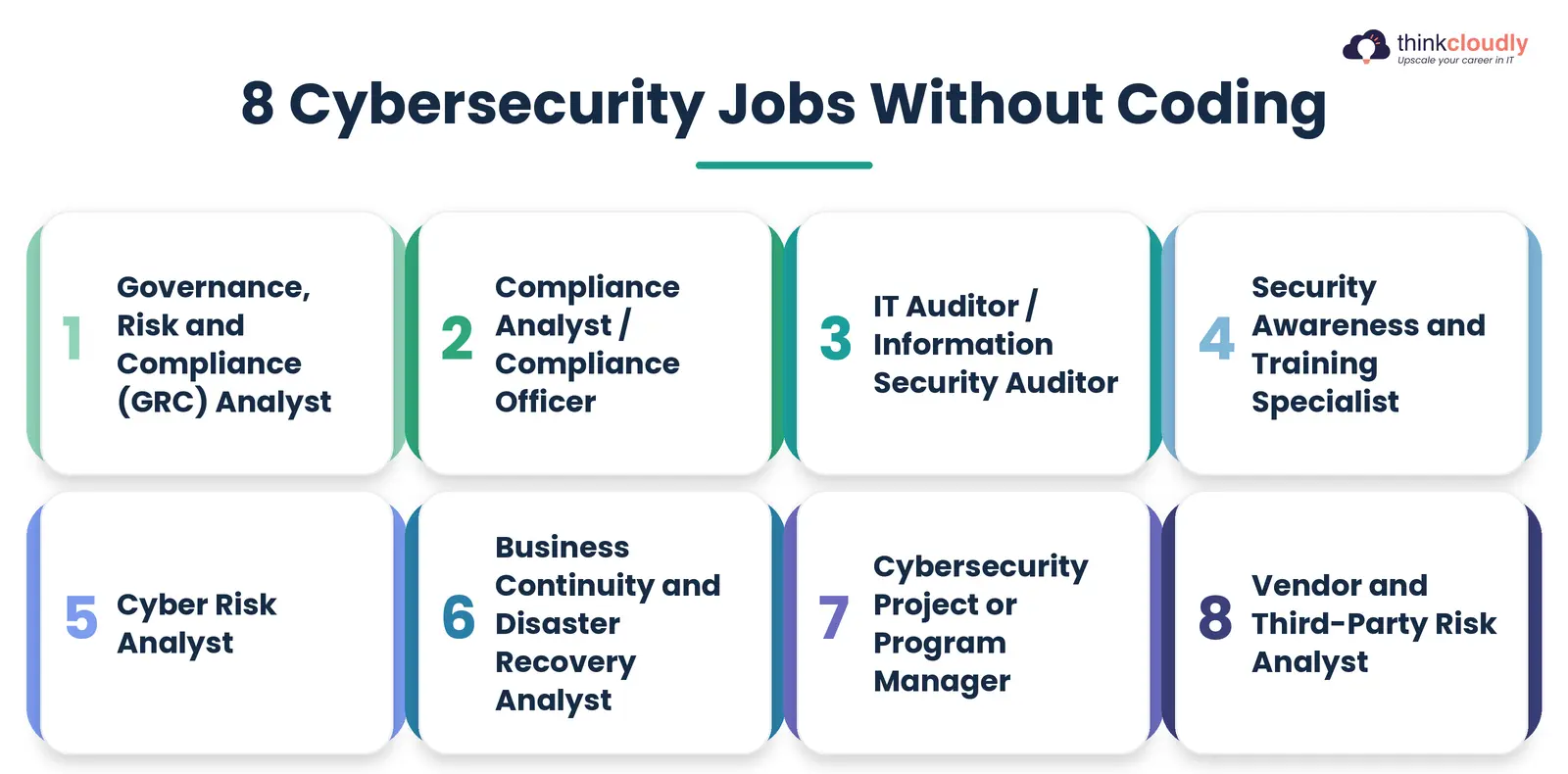
- Governance, Risk, and Compliance (GRC) Analyst—Maps security controls to frameworks like ISO 27001, NIST, or SOC 2, and tracks whether the organization is actually following its own policies. This is the clearest GRC career without a coding entry point, and it rewards people who are comfortable reading dense regulatory language and turning it into checklists.
- Compliance Analyst / Compliance Officer—Focuses on regulatory obligations (GDPR, HIPAA, PCI DSS) rather than technical controls specifically, working closely with legal and audit teams to keep documentation current.
- IT Auditor / Information Security Auditor—Independently tests whether security controls work as designed, interviews system owners, and writes findings reports. Strong fit for detail-oriented people coming from finance or traditional audit backgrounds.
- Security Awareness and Training Specialist—Builds phishing simulations, onboarding modules, and internal campaigns that reduce human error, which remains the leading cause of breaches across nearly every industry.
- Cyber Risk Analyst—Quantifies and prioritizes risk across the business, often using frameworks rather than code, and presents findings to leadership in plain business terms.
- Business Continuity and Disaster Recovery Analysis—Builds and tests the plans that keep operations running during an outage or incident, a role built almost entirely on documentation, interviews, and tabletop exercises.
- Cybersecurity Project or Program Manager—Coordinates audits, tool rollouts, and remediation timelines across technical teams without needing to write the underlying code those teams produce.
- Vendor and Third-Party Risk Analyst—Reviews the security posture of external vendors and suppliers before and after contracts are signed, a function that has exploded in demand as supply chain attacks have climbed.
None of these eight require a programming background to start, and several of them actively prefer candidates with strong writing, interviewing, and stakeholder-management skills over raw technical depth. That is the quiet secret behind most cybersecurity jobs without coding: the bottleneck is rarely technical fluency; it’s the ability to document, question, and communicate clearly under pressure.
Cybersecurity Jobs Without Coding at a Glance
The table below offers a quick cybersecurity salary snapshot across all eight roles before we go deeper into each one.
|
Role |
Core Day-to-Day Work | Coding Required |
Typical US Salary Range (2027 outlook) |
|
GRC Analyst |
Framework mapping, policy tracking | None |
$65,000 – $95,000 |
|
Compliance Analyst |
Regulatory documentation, audits | None |
$60,000 – $90,000 |
|
IT Auditor |
Control testing, findings reports | None |
$70,000 – $100,000 |
|
Security Awareness Specialist |
Training, phishing simulations | None |
$55,000 – $80,000 |
|
Cyber Risk Analyst |
Risk scoring, leadership reporting | Minimal (spreadsheets) |
$70,000 – $105,000 |
|
BC/DR Analyst |
Continuity plans, tabletop drills | None |
$65,000 – $95,000 |
|
Cybersecurity Program Manager |
Cross-team coordination, timelines | None |
$85,000 – $125,000 |
|
Vendor Risk Analyst |
Third-party assessments, questionnaires | None |
$65,000 – $95,000 |
These are directional US ranges from market postings and surveys, not guaranteed figures—location, sector, and company size will move the final offer up or down.
GRC Career Without Coding: Why This Path Keeps Growing
Of all the career paths on this list built around judgment rather than code, a GRC career without coding is arguably the fastest-growing and most misunderstood—often dismissed as a paperwork-heavy backwater rather than where real decisions get made. In practice, a GRC analyst’s control mapping determines what an auditor tests, what a board approves, and what a regulator accepts during an examination.
The NIST NICE Cybersecurity Workforce Framework explicitly categorizes governance, risk management, and oversight as distinct, formally recognized specialty areas—not a watered-down version of a technical job, but a separate professional track with its own skill set and career ladder.
Certifications built specifically for this track, such as ISACA’s CRISC credential, exist precisely because this governance-focused specialty has matured into a standalone discipline rather than a stopgap for people who couldn’t pass a scripting interview.
What makes this path attractive for career switchers is that it rewards experience they already have. A background in financial audit, legal compliance, project coordination, or healthcare administration translates almost directly into GRC work, since the discipline is built on structured documentation and risk judgment, not infrastructure.
Skills That Matter More Than Coding in Non-Technical Cybersecurity Roles
Hiring managers filling these non-coding positions consistently prioritize a different skill set than the one assumed by outsiders. Here’s what actually moves a resume to the interview pile:
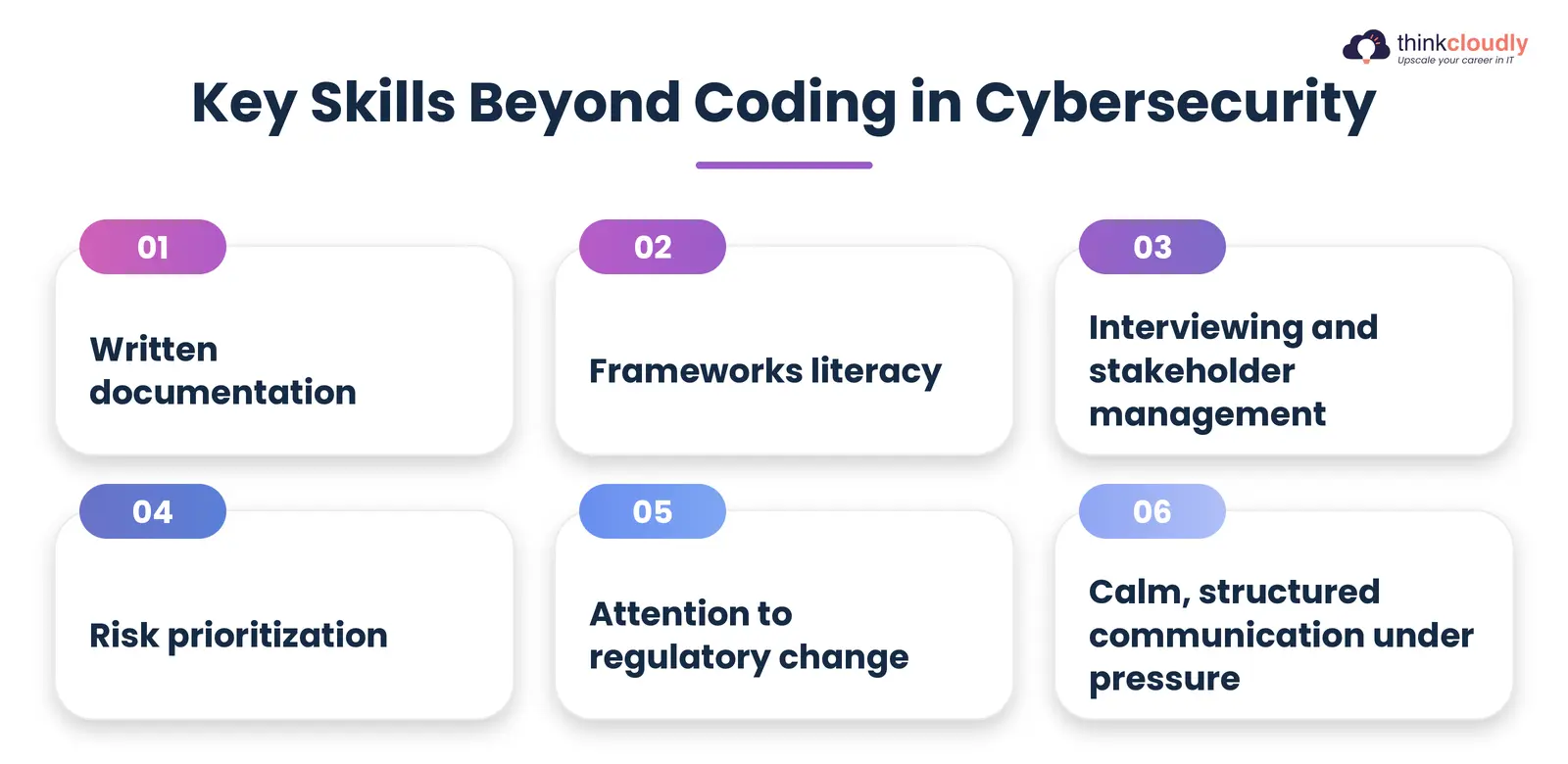
- Written documentation—turning a messy control gap or vendor response into a clear finding a non-technical executive can act on.
- Frameworks literacy—comfort navigating ISO 27001, NIST CSF, SOC 2, or PCI DSS well enough to map real controls against them.
- Interviewing and stakeholder management—audits and risk assessments depend on asking system owners the right follow-up questions, not just filling out a template.
- Risk prioritization—sorting fifty findings into “fix this week” versus “monitor quarterly” based on business impact rather than technical severity alone.
- Attention to regulatory change—tracking how a new rule (a state privacy law, an updated PCI requirement) actually changes what the organization must document or prove.
- Calm, structured communication under pressure—especially in incident-adjacent roles like business continuity, where a clear voice during a crisis matters more than technical depth.
Every one of these skills is learnable through structured coursework and on-the-job practice, and none of them require touching a terminal. That’s precisely why so many of these early-career security positions hire people straight out of adjacent fields rather than requiring a computer science degree.
Entry-Level Security Jobs: A Realistic First Step
Breaking into entry-level security jobs without a technical background is less about finding a shortcut and more about choosing the right first title. A few realistic starting points:
- Junior GRC or compliance analyst at a mid-size company with a structured onboarding program, where the learning curve is steep but manageable.
- Internal audit associate with a rotation into IT and security audit work, common at larger enterprises and professional services firms.
- Security awareness coordinator, especially appealing for people coming from training, communications, or teaching backgrounds.
- Risk or vendor management assistant, often overlooked by job seekers because the title doesn’t say “security” explicitly, even though the work sits squarely inside it.
Most of these early-career openings pair well with a foundational, vendor-neutral certification rather than a technical one — something that proves baseline literacy in frameworks and terminology without pretending the holder can write code they never intend to write.
Cybersecurity Salary Expectations by Role and Experience
Cybersecurity salary figures vary more by seniority and sector than by whether the role happens to involve coding. A junior GRC or compliance hire typically starts in the $55,000 to $70,000 range in the US, while someone with three to five years of documented audit or risk experience routinely clears $90,000, and senior leadership in this non-coding track — audit managers, GRC directors, risk leads — regularly reach $120,000 to $150,000 at larger organizations.
What drives cybersecurity salary growth fastest in these roles isn’t a late-career pivot into scripting. It’s depth within the discipline itself: pairing a GRC career without coding with a second credential, moving into a regulated sector like financial services or healthcare where compliance carries real legal weight, or taking on program-management responsibility across multiple audits at once. A realistic cybersecurity salary trajectory in this lane looks less like a single jump and more like a steady climb tied to documented, provable judgment calls over time.
Cybersecurity Career Path Options Beyond the Entry Level
A common worry about non-technical cybersecurity roles is that they cap out early, leaving no further cybersecurity career path once the entry-level title is outgrown. That worry doesn’t hold up in practice. A GRC analyst track typically leads toward GRC manager, then director of governance and risk, with some professionals eventually reaching chief risk officer or chief compliance officer. An audit-focused track moves from IT auditor through audit manager and into roles like director of internal audit or, in some organizations, chief audit executive.
A third branch worth naming explicitly: consulting. Advisory firms hire professionals from this non-coding track specifically to run client-facing risk assessments and audits across multiple organizations at once, which tends to accelerate both pay and exposure compared with staying inside a single company’s internal team.
Whichever branch someone chooses, this governance-and-risk track rarely dead-ends — it simply branches toward leadership rather than toward deeper technical specialization, which suits people who got into this field for the judgment and communication work in the first place.
Common Mistakes People Make Chasing Cybersecurity Jobs Without Coding
The biggest mistake isn’t lacking technical skill — it’s apologizing for it in interviews instead of leading with what you actually bring. Candidates routinely undersell audit, legal, or project-management backgrounds that are directly relevant, because they assume a security hiring manager only wants to hear about technical depth.
A second mistake is collecting too many overlapping entry-level certifications before applying anywhere, mistaking volume for readiness. One finished, recognized credential paired with a documented example of real risk or compliance work beats a stack of half-explained badges.
A third mistake is ignoring adjacent titles — “vendor risk assistant,” “audit associate,” “compliance coordinator” — that don’t say “cybersecurity” outright but function as the clearest early-career openings available to someone without a technical résumé.
Final Thoughts
Cybersecurity jobs without coding aren’t a consolation prize for people who couldn’t learn to program — they are a distinct, well-paid, and growing professional track built on judgment, documentation, and communication instead of scripting.
The practical path is almost boring on paper: pick one recognized entry point (GRC, audit, awareness, or risk), document every real finding and assessment you touch, pursue one credential that matches the discipline rather than three that overlap, and apply to the adjacent-sounding entry-level security jobs that don’t advertise themselves loudly.
Anyone mapping this out should also look at the CyberSeek career pathway tool, which uses live US labor-market data to show which non-technical cybersecurity roles are actually hired by region, rather than guesswork.
A Personal Note
A friend of mine spent two years assuming she wasn’t “technical enough” for security, despite running vendor risk reviews at an insurance company for most of that time without ever calling it a cybersecurity job. The moment she relabeled her own resume honestly — vendor questionnaires became “third-party risk assessments,” her compliance tracker became “control mapping to ISO 27001” — she had three interviews in a month.
Nothing about her actual work changed. If you’re reading this and assuming your background doesn’t count because it never involved a terminal, it probably counts more than you think. Write it down properly, and let the title catch up to the work you’re already doing.