

A few weeks ago, I sat on a hiring panel for a mid-level IT audit opening, and I watched four technically solid candidates stumble over the exact same thing. They could define ITGC testing in their sleep and recite control frameworks without blinking. The moment we switched from “what is” to “what would you do,” though, two of them froze completely. That gap, between knowing audit theory and actually handling IT auditor interview questions the way a hiring panel wants, is the entire reason I’m writing this.
If you’re preparing for interviews in 2027, whether it’s a Big Four associate seat or an in-house internal audit role, this isn’t a recycled list copied from a job board. It’s built around how IT auditor interview questions are actually asked right now, what a strong scenario answer sounds like out loud, and where candidates with genuinely good technical knowledge still lose the room.
Why Have IT Auditor Interview Questions Changed for 2027?
Interview panels aren’t testing the same things they tested five years ago. The audit function itself has shifted, so IT auditor interview questions have shifted with it. A few forces are driving that change directly:
- Audit teams are smaller and expected to cover more ground, so panels want proof you can prioritize instead of just execute a checklist
- Risk-based auditing has become the default planning method rather than a specialty skill, per the IIA’s Global Internal Audit Standards, which formally shifted emphasis toward risk and governance judgment over mechanical procedure-following
- Cloud environments and continuous monitoring tools mean controls testing happens differently than it did even three years ago, and panels want to know you’ve kept up
- AI-assisted fraud and faster system change cycles mean auditors need to explain judgment calls, not just cite a standard from memory
That last point is worth sitting with. A panel today cares less about whether you memorized a framework and more about whether you can walk through a messy, ambiguous situation and land on a defensible position. That’s exactly why scenario-based formats dominate modern interviews, and it’s why this guide spends more time on how to answer than on what to memorize.
The Core Categories of IT Auditor Interview Questions
Almost every interview I’ve sat in on, on either side of the table, breaks down into the same handful of buckets. Knowing the category before you’re asked the question changes how you listen to it:
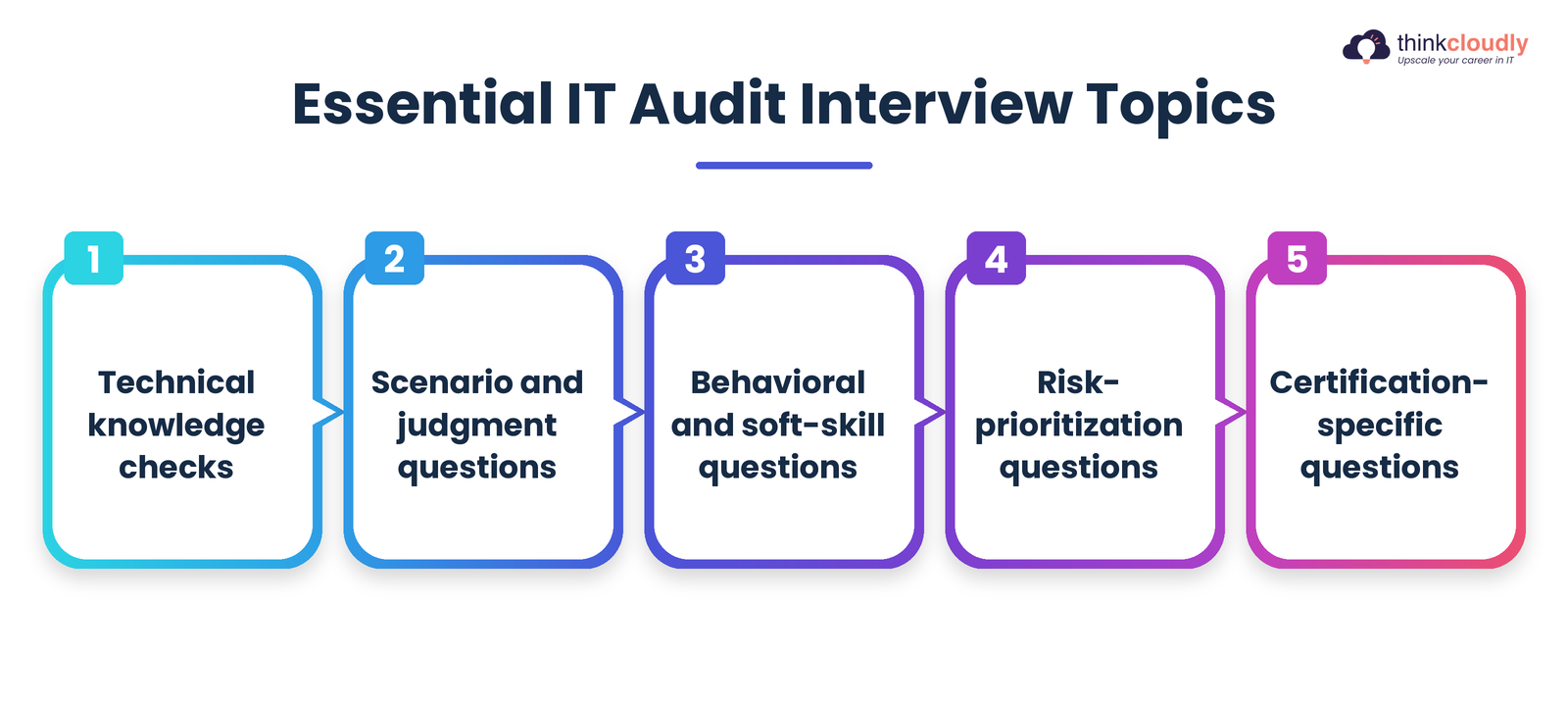
- Technical knowledge checks — direct questions about frameworks, standards, or IT general controls terminology (COBIT, SOX, ISO 27001, access provisioning)
- Scenario and judgment questions — “walk me through how you’d handle…” style prompts that test reasoning over recall
- Behavioral and soft-skill questions — how you’ve handled pushback from a process owner, a missed deadline, or a disagreement with a manager
- Risk-prioritization questions — given limited time or scope, what would you test first and why
- Certification-specific questions — particularly common if CISA, CIA, or CRISC appears on your resume, since panels will probe whether the credential reflects real understanding
Most candidates over-prepare for category one and under-prepare for categories two and four, which is precisely backward given how interviews are actually weighted in 2027.
CISA Interview Questions: What Makes Them Different
If CISA sits on your resume, expect CISA interview questions that go beyond “What are the five domains?” Panels assume you passed the exam; what they want to know is whether you can apply that domain knowledge under pressure. These questions tend to probe things like how you’d scope an audit of a newly migrated cloud application or how you’d justify a materiality threshold to a skeptical business owner.
The honest difference between CISA interview questions and general IT audit questions is depth of expectation. A generalist can say, “I’d review access controls.” Someone with CISA on their resume is expected to say which access control gaps matter most given the system’s risk profile and why. If you can’t clear that bar, having the letters after your name can actually work against you, since it raises the baseline the panel is measuring you by.
IT Audit: Practice Prompts With Model Answers
This is where most prep falls apart, so let’s work through real IT audit scenario questions the way they’re actually asked, with the kind of answer structure that holds up under follow-up questions.
Scenario 1: “A business unit bypassed change management to push an urgent fix. What do you do?” A weak answer jumps straight to “That’s a control violation; I’d write it up.” A strong answer separates the control gap from the business reality: acknowledge the urgency, confirm whether a compensating control (like post-implementation review) exists, assess actual risk exposure from the bypass, and only then discuss remediation and reporting. Panels are listening for whether you can hold two things at once: the rule matters, and context matters too.
Scenario 2: “You find the same finding repeated for the third straight year. How do you handle it?” This is one of the IT audit scenario questions designed to test whether you think beyond the current audit cycle. The strong move is to stop treating it as a single finding and start asking why remediation keeps failing, structurally, not individually, then escalate the pattern itself to audit committee visibility rather than just restating the same recommendation a fourth time.
Scenario 3: “A system owner disagrees with your risk rating. What now?” Don’t cave, and don’t dig in defensively either. Walk through your evidence, ask what they’re seeing that you might be missing, and be willing to adjust the rating if their point is genuinely valid. What panels are testing with questions like this is whether disagreement makes you rigid or makes you curious.
The pattern across all of these IT audit scenario questions is the same: name the tension, show your reasoning out loud, and land on a position you can defend rather than one that just sounds safe.
20 Scenario-Based Interview Questions
The three walkthroughs above show the pattern. What follows is a longer bank of scenario prompts, each with a model answer written the way a composed, experienced candidate would actually respond under questioning, so the reasoning can be studied and adapted rather than memorized word for word.
Q1. During a segregation-of-duties review, the same employee can create a vendor and approve vendor payments in the ERP system. How should this be addressed?
Answer. A strong auditor first confirms whether the access was ever actually used to process a conflicting transaction, rather than treating the access conflict alone as the finding. The recommended path is to quantify the exposure, check for a compensating control such as a secondary payment approval workflow, and recommend role redesign or a detective exception report if full role separation isn’t immediately feasible.
Q2. A finance system is migrating to the cloud next quarter. How would the first audit of that environment be scoped?
Answer. The response starts by mapping the shared-responsibility split between the cloud provider and the organization, since testing differs sharply depending on who owns which controls. A seasoned candidate prioritizes identity and access management, data residency, and encryption-in-transit as the first-cycle focus, treating deeper configuration testing as a second-phase activity once baseline risk is understood.
Q3. A critical vendor’s SOC 2 report returns a qualified opinion on one control area. What’s the correct answer?
Answer. Instead of outright accepting or rejecting the report, a good candidate explains that the qualified area requires independent follow-up: requesting the vendor’s remediation plan, determining whether the gap impacts data handled on the organization’s behalf, and looking for an internal compensating control. Blind trust in a clean report and blind rejection of a qualified report both show weaker judgement than targeted follow-up.
Q4. Fieldwork fails a backup recovery test. What to do with it right in the moment?
Answer. The response documents the failure in detail, including the exact scope of data that could not be restored, and flags it to IT leadership immediately given the business continuity implications, rather than waiting for the final report. The severity rating is higher than a typical finding because a failed restore has real operational risk, not just theoretical risk.
Q5. A privileged access review turns up an admin account still active for an employee who left four months ago. What comes next?
Answer. This moves straight to a high-priority finding rather than a routine observation, since dormant privileged access represents live risk. A thorough candidate checks system logs for any post-departure activity on that account, notifies security immediately regardless of the audit timeline, and uses the finding to question the broader deprovisioning process rather than treating it as an isolated miss.
Q6. A process owner asks that a finding’s severity be downgraded before it reaches the audit committee. How should this be handled?
Answer. A composed response holds the rating unless new evidence genuinely changes the risk picture. The right move walks the process owner through the exact criteria used to assign severity, invites them to present evidence if they believe the rating is wrong, and makes clear that the final call rests on independent audit judgment rather than how uncomfortable the number feels.
Q7. Halfway through testing, the auditee stops providing requested evidence and goes quiet. What’s the appropriate next step?
Answer. Escalation happens methodically rather than going over anyone’s head immediately. A seasoned candidate documents the specific requests and dates, follows up once directly with the process owner, and only escalates to management if the delay continues beyond a reasonable window, since a persistent evidence gap often becomes part of the finding itself.
Q8. Encryption keys for a sensitive database haven’t been rotated in over two years, against stated policy. How is this assessed?
Answer. A capable candidate separates the policy violation from the actual risk exposure, asking how the keys are stored and whether there’s any evidence of compromise before writing the finding. The response also checks whether the stated rotation schedule is operationally realistic, since recommending a fix nobody can sustain is a common and avoidable mistake.
Q9. A subset of remote users lack enforcement of multi-factor authentication when accessing a finance application. How do you present the finding?
Answer. The response does not treat all unenforced accounts the same. It begins with segmenting the population by role and level of access, because a read-only reporting account has a different risk profile than one with payment authority. It closes the highest-risk accounts straight away while looking at a realistic timeline for full enforcement for the rest.
Q10. Testing shows a massive backlog of critical vulnerabilities that have not been patched. How should this be properly raised?
Answer. The finding is not simply about patch counts but is framed around business risk. It describes what an unpatched critical vulnerability actually exposes the organization to, if exploited. A good candidate will also identify if the backlog is a resourcing gap or a process gap as the recommendation would vary depending on the root cause of the delay.
Q11. A DevOps team deploys changes to production code without formal change tickets, using automated pipelines instead. How is that decided?
Answer. The modern auditor knows that automated pipelines can embed approval gates and rollback logic right into the deployment process and no longer defaults to demanding manual tickets for each change. The evaluation looks at whether these automated controls actually enforce separation of duties and provide an audit trail, rather than assuming that informality is automatically a control gap.
Q12. A disaster recovery plan has only ever been paper-tested, never actually executed. How should this be reported?
Answer. This is treated as a meaningful gap rather than a minor documentation issue, since an untested plan carries real uncertainty about recovery time in an actual outage. The recommendation pushes for at least a partial live test of the most critical systems, rather than accepting another round of tabletop review as sufficient remediation.
Q13. An auditee becomes visibly irritated and defensive during a control walkthrough. How should the interview be managed?
Answer. The tone of the room is managed before the content of the finding is pressed further. A steady response acknowledges the auditee’s frustration directly, reframes the conversation around understanding the process rather than assigning blame, and keeps the discussion focused on facts, since a defensive auditee who feels attacked typically becomes a less reliable source of information.
Q14. While testing access logs, unusual journal entries tied to a terminated employee’s old credentials are discovered. What happens next?
Answer. Standard procedure shifts the moment fraud becomes a possibility rather than a control gap. The response pauses routine testing on that thread, preserves the evidence without further handling that could compromise it, and escalates immediately to the audit lead and, where policy requires, to legal or forensic specialists, rather than continuing to investigate informally.
Q15. Midway through an engagement, the audit scope is cut in half due to resource constraints. How should the remaining work be prioritized?
Answer. Prioritization follows risk rather than simply working through whatever’s left on the original plan. The approach revisits the original risk assessment, keeps the highest-exposure areas in scope even if that means dropping lower-risk items entirely, and documents the scope reduction clearly so the final report reflects what wasn’t tested and why.
Q16. The finance team has started using an unapproved AI tool to draft journal entry explanations with no governance review. How is this assessed?
Answer. The finding centers on the absence of a governance process rather than condemning the tool itself, since the underlying risk is unmanaged data exposure and unchecked output rather than automation. A well-rounded candidate recommends a lightweight approval and monitoring process for such tools generally, recognizing that blocking the technology outright usually just pushes the behavior underground.
Q17. Personal data is found retained well beyond the organization’s stated retention policy. How should this be addressed?
Answer. This is treated as both a compliance exposure and an operational risk, since excess retained data simply expands what could be compromised in a breach. The recommendation pairs an immediate data disposition review with a root-cause look at why the retention schedule wasn’t enforced systematically in the first place, rather than a one-time cleanup.
Q18. Compliance wants a deep-dive review while the business unit is pushing for a faster, lighter-touch audit. How is that tension resolved?
Answer. Neither side gets a blanket win. A balanced approach explains the trade-off to both parties directly, proposes a tiered scope that goes deep on the highest-risk areas and lighter on the rest, and keeps the final scoping decision anchored to the underlying risk assessment rather than to whichever side pushed harder.
Q19. The organization is rolling out a zero-trust architecture and asks the audit team to assess readiness. Where does the review begin?
Answer. The review begins with identity, since zero trust fundamentally depends on verifying every access request rather than trusting network location. A capable candidate starts by testing how consistently identity verification and least-privilege access are enforced across systems, treating network segmentation and continuous monitoring as the next layer rather than the starting point.
Q20. An API integration between two internal systems has no access logging enabled. How serious is this, and what’s recommended?
Answer. This is rated higher than it might first appear, since an unlogged integration point removes visibility into exactly the kind of activity an attacker would exploit quietly. The recommendation prioritizes enabling logging immediately as a low-cost fix, paired with a broader review of whether other system integrations share the same blind spot.
IT General Controls Questions You Should Expect
Almost no technical audit interview skips IT general controls, since they’re the backbone of nearly every IT audit regardless of industry. Expect questions on access provisioning and deprovisioning, change management, backup and recovery testing, and job scheduling or batch processing controls.
A common trap is treating IT general control questions as pure recall. A better approach, aligned with current guidance is to connect each control to the actual risk it mitigates rather than just naming it. If asked how you’d test access de-provisioning, don’t just say “pull a termination list and sample it.” Explain why timing matters, what a gap actually exposes the organization to, and how you’d size your sample based on population risk rather than a flat percentage.
Panels asking IT general controls questions in 2027 are also more likely to work cloud and SaaS environments into the scenario, since the NIST Cybersecurity Framework has pushed many organizations toward more continuous, automated control monitoring rather than point-in-time testing. If your only frame of reference is an on-premises data center, say so honestly and pivot to how the underlying control objective still applies.
Risk-Based Auditing Questions: Proving You Know Where to Look First
Risk-based auditing questions are designed to separate candidates who can follow an audit program from candidates who could build one. A typical prompt sounds like: “You have two weeks and limited resources to audit a new vendor relationship. Where do you start?”
The strongest answers don’t start with a testing step. They start with a question: what’s the actual exposure here, financial, operational, reputational, and which of those risks would hurt the most if it materialized.
Only after that triage does the conversation move to specific controls or testing procedures. That sequencing is the entire point of thinking this way, and panels can tell within thirty seconds whether a candidate is reasoning from risk or just reciting the phrase on command.
Preparing for this kind of question is less about memorizing a list and more about rehearsing the triage habit itself. Before any mock interview, I’d suggest picking three unfamiliar business scenarios (a new vendor, a system migration, a merger) and forcing yourself to name the top two risks out loud in under thirty seconds, before touching any control detail. Candidates who skip this drill almost always default back to listing controls first, which is the exact habit panels are screening against.
A quick reference for how these pieces typically map against each other in an interview setting:
|
Question Category |
What It Sounds Like | What the Panel Is Really Testing |
|
Technical recall |
“What’s the difference between a preventive and detective control?” |
Baseline fluency with terminology |
|
Scenario-based |
“A control fails during testing. Walk me through your next steps.” |
Judgment under ambiguity |
|
Risk prioritization |
“You can only test three areas this quarter. Which ones?” |
Ability to triage, not just execute |
|
Behavioral |
“Tell me about a time a stakeholder pushed back on a finding.” |
Communication and composure |
|
Certification-specific |
“How would a CISA-certified auditor approach this differently?” |
Depth behind the credential |
That same risk-first lens shows up across nearly every row in that table, even when the question isn’t phrased as a risk question directly, because it’s become the filter the whole interview runs through.
Internal Audit Interview Questions Beyond the Technical Checklist
Not every audit interview focuses on IT specifically, especially for roles that sit inside a broader internal audit function rather than a standalone IT audit team. Expect internal audit interview questions about stakeholder management, how you handle a disagreement with a process owner, and how you communicate a sensitive finding to senior leadership without triggering unnecessary defensiveness.
One internal audit interview questions pattern worth preparing for specifically: “Tell me about a finding you had to deliver that wasn’t well received.” Panels aren’t looking for a story where everything went smoothly. They want to see that you can stay calm, stick to evidence, and keep the relationship intact even when the message itself is unwelcome.
According to recent hiring commentary in Robert Half’s research, communication skills are increasingly weighted alongside technical ability when organizations fill audit and risk roles, which is exactly why these questions haven’t gone away even as the technical bar has risen.
Common Mistakes Candidates Make With IT Auditor Interview Questions
I’ve watched the same patterns derail otherwise strong candidates often enough that they’re worth listing out plainly:
- Answering a scenario question like a definition question, reciting a framework instead of walking through actual reasoning
- Treating every control as equally important instead of showing risk judgment
- Going silent when a panel pushes back, instead of explaining the thinking behind an answer
- Overusing jargon to sound credible instead of explaining the “why” behind a control or finding in plain language
- Failing to ask a single clarifying question before diving into an answer, which signals you’ll do the same on the actual job
- Preparing only for technical recall and getting blindsided by behavioral or risk-prioritization questions
- Memorizing a generic answer bank instead of practicing the reasoning behind each answer, which falls apart the moment a panel asks a single follow-up question
None of these require more technical knowledge to fix. They require slowing down for three extra seconds before answering and actually structuring a response instead of rushing to sound confident. A simple fix that works for almost everyone: before the interview, write out two or three of your own real work situations in a short paragraph each, then practice mapping them onto whatever question gets asked, instead of trying to invent a fresh example on the spot.
Final Thoughts
IT auditor interview questions in 2027 aren’t harder because the frameworks got more complicated. They’re harder because panels have gotten better at separating candidates who memorized the material from candidates who can actually reason through it live, under mild pressure, with someone watching.
The fix isn’t more flashcards. It’s deliberately practicing scenario answers out loud, building a habit of naming the risk before naming the control, and getting comfortable saying “here’s how I’d think about it” instead of reaching for a textbook definition.
A Personal Note
I’ve been on both sides of this table more times than I can count, and the thing that still surprises me is how rarely raw technical knowledge is actually the deciding factor. The candidates who get offers aren’t always the ones who know the most. They’re the ones who can show their thinking without flinching when a panel pokes at it. If you take one thing from this post, let it be that: practice saying your reasoning out loud, to a mirror, to a friend, to anyone, before you say it to a panel that’s deciding whether to hire you.
At ThinkCloudly, we help aspiring professionals strengthen their technical knowledge, build practical confidence, and prepare for real-world interviews through industry-focused training.