
I spent four years as a system admin before applying for a cloud security role, and my first loop humbled me. I knew IAM syntax was cold, but when asked how I’d respond to a security group misconfigured for three weeks, I froze—answering like someone studying for a test, not someone who’d thought about risk.
This guide is built from failing once and figuring out what separates memorizing from reasoning. If you’re preparing for cloud security engineer interview questions right now, this shows what panels actually listen for in 2027.
What Changed in Cloud Security Engineer Interview Questions This Year
2027 loops test for a different shape of candidate than eighteen months ago:
- Multi-cloud footprints are standard, so even AWS-heavy loops expect comfort across providers
- Kubernetes adoption pushed container security into every cloud engineer’s daily workload
- Zero trust architecture became the default panel build scenario questions around
- Faster, automated attacks mean interviewers reward reasoning speed over acronym recall
- Broader compliance means cloud security best practices get tested against overlapping standards
The weight sits on judgment, not recall.
The Five Buckets Every Loop Pulls From
Nearly every loop pulls cloud security engineer interview questions from the same five buckets:
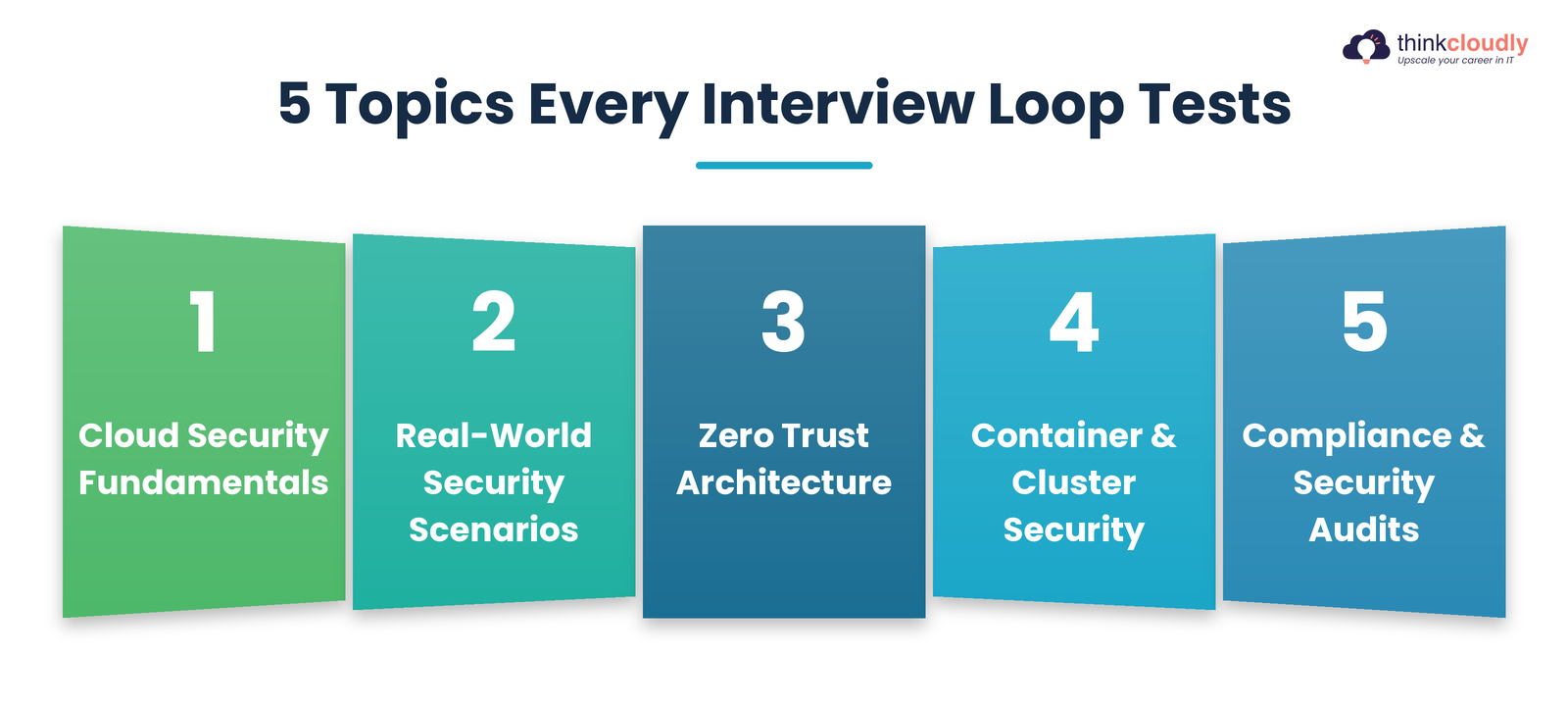
- Technical fundamentals—encryption, identity, segmentation, cloud-native tooling
- Applied judgment, framed as cloud security scenario questions tied to a live incident
- Architecture, centered on rolling out zero trust architecture across a legacy estate
- Container and orchestration specifics—image integrity, runtime behavior, cluster hardening
- Compliance, testing whether cloud security best practices hold up under audit pressure
Most candidates over-prep bucket one and walk in unprepared for the rest.
AWS Security Interview Questions 2027: Why They Still Dominate the Loop
Even in multi-cloud hiring, AWS security interview questions for 2027 show up more than any other provider line, since AWS has the deepest candidate pool to compare against. Panels assume IAM fluency, so AWS security interview questions 2027 Skip definitions for judgment: how would you scope a new Lambda function’s permissions, or what would you check if CloudTrail showed an unfamiliar role at 3 a.m.?
The gap isn’t catalog knowledge. It’s naming which permission is excessive and explaining the blast radius. AWS’s IAM best-practices guide runs on that instinct: default to restriction.
20 Cloud Security Engineer Interview Questions
Below is a working bank of prompts phrased the way interviewers ask them, each followed by how a composed candidate would reason through it.
Q1. Describe the shared-responsibility model.
Answer. The shared-responsibility model frames it as a split of duties: the provider secures the physical infrastructure and underlying managed services, while the customer stays responsible for configuration, identity, and what ends up exposed to the internet. The exact split shifts depending on whether the workload sits on IaaS, PaaS, or SaaS.
Q2. What’s the first thing you do when you find an exposed storage bucket with customer data in it?
Answer. Changing a policy to lock down access right away, then figuring out exactly what data was in there and how long that bucket had been exposed before anyone noticed. The engineer checks access logs to see if the exposure was actually read externally after containment. We don’t assume facts, we verify them before we inform stakeholders.
Q3. How do you design IAM roles for a new microservice?
Answer. It starts with zero permissions and adds access as actual functionality is needed. Rather than copying an existing broad role and then trimming it which almost always leaves something over-permissioned. They mention running the final policy through a simulator to validate it and documenting the justification for each permission before the role goes into production.
Q4. What if a load balancer accepts traffic from any IP on a sensitive port?
Answer. It needs to treat this as urgent and either figure out who really needs that access, narrow the rule down to specific ranges or route it through a bastion. Finally, they’ll look at historical traffic logs to see if the exposure was exploited before it was discovered, because a fix alone does not guarantee that damage has not already been done.
Q5. How can an engineer detect and respond to repeated failed login attempts against an application hosted in the cloud?
Answer. That’s rate limiting and anomaly detection on login patterns and a web application firewall rule, all working together, not just one control. A single spike is not grounds for a block, and only if a clear malicious pattern is proven does it escalate into a temporary IP block.
Q6. What does a secure container build pipeline look like?
Answer. It describes scanning base images before they’re approved, trimming unnecessary packages from the build, and signing finished images so only verified builds reach a cluster. They typically add that catching a vulnerable dependency at build time is far cheaper than catching the same issue once it’s already running in production.
Q7. How should secrets be managed for workloads running inside containers?
Answer. At the first place, it must reject environment variables and credentials baked into images outright, describing instead a dedicated secrets manager that issues short-lived, automatically rotated credentials injected only at runtime. They usually add that the application itself should never need to know where a secret came from or how long it will remain valid.
Q8. What steps to take when a pod shows signs of compromise inside a live cluster?
Answer. They isolate the pod using network policy before doing anything else, preserving forensic evidence rather than terminating it immediately and losing the chance to learn how the compromise happened. Only after evidence is captured do they check whether lateral movement reached any neighboring workloads and rebuild the affected image from a known-clean base.
Q9. Explain zero trust to a team used to perimeter-based thinking?
Answer. They describe the core shift plainly: nothing is trusted by default just because it sits inside the network boundary, and every request gets verified against identity and context regardless of where it originates. This doesn’t remove network controls, it just stops them being the only line of defense.
Q10. What’s the first priority when rolling out a zero trust model across a legacy organization?
Answer. To correctly identify strong identity verification as the starting point, since nearly every later control, from segmentation to access policy, depends on confidently knowing who or what is making a request. Sequencing matters here too, since enforcing policy before identity is solid tends to lock out legitimate users and undermine the rollout.
Q11. How to evaluate a new third-party integration before giving it access?
Answer. First, scope out what access the integration really needs rather than taking whatever permissions it wants by default, and check the vendor’s compliance posture and incident history. It also suggests creating a calendar reminder to review that access at a later date, because integrations tend to be approved once and never reviewed again.
Q12. What’s the right way to handle a posture-management alert that turns out to be a false positive?
Answer. To document the reasoning behind dismissing it rather than closing it silently, adjust the underlying detection rule if one exists, and periodically revisits suppressed alerts going forward. It notes that an undocumented dismissal today tends to become next quarter’s missed real incident, since nobody remembers why the exception was made.
Q13. What is the reason for encryption across a workload spanning two cloud providers?
Answer. To treat the encryption at rest and in transit as non-negotiable everywhere, using provider-native key management where possible rather than building a custom solution. Extra care goes toward anything crossing between the two environments, since that boundary is where assumptions from one provider quietly fail to carry over to the other.
Q14. What should you do if an audit finds that a dormant service account is still active and has broad permissions?
Answer. This immediately disables it, without waiting for a change window, and then investigates why the offboarding or access-review process missed it. It looks at the missed account as a symptom not the problem and suggests a recurring cadence of review so the same gap doesn’t reappear next year.
Q15. How to apply cloud security best practices when designing centralized logging?
Answer. It insists on tamper-resistant, centralized logging across every account and region from day one, paired with alert tuning so genuine signals don’t get buried under routine noise nobody actually reads. It usually mentions retention length too, since logs that expire before an investigation starts are close to useless.
Q16. How do you deal with pushback from a development team who views a new control as a release inhibitor?
Answer. Rather than digging in their heels or immediately caving, a composed candidate will lay out the precise risk in clear, concrete terms, examine whether automation can remove the friction altogether, and refrain from framing the conversation as security versus speed. They see the dev team as a partner to solve the same problem, not an enemy.
Q17. What’s the correct response when infrastructure-as-code templates keep deploying resources with insecure defaults?
Answer. The problem can be fixed at the template level instead of patching individual resources after each deployment, since correcting the source prevents the same misconfiguration from quietly reappearing next sprint. They add that this is usually cheaper in engineering time too, even though it requires convincing a team to pause and fix the template first.
Q18. What does a mature incident response process look like for a cloud-native environment?
Answer. It describes the roles defined well before an incident happens, automated containment wherever feasible instead of relying on someone being awake at 3 a.m., and a blameless review afterward focused on closing process gaps rather than assigning individual fault. They note that the post-incident review matters as much as the response itself.
Q19. How to decide between patching immediately and waiting for a scheduled window?
Answer. This weighs actual exploitability and internet-facing exposure against the risk introduced by an unscheduled change, rather than treating a severity score alone as the deciding factor. They add that a critical-rated vulnerability with no real exposure path can often wait, while a moderate one that’s actively reachable usually can’t.
Q20. How to demonstrate cloud security best practices without sounding like they’re reading a checklist?
Answer. The each practice back to a specific risk it addresses and mention one real trade-off they weighed while applying it, since a list recited without context reads as memorized rather than understood. They close by naming one thing they’d still improve, which signals ongoing judgment rather than a finished, static answer.
Cloud Security Best Practices Mapped Against What Panels Are Really Testing
|
Practice |
Protects Against |
Interviewer Is Measuring |
|
Least-privilege access |
Lateral movement |
Default instinct to restrict |
|
Defense in depth |
Single point of failure | One layered answer vs. five scattered ones |
| Continuous monitoring | Slow detection of compromise |
Spotting signal inside noise |
|
Dependency scanning |
Vulnerable components in production | Security built in, not bolted on |
| Identity-first verification | Implicit trust by location |
Reasoning from identity |
Where Strong Candidates Still Trip Up?
Watching candidates face cloud security engineer interview questions surfaces the same patterns:
- Answering a scenario like a definition, reciting a framework instead of reasoning
- Treating every misconfiguration as equally urgent instead of showing triage judgment
- Going silent when a panel pushes back instead of explaining the thinking
- Preparing heavily for AWS security interview questions 2027 and getting caught flat on GCP
A fix that works: write out two real situations you’ve handled, then map your answer onto whatever gets asked.
Closing Thoughts
Cloud security engineer interview questions in 2027 aren’t harder because services multiplied. They’re harder because panels got sharper at telling candidates who memorized apart from candidates who reason through it live. Reviewing MITRE’s ATT&CK matrix for cloud beforehand helps rehearse naming real attacker behavior — exactly what strong cloud security Traning scenario questions require.
A Personal Note
The loop I failed still sits with me, because of what it taught me about how I prepare. I’d spent weeks memorizing definitions and almost no time rehearsing how I’d talk through a mess in real time. The role I eventually got came after I started narrating my reasoning out loud, alone in my car, before I said it to a panel. Try that before your next loop. It works.