





Walk into almost any compliance or product review in 2027, and someone will eventually ask the same question: are we actually pursuing ISO 42001 certification, or waiting until a client forces our hand? That shift, from “should we” to “when do we,” is the real story behind this standard.
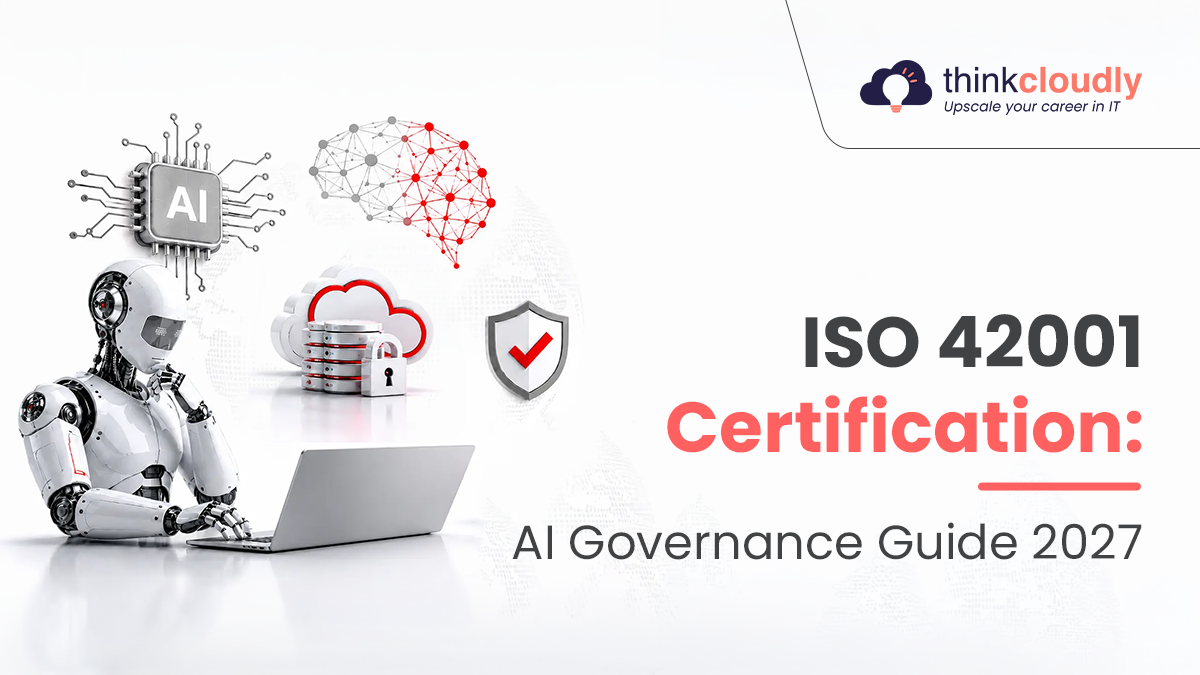
ISO/IEC 42001 is the first international standard built to certify how an organization governs artificial intelligence, and it has moved from a niche compliance topic to something procurement teams, regulators, and boards now expect evidence of.
This guide walks through what ISO 42001 certification actually involves, how it differs from becoming an ISO 42001 lead auditor, what an artificial intelligence management system needs to contain before an auditor will sign off, and how AI risk management and AI governance policies fit into the picture.
If you’re deciding whether to pursue an AI governance certification this year or whether your organization should certify at all, this is the practical version of that decision, not the sales version.
Why Is ISO 42001 Certification No Longer Optional for Many Teams?
Three forces converged to make this move so fast. The EU AI Act’s high-risk obligations under Annex III begin applying on 2 December 2027, and companies selling into the EU — regardless of where they’re headquartered — are expected to show documented governance processes well before that date, not scramble for them afterward, according to the European Commission’s AI Act overview.
A side-by-side look at how that binding regulation lines up against voluntary frameworks shows most of the groundwork for compliance has to exist before enforcement starts.
Second, the NIST AI Risk Management Framework gave US organizations a voluntary structure for AI risk management, and a growing number of them are now looking for a certifiable version of that same discipline—which is exactly what ISO 42001 certification provides, since it turns a framework into something an accredited third party can actually sign off on.
Third, enterprise buyers stopped accepting promises in vendor security reviews. A signed statement about responsible AI use carries far less weight than a certificate number an auditor can independently verify, and procurement teams have noticed.
Put together, these three forces explain why ISO 42001 certification now shows up in RFPs and job postings that had nothing to do with AI governance eighteen months ago. None of this means every company needs to certify immediately. It means the decision has stopped being theoretical and started being a line item somebody has to own.
What is an artificial intelligence management system?
Before comparing paths forward, it helps to define the core object everything else revolves around. An artificial intelligence management system, or AIMS, is the documented set of policies, roles, risk processes, and controls an organization uses to govern how it builds, buys, or deploys AI—the same way an information security management system governs security under ISO 27001.
ISO/IEC 42001, published by ISO in December 2023, is the standard that defines what a certifiable artificial intelligence management system has to contain, and it was written to apply whether your organization develops models, provides AI-enabled products, or simply uses AI tools built by someone else.
An AIMS is structured through ten core clauses covering organizational context, leadership and accountability, risk planning, resources, operation and control, performance evaluation, and continual improvement, built on the same Plan-Do-Check-Act cycle used by other ISO management-system standards.
Sitting alongside those clauses is an Annex of 38 AI-specific controls covering things like data provenance, AI system impact assessment, and human oversight—the part where most new work actually happens, especially for teams coming from a general IT compliance background rather than an AI-specific one.
None of this is theoretical paperwork sitting in a binder. Auditors pursuing ISO 42001 certification consistently ask why a particular control exists and how it was tested, not simply whether a policy document mentions it in passing.
What Does an ISO 42001 Certification Audit Actually Check?
Stop picturing a single exam and start picturing an audit that runs in two stages, months apart. Here’s what an accredited body actually looks for, broken into points simple enough to turn straight into an infographic:
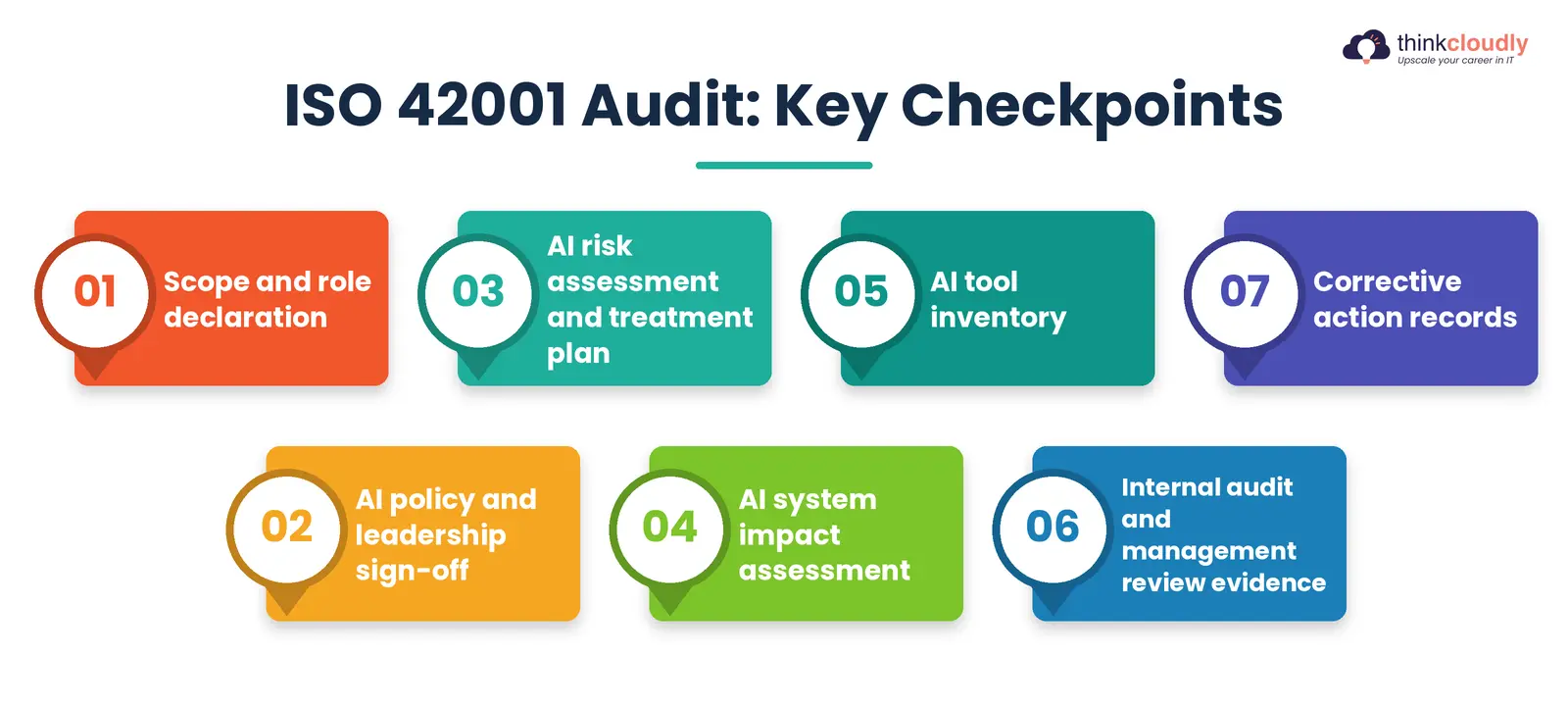
- Scope and role declaration—whether your organization is an AI developer, provider, or user, since that determines which Annex A controls even apply to you
- AI policy and leadership sign-off—a documented AI policy with real objectives, approved at a leadership level, not drafted quietly by one engineer and never reviewed again
- AI risk assessment and treatment plan—a live risk register mapped to Annex A controls, not a one-time spreadsheet built the week before the audit
- AI system impact assessment—a documented review of organizational, individual, and societal impact for every system inside scope
- AI tool inventory—a current, maintained list of every AI system, model, or vendor tool the management system actually covers
- Internal audit and management review evidence—proof the organization checks itself regularly, before an external auditor ever shows up
- Corrective action records—documentation showing how past findings were genuinely resolved, not just logged and forgotten
Fail to produce convincing evidence on any one of these, and the process stalls at Stage 2 even when Stage 1’s paperwork looked complete on the surface.
AI Governance Policies Every Organization Needs Before Certifying
A management system is only as strong as the policies feeding it, and this is the step most teams underestimate badly. Before an auditor will even schedule In Stage 1, these AI governance policies typically need to already exist in some documented, approved form:
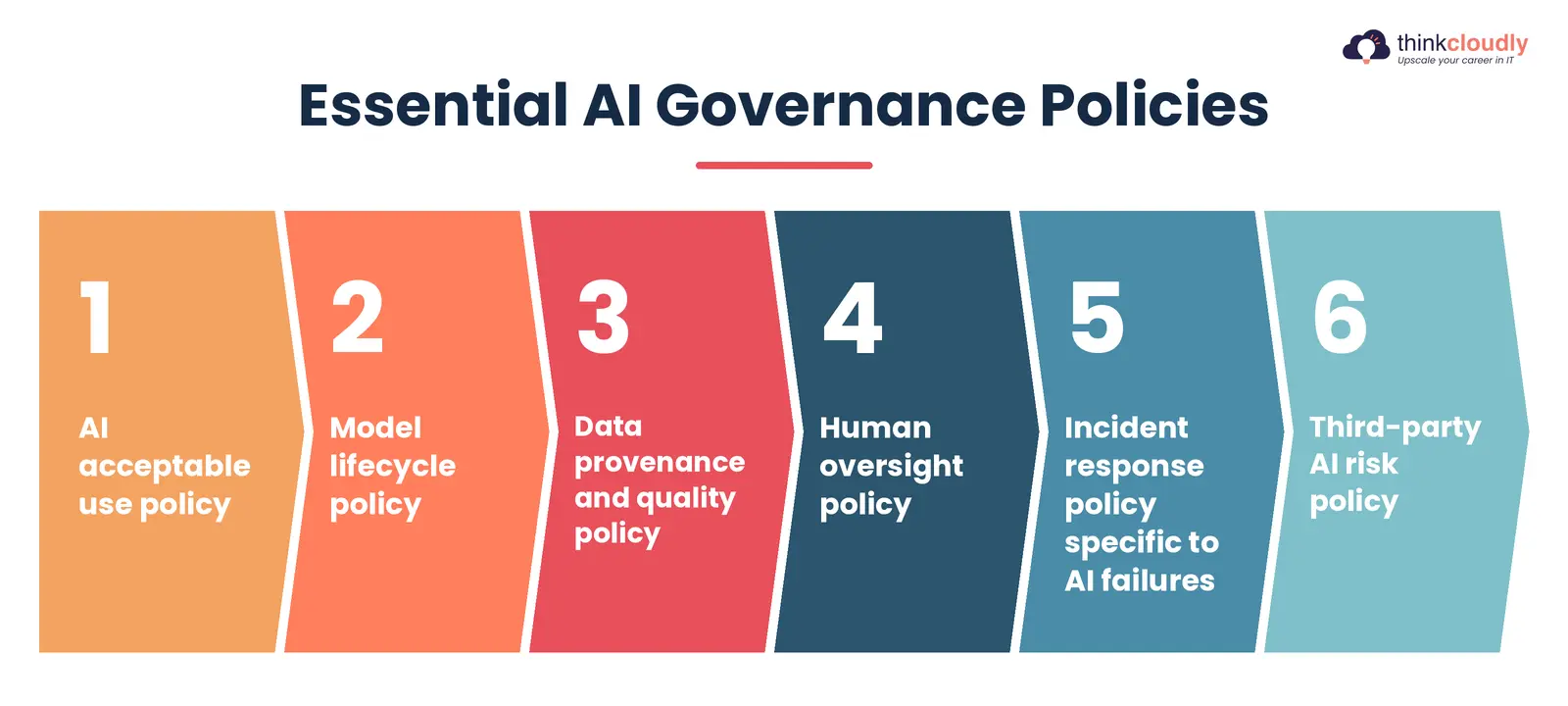
- An AI acceptable use policy defining which tools employees can use, for what purposes, and with what data
- A model lifecycle policy covering design, testing, deployment, ongoing monitoring, and eventual retirement
- A data provenance and quality policy for every dataset feeding a model inside scope
- A human oversight policy specifying exactly where a person must review or override an automated decision
- An incident response policy specific to AI failures—bias incidents, hallucinated outputs, security breaches—rather than a generic IT policy repurposed at the last minute
- A third-party AI risk policy covering vendor and foundation-model dependencies, since almost no organization builds every model it uses in-house
Skipping straight to Annex A controls without these underlying AI governance policies already in place is the single most common reason a first ISO 42001 certification attempt gets delayed by months rather than weeks.
The Organization’s Certificate vs. Your Own ISO 42001 Lead Auditor Credential
People often conflate two genuinely different things under one umbrella term. One is organizational: a company’s artificial intelligence management system gets audited and certified against the standard.
The other is personal: an individual completes training and becomes an ISO 42001 lead auditor, qualified to assess other organizations’ systems professionally, on behalf of a certification body or as an independent consultant.
The ISO 42001 lead auditor path is a multi-day course—BSI’s own version runs seven days of classroom instruction—covering AIMS concepts, audit planning under ISO 19011, and how to actually lead second- or third-party audits from opening meeting to final report.
It’s a different skill set from the AI governance certification programs built around policy design and legal frameworks, such as IAPP’s AIGP track, and it serves a smaller, more specialized audience than the people building governance programs from inside their own company.
If your career goal is auditing AI systems professionally for a living, the ISO 42001 lead auditor credential is the direct path, and job postings for “AI Audit Lead” or “Third-Party AI Assurance” roles tend to name it explicitly.
If your goal is running the day-to-day governance program inside your own organization instead, a Lead Implementer track—or a broader AI governance certification covering policy and risk design—usually fits the actual job better.
From Gap Analysis to Certificate: What the Process Actually Takes
|
Stage |
What Happens |
Typical Duration |
|
Gap analysis |
Compare current AI risk management and documentation against Annex A controls. |
2–4 weeks |
|
Build the AIMS. |
Draft governance policies, risk registers, AI system impact assessments, and tool inventory. |
2–4 months |
|
Internal audit |
Test the management system against its own documented controls before an outsider does. |
2–4 weeks |
|
Stage 1 audit |
The accredited body reviews documentation, scope, and statement of applicability. |
1–2 weeks |
|
Stage 2 audit |
Accredited bodies test whether controls actually operate in day-to-day practice. |
2–4 weeks |
|
Certificate issued |
Valid for three years, with annual surveillance audits in between |
— |
Most organizations move through this sequence in six to twelve months—faster with an existing ISO 27001 program to carry over, slower if AI risk management is being built from scratch.
What Does This Cost, Beyond the Training Fee?
Training for the lead auditor or lead implementer track typically runs somewhere between $1,200 and $1,800 per person, but that’s the smallest line item in the real ISO 42001 certification budget. Most of the cost sits in the build-out: internal hours spent writing policy, running the AI system impact assessment, and closing whatever gaps the initial gap analysis surfaces.
Audit fees from the accredited body itself usually run anywhere from $8,000 to $25,000 for a first-time certification, scaling with how many AI systems and business units fall inside the declared scope. That fee repeats, at a smaller scale, every year for surveillance audits and again in full at the three-year recertification mark.
A management system that only gets attention once every three years isn’t really a management system — it’s a filing cabinet with a renewal date stapled to it, so build quarterly risk reviews into someone’s job description before the first certificate is even issued.
Why a Risk Discipline Runs Through Every Clause?
Annex A’s 38 controls can look like a checklist from a distance, but one discipline sits underneath nearly all of them. Clause 6.1.2 requires a formal AI risk assessment; clauses 6.1.4 and 8.4 require an AI system impact assessment covering organizational, individual, and societal effects; and clause 9 requires performance evaluation that feeds findings back into that same risk register rather than filing them away in a folder nobody reopens until next year’s audit.
Treat that discipline as a habit tied to every model or data change — not an annual chore scheduled around the audit date — and the rest of the management system tends to stay current with far less last-minute scrambling.
Who Actually Needs This AI Governance Certification Right Now?
Not everyone needs to chase a credential just because the topic is trending across every LinkedIn feed. A rough filter: you likely benefit from pursuing this AI governance certification path if your organization sells AI-enabled products into regulated markets, if you work in compliance or risk and your company is actively building governance processes, or if client security reviews keep asking about AI controls your team can’t yet document with evidence.
You probably don’t need it yet if your only exposure to AI oversight is a single internal training video, or if your organization has no governance program at all for a credential to plug into. In that case, understanding the fundamentals matters far more right now than a specific credential tied to a framework nobody at your company is actually using yet.
Mistakes That Slow Down a Certification Attempt
A few patterns repeat across teams that stall partway through. Treating the standard as a one-time paperwork exercise instead of a living management system is the most common one — auditors can usually tell within minutes whether a policy was written to pass a review or to actually run the organization day to day.
Skipping the gap analysis and jumping straight to control implementation is a close second; it wastes budget rebuilding work that didn’t need rebuilding, especially for teams that already hold ISO 27001.
A third mistake is assuming a technical team can write AI governance policies alone, without legal, risk, and product input — audits consistently probe for cross-functional ownership, not just an engineering sign-off. A fourth is pursuing the lead auditor credential when what the role actually needs is a Lead Implementer background instead; the two credentials test different skills, and mismatching them wastes both time and money.
A Personal Note
I’ve sat through enough vendor security reviews this past year to notice the exact moment a conversation shifts: the moment someone asks for a certificate number instead of a policy document, and the room quietly realizes that promises don’t close deals the way accredited proof does.
What surprised me most wasn’t the compliance pressure itself — regulation always eventually demands evidence, that part was predictable. It was how many teams still treat this as a one-time documentation sprint instead of an operating habit that needs a permanent owner.
The organizations that get real value out of this work are the ones where the risk register gets reopened every time a model changes, not just once a year before an audit reminder lands in someone’s calendar.
If you’re deciding whether to start, start with the gap analysis before you buy a single training seat. You’ll know within a week whether this is a six-month project or a two-year one, and that single number will tell you more than any sales page ever will.