
If you’ve ever sat through a lecture on corporate governance and thought, “Okay, but how does this actually work inside a real company?” this guide is for you. I’ve broken down GRC implementation into the exact stages an organization moves through, without the jargon-heavy tone most corporate blogs use.
By the end, you’ll understand not just what GRC is but also how a business actually builds it from the ground up.
What Is GRC?
GRC stands for Governance, Risk, and Compliance. It’s not three separate departments awkwardly stapled together—it’s a single, coordinated approach that helps an organization run itself responsibly. Think of it like this: governance is the “how do we make decisions” layer, risk handling is the “what could go wrong” layer, and compliance is the “are we following the rules” layer.
When these three work in isolation, companies end up duplicating effort — one team runs a risk assessment, another builds a compliance checklist, and nobody talks to each other. That’s exactly the “silo problem” that pushed organizations toward a unified model in the first place, as Wikipedia’s overview of governance, risk, and compliance explains.
A successful GRC implementation removes those silos. It connects a governance framework, a structured risk process, and a compliance management system into one coordinated engine so decisions made at the top actually filter down into daily operations—and problems spotted on the ground actually reach the top.
Why Should Students Care About GRC Implementation?
If you’re studying business, IT, cybersecurity, or law, GRC is one of those topics that quietly shows up everywhere. Auditors need it. Compliance officers live in it. Even software engineers building enterprise tools need to understand it, because so much of enterprise software today is built to support GRC software platforms.
Understanding this discipline early gives you a real advantage — it’s the kind of practical, cross-functional knowledge that looks great on a resume and comes up constantly in interviews for risk, audit, and compliance roles.
The Core Pillars Before You Start Implementing
Before jumping into the steps, it helps to understand the three pillars a strong governance framework rests on:
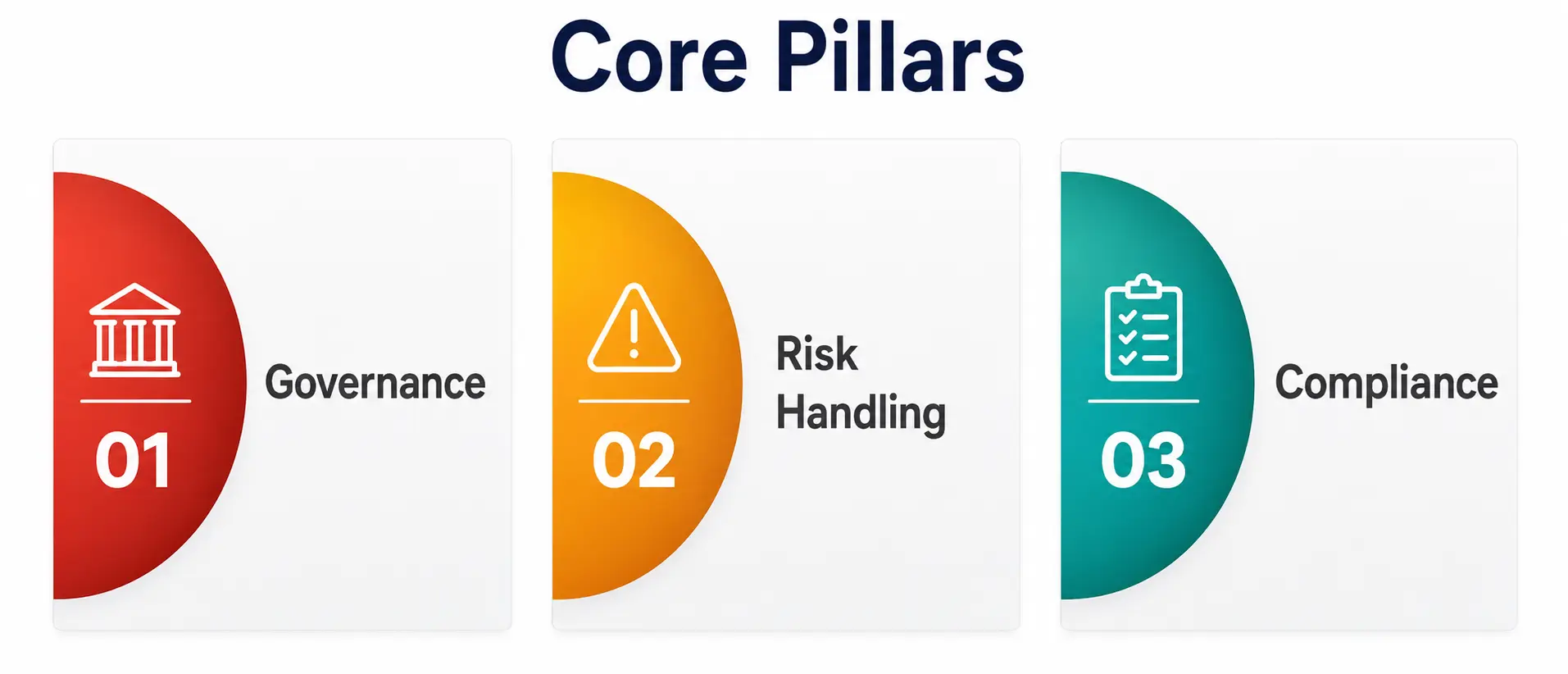
- Governance — leadership accountability, policy ownership, and ethical decision-making structures.
- Risk Handling — the ongoing process of identifying, assessing, and reducing threats to the business.
- Compliance — meeting legal, regulatory, and internal policy obligations without treating it as a box-ticking exercise.
Every stage of the rollout touches at least one of these pillars, often all three at once.
Step-by-Step GRC Implementation Guide
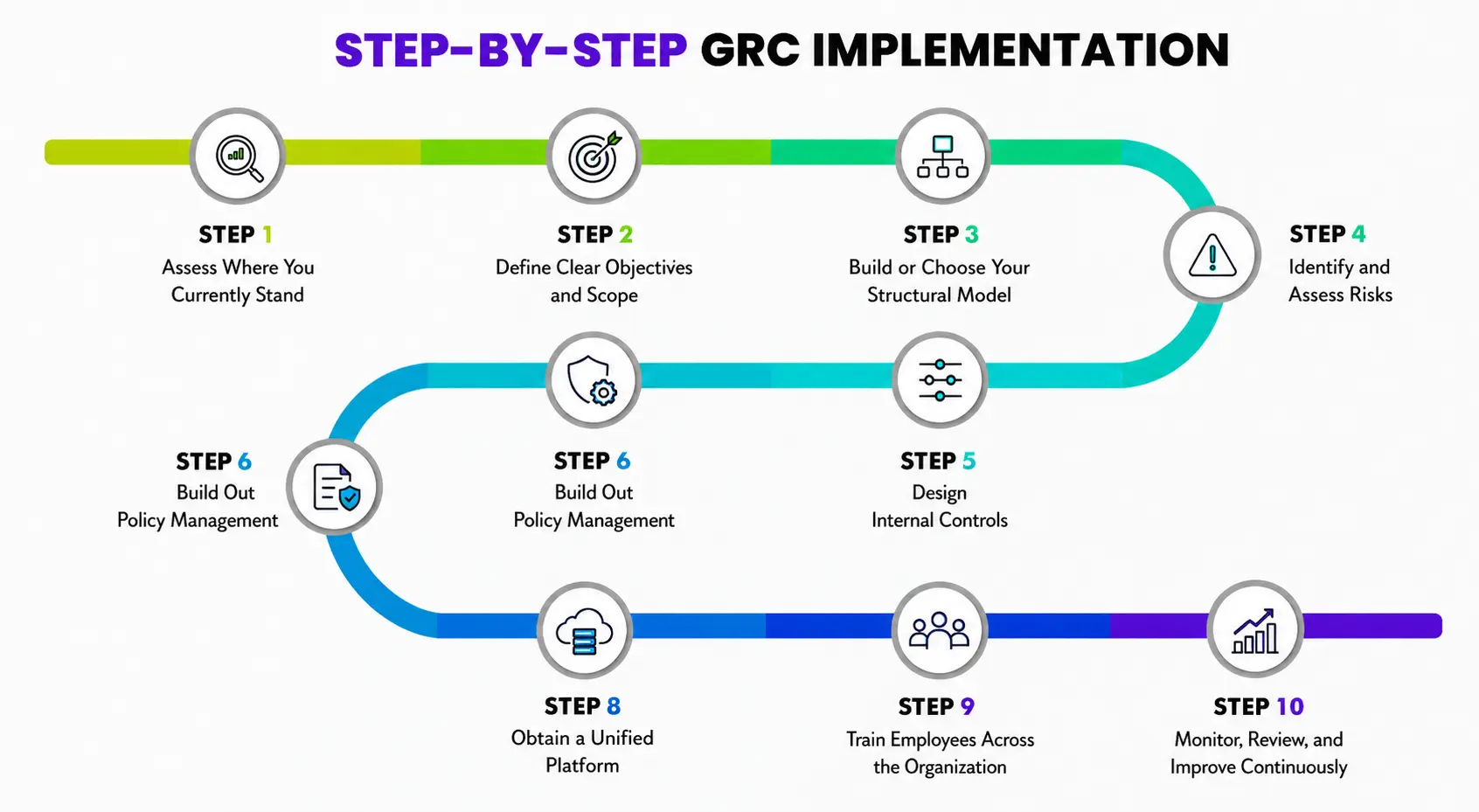
Step 1: Assess Where You Currently Stand
You can’t build a house without checking the foundation first. The first stage of any rollout is an honest audit of your existing setup. Where are your current policies documented? Who owns risk decisions today? Are compliance obligations tracked manually in spreadsheets, or is there already some structure in place?
This step usually surfaces uncomfortable truths—duplicate policies, undocumented processes, or compliance gaps nobody was tracking. That’s the point. You want the mess visible before you try to organize it.
Step 2: Define Clear Objectives and Scope
Once you know where you stand, define what “success” looks like. Are you implementing GRC to prepare for an audit? To meet a specific regulation like GDPR or HIPAA? To reduce operational risk across departments?
Your objectives should tie directly back to business goals, not just compliance for compliance’s sake. A structure built only to satisfy an auditor tends to fall apart the moment nobody’s watching. One built around real business risk tends to stick.
Step 3: Build or Choose Your Structural Model
This is where structure gets formalized. Many organizations don’t invent a framework from scratch—they adopt an established one and adapt it. Two of the most referenced are the NIST Cybersecurity Framework and ISO 31000, both of which offer proven structures instead of forcing every company to reinvent risk governance from zero.
Choosing a recognized model early makes every later step faster, because you’re not debating structure — you’re just filling it in with your organization’s specifics.
Step 4: Identify and Assess Risks
Now the actual work of identifying threats begins. This step involves cataloging risks—financial, operational, cybersecurity, and reputational—and ranking them by likelihood and potential impact. Not every risk deserves the same amount of attention, and part of mature risk governance is knowing which fires actually need putting out first. This is the heart of the discipline: turning a vague sense of “things could go wrong” into a prioritized, actionable list.
A common technique here is a risk register: a living document listing each identified risk, its owner, its severity, and the current mitigation plan.
Step 5: Design Internal Controls
Once risks are mapped, you need mechanisms to actually contain them. This is where internal controls come in — the specific checks, approvals, and safeguards that reduce the chance of a risk becoming a real problem.
Internal controls can be as simple as requiring two signatures on large payments or as complex as automated access-logging systems. The goal isn’t to eliminate all risk—that’s impossible—it’s to bring risk down to a level the organization is comfortable accepting, which is really the whole point of risk governance in practice.
Step 6: Build Out Policy Management
Policies are how governance decisions get communicated to actual employees. Strong policy management means every policy has a clear owner, a review date, and a distribution plan—so policies don’t just sit in a folder nobody opens.
One of the most common reasons GRC programs fail is poor policy management. A policy that exists on paper but no employee has read or acknowledged provides no real protection – it only creates a false sense of coverage.
Step 7: Set Up Compliance Oversight
Compliance is not a one-time check box; it is an ongoing thing. This step sets up the systems that continuously verify that the company is actually living up to its own policies and external regulations. For example, ISACA offers detailed guidance on the structure of ongoing compliance management processes that can withstand audit scrutiny.
Good compliance management at this stage often includes scheduled internal audits, automated policy violation alerts, and well-defined escalation paths when something doesn’t add up.
Step 8: Obtain a Unified Platform
Manual spreadsheets are okay for small teams but collapse under real organizational complexity. This is the power of GRC software—unifying risk registers, policy libraries, audit trails, and compliance dashboards onto a single platform that everyone can use.
The right platform doesn’t just store information — it should surface real-time risk indicators and flag compliance gaps before they turn into violations. That shift, from reactive to proactive, is often the biggest single improvement this kind of rollout delivers.
Step 9: Train Employees Across the Organization
A framework nobody understands is a framework nobody follows. Training turns abstract policy documents into behavior people actually practice—recognizing phishing attempts, correctly classifying sensitive data, and escalating risks they notice on the ground.
This step is frequently underfunded, which is a mistake. The strongest governance framework in the world fails if the people executing it every day don’t understand why it exists.
Step 10: Monitor, Review, and Improve Continuously
This process isn’t a project with an end date — it’s a cycle. Regulations change, new risks emerge, and business priorities shift. The final step is building a rhythm of continuous review: quarterly risk reassessments, annual policy refreshes, and regular audits of your internal controls to confirm they’re still doing their job.
Organizations that treat this work as “done” after the initial rollout tend to drift out of compliance within a year or two. The ones that treat it as a living system stay ahead of both regulators and real-world threats.
GRC Implementation Stages at a Glance
|
Stage |
Primary Focus |
Typical Output |
|
Assessment |
Current-state review |
Gap analysis report |
|
Objective Setting |
Business alignment |
Defined scope and goals |
|
Framework Selection |
Structure |
Adopted governance framework |
|
Risk Identification |
Risk management |
Risk register |
|
Control Design |
Risk mitigation |
Internal controls documentation |
|
Policy Management |
Communication |
Published, owned policies |
|
Compliance Monitoring |
Ongoing oversight |
Audit schedule, alerts |
|
Software Adoption |
Centralization |
Deployed GRC software |
|
Training |
Adoption |
Trained workforce |
|
Continuous Review |
Sustainability | Updated framework, ongoing audits |
Common Mistakes Organizations Make During the Rollout
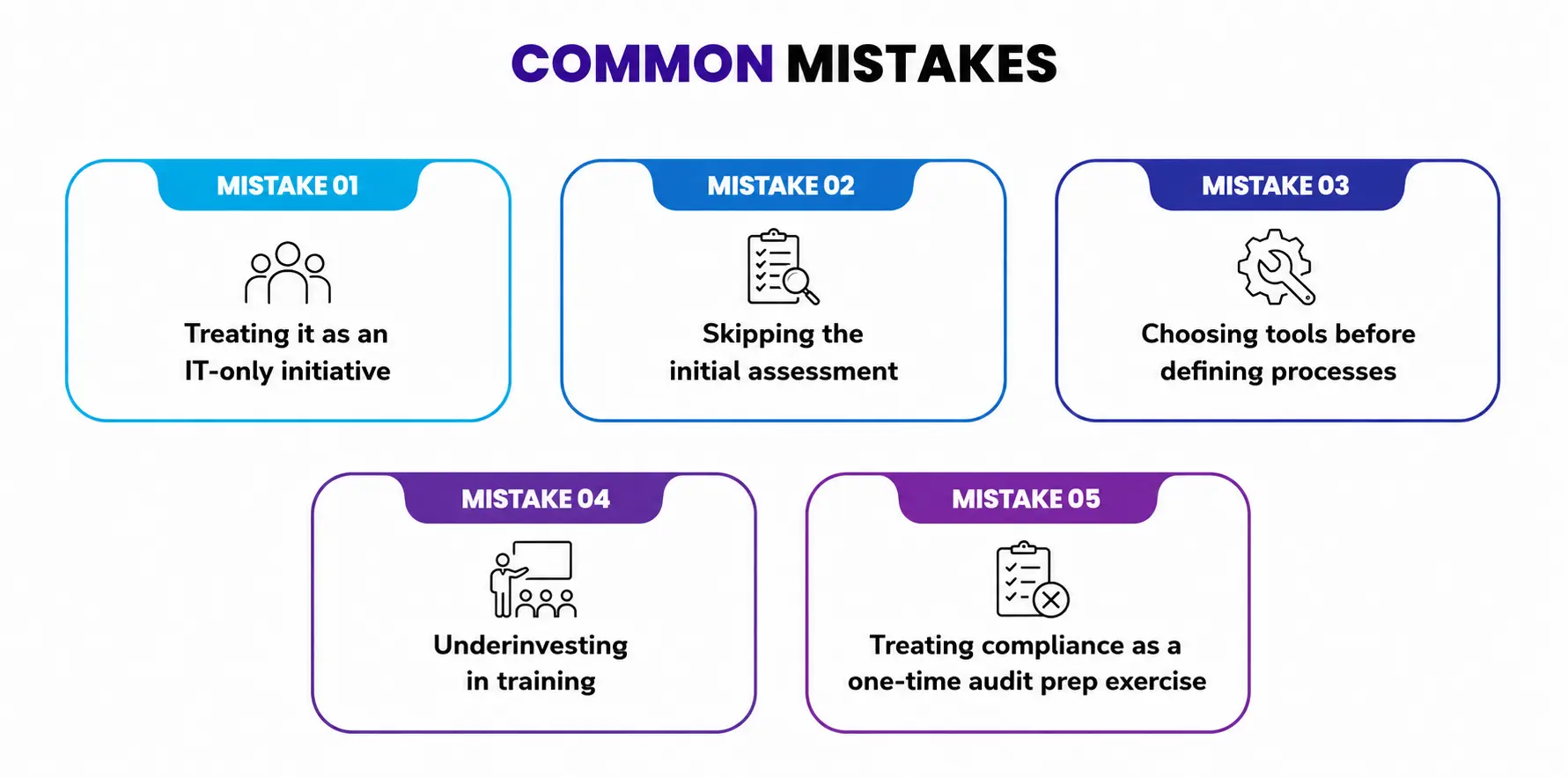
- Treating it as an IT-only initiative. GRC touches HR, finance, legal, and operations — not just the security team.
- Skipping the initial assessment. Building your structure on an unclear foundation guarantees rework later.
- Choosing tools before defining processes. Software should support your risk governance approach, not dictate it.
- Underinvesting in training. Policies without understanding rarely translate into actual compliant behavior, no matter how thorough your policy management process looks on paper.
- Treating compliance as a one-time audit prep exercise instead of an ongoing discipline.
A Personal Note
I’ve written a fair number of process guides, and GRC is one of those topics that look intimidating from the outside—three big words, a lot of acronyms, a lot of consulting-speak. But once you break it down step by step, it’s really just structured common sense: know your risks, write down your rules, check that people are following them, and keep improving.
If you’re a student trying to break into risk, audit, or compliance work, don’t wait until your first job to understand this—spend an afternoon mapping out how a company you know (even a small one) might approach these ten steps. That exercise will teach you more than any textbook chapter on the subject.