

When most people hear the words “IT Audit,” they picture a stack of spreadsheets and a stressed-out IT manager. But an IT Audit is really just a structured check-up — someone independent looks at how a company’s systems, data, and internal controls are actually run, compares that to how they’re supposed to be run, and writes down the gaps.
Those gaps are what auditors call audit findings, and if you look across enough of them, a clear pattern emerges: the same ten problems show up again and again, in almost every industry, almost every year.
I put this guide together for students and early-career professionals who want to understand what a real IT Audit actually uncovers — not the textbook version, but the version that shows up in actual reports. Each finding below includes why it happens, what it looks like on paper, and a practical fix, along with a link to a credible source if you want to go deeper.
Why Do the Same Audit Findings Keep Coming Back?
Here’s the uncomfortable truth: most organizations don’t fail an IT Audit because they lack good policies. They fail because nobody enforces the policies consistently, and nobody checks whether the controls are actually working until an auditor shows up and asks.
According to ISACA’s resource library on information systems auditing, auditors are increasingly finding that governance frameworks exist on paper but aren’t operating as intended — which matters just as much for regulatory compliance as it does for day-to-day operations, and is exactly why internal controls testing keeps surfacing the same weaknesses year after year.
Below is a quick reference table, followed by a full breakdown of each finding.
|
# |
Common Finding | Underlying Cause |
Quick Fix |
|
1 |
Weak access controls | No regular access reviews |
Quarterly user access recertification |
|
2 |
Missing patch management | No formal patching schedule |
Automated patch deployment + tracking |
|
3 |
Weak password policies | Outdated complexity rules |
Adopt NIST-aligned passphrase policy |
|
4 |
Lack of segregation of duties | Small teams, overlapping roles |
Role redesign + compensating controls |
|
5 |
Poor change management | Undocumented production changes |
Formal change approval workflow |
|
6 |
Weak backup/disaster recovery | Backups untested |
Scheduled recovery drills |
|
7 |
Insufficient logging and monitoring | Logs not centralized or reviewed |
Centralized SIEM with alerting |
|
8 |
Unencrypted sensitive data | Encryption seen as optional |
Encrypt data at rest and in transit |
|
9 |
No security awareness training | One-time onboarding session only |
Ongoing, recurring training program |
|
10 |
Non-compliance with regulations | No mapped compliance framework |
Map controls to a recognized framework |
Let’s walk through each one.
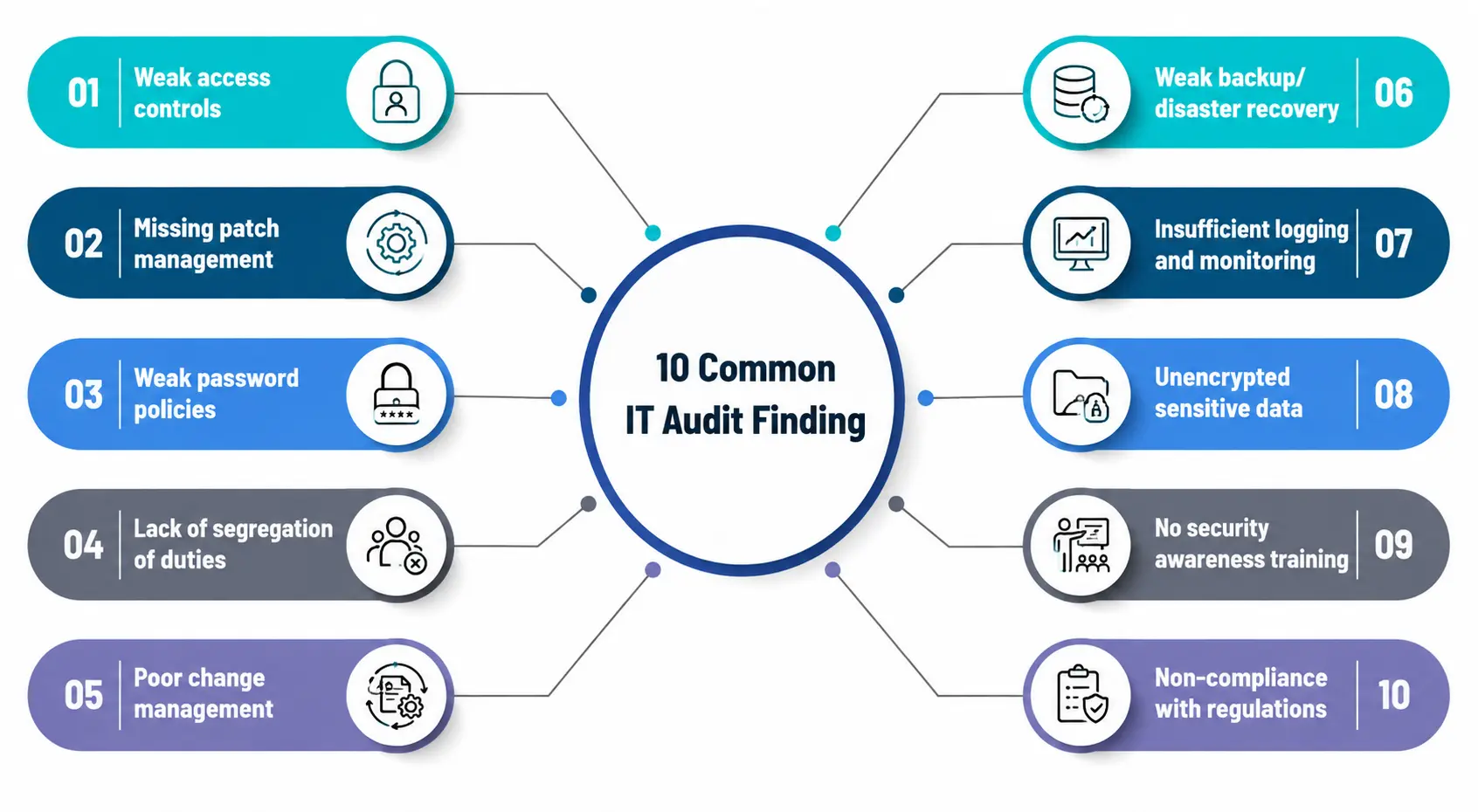
1. Weak Access Controls and Excessive User Privileges
This is, by far, the most common finding in nearly every IT Audit. Auditors pull a list of user accounts and find employees who left the company eight months ago still holding active logins, contractors with admin rights nobody remembers granting, and “temporary” access that became permanent by accident.
Why it happens: Access is easy to grant and easy to forget to revoke. Without a scheduled review process, permissions just accumulate.
How to fix it: Run a formal user access review every quarter, tie access directly to job role (not to convenience), and automatically disable accounts the moment someone leaves. ISACA’s step-by-step guide to user access reviews walks through exactly how to build this process from scratch.
The risk, if ignored: Excess privileges are one of the fastest routes to a serious cyber risk event, since a single compromised account can suddenly have far more reach than it should. Tightening access is also one of the highest-leverage network security improvements a team can make, because it shrinks the blast radius of almost every other weakness on this list.
2. Missing or Delayed Patch Management
Auditors love checking patch levels because it’s an easy, factual thing to verify — and it’s almost always behind schedule somewhere. A missing patch on a public-facing server is one of the simplest ways attackers get in, and it’s also one of the easiest things to prevent.
Why it happens: Patching gets deprioritized because it can cause downtime, and “we’ll do it next sprint” quietly becomes “we never did it.”
How to fix it: Build a documented patch management policy with defined timeframes for critical, high, and low-severity vulnerabilities, and track exceptions formally instead of letting them slide. NIST’s guide to enterprise patch management is the standard reference most auditors will expect your policy to resemble.
The risk, if ignored: Unpatched systems are a direct and well-documented source of cyber risk, and they’re often the first thing flagged in an external network security assessment.
3. Weak Password Policies
For years, companies enforced complex passwords that had to be changed every 30 or 60 days — and it turns out that approach actually made security worse, because people wrote passwords down or reused predictable patterns. This is now a very common IT Audit finding in the opposite direction: outdated policies that don’t reflect current guidance.
Why it happens: Password policy was set years ago and nobody revisited it once better research came out.
How to fix it: Move toward longer passphrases instead of complexity requirements, screen new passwords against breach databases, and only force resets when there’s evidence of compromise. NIST’s guidance on digital identity explains exactly why this approach is now considered best practice.
The risk, if ignored: Weak or reused passwords remain one of the top entry points attackers use, undermining network security no matter how strong the rest of your defenses look.
4. Lack of Segregation of Duties
This finding shows up constantly in smaller IT teams. One person can request a change, approve it, and deploy it to production — with nobody else in the loop. That’s not a personal trust issue; it’s a structural control gap.
Why it happens: Small teams wear multiple hats, and segregation of duties feels like a luxury they can’t afford.
How to fix it: Where you can’t fully separate roles, add compensating internal controls — like mandatory peer review or a second approver for high-risk changes. The COSO Internal Control framework is the reference point most auditors use to evaluate whether your internal controls are actually sufficient given your team size.
The risk, if ignored: Without segregation of duties, both honest mistakes and deliberate fraud are far harder to catch before damage is done.
5. Poor Change Management
Auditors ask a simple question: “Show me the approval trail for this production change.” Too often, there isn’t one. A developer pushed a fix directly to production because it was urgent, and nobody documented it.
Why it happens: Change management processes feel slow, so under deadline pressure, people route around them.
How to fix it: Implement a lightweight but mandatory change approval workflow — even an expedited “emergency change” path still needs documentation and after-the-fact review. Strong IT general controls, as described in SailPoint’s overview of ITGC, depend heavily on this kind of documented change trail.
The risk, if ignored: Undocumented changes are a leading cause of unplanned outages, represent a quiet but real cyber risk, and make it nearly impossible to trace the root cause when something breaks.
6. Weak Backup and Disaster Recovery Planning
Backups exist almost everywhere. What’s often missing is proof that they actually work. Auditors regularly find backup jobs that have been silently failing for months, or a disaster recovery plan that was written once and never tested.
Why it happens: Backup and recovery feel like “set it and forget it” tasks until an actual incident proves otherwise.
How to fix it: Schedule regular recovery drills, not just backup jobs, and document recovery time and recovery point objectives for every critical system. NIST’s contingency planning guide lays out a structured, seven-step process for building and testing a real recovery plan.
The risk, if ignored: An untested backup is really just a guess. Ransomware incidents in particular expose this finding fast, since recovery only matters when it’s actually needed.
7. Insufficient Logging and Monitoring
This finding often surfaces after something has already gone wrong: an auditor — or worse, an incident responder — asks for logs from three months ago, and they simply don’t exist, or nobody was watching them in real time.
Why it happens: Logging gets turned on by default, but reviewing it is a manual, unglamorous task that keeps getting deprioritized.
How to fix it: Centralize logs from critical systems into a single monitoring platform, set up alerting for suspicious activity, and define a minimum retention period. NIST’s guide to computer security log management is a solid foundation for building this out properly, and it directly strengthens your overall network security posture.
The risk, if ignored: Without visibility, a breach can sit undetected for months, quietly increasing cyber risk and giving attackers far more time inside the environment.
8. Unencrypted or Poorly Protected Sensitive Data
Auditors frequently find sensitive data — customer records, financial data, credentials — stored or transmitted without encryption. Sometimes it’s a legacy system nobody wanted to touch; sometimes it’s simply an oversight.
Why it happens: Encryption is treated as a “nice to have” rather than a baseline requirement, especially for internal systems assumed to be “safe enough.”
How to fix it: Encrypt sensitive data both at rest and in transit as a default, not an exception, and include encryption requirements explicitly in your information security management system. The ISO/IEC 27001 standard treats encryption as a core control within a broader risk-based approach to information security, and it’s often the fastest way to strengthen regulatory compliance across several frameworks at once.
The risk, if ignored: Unencrypted data turns a routine breach into a catastrophic one, since the attacker doesn’t just get access — they get usable, readable information.
9. No Ongoing Security Awareness Training
A single onboarding presentation about phishing, delivered once on someone’s first day and never repeated, is one of the most common gaps auditors call out. People forget, threats evolve, and a one-and-done approach doesn’t hold up.
Why it happens: Training is treated as a compliance checkbox rather than an ongoing behavioral program.
How to fix it: Run short, recurring training sessions, combined with simulated phishing tests, so awareness stays current. CISA’s cybersecurity best practices resources are a genuinely useful, free starting point for building this kind of program.
The risk, if ignored: Since human error is behind the large majority of breaches, skipping ongoing training leaves your biggest attack surface — your own people — essentially unmanaged.
10. Non-Compliance With Regulatory Frameworks
Finally, auditors often find that a company claims to follow a particular standard — ISO 27001, SOC 2, GDPR, HIPAA — without having actually mapped its controls to that framework’s specific requirements. The intention was there; the documentation wasn’t.
Why it happens: Regulatory compliance gets treated as a one-time certification project instead of an ongoing operating discipline.
How to fix it: Pick the frameworks that actually apply to your industry and data, map your existing controls against them explicitly, and assign clear ownership for keeping that mapping current. This comparison of SOC 2, ISO 27001, and GDPR is a useful starting point for understanding how these frameworks overlap and where they differ.
The risk, if ignored: Beyond fines, failing regulatory compliance checks damages customer trust and can disqualify you from doing business with larger, more security-conscious partners.
A Personal Note
I’ll be honest with you: the first time I read a full IT Audit report, it felt less like a technical document and more like a mirror. Every finding pointed back to a decision someone made under time pressure — skip the review this quarter, push the change without sign-off, put off the password policy update.
None of these ten findings are really about technology failing. They’re about process discipline slipping, quietly, over time. If you’re a student learning this field, the real skill isn’t memorizing frameworks — it’s learning to notice where shortcuts are quietly becoming habits, before an auditor has to point it out for you.