
Every commerce or finance student runs into the word “audit” sooner or later, and the first real confusion usually shows up when comparing internal vs. external audits. The two terms get used interchangeably in textbooks and exam answers, but they describe two very different jobs, with different bosses, different goals, and different outputs.
This guide breaks down the internal vs. external audit question in plain language, walks through seven concrete differences, and gives you a reference table you can actually use while studying or working on your first audit file.
What Is an Internal Audit?
Internal audit is a function that lives inside the organization. According to the Institute of Internal Auditors, internal auditing is an independent, objective assurance and consulting activity designed to add value and improve an organization’s operations, helping it achieve its objectives through a systematic, disciplined approach.
In other words, an internal audit isn’t just checking numbers—it’s checking whether the whole machine is running the way management thinks it is. Internal auditors are usually full-time employees or an outsourced team, reporting to the audit committee or the board rather than to the CEO alone.
Their job includes reviewing financial controls, testing whether processes are followed correctly, and flagging weaknesses before they turn into real problems. This is one half of the picture — the half that’s always watching from the inside.
What Is an External Audit?
External audits work the opposite way. It’s performed by an independent firm—usually a chartered accountant or CPA practice—with no employment relationship to the company being audited.
Under standard financial statement audit guidance, auditors test whether financial statements fairly represent a company’s financial position, using formal auditing standards developed and maintained by professional accounting bodies.
An external audit exists to protect people outside the company: shareholders, banks, tax authorities, and regulators. That’s the core split between the two functions—one serves management, the other serves the outside world. A statutory external audit is usually a legal requirement for listed companies, and its output is a formal audit opinion, not a private management memo.
Internal vs External Audit: 7 Key Differences
Here’s the side-by-side comparison most students actually need when they’re trying to separate internal vs. external audits for an exam or a client conversation.
|
Aspect |
Internal Audit |
External Audit |
|
Performed by |
In-house or outsourced audit team |
Independent CPA/CA firm |
|
Reports to |
Audit committee / board (Management Reporting) |
Shareholders and regulators |
|
Objective |
Improve operations, test Financial Controls |
Give an opinion on financial statements |
|
Scope |
Broad—includes Operational Audit work |
Narrow — mainly financial statements |
|
Frequency |
Continuous, year-round |
Usually annual |
|
Legal requirement |
Optional, unless mandated by a regulator |
Often mandatory (statutory) |
|
Independence |
Independent of the department audited, not the company |
Fully independent of the company |
1. Purpose and Objective
Internal audit exists to help the organization run better. An external audit exists to confirm the organization’s numbers are trustworthy for outsiders. This single distinction drives everything else in this comparison — it decides who the auditor answers to and what “success” looks like on each side.
2. Who Performs the Work
Internal auditors are part of, or contracted directly by, the company. External auditors must stay independent — under most regulatory regimes, the same firm generally cannot audit a client’s internal controls and its financial statements without independence safeguards in place.
3. Reporting Line and Management Reporting
Internal audit findings flow into management reporting—a working paper trail seen by department heads, the CFO, and the audit committee. External audit output is a formal, public opinion letter attached to the financial statements, not an internal memo. This is a defining line in the internal vs. external audit relationship: one report stays inside the building, the other goes out with the annual report.
4. Scope: Financial vs Operational Audit
An external audit sticks close to the numbers. An internal audit stretches further into operational audit territory—reviewing whether a warehouse process, a procurement cycle, or an IT access policy actually works as intended, well beyond what shows up on a balance sheet. An operational audit rarely happens externally, because outside auditors aren’t scoped or paid to review day-to-day operations.
5. Audit Procedures Used
Both sides use overlapping audit procedures—sampling, vouching, confirmation, and analytical review—but they apply them differently. Internal audit procedures often repeat throughout the year on a rolling, risk-based plan. External audit procedures are concentrated into a single engagement window built around year-end reporting deadlines.
6. Control Testing Approach
Control Testing is where the two functions actually cooperate. An internal audit typically runs control testing continuously and reports gaps to management before year-end. External auditors then rely partly on that control testing work to decide how much of their own testing they still need to do and how far to extend it, following guidance on evaluating an internal audit’s contribution to a financial audit.
7. Frequency and Independence Standard
Internal audits run all year; external audits are typically a once-a-year statutory event. Internal auditors need to be independent of the specific unit they’re reviewing, not of the whole company—they’re still employees. External auditors must be completely independent of the entire entity, which is one reason regulators restrict an external audit firm from also performing certain internal audit functions for the same client.
Types of Audits Internal Auditors Actually Run
Internal audit isn’t one fixed checklist—it covers several distinct audit types, and knowing them helps separate the function from a narrow one. External audit engagement:
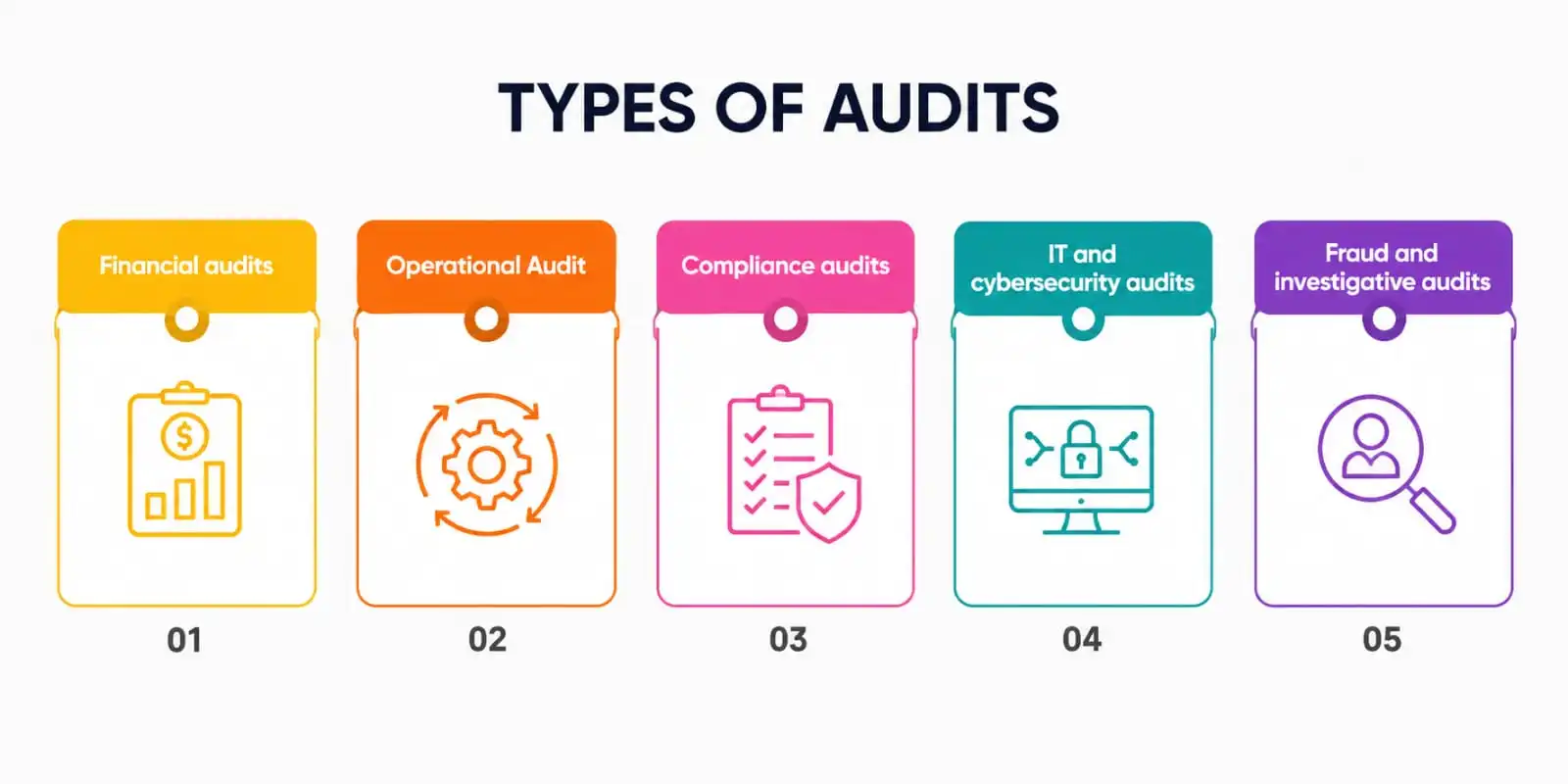
- Financial audits—testing financial controls and transaction accuracy, similar in technique to what an external firm does, but run on the company’s own schedule.
- Operational Audit — reviewing process efficiency: procurement cycles, inventory handling, production workflows, and approval chains.
- Compliance audits — checking adherence to laws, industry regulations, or internal policy.
- IT and cybersecurity audits — testing access controls, data security, and system change management.
- Fraud and investigative audits — following up on specific red flags raised by whistleblowers or unusual transaction patterns.
An external audit almost never runs all five of these in one engagement; it’s scoped tightly around the financial statements, with anything else treated as incidental.
What an External Audit Report Actually Contains
The end product of an external audit is a formal opinion, and it comes in one of four standard flavors: unqualified (clean), qualified, adverse, or a disclaimer of opinion. Each signals a different level of confidence in the financial statements to the people reading the annual report.
Beyond the opinion itself, external auditors may also issue related assurance reports — for example, SOC 1 and SOC 2 reports covering controls relevant to a company’s customers and business partners. Internal audit, by contrast, rarely produces a single formal opinion at all; its output is a continuous stream of findings and action plans rather than one annual verdict.
Career Path: Internal Auditor vs External Auditor
For students weighing which side to pursue, the qualifications and day-to-day work differ meaningfully. External auditors typically build their career around a CPA or CA license, spend early years at a public accounting firm, and work engagement-by-engagement across multiple clients each year.
Internal auditors more often pursue a Certified Internal Auditor (CIA) credential, sometimes alongside a CPA, and build deep, long-term knowledge of a single organization’s operations, risk register, and financial controls rather than rotating between clients.
Neither path is objectively “better”—external audit tends to offer broader exposure to different industries early on, while internal audit tends to offer closer involvement in strategy, operational audit work, and risk management. Plenty of professionals move between the two over a career, taking audit procedure experience from one side into the other.
Documentation and Evidence Standards
Both functions live and die by their working papers, but the retention and formality differ. External audit documentation must meet professional standards strict enough to support a legal opinion—file retention periods, evidence sufficiency, and sign-off trails are all tightly regulated.
Internal audit documentation still needs to be defensible, especially for control testing that feeds into management reporting for the audit committee, but it has more flexibility in format since it isn’t backing a public opinion letter.
Why the Internal vs. External Audit Line Matters for Students
If you’re studying accounting, the internal vs. external audit distinction shows up everywhere—in CA and CPA exam papers, in interview questions, and in your first real audit assignment.
Get the reporting line wrong (saying internal audit reports to shareholders, for instance), and you’ve misunderstood the whole point of the function. The simplest way to remember it: an internal audit protects the organization from itself; an external audit protects outsiders from being misled by the organization.
Financial Controls: The Shared Ground Between Both Audits
Financial controls sit at the center of both audit types, just viewed from different angles. Internal audit designs and tests Financial controls are proactive, often using the COSO Internal Control framework as a reference model for the control environment, risk assessment, and monitoring.
External auditors test a sample of those same financial controls, but only deep enough to support their opinion on the financial statements—they aren’t trying to redesign the control environment, just verify it holds up.
Weak financial controls usually surface first in internal audit reports, long before an external engagement even begins. That’s part of why boards increasingly expect internal audits to flag financial control issues early, rather than let them surface later as external audit findings.
Operational Audit: Where Internal Audit Goes Further
An operational audit looks at efficiency and effectiveness, not just accuracy. Think process bottlenecks, wasted inventory, weak approval chains, or a procurement system that lets duplicate payments slip through.
This kind of operational audit work almost never appears in an external engagement’s scope—it’s too far removed from “true and fair” financial reporting to be commercially or legally required there. For students, remembering that operational audit work belongs almost exclusively to internal audit is a quick way to settle audit-scope questions on an exam.
Management Reporting: Who Actually Reads the Output
Management reporting from internal audits tends to be detailed, frequent, and operational—a running list of findings, root causes, and corrective-action deadlines shared with department heads.
The external audit’s version of management reporting is narrower: a management letter noting control deficiencies discovered incidentally while forming the audit opinion, shared once a year. Neither replaces the other; strong management reporting from internal audit actually makes the external process faster because less gets discovered cold.
A Quick Real-World Example
Picture a mid-size manufacturing company. Its internal audit team runs quarterly control testing on the purchase-to-pay cycle and reports gaps directly to the audit committee as part of routine management reporting. Nine months later, the external firm arrives to audit year-end financial statements.
Because the internal audit’s financial controls testing has already caught and fixed a duplicate-payment gap, the external auditors reduce their own testing in that area and finish the engagement faster. That’s an internal and external audit working together as intended—not two separate exercises, but two checkpoints on the same set of risks, connected by evidence.
Common Mistakes Students Make
A few recurring errors show up when people first learn about internal and external audits:
- Assuming an internal audit is “less important” because it isn’t a legal requirement everywhere—in regulated industries, it often is mandatory.
- Confusing an operational audit with a compliance audit; they overlap but aren’t identical.
- Forgetting that external audit opinions cover the financial statements as a whole, not every single transaction.
- Assuming audit procedures are identical across both, the objective changes the procedure, even when the technique, such as sampling or confirmation, looks the same on paper.
Personal Note
I’ve sat through enough first-year audit lectures to know this topic usually gets taught as a memorization exercise—internal reports here, external reports there—and that’s exactly why it doesn’t stick.
What actually made it click for me was following one control gap from an internal audit working paper all the way through to how the external auditors treated it months later. Once you see internal vs. external audit as two connected checkpoints on the same set of risks, rather than two unrelated definitions to memorize, the whole topic gets a lot easier to hold onto—for an exam and for the actual job.
Key Takeaways
- Internal audit works inside the organization, year-round, to strengthen financial controls and operations; external audit is an independent, usually annual, check on the financial statements for outside stakeholders.
- Management reporting from internal audit stays largely internal; an external opinion letter is public and attached to the annual report.
- Operational audit work belongs almost entirely to internal audit—external engagements rarely go beyond the numbers.
- Both sides rely on overlapping audit procedures and control testing but apply them on different schedules and for different purposes.
- Strong internal financial controls testing tends to shorten and simplify the external audit that follows later in the year.
Keep this table and these seven points handy the next time you’re asked to explain audit types in an interview, a case study, or an exam—they cover the distinction cleanly without needing to memorize a textbook definition word-for-word.