
If you’re studying compliance, risk, or information security, you’ll eventually run into the same phrase again and again: GRC audit. It sounds intimidating the first time you hear it, but once you understand what auditors are actually looking for, it stops being a mystery and starts being a checklist you can learn.
A GRC audit is simply a structured review of how well an organization’s governance, risk, and compliance activities actually work in practice — not just on paper. Auditors compare what a company says it does against what it actually does, and the gap between the two is where every finding comes from.
Some findings are minor and get closed within a week. Others point to real weaknesses in how a business is run, and those can take months to fix properly. This post walks through the findings that show up most often during this kind of review, why they happen, and what a realistic fix usually looks like.
It’s written for students and early-career professionals who want to understand this field the way a working auditor actually thinks about it, not the way a textbook summarizes it.
What Is a GRC Audit, Really?
Governance, Risk, and Compliance (GRC) is the umbrella term for how an organization sets direction (governance), identifies and manages threats to its objectives (risk), and follows the laws and standards that apply to it (compliance).
A GRC audit tests all three at once, because in most companies they’re tangled together — a weak governance framework almost always shows up later as a compliance gap, and a skipped risk step almost always shows up later as an incident.
During this stage of the review, the assessor isn’t just skimming policy documents. They’re asking whether the organization can prove, with evidence, that controls were actually followed on the dates they were supposed to be followed.
That’s the part students usually underestimate: it’s not enough to have good policy written down somewhere. You need logs, sign-offs, ticket histories, and version control that show the policy was lived, not just published.
Why This Topic Matters for Students and Early-Career Professionals?
Every certification in this space — from ISACA’s CISA to ISO 27001 lead auditor training — tests your ability to spot these patterns. Employers hiring for GRC, internal audit, or compliance analyst roles will often ask candidates to walk through a mock finding and describe root cause and remediation in the interview itself.
Knowing the common issues before you sit through your first real GRC audit gives you a real head start, because the same handful of problems repeat across almost every industry, from banking to healthcare to SaaS.
It also changes how you read a job description. When a posting mentions “control testing,” “evidence collection,” or “framework alignment,” it’s usually describing the exact activities covered below.
The Most Common Findings You’ll See
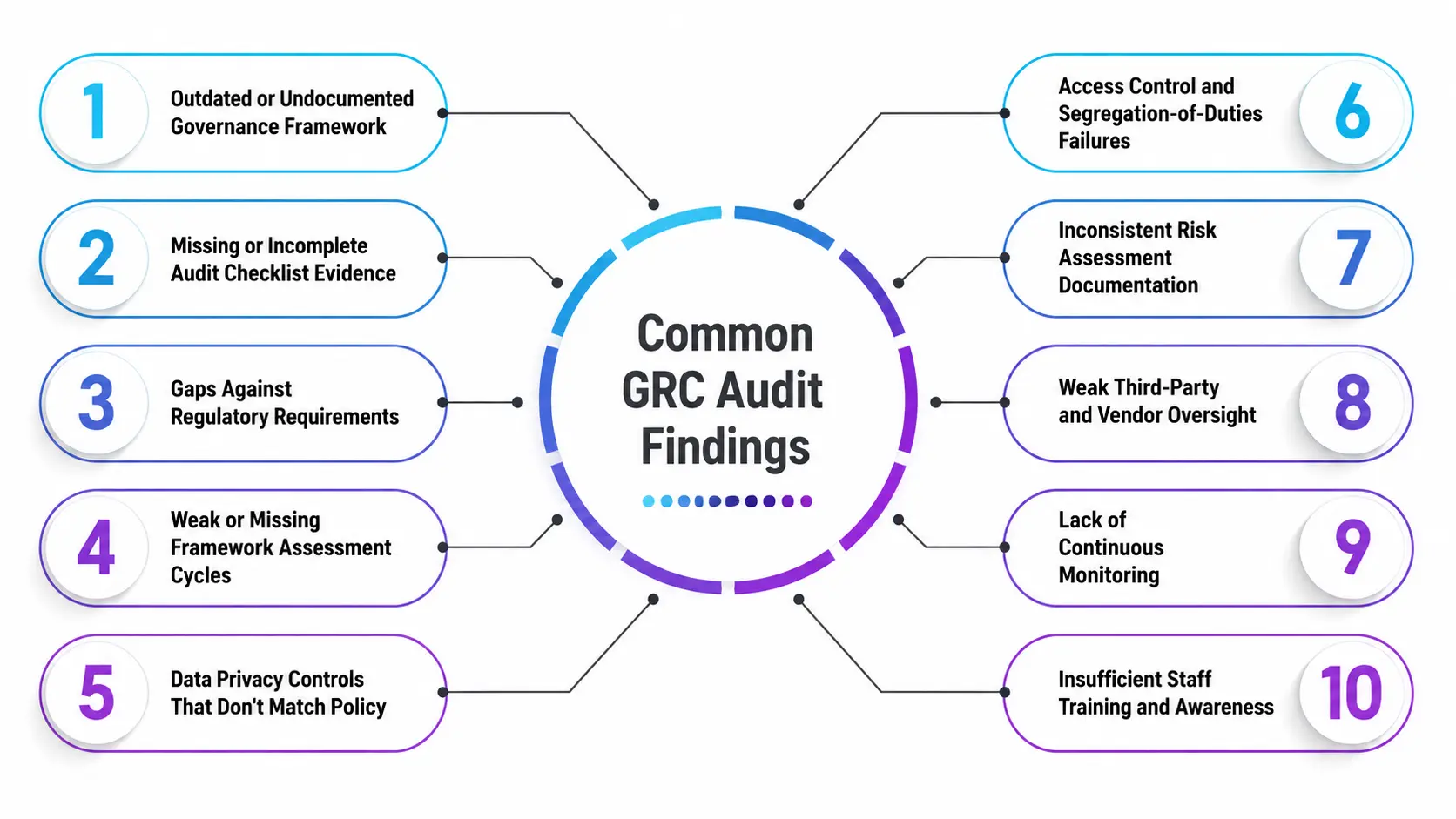
1. Outdated or Undocumented Governance Framework
This is the single most common opening finding in almost any review of this kind. A company built its governance structure three or four years ago, assigned ownership to someone who has since left, and nobody has revisited it since.
The document still technically “exists,” but it no longer matches how the business actually operates — new systems, new vendors, new reporting lines. Auditors flag this because a framework that isn’t maintained can’t protect against risks that didn’t exist when it was written.
ISACA’s COBIT model is one of the most widely referenced approaches for keeping ownership and review cycles built into the structure itself, rather than left to chance.
2. Missing or Incomplete Audit Checklist Evidence
Auditors don’t take your word for it — they want proof. A recurring finding is a control that’s described correctly in policy but has no supporting evidence trail behind it: no sign-off records, no change logs, no ticket history.
If a control can’t be evidenced, the reviewer has to treat it as if it didn’t happen, even if the team insists it did. Building and maintaining a living audit checklist for every control is one of the simplest ways an organization can avoid this finding entirely, because it turns “we believe this happened” into “here’s the record.”
3. Gaps Against Regulatory Requirements
Regulations move faster than most internal policies do. A finding here usually means the organization is still operating against last year’s understanding of the rules that apply to it — a new data-protection amendment, an updated payment-security rule, or a sector-specific reporting obligation nobody assigned to a specific owner.
The GDPR text is a good example of how detailed and fast-moving regulatory requirements can get, and why “we complied when we launched” isn’t the same thing as “we comply today.”
4. Weak or Missing Framework Assessment Cycles
A framework assessment is the periodic exercise of comparing your current controls against the standard you claim to follow — ISO 27001, NIST CSF, COSO, whichever applies. Auditors frequently find that this exercise was done once, at initial certification, and never repeated since.
Without a regular check-in against the standard, an organization has no early warning that its controls have drifted out of alignment, and the audit itself becomes the first sign of the problem. The NIST Cybersecurity Framework is built specifically to support repeatable, ongoing review rather than a one-time exercise.
5. Data Privacy Controls That Don’t Match Policy
This finding shows up constantly in any review that touches customer or employee information. The written policy says one thing — information is encrypted, access is limited, retention periods are enforced — but the technical reality doesn’t match.
Common examples include personal records kept well past their stated retention period, or data privacy access rights granted to more employees than the policy allows. Because privacy failures carry direct legal and reputational consequences, auditors treat any mismatch between stated practice and actual practice as a high-priority item, not a minor one.
6. Access Control and Segregation-of-Duties Failures
One person having the ability to both create and approve a transaction, or a former employee retaining system access weeks after leaving, is a textbook finding. It’s popular with auditors because it’s easy to test and easy to prove — pull the access list, compare it to the HR termination list, and the gap is right there.
This finding usually traces back to the same root cause as the governance framework problem above: nobody owns the review cycle.
7. Inconsistent Risk Assessment Documentation
Every serious audit checklist includes a step for reviewing how risks were identified, scored, and tracked over time. A common finding is a risk register that hasn’t been updated in over a year, or risk scores that were assigned once and never revisited after the business changed shape.
Risk isn’t static, and a review that only checks for the existence of a risk register — without checking whether it’s current — misses the real issue entirely.
8. Weak Third-Party and Vendor Oversight
Outsourcing a function doesn’t outsource the accountability for it. Auditors regularly find that vendor contracts don’t include the same regulatory requirements the organization itself is bound by, or that vendor security reviews were done once at onboarding and never repeated.
This is one of the fastest-growing categories of findings as companies rely more heavily on cloud vendors and subcontractors for core operations.
9. Lack of Continuous Monitoring
A control that’s only checked once a year isn’t really being managed — it’s being hoped for. Frameworks like the COSO Internal Control model list ongoing monitoring as one of its five core components precisely because point-in-time checks miss problems that develop gradually between review cycles.
Auditors consistently flag organizations that treat monitoring as an annual event rather than a continuous one.
10. Insufficient Staff Training and Awareness
The last common finding isn’t technical at all — it’s human. Employees who don’t know a policy exists, or haven’t been trained on its current version, are one of the most frequently cited root causes behind every other item on this list. Even the strongest governance framework is only as good as the people expected to follow it day to day.
Findings at a Glance
|
Finding Category |
What Reviewers Typically See |
Framework Most Often Referenced |
|
Governance |
Outdated or unowned policy documents |
COBIT, ISO 27001 |
|
Evidence & documentation |
Controls without sign-off or logs |
ISO 27001, SOC 2 |
|
Regulatory alignment |
Policy lags behind current law |
GDPR, PCI DSS |
|
Assessment cycle |
No repeat review after certification |
NIST CSF, ISO 27001 |
|
Privacy practice |
Practice doesn’t match stated policy |
GDPR |
|
Access control |
Excess or orphaned system access |
SOC 2, COBIT |
|
Risk register |
Stale or unreviewed risk records |
COSO |
|
Vendor oversight |
Third parties held to a lower standard |
SOC 2, PCI DSS |
|
Continuous monitoring |
Annual checks instead of ongoing ones |
COSO |
|
Training and awareness |
Staff unaware of the current policy |
ISO 27001 |
How Auditors Rate the Severity of a Finding?
Not every issue carries the same weight, and part of learning this field is learning how severity gets assigned. Reviewers usually sort findings into a small number of tiers — something like critical, high, medium, and low — based on two questions: how likely is this gap to cause real harm, and how long has it existed unnoticed?
A single missed sign-off is usually low severity. A years-old gap in access control tied to customer records is usually critical, because it combines a high chance of harm with a long window of exposure.
Understanding this rating logic matters just as much as spotting the gap itself, since it determines whether remediation happens in a week or gets a formal 90-day plan with executive sign-off.
How to Prepare Before Your Next Review?
Preparing well is mostly about proof, not perfection. A few habits make the biggest difference over time:
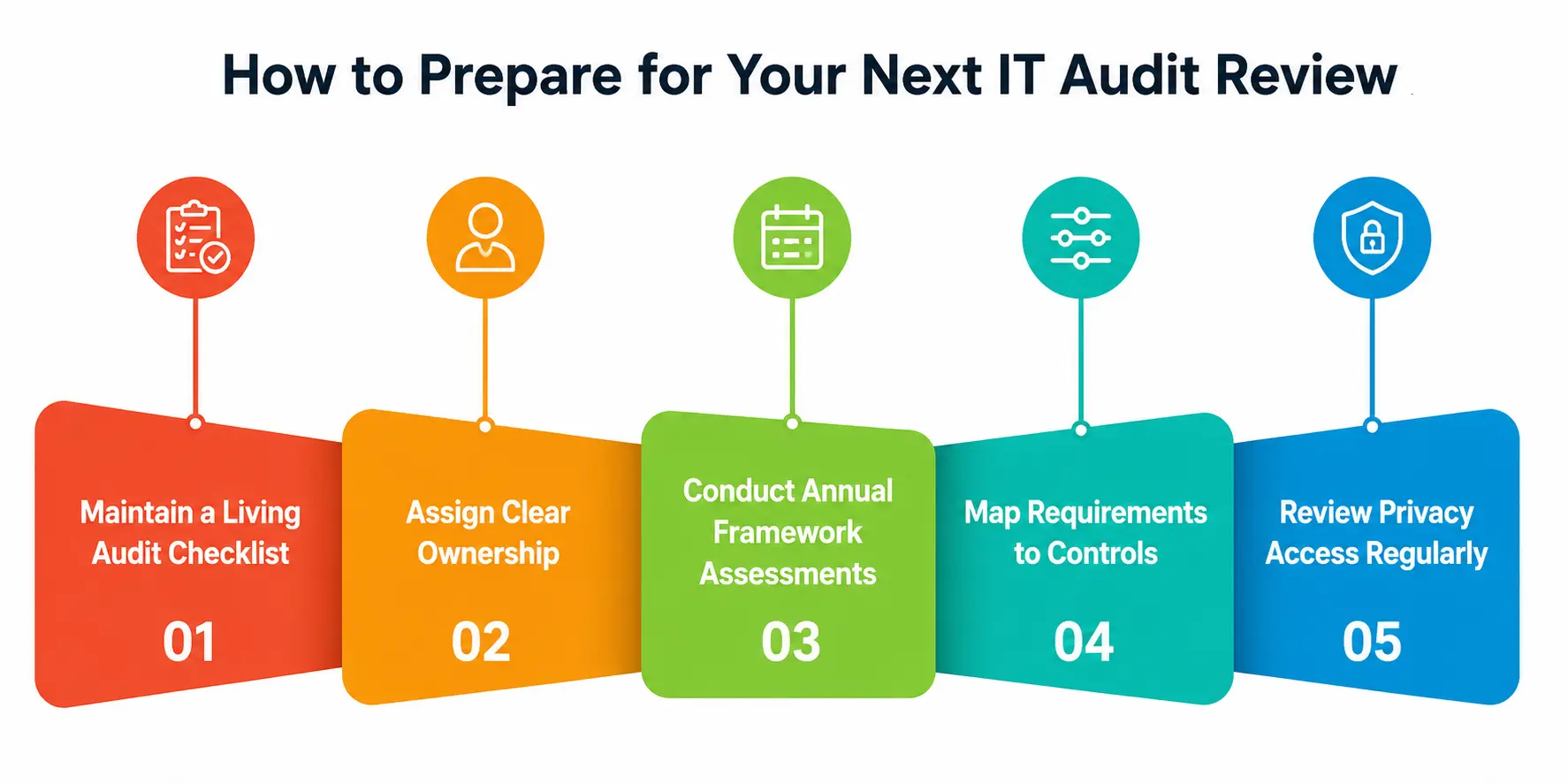
- Keep a living audit checklist for every control, updated as the control changes — not recreated from memory right before the review starts.
- Assign a named owner to your governance framework, with a fixed review date on the calendar, not an open-ended “as needed” review.
- Run a framework assessment against your chosen standard at least once a year, and document what changed since the last one.
- Map every applicable obligation to a specific control so your regulatory requirements are tracked formally, not informally.
- Review data privacy access lists on the same cadence you review general system access — don’t treat it as a separate exercise.
None of this eliminates every finding, and it isn’t supposed to. Even mature, well-run organizations walk away from a GRC audit with a handful of items to fix — that’s normal, and it’s actually the point of the exercise. A review that finds nothing at all is usually a sign the review wasn’t thorough, not a sign the organization is flawless.
A Personal Note
I’ve sat on both sides of the table during a GRC audit — as the person building the evidence and as the person reviewing it — and the pattern that surprised me most early on was how rarely findings come from bad intentions.
Almost every one of them traces back to something ordinary: a policy nobody updated after a reorg, a spreadsheet that quietly became the “real” risk register, an access review that got postponed once and never rescheduled.
If you’re just starting out in this field, don’t walk into your first review expecting villains. Walk in expecting gaps, because gaps are what you’re actually there to find and fix.