

A few years ago, “risk and compliance” was the department people joked about — the one that slowed everything down with paperwork. Nobody’s laughing anymore. Between AI regulation, data privacy laws, and a steady stream of breach headlines, companies have quietly turned governance, risk, and compliance into one of the busiest hiring categories in tech and finance.
If you’ve been eyeing GRC jobs and wondering whether the hype is real, this guide walks through what the roles actually involve, what they pay, and how a student or career-switcher can realistically land one.
What does GRC Actually Means?
GRC stands for Governance, Risk, and Compliance — three functions that used to sit in separate corners of a company and now increasingly work as one team.
- Governance is about who makes decisions and how. It sets the policies, ownership, and accountability structure that everything else hangs on. This is where security governance work lives — deciding who owns which risk, which committee signs off on new tools, and how policy exceptions get approved.
- Risk is about identifying what could go wrong — a vendor breach, a regulatory fine, a system outage — and putting a number or a plan against it.
- Compliance is about proving, with evidence, that the organization actually does what its policies and the law say it should.
Put together, security compliance is essentially GRC applied to information security: making sure technical controls line up with frameworks like ISO 27001, SOC 2, HIPAA, or GDPR, and that someone can produce the paperwork to prove it during an audit.
Why Are GRC Jobs Suddenly Everywhere?
This isn’t a marketing story — it’s a regulation story. According to the U.S. Bureau of Labor Statistics, demand for compliance officers is projected to grow steadily through the next decade, with roughly 33,300 openings expected each year in the U.S. alone as regulatory obligations pile up and experienced staff move into other roles.
A few forces are driving the surge in this field specifically:
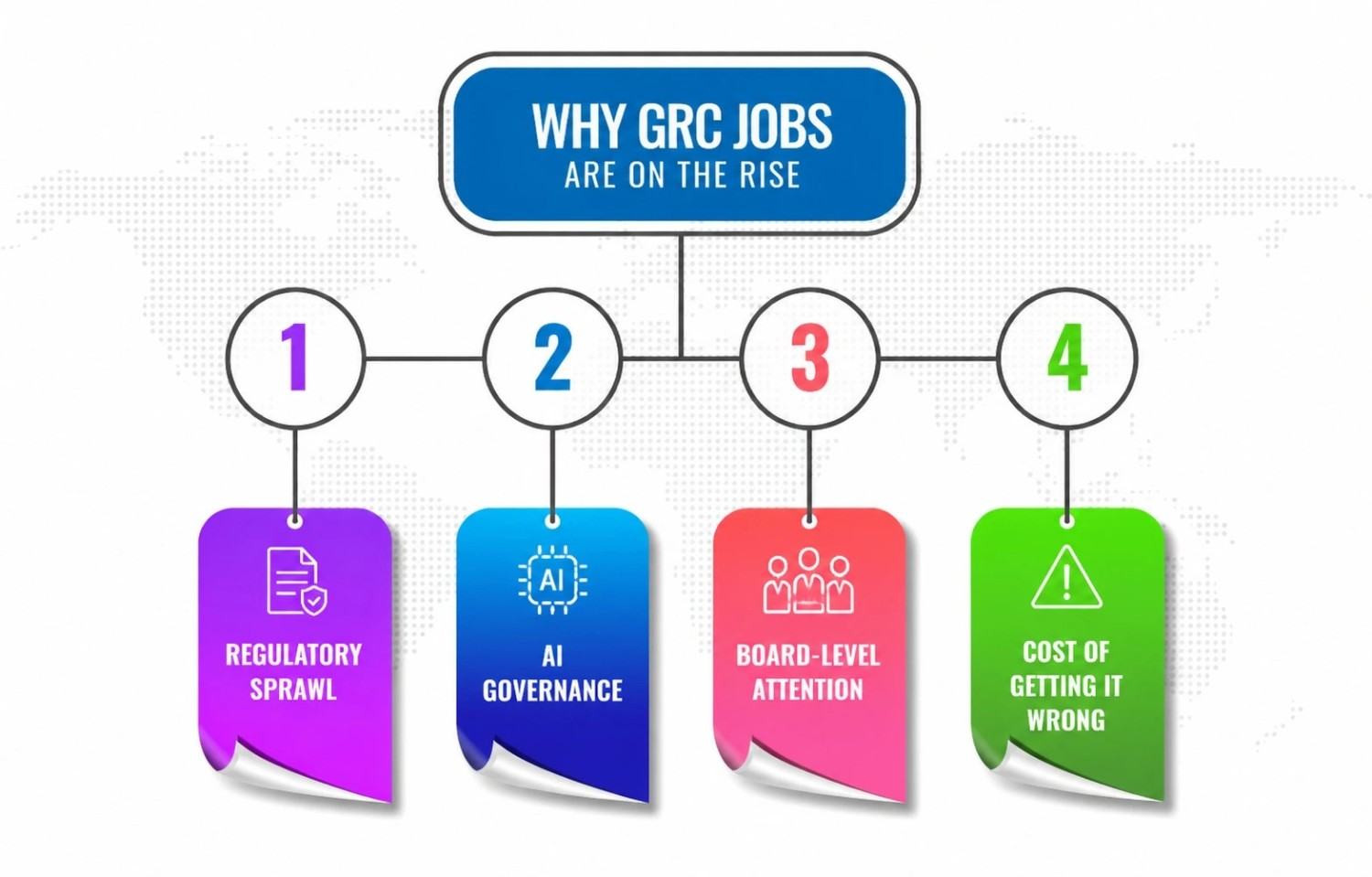
- Regulatory sprawl. GDPR, HIPAA, SOC 2, PCI-DSS, and a growing patchwork of state privacy laws all require documented, ongoing compliance work — not a one-time checklist.
- AI governance. Companies are now writing policies around model risk, data handling, and algorithmic bias, which has created an entirely new lane inside GRC that didn’t exist five years ago.
- Board-level attention. Cyber risk now gets reported next to financial risk in boardrooms, and someone has to translate one into the language of the other. That someone is usually a risk manager or GRC lead.
- Cost of getting it wrong. A failed audit or a mishandled breach disclosure can mean fines, lawsuits, and reputational damage that a good compliance auditor could have flagged months earlier.
None of this is explosive, headline-grabbing growth — the BLS projects about 3% growth for compliance officers through 2034, roughly in line with the average occupation. What makes this career path worth paying attention to isn’t speed, it’s stability: this work doesn’t disappear in a downturn, because the regulations don’t disappear either.
The Core Roles Inside GRC Jobs
“GRC” isn’t one job title — it’s an umbrella covering several distinct roles, each with its own day-to-day rhythm. Here’s how the major ones break down.
|
Role |
What They Actually Do | Best Entry Point |
Typical Trajectory |
|
Risk Analyst |
Identifies, scores, and tracks risks across the business; builds risk registers and heat maps | Entry-level, often from a business, finance, or IT background |
Promotes to Senior Analyst or Risk manager |
|
Compliance Auditor |
Tests controls against a framework (SOC 2, ISO 27001, HIPAA) and documents evidence for external auditors | Entry to mid-level, often from internal audit or accounting |
Moves into Lead Auditor or Compliance Manager |
|
Security Compliance Specialist |
Maps technical security controls to compliance requirements and manages audit readiness | Mid-level, usually needs some IT or security exposure |
Progresses toward Compliance Manager |
|
Security Governance Analyst |
Writes and maintains security policy, manages exception approvals, runs governance committees | Mid-level, often from policy, legal, or security operations |
Grows into a Governance Lead or CISO-track role |
|
Risk Manager |
Owns the enterprise risk program, sets risk appetite, reports to leadership | Mid to senior, usually 4+ years of relevant experience |
Advances to Director of Risk or Chief Risk Officer |
|
GRC Manager / Director |
Runs the whole GRC function, sets strategy, manages the team, owns board reporting | Senior, typically 7+ years across the roles above |
Reaches VP, CISO, or Chief Compliance Officer |
A useful way to think about it: a Risk Analyst finds the problem, an auditor proves whether a control actually catches it, a governance analyst decides who’s accountable for fixing it, and someone in leadership decides how much of that risk the company is willing to live with.
Skills That Actually Get You Hired
Job postings in this space tend to repeat the same wish list, but a few skills genuinely separate candidates who get interviews from candidates who don’t:
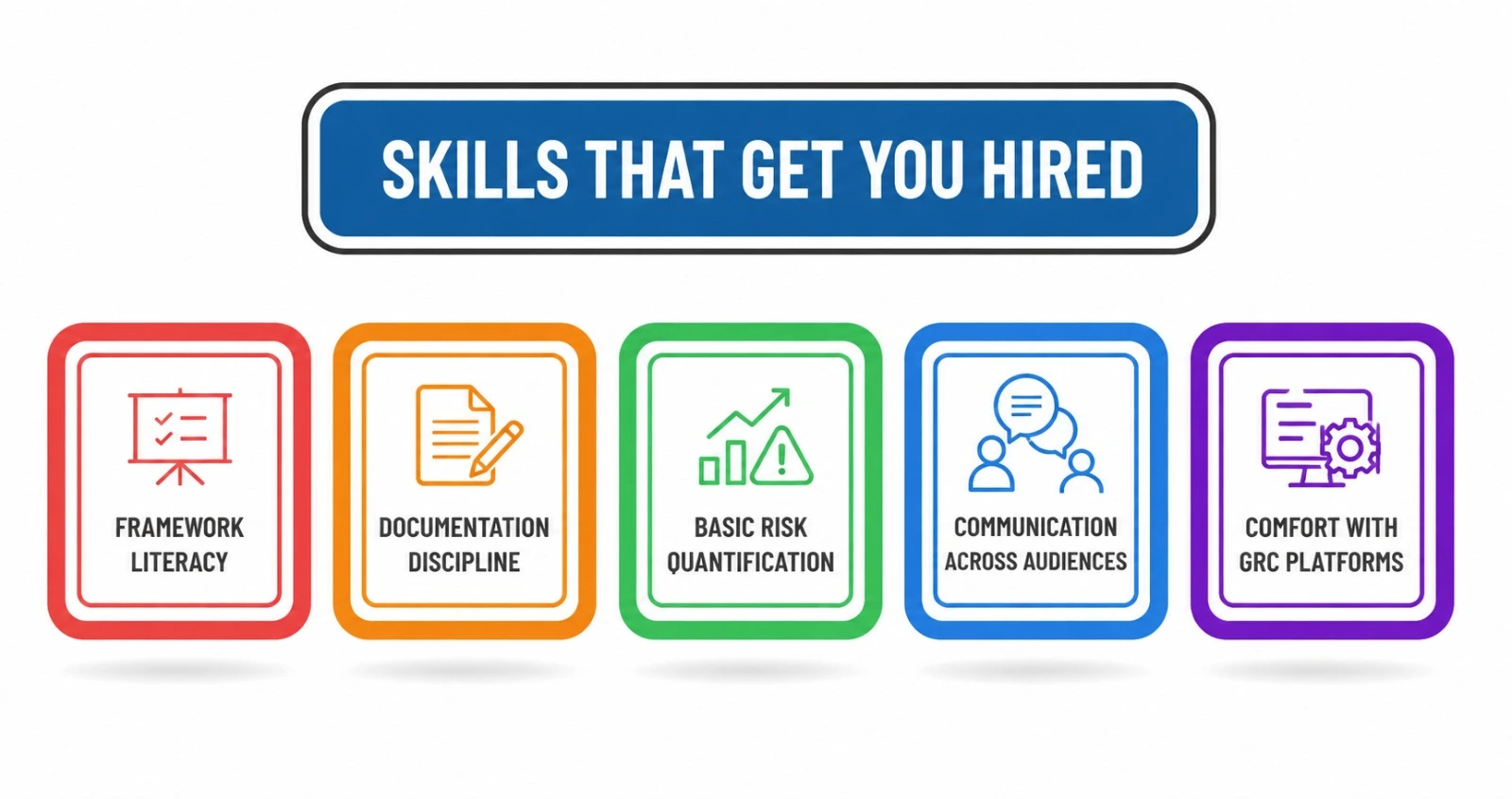
- Framework literacy. Knowing the difference between ISO 27001, NIST CSF, SOC 2, and HIPAA — not memorized, but well enough to explain what each one actually requires.
- Documentation discipline. GRC work runs on evidence. If you can’t write a clear, defensible audit trail, the rest of the skill set doesn’t matter much.
- Basic risk quantification. Employers increasingly want people who can say “this vulnerability could cost roughly $2M” instead of just “this is high risk.” A Risk Analyst who can put a number on exposure stands out immediately.
- Communication across audiences. You’ll explain the same finding differently to an engineer, a general counsel, and a board member — often in the same week.
- Comfort with GRC platforms. Tools like Archer, ServiceNow GRC, or Vanta show up constantly in postings, and even light familiarity helps at the entry level.
Technical depth matters less than people assume. Security compliance roles reward people who can bridge the technical and the procedural — you don’t need to write code, but you do need to understand what a control is actually doing.
Certifications Worth the Money
Not every certification is worth the exam fee, but a few genuinely move the needle for a GRC career:
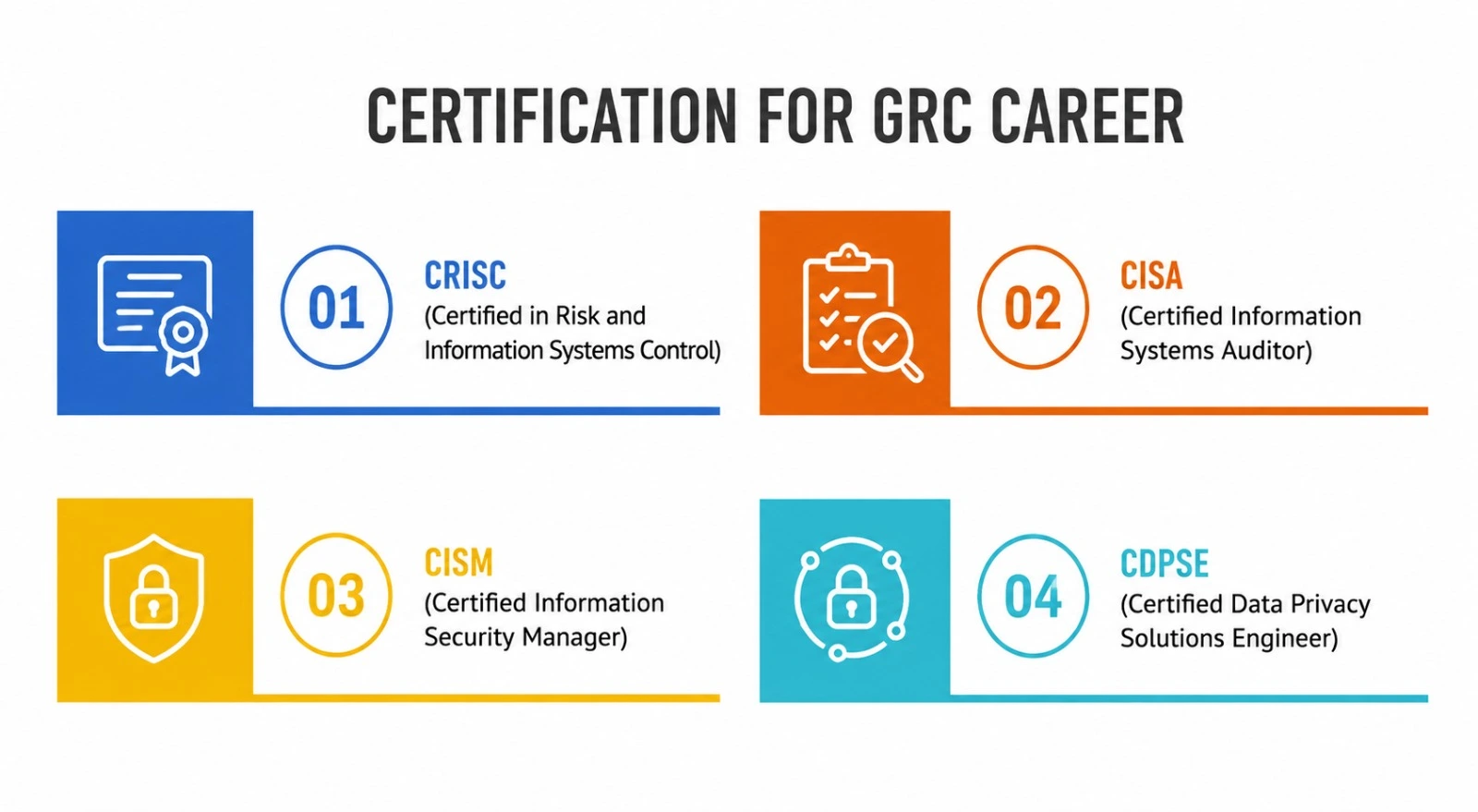
- CRISC (Certified in Risk and Information Systems Control) from ISACA — built specifically for IT risk management and control, and one of the clearest signals for a Risk manager career track.
- CISA (Certified Information Systems Auditor) — the standard credential for anyone doing formal IT audit work, useful for an aspiring Compliance Auditor.
- CISM (Certified Information Security Manager) — geared toward people managing security programs with governance responsibilities.
- CDPSE (Certified Data Privacy Solutions Engineer) — increasingly relevant as privacy law expands, and useful for security governance roles that touch data protection.
ISACA’s career guidance generally recommends picking one certification that matches your current lane — audit, risk, or governance — rather than collecting all of them at once. Most CRISC or CISA holders qualify with a mix of a bachelor’s degree and a few years of relevant experience, since ISACA allows partial education-for-experience substitution.
How to Break Into GRC Jobs With No Experience?
Students and career-switchers usually get stuck on the same question: how do you get a compliance-adjacent job without ever having held one? A few realistic paths:
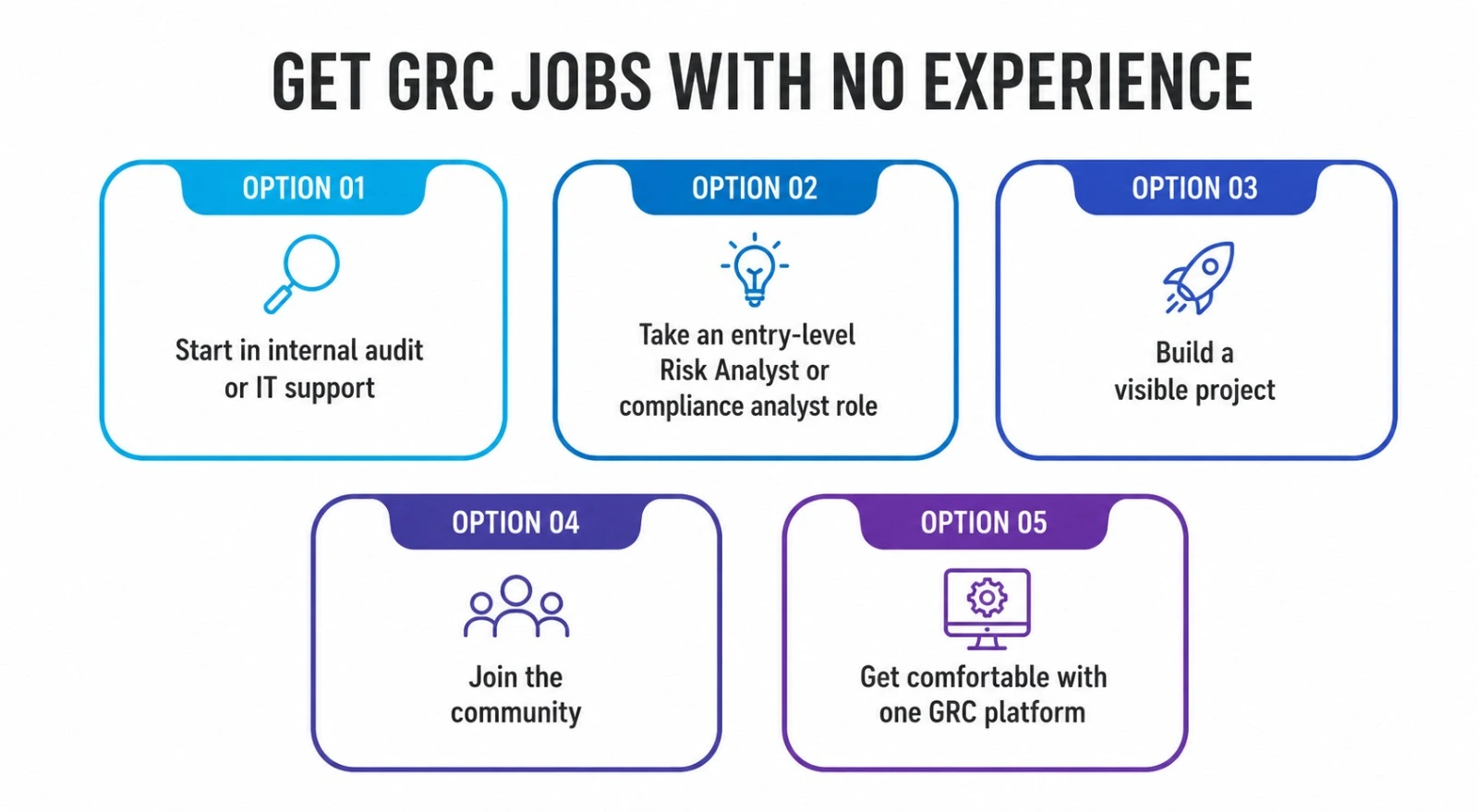
- Start in internal audit or IT support. Both feed directly into this career path because you’re already close to controls, systems, and documentation.
- Take an entry-level Risk Analyst or compliance analyst role. These postings often accept a bachelor’s degree in business, IT, or a related field with no direct experience required.
- Build a visible project. Map a fictional company’s controls to SOC 2 or ISO 27001 and put it on GitHub or LinkedIn — hiring managers notice candidates who’ve done the work unprompted.
- Join the community. Local ISACA or IAPP chapters, and GRC-focused groups online, are where a lot of entry-level referrals actually happen — this field still hires heavily through warm introductions.
- Get comfortable with one GRC platform. Even a free trial of a tool like Vanta or Drata gives you something concrete to talk about in interviews.
The honest version: your first GRC job probably won’t have “GRC” in the title. It’ll be an audit associate, a junior audit coordinator, or a compliance coordinator — and that’s fine. The title changes fast once you have eighteen months of real experience.
Salary Reality Check for GRC Jobs
Numbers vary widely by industry, location, and seniority, but the reports a median annual wage of $78,420 for compliance officers broadly, with the bottom 10% around $46,000 and the top 10% above $130,000. Specialized, security-focused GRC jobs — particularly a Risk manager or senior Compliance Auditor role in finance, healthcare, or tech — tend to sit well above that median, especially once a relevant certification is attached.
A rough, honest breakdown for the U.S. market:
- Entry-level Risk Analyst / compliance analyst: roughly 55,000–75,000
- Mid-level Compliance Auditor / Security Compliance Specialist: roughly 75,000–105,000
- Senior risk lead / Security Governance Lead: roughly 105,000–145,000
- GRC Director / Chief Risk Officer: $150,000 and up, heavily dependent on company size
Location matters more than most people expect — regulated hubs (finance in New York, healthcare in Houston or Boston, tech on the West Coast) consistently pay above these ranges.
Where GRC Jobs Are Headed?
The next few years of this profession will look noticeably different from the last decade. AI governance is the biggest shift — organizations now need policy around model risk, algorithmic bias, and data handling that didn’t exist as a formal discipline before.
That’s creating fresh security governance roles focused specifically on how AI systems are approved, monitored, and audited.
At the same time, automation is quietly removing the most repetitive parts of the job — manual evidence collection, basic control testing — which means future roles in this field will lean more on judgment and communication than data entry.
Security compliance professionals who can interpret a framework and explain its business impact will stay in demand longer than those who can only fill out a checklist.
Mistakes That Slow Down a GRC Career
A handful of avoidable habits keep otherwise strong candidates stuck at the entry level longer than necessary.
- Treating every framework the same. ISO 27001, SOC 2, and HIPAA share DNA, but a hiring manager can tell within a few minutes whether a candidate actually understands the differences or is just repeating acronyms.
- Skipping the business context. A control means nothing without knowing what it protects and why. Candidates who can connect a policy back to a real business risk stand out immediately over those who only recite requirements.
- Ignoring soft skills. This line of work runs on interviews, evidence requests, and uncomfortable conversations with people who’d rather not be audited. Being organized matters, but being able to ask good questions and hold a firm line under pushback matters more.
- Chasing every certification at once. Stacking three or four exams in a single year rarely helps as much as one solid credential paired with real project experience. Depth beats breadth early on.
- Waiting for the “perfect” title. Plenty of strong careers in this space started in adjacent roles — audit support, IT operations, legal ops — rather than a job posting that used the exact right label.
None of these mistakes are fatal, but avoiding them tends to shave a year or more off the climb from an entry-level position to something with real ownership and a better paycheck attached.
A Personal Note
I’ll be straight with you: nobody grows up dreaming of a career in compliance. I’ve watched plenty of people land in this field almost by accident — an audit internship, a support ticket queue that turned into a security role — and end up genuinely enjoying it, because it sits at the intersection of business, technology, and law in a way few other jobs do.
If you’re a student weighing GRC jobs against something flashier, know that this is one of the few corners of the industry where steady beats trendy, and where a methodical, detail-oriented person tends to outperform a flashy one. That’s rare, and it’s worth something.