
If you’ve ever sat in a compliance review and watched three departments produce three different versions of the same policy, you’ve already met the problem a GRC maturity model exists to solve. Governance, Risk, and Compliance (GRC) sounds like a single discipline on paper.
In practice, it’s usually a patchwork—legal owns one piece, IT owns another, and risk sits somewhere in between, rarely talking to either. This kind of framework gives you a shared yardstick to measure how far along that patchwork has come and a roadmap for stitching it into something coherent.
This guide walks through what this maturity framework actually is, why it matters more in 2026 than it did five years ago, how the maturity levels work, and what concrete steps move an organization from reactive firefighting to a program that runs itself.
It’s written for students, early-career risk and compliance professionals, and anyone trying to make sense of GRC beyond the buzzwords.
What Is a GRC Maturity Model?
A GRC maturity model is a structured framework that measures how developed, consistent, and integrated an organization’s governance, risk, and compliance activities are and lays out a staged path for improving them.
Rather than treating GRC as a binary—either you have it or you don’t—a maturity model recognizes that most organizations sit somewhere on a spectrum between chaotic and optimized.
The most widely referenced version comes from OCEG, a global nonprofit dedicated to GRC research and education. Its GRC Capability Model, commonly known as the Red Book, presents one view of a maturity model for integrated GRC and discusses how GRC structures, practices, and technologies change as an organization’s capability grows.
A separate, freely available reference — the GRC Capability Model 3.5 — is worth bookmarking if you’re studying GRC formally, since it functions as an open-source standard that integrates governance, strategy, risk, audit, compliance, ethics, culture, and IT into one unified approach.
Other frameworks exist too. The CMMI Institute, now part of ISACA, popularized the idea of measuring process maturity long before GRC borrowed the concept. Its Capability Maturity Model Integration defines five levels—Initial, Managed, Defined, Quantitatively Managed, and Optimizing—a structure many GRC-specific models still echo today.
Whichever framework an organization adopts, the underlying idea of capability maturity stays the same: capability grows in stages, and each stage builds a foundation the next one depends on.
Why Does a GRC Maturity Model Matter for Your Organization?
It’s tempting to treat GRC as a compliance checkbox—something you do because a regulator or an auditor asked for it. That mindset is exactly what keeps organizations stuck at the bottom of the maturity curve.
A GRC maturity model reframes the conversation: instead of asking, “Are we compliant right now?” It asks, “How repeatable, visible, and resilient our overall risk approach is over time.”
There are a few concrete reasons this reframing matters:
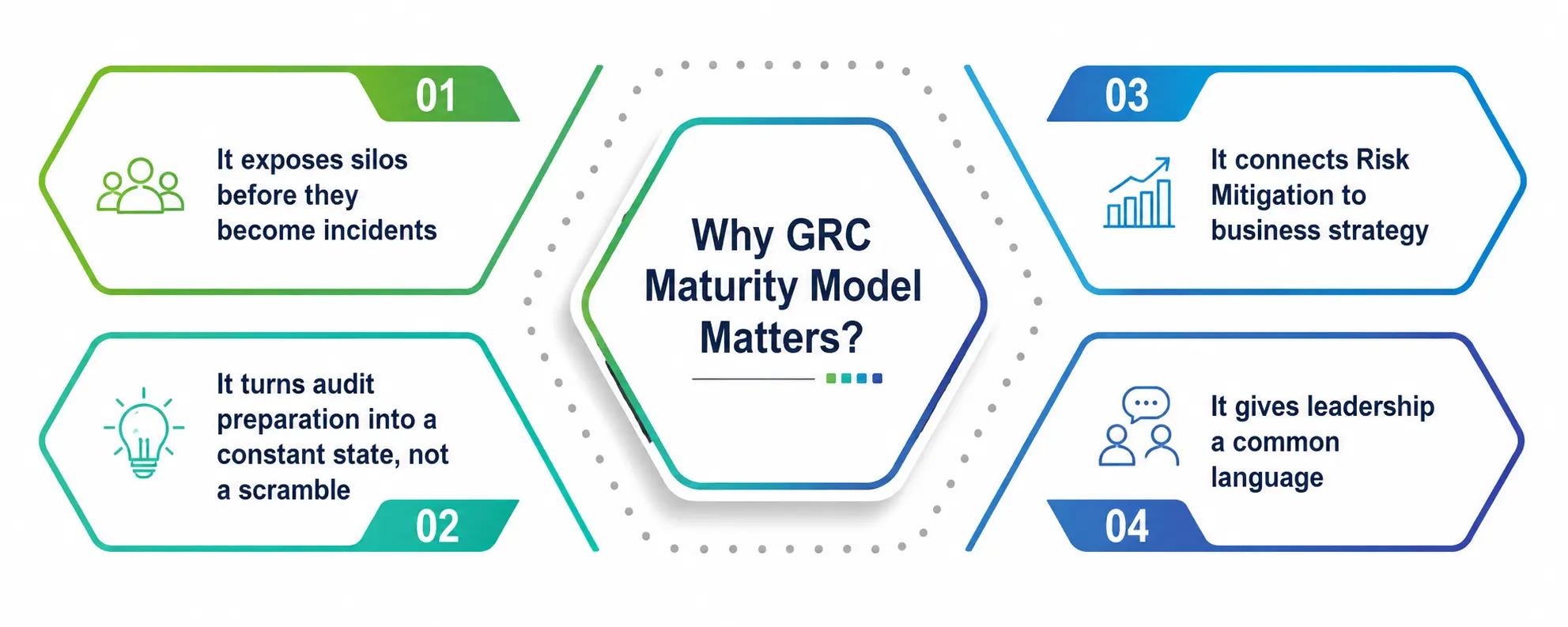
- It exposes silos before they become incidents. When policy management lives in a shared drive that only one department checks, gaps go unnoticed until something breaks. A maturity assessment forces those gaps into the open.
- It turns audit preparation into a constant state, not a scramble. Organizations at low maturity levels treat every audit as a fire drill. Higher-maturity organizations keep evidence, control mappings, and documentation current year-round, so an auditor’s request doesn’t trigger a week of panic.
- It connects risk mitigation to business strategy. At advanced maturity levels, risk data isn’t just reported upward — it actually informs decisions about vendors, markets, and investments.
- It gives leadership a common language. It gives the board, senior executives, and department heads a shared way to talk about where the program stands and what it needs next, rather than relying on anecdotes from whichever department spoke up loudest in the last meeting.
The Levels of a GRC Maturity Model
Most versions of this maturity framework—OCEG’s included—use a five-level structure. The labels vary slightly between vendors and consultancies, but the underlying progression is consistent: from ad hoc and reactive to documented to consistent to measured to fully integrated and adaptive.
|
Maturity Level |
Common Name | What It Looks Like |
Typical Weak Point |
|
Level 1 |
Initial / Ad Hoc | GRC activities are reactive, undocumented, and handled department by department with no shared process |
No visibility into overall risk posture |
|
Level 2 |
Managed / Fragmented | Some policies exist and practices are more strategic, but they’re informal and inconsistently applied |
Weak policy documentation; information doesn’t flow between teams |
|
Level 3 |
Defined / Consistent | The organization operates from a common framework with formally documented, consistently managed practices |
Manual processes slow down audit readiness. |
|
Level 4 |
Managed / Measured | GRC practices are data-driven, cross-department alignment is strong, and automation begins to appear |
Metrics exist but aren’t always tied to business outcomes |
|
Level 5 |
Optimized / Integrated | GRC is embedded in daily operations, supported by automation, and continuously improved using real data |
Requires sustained investment to maintain |
According to Secureframe’s OCEG model, organizations should demonstrate the characteristics of one level before incrementally adopting the practices of the next, and the highest level reflects data-driven decision-making with automation streamlining processes throughout the organization.
That incremental logic is the whole point of the model — you can’t leapfrog from Level 1 to Level 5 by buying software. Capability maturity is earned stage by stage.
It’s also worth knowing the model isn’t the only one in circulation. Some firms use a four-domain approach spanning governance, risk, compliance, and compliance operations, while others adapt CMMI or ISO 31000 principles for GRC-specific assessment. The specific labels matter less than picking one model and applying it consistently.
Core Components a Strong GRC Program Must Cover
A maturity assessment is only useful if it looks at the right building blocks. Four areas come up again and again across every credible framework.
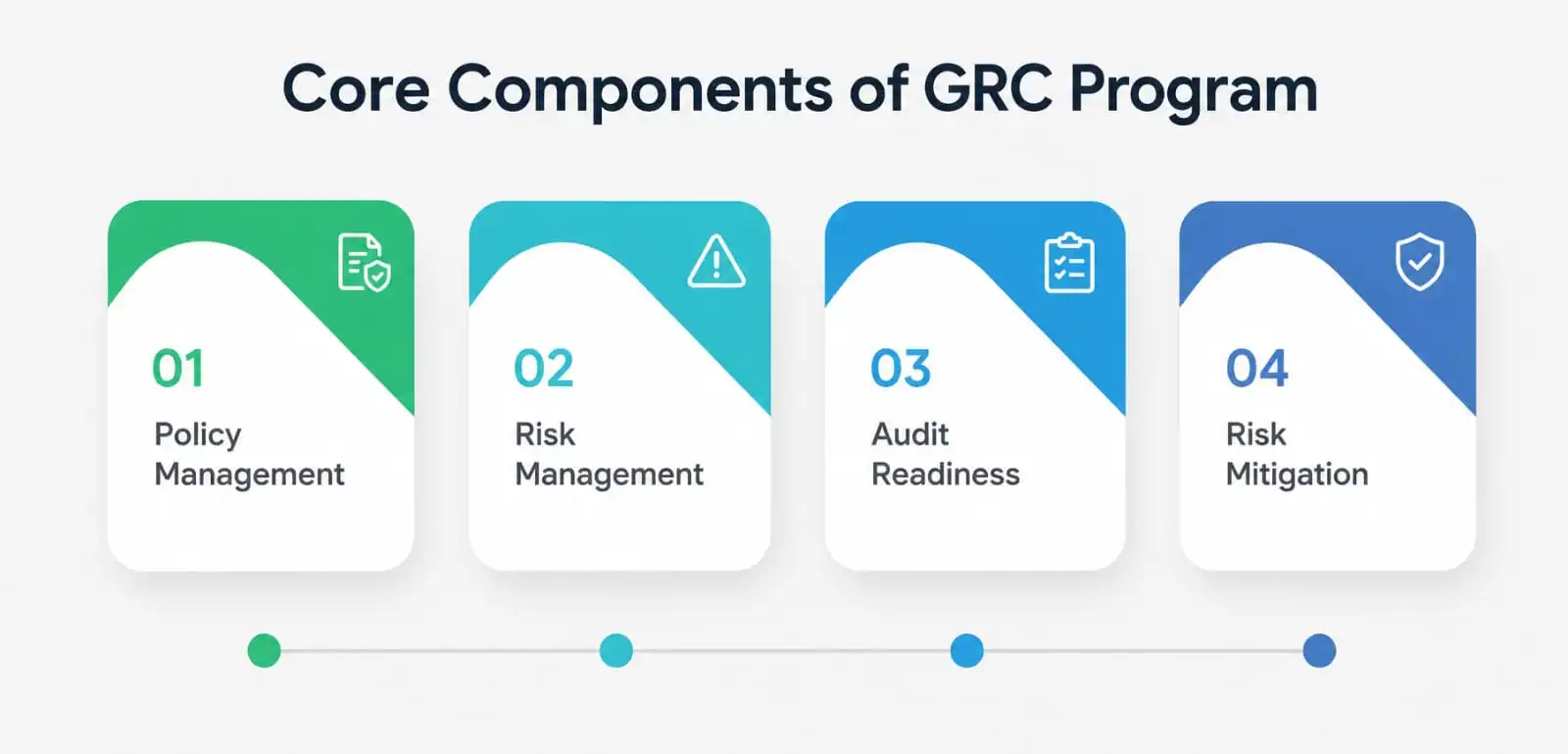
1. Policy Management
Policies are the backbone of any GRC program, but at low maturity, they are often out of date, duplicated across departments or simply unread. Mature policy management means version-controlled documents, clear ownership, scheduled reviews, and policies that actually map to the controls and regulations they are supposed to support. Without good policy governance, your other GRC disciplines are built on sand.
2. Risk Management
Risk governance is the ownership of risk decisions and the processes for taking those decisions. In immature organizations, risk is discussed only after something has gone wrong. In mature organizations this discipline is proactive—there is a defined risk appetite, a clear escalation path, and regular reporting to leadership. The difference between a GRC program that reacts and a GRC program that anticipates is strong risk oversight.
3. Audit Readiness
Audit readiness reflects how quickly and painlessly an organization can respond when a regulator, customer, or internal audit team comes asking for evidence. As one industry guide on CyberArrow’s GRC maturity overview puts it, organizations at higher maturity levels keep policy documentation, approvals, and evidence readily available, which reduces the stress of audits and increases confidence with regulators, partners, and customers. Weak audit readiness, by contrast, means scrambling for spreadsheets the week before a review—a clear sign of Level 1 or Level 2 maturity.
4. Risk Mitigation
Identifying a risk is only half the job; risk mitigation is the discipline of actually reducing exposure through controls, training, technology, or process change. Mature programs track mitigation actions to completion and measure whether they actually reduced the risk they targeted, rather than treating mitigation as a one-time checkbox.
How to Assess Your Current GRC Maturity Level?
Self-assessment is where most organizations start, and it’s worth doing honestly rather than optimistically. A few practical questions help place a program on the maturity scale:
- Are policies centrally stored, version-controlled, and reviewed on a schedule, or scattered across departments?
- Can the organization produce audit evidence within days, or does it take weeks of manual searching?
- Is risk data reported consistently to leadership, or only when something goes wrong?
- Are controls mapped to specific regulatory or framework requirements or handled ad hoc?
- Is there any automation in evidence collection and monitoring, or is everything manual?
It’s worth noting that self-assessment carries a known bias. Research from GRC Index’s analysis of UK organizations found that most organizations underestimate their own GRC maturity gaps due to internal self-assessment bias, and the most common finding isn’t the absence of GRC processes but that existing processes are siloed and inconsistently applied.
That’s a useful reality check: don’t assume you’re further along than an outside reviewer would say you are. For a broader external perspective with organizations that have one demonstrating significantly higher performance across every GRC discipline compared to those without.
That single finding is worth sitting with: maturity doesn’t start with a tool purchase. It starts with a written strategy.
Steps to Improve Your GRC Maturity Model
Moving up the maturity curve is rarely about a single big initiative. It’s a steady climb in capability maturity, built through a sequence of smaller, deliberate changes.
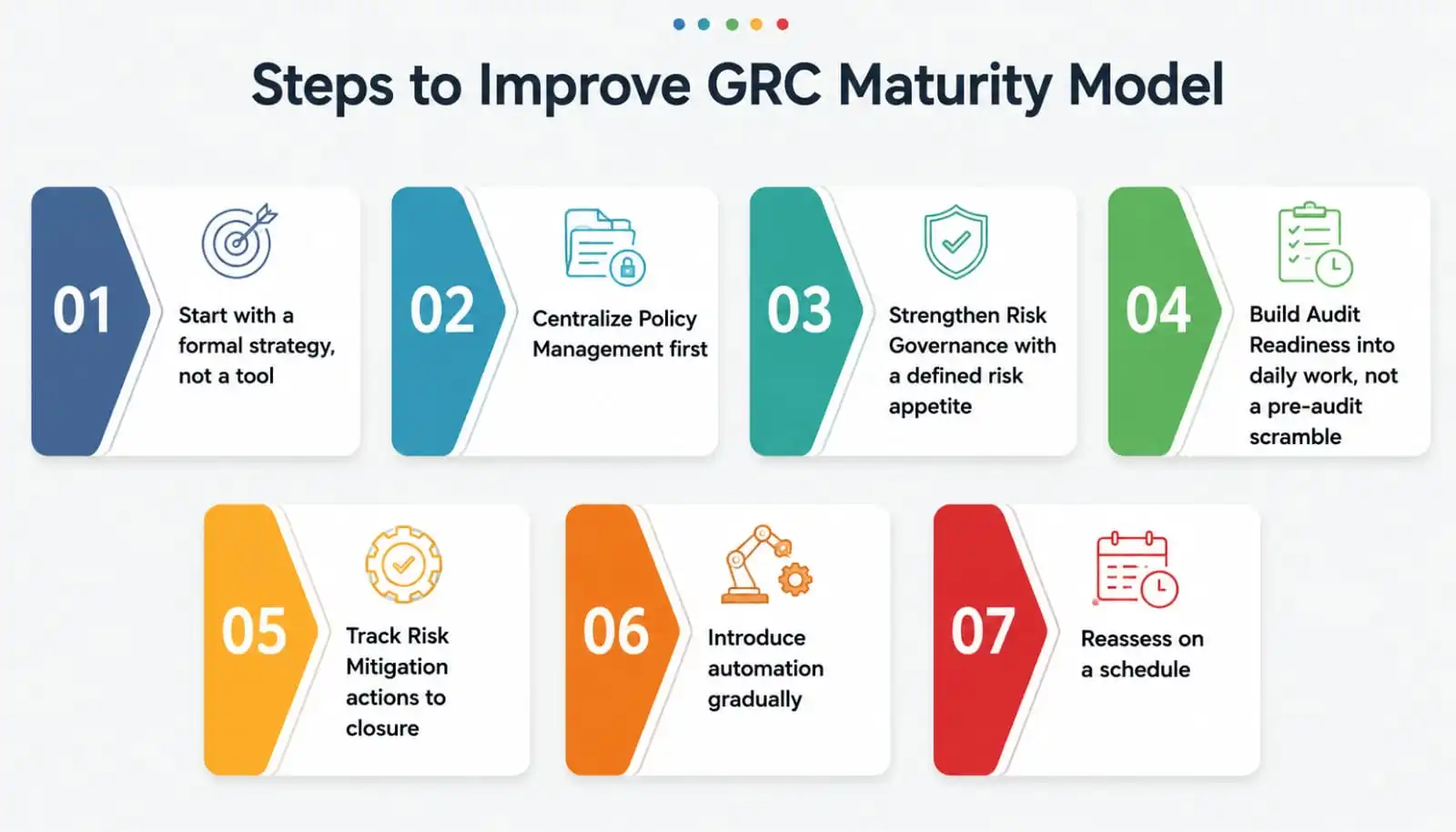
- Start with a formal strategy, not a tool. Before evaluating software, write down what the GRC program is actually trying to achieve and who owns which piece of it.
- Centralize policy management first. Get every policy into one system, assign an owner to each, and set a review cadence. This single step resolves a huge share of Level 1 and Level 2 problems.
- Strengthen risk governance with a defined risk appetite. Decide, in writing, how much risk the organization is willing to accept in different areas, and route decisions through a consistent escalation process.
- Build audit readiness into daily work, not a pre-audit scramble. Maintain evidence continuously rather than reconstructing it under deadline pressure. According to Scrut Automation’s continuous GRC, traditional GRC programs prepare for audits at fixed points in time, while continuous GRC keeps compliance work current as systems and controls change—a meaningful shift for how ready the organization stays for audits.
- Track risk mitigation actions to closure. A logged risk with no follow-up isn’t mitigation; it’s documentation. Assign deadlines and owners to every mitigation action, and revisit whether it actually worked.
- Introduce automation gradually. Manual tracking is the single biggest brake on progress toward higher capability maturity. Even basic automation — automated reminders for policy reviews, or dashboards pulling control status in real time — moves a program meaningfully forward.
- Reassess on a schedule. This kind of assessment isn’t a one-time report card. Reassessing every 6–12 months keeps the roadmap honest and shows whether investments are actually paying off.
Common Mistakes Organizations Make
A few patterns show up repeatedly in organizations that stall out mid-journey:
- Buying a GRC platform before defining the processes it’s supposed to support, which just automates chaos faster.
- Treating maturity as a one-time audit rather than an ongoing measurement.
- Letting policy and risk decisions live in separate silos with no shared reporting line.
- Measuring activity (number of policies written) instead of outcomes (whether risk actually decreased).
- Skipping the self-assessment bias check and assuming the program is more advanced than it is.
Benefits of a Mature GRC Program
The payoff for climbing the maturity curve isn’t abstract. As outlined in Sprinto’s guide to GRC maturity, mature programs identify risks early and address them through consistent risk mitigation before they escalate into incidents; keep compliance consistent enough to avoid fines and audit failures; and build the kind of trust with customers, partners, and regulators that comes from demonstrating a transparent, structured approach to risk.
Beyond risk reduction, mature programs also cut duplicated effort—when risk governance, legal, and security stop working in isolated pockets, the same evidence and controls can serve multiple purposes instead of being recreated by every team.
A Personal Note
I’ve reviewed enough GRC programs to notice the same pattern almost every time: the organizations that struggle most aren’t the ones with the fewest resources—they’re the ones that never wrote down what “mature” would actually look like for them. A GRC maturity model isn’t a certificate you earn once.
It’s closer to a fitness routine—the value comes from checking in regularly, being honest about where you actually stand, and making the next small improvement instead of chasing a perfect program overnight.
If you’re a student heading into this field, my honest advice is to get comfortable reading real frameworks like OCEG’s Red Book before you rely on any vendor’s simplified version of it. The simplified versions are useful for a quick overview, but the primary sources are where the actual thinking lives.