
Most businesses don’t get taken offline because an attacker found some brilliant new exploit. They were taken offline because nobody was watching the traffic, the network had a single point of failure, and the DNS layer was left wide open like an unlocked side door. A flood of junk requests doesn’t need to be clever—it just needs an unmonitored pipe and a target that never rehearsed what to do when that pipe fills up.
That’s the uncomfortable part of this topic: the most effective DDoS attack prevention strategies for businesses aren’t exotic. They’re the boring fundamentals nobody quite got around to finishing, and application availability suffers the moment one of them gets skipped.
This guide walks through what actually works right now, in 2026, when it comes to keeping a business online during a distributed denial-of-service attack. It’s written for students, IT teams, and anyone building their first real understanding of why this keeps happening and what real DDoS attack prevention strategies for businesses actually look like—not a vendor pitch, just the mechanics done properly.
Why This Problem Got Worse, Not Better, in 2026?
The scale of what businesses are dealing with this year is genuinely different from a few years ago. Cloudflare’s DDoS Threat Report for the first half of 2026 recorded 23.2 million network-layer attacks and nearly 29.64 trillion HTTP DDoS requests mitigated in just six months—an average of roughly 5,343 network-layer attacks every single hour.
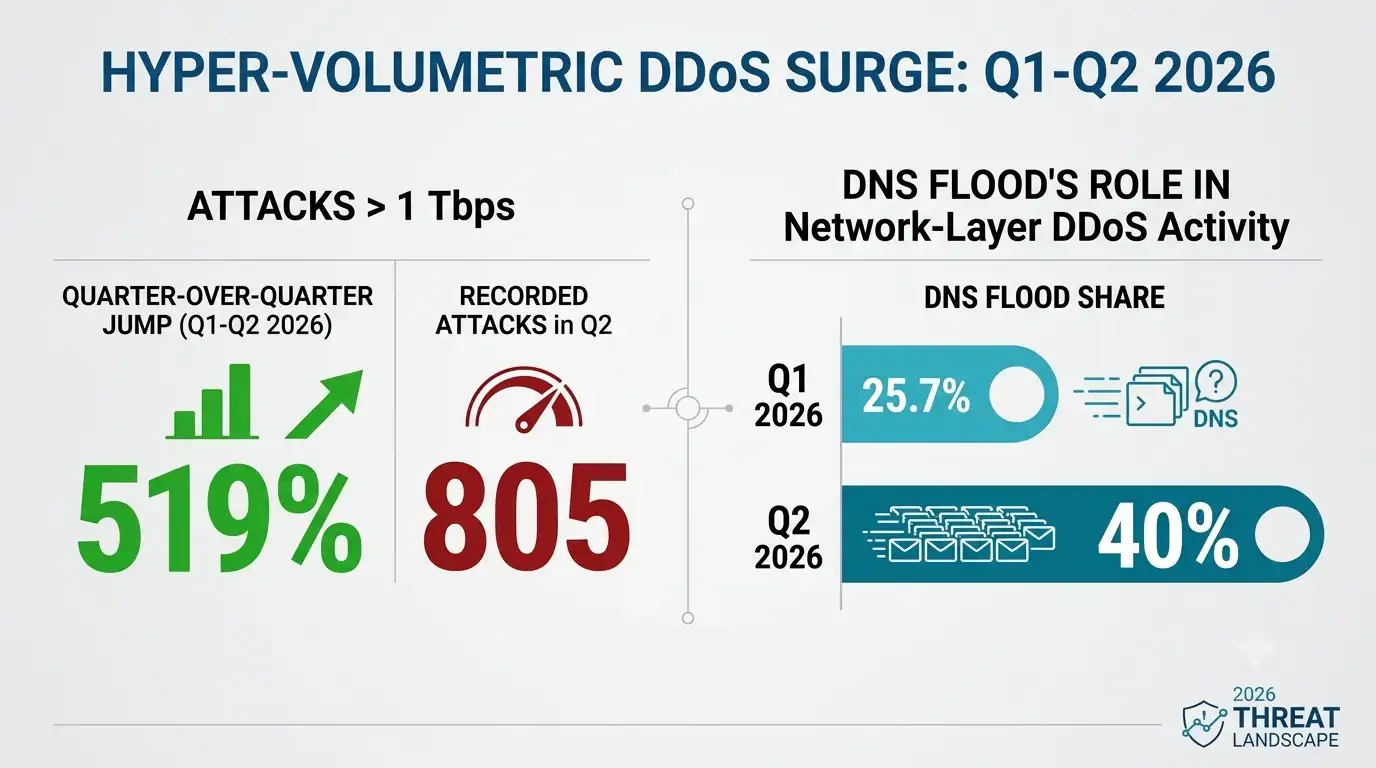
Attacks exceeding 1 Tbps jumped 519% quarter-over-quarter between Q1 and Q2 2026 alone, with 805 such hyper-volumetric attacks recorded in Q2. DNS floods drove much of that surge, climbing from 25.7% to 40% of network-layer activity in a single quarter, which is exactly why DNS security keeps coming up in any serious conversation about 2026’s threat landscape.
And the record itself keeps climbing: a 31.4 Tbps attack traced back to the Aisuru botnet, built from roughly 3 million hijacked routers, cameras, and DVRs, lasted only 35 seconds but hit with a volume researchers compared to the combined populations of the UK, Germany, and Spain, all loading a website in the same instant.
What makes this year different isn’t just size—it’s speed. Over 90% of network-layer attacks now conclude within ten minutes, and the shortest hyper-volumetric attack on record lasted just 35 seconds, faster than most teams can get a human looking at a dashboard.
When an attack is over before anyone notices the alert, knowing how to stop a DDoS attack can’t depend on a person reacting in real time. It has to depend on systems that already know what to do the moment traffic crosses a threshold.
The financial stakes have sharpened too. Splunk-backed research covered by Cisco’s newsroom put the global cost of downtime for large enterprises at $600 billion a year, averaging roughly $15,000 per minute of outage, with the typical organization now losing $95 million annually to unplanned downtime—nearly double the figure from two years earlier. A DDoS attack doesn’t have to steal a single record to hurt a business. It just has to keep the front door closed long enough for customers to leave.
Understanding What You’re Actually Defending Against
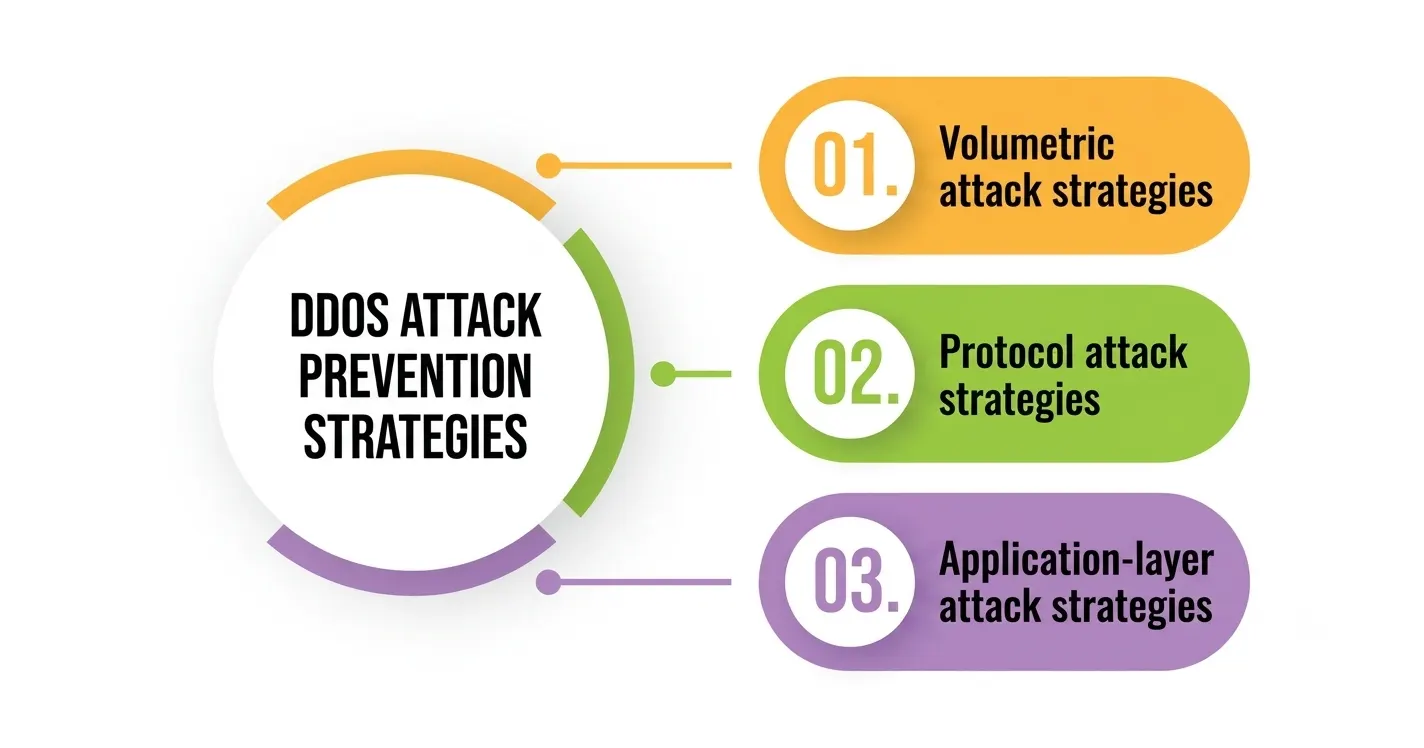
A distributed denial-of-service attack works by overwhelming a target—a server, an application, or the network path leading to it—with more traffic or requests than it can handle until real users can’t get through. There are three broad categories worth knowing before any DDoS attack prevention strategies for businesses will make sense.
-
Volumetric attacks try to saturate the raw bandwidth available to a network, using techniques like UDP floods or amplification attacks that bounce small requests off misconfigured servers to generate enormous responses aimed at the victim.
-
Protocol attacks target weaknesses in how servers and load balancers handle connections. A SYN flood, for instance, opens thousands of half-finished handshakes until the connection table fills up and legitimate sessions get rejected.
-
Application-layer attacks are the quietest and hardest to catch, mimicking normal HTTP requests aimed at a specific page or API endpoint until the application buckles, even though the bandwidth involved looks unremarkable.
Most real attacks blend more than one category at once, which is exactly why a defense built around a single technique tends to fail. Real protection needs layers, starting with visibility into what “normal” traffic even looks like for a given business.
Network Traffic Monitoring: The Foundation Everything Else Depends On
You cannot defend against a flood you can’t see coming, which is why network traffic monitoring sits at the base of nearly every serious defense plan. Network traffic monitoring means continuously analyzing the volume, source, and pattern of requests hitting a network so a deviation from the baseline—a sudden spike in connections from an unfamiliar region, an unusual concentration of requests hitting a single endpoint—gets flagged before it turns into an outage.
The businesses that get hurt the worst are almost always the ones with no real baseline. If nobody knows what a normal Tuesday afternoon looks like, nobody can tell that Wednesday’s traffic is forty times higher for a bad reason instead of a viral marketing win.
This is where most workable DDoS attack prevention strategies for businesses actually begin—not with a bigger firewall, but with knowing what the network is supposed to look like in the first place, so anomalies feeding into automated mitigation don’t need a person watching a screen to matter.
Network Redundancy: Removing the Single Point of Failure
If monitoring is about seeing the flood coming, network redundancy is about making sure one flooded pipe doesn’t take the whole business down with it. It means designing infrastructure so no single server, data center, internet provider, or DNS resolver is a single point of failure—traffic can reroute around a congested or attacked component while the rest of the system keeps serving real users.
In practice, this looks like multiple upstream internet providers instead of one, load balancing across geographically distributed data centers, and a content delivery network that can absorb and scrub traffic at the edge before it ever reaches origin servers. A business running everything through one data center on one connection is betting its entire uptime on that single path never being the target.
Network redundancy doesn’t stop an attack from happening, but it changes what an attack can accomplish—instead of a total outage, a well-distributed system degrades gracefully, and uptime barely dips instead of collapsing.
DNS Security: The Layer Businesses Forget
DNS security deserves its own conversation because it’s consistently the layer businesses overlook until it’s the one that gets hit. Every application, no matter how well-protected its servers are, depends on DNS resolution working correctly. If attackers can flood, poison, or hijack that layer, it doesn’t matter how solid the rest of the infrastructure is—customers simply can’t find the site.
CISA’s Protective DNS guidance frames DNS security as a preventive control rather than a reactive one, filtering malicious traffic at the resolution layer before a device ever connects to a harmful or overwhelmed destination.
Strong DNS protection in practice means using a provider with distributed, high-capacity resolvers, enabling DNSSEC to prevent spoofing, and keeping DNS infrastructure redundant across more than one provider so an attack on one resolver doesn’t take down the entire lookup chain.
Among all the DDoS attack prevention strategies for businesses discussed here, this is the one most likely to get treated as an afterthought, even though the data shows attackers increasingly target it first.
Application Availability: The Metric That Actually Matters to Customers
Every layer discussed so far exists to protect one thing customers actually experience: application availability. Nobody outside the security team cares about Tbps figures or attack vectors. They care whether the checkout page loaded, whether the login worked, and whether the app was simply there when they needed it.
Application availability during an attack depends heavily on architecture choices made long before any attack starts. Applications built with auto-scaling, rate limiting, and circuit breakers that gracefully degrade non-essential features under load tend to stay up in a way monolithic, single-instance applications simply don’t.
A business that treats staying online as a design requirement from day one, rather than an afterthought bolted on after a bad outage, ends up in a fundamentally stronger position than one scrambling for a fix mid-attack.
How to Stop a DDoS Attack Once It’s Already Happening?
Prevention matters, but every business also needs a real answer to how to stop a DDoS attack once one is actively underway, because eventually something gets through the perimeter regardless of preparation. The honest truth is that it rarely gets stopped by a single heroic action. It gets absorbed, filtered, and rerouted by systems that were already built to do exactly that before the attack began.
A practical response sequence looks like this: confirm it’s actually an attack and not a legitimate spike, which a solid traffic baseline makes fast rather than a guessing game; activate upstream scrubbing that filters malicious requests before they reach origin servers; shift traffic across redundant paths so the attacked component isn’t the only route available; and communicate early with customers if service is visibly degraded, since silence does more reputational damage than the outage itself.
A Practical Framework for Building Real Defenses
Good DDoS attack prevention strategies for businesses aren’t a single purchase—they’re a stack of layers that reinforce each other, roughly in the order a business should build them.
|
Defense Layer |
What It Does | Typical Approach |
Failure Mode If Skipped |
|
Network traffic monitoring |
Establishes a baseline and flags anomalies in real time | Flow-based analytics tied to automated alerting and mitigation |
Attacks go unnoticed until customers report the outage |
|
Network redundancy |
Removes single points of failure across ISPs, data centers, and DNS | Multiple upstream providers, geo-distributed load balancing, edge scrubbing |
One attacked component takes the whole business offline |
|
DNS security |
Protects the resolution layer attackers frequently target first | DNSSEC, redundant resolvers, protective DNS filtering |
Customers can’t reach a perfectly healthy application |
|
Application-layer hardening |
Keeps application availability high under load | Rate limiting, auto-scaling, circuit breakers, WAF rules |
The application buckles even when the network holds |
|
Incident response plan |
Defines the exact steps for how to stop a DDoS attack once it starts | Rehearsed runbooks, scrubbing activation, customer communication |
Teams improvise under pressure and lose critical minutes |
None of these layers substitutes for another. Strong infrastructure with no visibility into traffic is still flying blind, and airtight DNS protection with no application hardening still leaves the app itself exposed to a quieter kind of flood. The strongest defenses treat this as a stack, not a shopping list of one favorite tool.
Common Mistakes That Undermine Otherwise Solid Defenses
A few mistakes show up repeatedly, even at businesses that have clearly invested in security. Some treat this as a one-time purchase rather than an ongoing practice — a scrubbing contract signed once and never tested again.
Others build strong redundancy into their data centers but never extend the same thinking to their DNS provider, leaving a single, unprotected chokepoint between customers and an otherwise resilient system. Many skip rehearsal entirely, so the first real test of how to stop a DDoS attack happens during an actual one, with customers already noticing.
Another common gap is treating traffic visibility as a compliance checkbox instead of an operational tool — logs get collected and stored, but nobody sets meaningful thresholds or revisits the baseline as the business grows.
Not investing in real network traffic monitoring at that stage means alerts either never fire or fire so often nobody trusts them anymore, which defeats the entire purpose. Skipping any one of these steps is how otherwise sound DDoS attack prevention strategies for businesses quietly fall apart in practice.
A Personal Note
Working through this topic, what stuck with me most wasn’t the eye-catching Tbps records — it was how short these attacks have gotten. Ninety percent wrapping up inside ten minutes, some lasting barely half a minute, means the old mental model of “we’ll notice and respond” simply doesn’t hold anymore.
If I were advising a small or mid-size business starting from scratch, I wouldn’t start with the biggest budget line item. I’d start with the boring stuff: build real visibility into your own traffic, add a second DNS provider so a single flood can’t erase you from the internet, and invest in genuine network redundancy before anything fancier.
Solid DDoS attack prevention strategies for businesses are won in the weeks beforehand, when nobody’s watching, and it’s tempting to skip the rehearsal — not during the ten minutes an attack is actually live.