

Walk into any hospital today and you’ll notice something: there are almost as many screens as there are stethoscopes. Every prescription, lab result, insurance claim, and nurse’s note now lives on a server somewhere. That shift has made care faster and more connected, but it has also created a massive, high-value target for criminals.
This is exactly why healthcare data security has moved from an IT department’s problem to a boardroom priority, a regulatory obligation, and, for students entering the field, one of the most practical skills you can learn right now.
This guide breaks down what the term actually means, why the industry keeps getting hit so hard, the biggest risks on the table today, and the checklist and trends shaping how hospitals, clinics, and health-tech companies are trying to stay ahead of attackers in 2026.
What Is Healthcare Data Security?
At its core, it is the set of technical, administrative, and physical safeguards used to protect patient information—names, diagnoses, insurance details, billing records, and clinical histories—from being lost, stolen, altered, or accessed by anyone who shouldn’t see it. It covers everything from the encryption on a hospital’s servers to the password policy on a nurse’s laptop to the locked door of a records room.
It’s easy to think of this as just “cybersecurity for hospitals,” but healthcare security is broader than that. It includes legal compliance (like HIPAA in the United States), staff training, vendor risk management, and incident response planning.
A hospital can have excellent firewalls and still fail at protecting patient information if a staff member emails an unencrypted spreadsheet of patient names to the wrong address or if a laptop with unencrypted records is stolen from a car.
Why Healthcare Data Security Matters More Than Ever
Health records are worth more on the black market than credit card numbers, because unlike a card number, a stolen medical identity can’t simply be cancelled and reissued. That single fact explains why hospitals remain such a favored target.
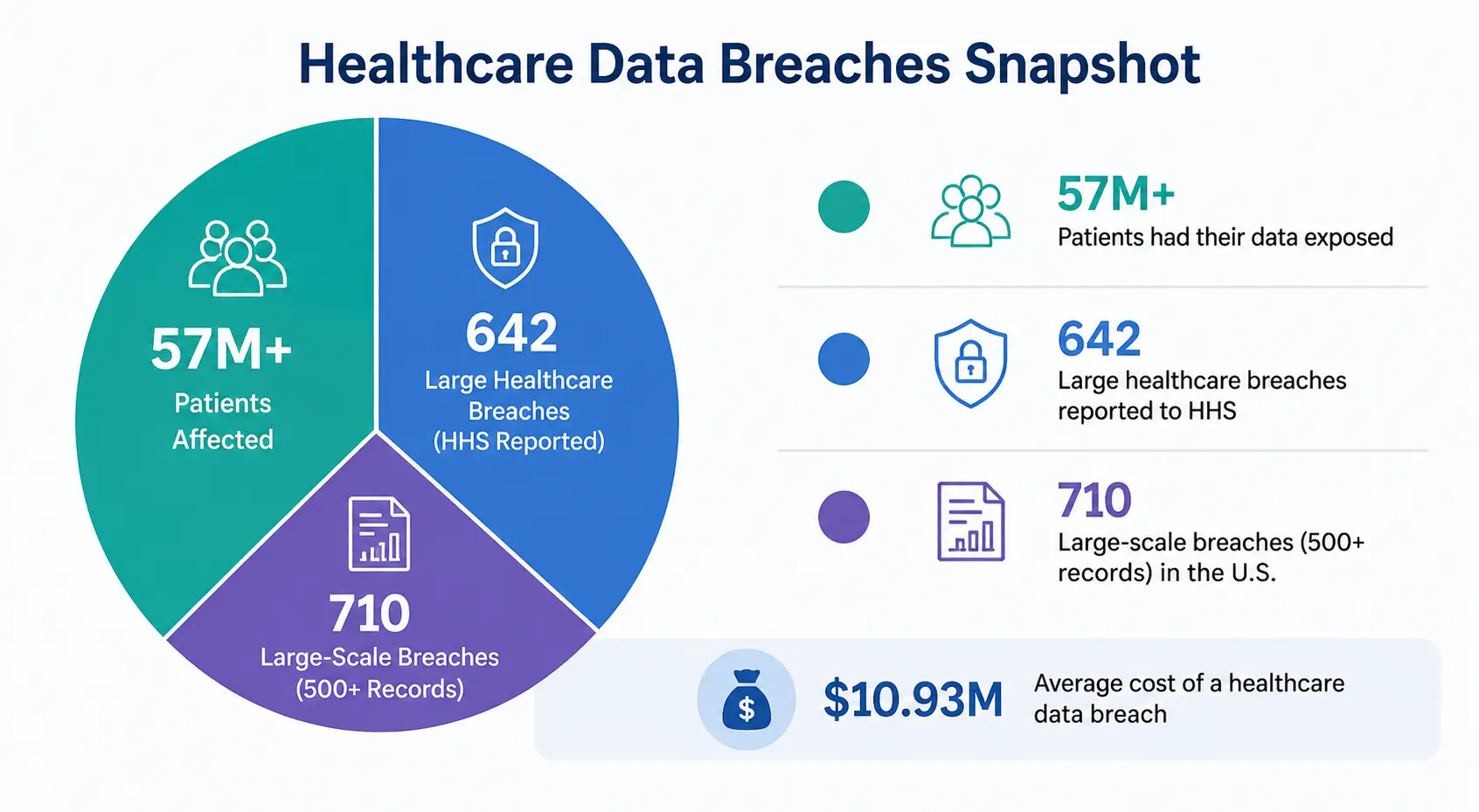
The numbers back this up. More than 57 million patients had their data exposed across 642 large healthcare breaches reported to the U.S. Department of Health and Human Services, and healthcare again ranked as the industry with the most expensive data breaches, averaging $10.93 million per incident, according to the IECC Annual Healthcare Cybersecurity Report. Separately, U.S. healthcare organizations reported 710 large-scale breaches affecting 500 or more records, based on data compiled by Statista from HIPAA Journal reporting.
Those aren’t abstract statistics. When a hospital’s systems go down because of an attack, appointments get cancelled, prescriptions get delayed, and in the worst cases, patient safety is directly affected. That’s the real reason healthcare security has become a patient-safety issue, not just a compliance checkbox.
Top Risks Facing Healthcare Data Security Today
A few patterns show up again and again when breaches are investigated:
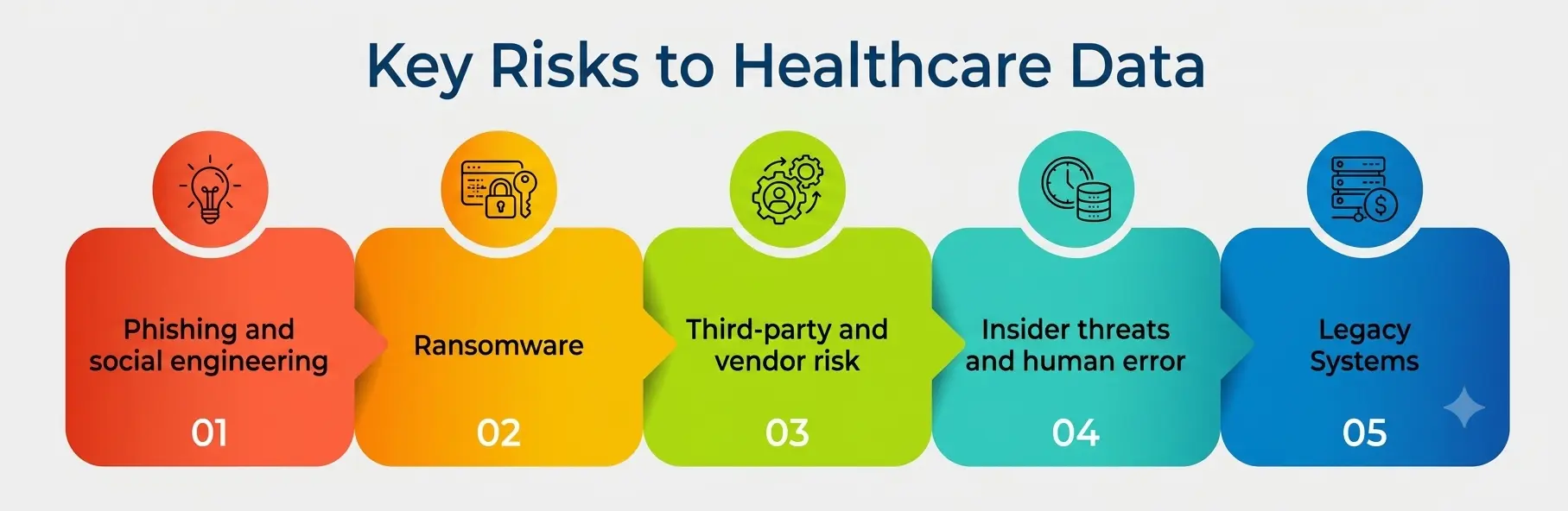
- Phishing and social engineering—Staff are tricked into clicking malicious links or handing over login credentials, often through emails that look like they’re from IT or a trusted vendor.
- Ransomware – Attackers encrypt hospital systems and demand payment. Sometimes they steal data first and threaten to leak it if the ransom isn’t paid.
- Third-party and vendor risk—Hospitals depend on dozens of outside vendors for billing, imaging, and software. A weak link in any of those can expose the entire network, which is what happened in the 2024 Change Healthcare incident that shut down prescription processing and insurance payments nationwide for weeks.
- Insider threats and human error—Misconfigured databases, lost devices, and simple mistakes still contribute to many exposures.
- Legacy Systems—Many hospitals are still running old software that is not patched for security vulnerabilities, which makes it an easy entry point for attackers.
That’s why patient information is protected in layers—there’s no one tool or policy that does it all.
Organizations Implement Healthcare Cybersecurity Solutions
Hospitals and health systems are responding to this threat landscape with a variety of tools and practices, often bundled under the moniker of healthcare cybersecurity solutions. Primarily these are:
- Endpoint detection and response (EDR) tools that watch every device on the network for suspicious activity
- Multi-factor authentication (MFA) so that a stolen password cannot be used alone to access patient systems.
- Network segmentation, which means isolating sensitive systems so that if one part of the network is compromised, the damage doesn’t ripple through.
- Security operations centers (SOCs), either in-house or outsourced, that provide 24/7 threat monitoring.
- Regular training of staff, because no matter how good your healthcare cybersecurity solutions are, they won’t stop an employee from clicking on a well-crafted phishing link.
The best security programs aren’t the most flashy ones; they’re the ones that are actually implemented consistently throughout a large, often understaffed organization.
Healthcare Cloud Security: The New Frontier
More hospitals are moving records, imaging, and applications to the cloud for flexibility and cost savings, which makes healthcare cloud security one of the fastest-growing concerns in the field.
Cloud platforms can actually be more secure than on-premise servers when configured correctly, because major providers invest heavily in infrastructure protection—but “configured correctly” is doing a lot of work in that sentence.
Common cloud security failures in healthcare include misconfigured storage buckets left open to the public internet, weak access controls that give too many employees admin-level permissions, and a lack of clarity about who—the hospital or the cloud vendor—is responsible for which layer of protection.
This is usually called the “shared responsibility model,” and misunderstanding it is one of the most common causes of cloud-related exposure in healthcare.
Getting cloud security right in healthcare means encrypting data both at rest and in transit, auditing permissions regularly, and choosing vendors that can demonstrate compliance with healthcare-specific standards, not just general-purpose ones.
Medical Device Cybersecurity: A Growing Blind Spot
Insulin pumps, pacemakers, infusion pumps, and imaging machines are increasingly connected to hospital networks and, in some cases, the internet directly. That connectivity improves patient monitoring, but it also means medical device cybersecurity has become a real and growing concern, since many of these devices were never designed with security as a priority.
The FDA now requires manufacturers of internet-connected “cyber devices” to submit a plan for monitoring and addressing post-market vulnerabilities, maintain processes that provide reasonable assurance the device is cybersecure, and provide a software bill of materials listing every component used, under FDA guidance implementing Section 524B of the Federal Food, Drug, and Cosmetic Act. The agency issued updated final guidance on this in mid-2025, reflecting how quickly expectations in this space are evolving.
Still, plenty of older devices already in hospitals were approved before these rules existed, and many can’t be patched the way a laptop can. That’s why medical device cybersecurity now involves not just manufacturers but also hospital IT teams that have to isolate and monitor devices they can’t fully update themselves.
HIPAA Compliance Checklist for Healthcare Organizations
For any U.S. healthcare organization, a working HIPAA compliance checklist is the backbone of healthcare data security. HIPAA doesn’t prescribe one exact technical setup—it requires “reasonable and appropriate” safeguards, which means organizations have to actually assess their own risks rather than follow a one-size-fits-all template.
Here’s a simplified breakdown of what a practical HIPAA compliance checklist typically covers:
|
Category |
What It Involves |
Example Action |
|
Risk Analysis |
Identify where patient data lives and how it could be exposed. |
Conduct an annual, documented risk assessment. |
|
Access Controls |
Limit who can view or edit patient records |
Assign role-based permissions; enforce MFA. |
|
Encryption |
Protect data at rest and in transit. |
Encrypt databases, backups, and email containing PHI. |
|
Audit Logging |
Track who accessed what and when. |
Enable and regularly review system access logs. |
|
Workforce Training |
Ensure staff recognize threats. |
Run phishing simulations and annual HIPAA training. |
|
Breach Response Plan |
Prepare for when, not if, an incident occurs. |
Document notification timelines and responsibilities. |
|
Business Associate Agreements |
Manage third-party vendor risk. |
Require signed BAAs before sharing any PHI. |
A proposed update to the HIPAA Security Rule, introduced by HHS in early 2025, would remove much of the current flexibility by making most security controls explicitly required rather than “addressable” and would add requirements like a documented technology asset inventory, network mapping, and mandatory multi-factor authentication.
If finalized, this would meaningfully expand what belongs on every organization’s compliance checklist. Even authentication methods keep evolving—HIPAA-covered organizations have been shifting from basic push notifications to verified, code-based multi-factor logins for exactly this reason, as detailed in Boston University’s HIPAA policy updates.
Treat your compliance checklist as a living document, not a one-time form to file away. Threats change, staff change, and systems change—your checklist has to keep up.
Emerging Trends Shaping Healthcare Data Security in 2026
A few trends are worth watching if you want to understand where this field is headed next:
- AI on both sides of the fight—Attackers are using AI to write more convincing phishing emails and probe for vulnerabilities faster, while defenders use it to detect unusual network behavior in real time.
- Zero-trust architecture—Instead of trusting anyone inside the network by default, systems now verify every user and device continuously, which is becoming a standard part of modern healthcare cybersecurity solutions.
- Stricter regulation—Between the proposed HIPAA Security Rule overhaul and new FDA requirements for connected devices, regulators are pushing patient-data protection from a “best effort” standard toward a more explicitly enforced one.
- Cloud-first infrastructure—As more systems migrate off legacy servers, healthcare cloud security is shifting from a side conversation to a core part of IT strategy from day one.
- Consolidated vendor risk management—Because so many breaches now originate through a third party, hospitals are formalizing how they vet, monitor, and contractually bind vendors that touch patient data.
Getting Started: Advice for Students and Early-Career Professionals
If you’re studying healthcare IT, cybersecurity, health informatics, or even nursing administration, healthcare security is a genuinely good field to specialize in—demand is high, and the stakes are real. A few practical starting points:
- Learn the fundamentals of HIPAA and build your own compliance checklist as a study exercise; understanding the “why” behind each rule sticks better than memorizing it.
- Get hands-on with basic security tools—even free-tier network monitoring or vulnerability scanners will teach you more than reading alone.
- Follow FDA and HHS guidance updates directly rather than only secondary sources, since connected-device security rules and HIPAA requirements both change faster than most textbooks do.
- Shadow or intern with a hospital IT or compliance team if you can; healthcare security looks very different in practice than it does in a classroom.
Conclusion
Healthcare data security isn’t a problem that gets “solved” once and forgotten—it’s an ongoing discipline that has to keep pace with new technology, new regulations, and increasingly sophisticated attackers. From healthcare cloud security to medical device cybersecurity to the humble but essential HIPAA compliance checklist, every layer matters, and no single tool or policy covers all of it.
Organizations that treat this work as a continuous process, backed by real healthcare cybersecurity solutions and a culture of accountability, are the ones that stay resilient when — not if — they’re tested. For anyone building a career in this space, healthcare security is only going to become more central to how care is delivered, not less.
A Personal Note
I’ll be honest—when I first started reading about healthcare data security, it felt like a dry compliance topic best left to lawyers and IT admins. What changed my mind was realizing how personal it actually is. Somewhere in a hospital database right now is a record with your name on it, or your parent’s, or your kid’s.
The checklists and acronyms in this piece aren’t bureaucracy for its own sake—they exist because a breach doesn’t just cost a company money; it costs real people their privacy and sometimes their safety.
If you’re a student weighing whether this field is “interesting enough” to specialize in, my honest answer is: it’s one of the few corners of cybersecurity where the stakes are impossible to ignore, and that makes the work feel like it actually matters.