Every business today runs on data, apps, cloud platforms, and connected devices—and every one of those things carries a hidden cost: risk. A single unpatched server, one careless click on a phishing email, or a poorly configured cloud bucket can undo years of hard work in a matter of hours.
This is exactly why digital risk management has moved from being a “nice to have” IT function to a boardroom priority. Whether you run a five-person startup or a multinational company, understanding how to identify, assess, and reduce digital threats is no longer optional—it is a survival skill, and it is a skill worth learning early.
In this guide, we will break down what the practice actually means, why it matters more than ever in 2026, and how students and future professionals can build a career around protecting the digital world we all depend on. We have kept the language simple on purpose, because this topic affects everyone, not just IT specialists sitting behind a firewall somewhere.
What Is Digital Risk Management?
Digital risk management is fundamentally the ongoing process of identifying, assessing, and mitigating the risks that come from the use of digital technology—websites, apps, cloud storage, third-party vendors, employee devices and even social media accounts. It sits at the intersection of technology, business strategy, and compliance and seldom lives in one department.
Traditional cybersecurity is mostly about keeping hackers out at the edge of the network. This discipline takes a step back. It asks questions like what happens if a vendor’s system goes down for three days.
What if an employee uploads sensitive data to an unapproved application? What if a regulator fines the company for mishandling customer information? This broader lens is what makes the field so valuable for modern organizations, and it is also why globally recognized frameworks such as the NIST Cybersecurity Framework are widely used as a structured starting point.
Why Is Digital Risk Management No Longer Optional?
The numbers make the case better than any opinion could. According to the 2026 Allianz Risk Barometer, a survey of more than 3,300 risk professionals across nearly 100 countries, cyber incidents rank as the number one global business risk for the fifth year running, ahead of business interruption and even natural disasters. That alone should tell you how seriously boards are expected to treat this issue in 2026.
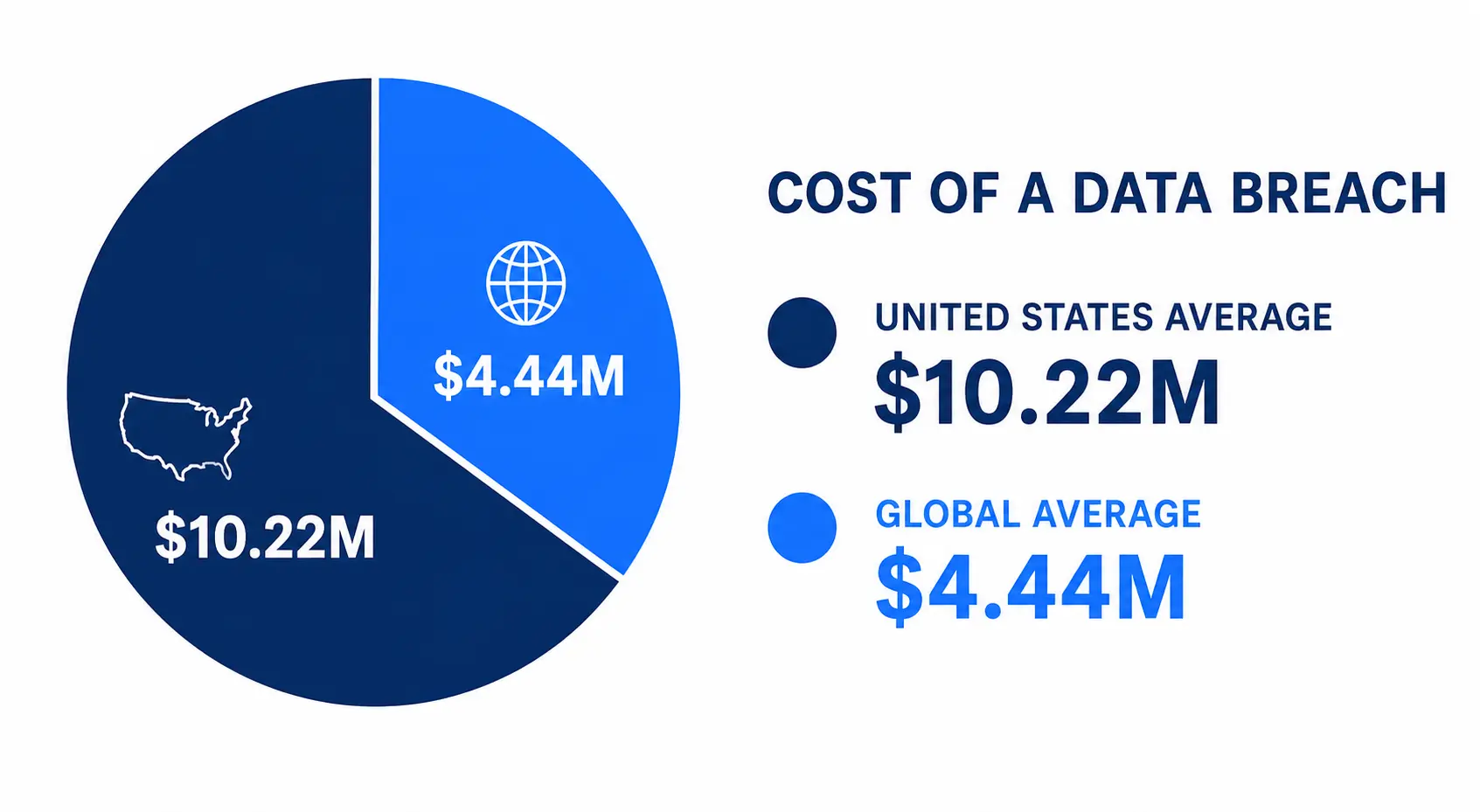
Money backs up the concern too. IBM’s Cost of a Data Breach Report found that the global average cost of a data breach reached $4.44 million, while breaches in the United States averaged a staggering $10.22 million.
The same report noted that a large share of organizations using AI tools still lack any formal governance around them, quietly creating a brand-new category of exposure that most companies have not budgeted for.
None of this is meant to scare you—it is meant to show why this work deserves a real budget, a named owner, and an actual plan, rather than an afterthought bolted onto the IT department in December.
The Core Pillars of a Strong Program
A mature approach to digital risk management does not rely on a single tool or a single policy. It is built on several interconnected pillars that work together every day. Here is a simple breakdown of what each one covers and why it matters to a business.
|
Pillar |
What It Covers |
Why It Matters to the Business |
|
Information security governance |
The policies, roles, and accountability structures that decide who protects what data and how decisions get made |
Without clear ownership, security efforts become scattered and inconsistent across departments. |
|
Security risk assessment |
The structured process of identifying assets, spotting vulnerabilities, and ranking threats by likelihood and impact |
Helps leadership spend limited budgets on the risks that could actually hurt the business most |
|
Cybersecurity governance |
Board-level oversight, reporting lines, and policy enforcement that keep security aligned with business goals | Ensures security is treated as a strategic priority rather than a purely technical checkbox |
| Technology risk | Exposure created by outdated systems, poor integrations, cloud misconfigurations, and unsupported software |
Legacy and misconfigured technology remains one of the most common entry points for attackers. |
|
Cyber threat management |
The ongoing work of detecting, analyzing, and responding to active threats such as malware, phishing, and ransomware |
Reduces the time attackers spend undetected inside a network, limiting damage and cost |
Notice how each pillar feeds into the next one. Strong information security governance sets the rules of the game, a proper security risk assessment tells leadership exactly where the gaps sit, cybersecurity governance keeps executives accountable for closing those gaps, an honest view of technology risk shows where the weak spots physically live inside the estate, and cyber threat management is the day-to-day muscle that keeps everything running safely once the other four pillars are in place.
How the Process Works: A Step-by-Step Framework
Most organizations that succeed at this follow a version of the same five-step cycle, closely mirrored by globally recognized standards such as the NIST framework mentioned earlier and ISO/IEC 27001, the leading international standard for information security management systems.
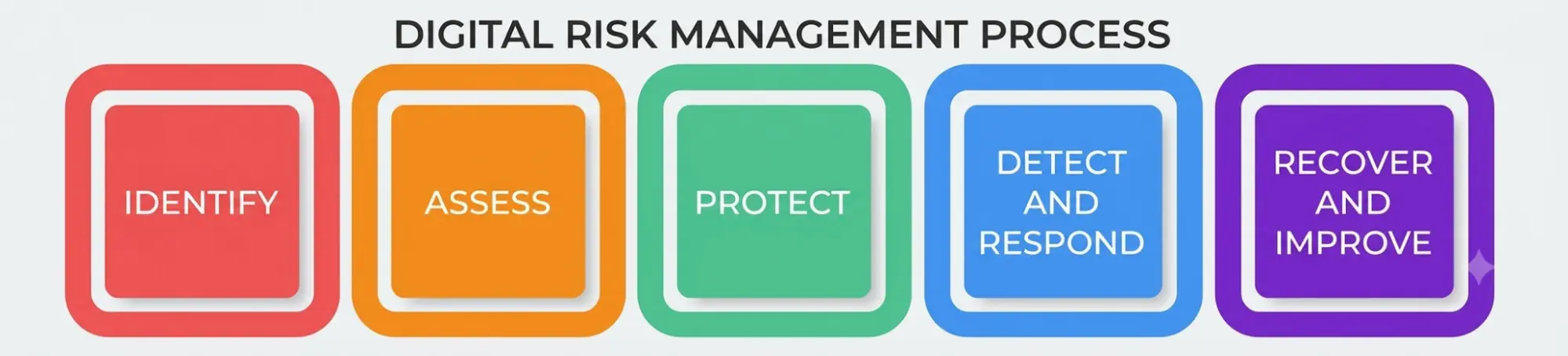
- Identify—List every digital asset: servers, applications, cloud accounts, third-party vendors, and the data each one touches.
- Assess—Run a formal security risk assessment to rank which assets are most exposed and most valuable to an attacker.
- Protect—Put in place controls—encryption, control of access, employee training, and disciplined patch management.
- Detect and Respond—Monitor and have a trained team to catch problems early with active cyber threat management, so small incidents don’t snowball into big ones.
- Recover and Improve – After any incident, review what happened, update policies, and feed the lessons straight back into governance.
This cycle never really ends, and that is by design. New apps get added, employees change roles, vendors get swapped out, and attackers keep inventing new tricks—so the whole approach has to be treated as a living process rather than a one-time project that gets filed away after a single audit.
Common Digital Risks Every Business Faces Today
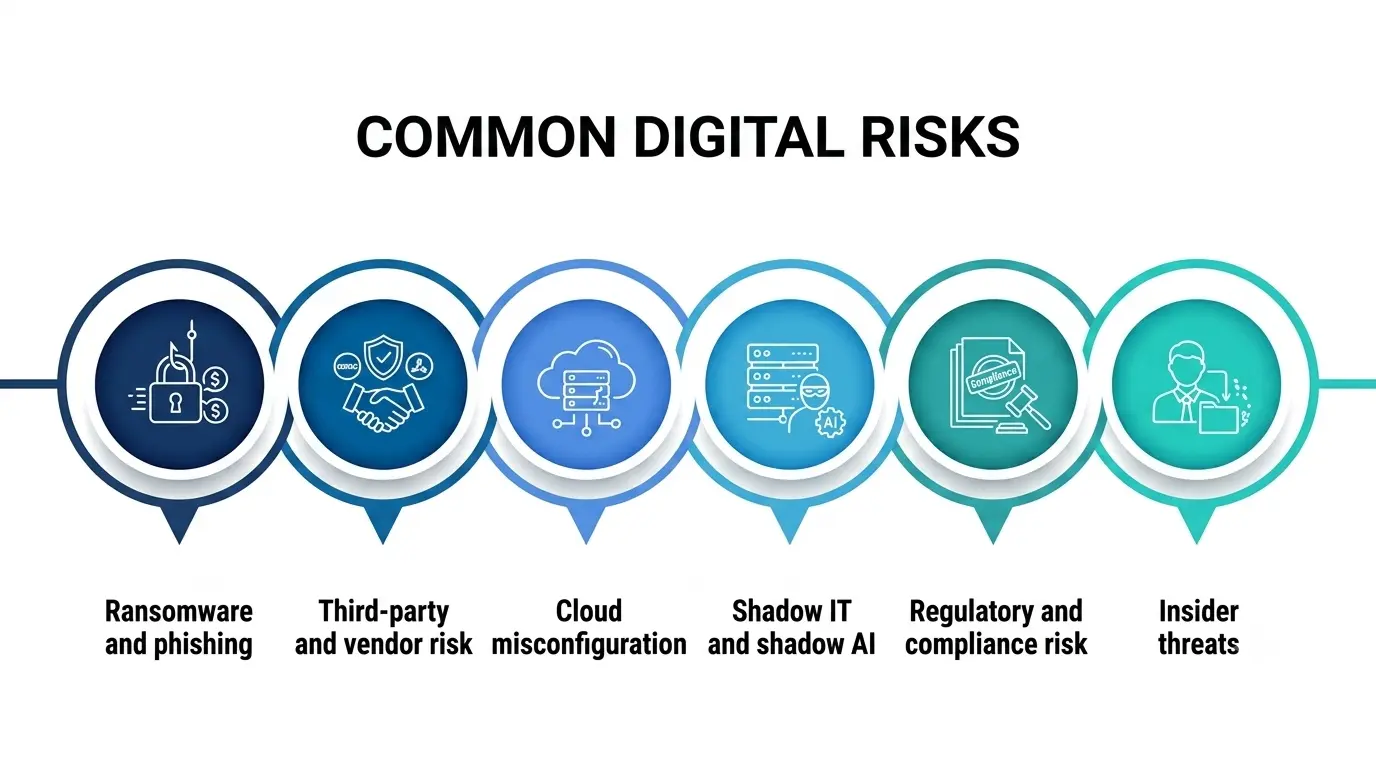
- Ransomware and phishing—Still the most common way attackers get in, often through a single deceptive email that looks perfectly ordinary.
- Third-party and vendor risk—A company’s security is only as strong as the weakest supplier connected to its systems, which is often overlooked until something goes wrong.
- Cloud misconfiguration—Publicly exposed storage buckets or databases remain one of the easiest mistakes to make and one of the costliest to fix after the fact.
- Shadow IT and shadow AI—Employees using unauthorized apps or AI tools without oversight creates blind spots that security teams can’t just monitor.
- Regulatory and compliance risk—Poor understanding of technology risk can result in legal penalties and reputational damage in the form of laws such as GDPR and other regional data protection acts.
- Insider threats—Not always malicious; sometimes it is simply an untrained employee making an honest mistake with sensitive files.
Each of these risks looks different on paper, but they all point back to the same solution: a well-structured program that treats people, processes, and technology as one connected system rather than three separate problems.
Picture a mid-sized retail company that outsources its payment processing to a third-party vendor. The company itself might have excellent internal controls, trained staff, and an up-to-date firewall.
But if that vendor suffers a breach, customer card data can still leak, and the retailer’s brand takes the reputational hit regardless of whose servers were actually compromised. This is precisely the kind of scenario that a narrow, tools-only view of security misses, and it is exactly why a wider, business-level lens matters so much in practice.
Business Benefits of Digital Risk Management
It is easy to treat this as a cost center, but the return on investment is real and measurable once you look past the sticker price of the tools involved.
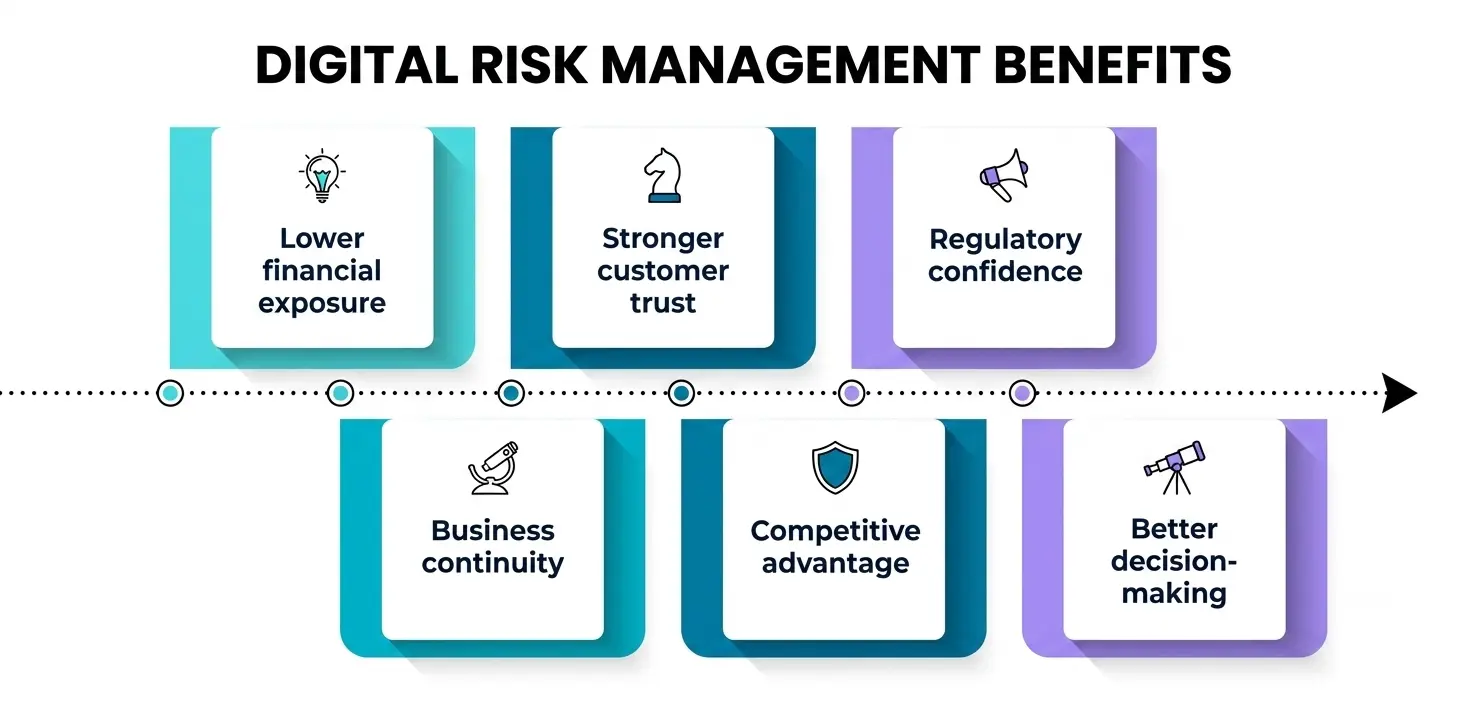
- Lower financial exposure—Catching issues early is dramatically cheaper than cleaning up after a full-blown breach.
- Stronger customer trust—Clients and partners increasingly ask for proof of solid information security governance before they will even sign a contract.
- Regulatory confidence—A documented program makes audits faster, cheaper, and considerably less stressful for everyone involved.
- Business continuity—Fewer surprises mean fewer disruptions to daily operations and revenue.
- Competitive advantage—Companies that can demonstrate mature cybersecurity governance often win deals that less prepared competitors quietly lose.
- Better decision-making—Leaders who can see their real risk picture make faster, more confident calls about new products, markets, and partnerships.
Digital Risk Management vs. Traditional Cybersecurity
People often use these terms interchangeably, but they are not quite the same thing. Traditional cybersecurity is mostly technical: firewalls, antivirus software, and network defenses designed to keep intruders out of a system.
The broader discipline covered in this article is more strategic. It includes cybersecurity, but it also covers reputational exposure, third-party relationships, regulatory obligations, and even the risks tied to how a brand gets discussed online.
Think of it this way: cybersecurity protects the systems, while this wider practice protects the business that depends on those systems. One is essentially a subset of the other, and both need constant threat monitoring working underneath them day and night to actually function in practice rather than just on paper.
Why Does This Matter for Students and Future Professionals?
If you are a student exploring career paths, this field deserves serious attention. Demand for people who understand risk assessment techniques, governance frameworks, and technology risk is growing far faster than the supply of trained professionals, which usually translates into strong salaries and genuine long-term job security.
A few practical starting points:
- Learn the frameworks—Get comfortable with NIST CSF and ISO/IEC 27001; employers consistently value candidates who already speak this language on day one.
- Build technical basics—Understand how networks, cloud platforms, and everyday business data actually move and connect.
- Consider certifications—Entry-level options such as CompTIA Security+ can lead toward more advanced credentials in information security governance and risk management later in your career.
- Practice with real scenarios—Free labs, capture-the-flag exercises, and internships teach far more in a month than theory alone teaches in a semester.
- Follow the news—Reading breach reports and annual risk barometers, like the ones cited in this article, keeps your knowledge current in a field that changes on a weekly basis.
Even students who end up in finance, law, or general management benefit from a working understanding of this material, since almost every modern role eventually touches data, vendors, or compliance in some form.
Best Practices for Implementing a Program
- Assign clear ownership; someone in the organization must be accountable for information security governance, even inside a small company with a lean team.
- Run a formal security risk assessment at least once a year, and again after any major change to your systems or vendor relationships.
- Keep leadership genuinely involved through regular cybersecurity governance reviews, not just a rushed slide deck once a year.
- Patch and update systems promptly to shrink the window of technology risk that opportunistic attackers can exploit.
- Invest in continuous monitoring and cyber threat management rather than relying on a single annual audit to catch everything.
- Train every employee, not just the IT team; human error remains one of the leading causes of real-world incidents.
- Document everything. Policies that exist only in someone’s head disappear the day that person leaves the company.
Conclusion
Digital risk is not going away, and pretending otherwise is a strategy that eventually fails, usually at the worst possible moment. Building a real program of digital risk management—grounded in solid governance, regular assessment, engaged leadership, honest awareness of technology exposure, and constant cyber threat management—gives a business the resilience to survive an incident rather than be defined by one.
For students entering the workforce, it also happens to be one of the more future-proof career paths available right now, with room to grow for years to come.
A Personal Note
I have spent enough time around security and risk teams to know that the biggest failures rarely come from a lack of tools—they come from treating risk as someone else’s problem until it very suddenly becomes everyone’s problem.
If there is one thing I hope you take from this piece, it is that this work is most effective when it is boring and consistent, not dramatic and reactive. Build the habit early, whether you are running a company, advising one, or just starting your career in the field, and the dramatic incidents become a lot less likely to ever land on your desk.