
The basic building block for your private network in Azure is provided by the Azure Virtual Network service. A virtual network, or instance of the service, allows various kinds of Azure resources to safely connect to the internet, on-premises networks, and one another. A complete guide covering the top cybersecurity projects for beginners and professionals, hands-on project ideas, cybersecurity skills, tools, and career guidance for 2026.
Cybersecurity meaning

“Cyber security” refers to a collection of technologies, protocols, and techniques that protect networks, devices, programs, and data against hacking, viruses, malware, and other threats. The fundamental objective of cybersecurity projects is to protect the confidentiality of all company data from internal and external attacks and disruptions caused by natural disasters. Cybersecurity is broadly divided into several domains — network security, application security, cloud security, endpoint security, identity and access management (IAM), and data security — each requiring specialized skills and tools in 2026.
Why Is a Career in Cyber Security a Good Fit?
Though the unemployment rate of 0% is undoubtedly a strong argument, one must take into account other factors before pursuing a career in cybersecurity. According to Cybersecurity Ventures, the global cybersecurity workforce gap has crossed 4 million unfilled positions in 2026 — making it one of the fastest-growing and most in-demand career fields worldwide
Some of the reasons why a job in cybersecurity is a good fit are as follows: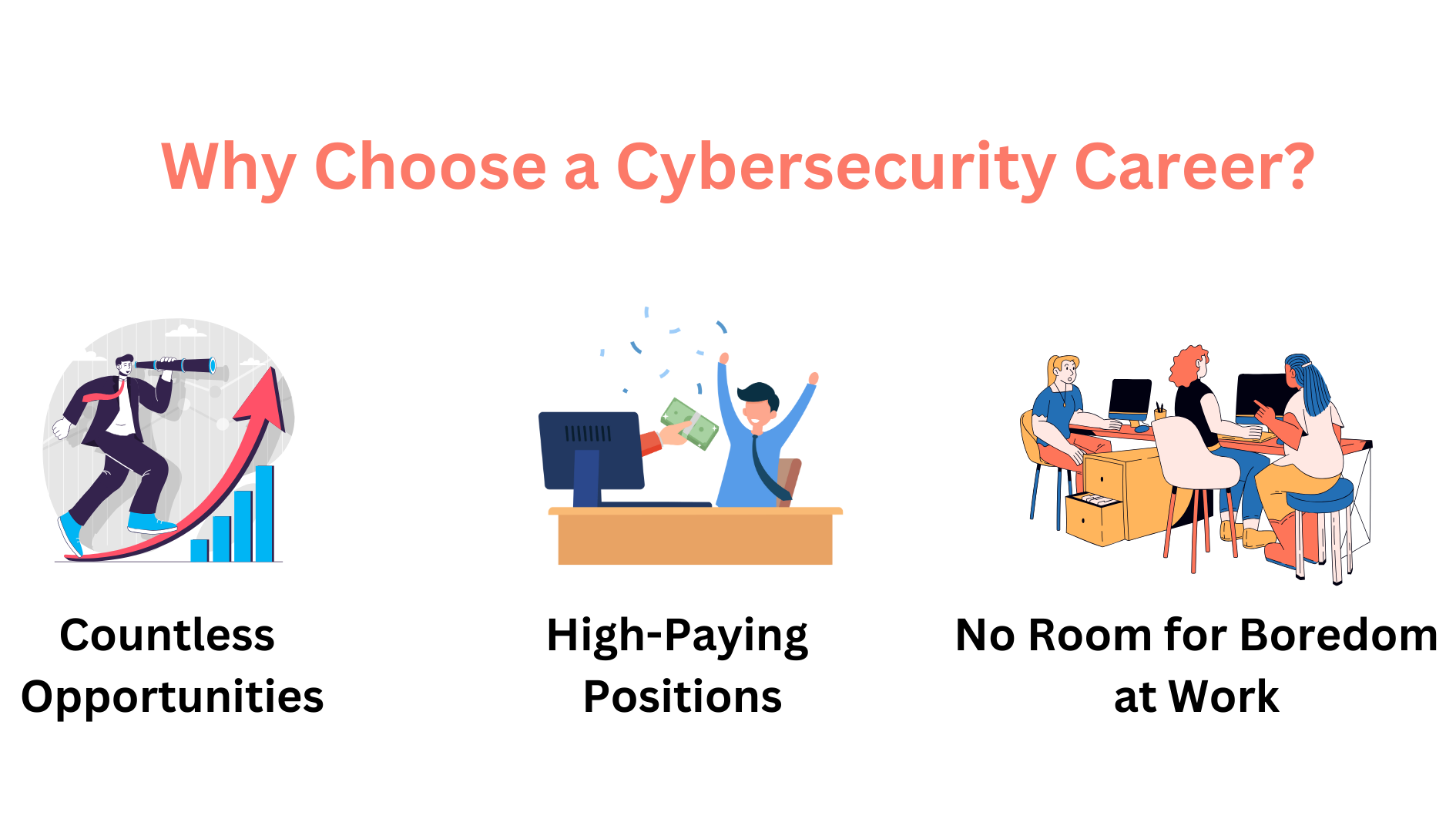
Countless Opportunities for Career Advancement
The growing frequency and severity of security breaches in a constantly changing digital environment amply demonstrate the growing need for and opportunity for expansion within the cybersecurity sector. There are several options for people who want to progress in their cybersecurity jobs. Popular cybersecurity career paths in 2026 include SOC Analyst, Penetration Tester, Security Engineer, Cloud Security Architect, Threat Intelligence Analyst, Digital Forensics Investigator, and Chief Information Security Officer (CISO)
High-Paying Positions
Not only does cybersecurity present a wealth of prospects for professional advancement, but it is also one of the top-paying fields. Cybersecurity analysts’ average yearly compensation increased by 16.3% between 2019 and 2020, to $103,106, according to Dice’s salary study.
In 2026, entry-level cybersecurity professionals globally earn between $55,000 and $80,000 per year, while experienced professionals in roles like Security Architect, Cloud Security Engineer, or CISO can earn upwards of $150,000–$200,000 annually depending on skills, certifications, and location.
There’s No Room for Boredom at Work
As technology and security threats evolve, so do cybersecurity solutions. As threats and technology change, so do the skills and positions that go with them. In 2026, from responding to live ransomware attacks to building AI-powered threat detection systems — every day in cybersecurity brings a new challenge, making it one of the most intellectually stimulating careers in technology.
Applications of Cybersecurity
Before applying cyber security you must be aware of the application of cyber security and how cybersecurity works. So, we discussed here two applications of cybersecurity: In 2026, cybersecurity is applied across industries including banking and finance, healthcare, government, e-commerce, manufacturing, and critical infrastructure — each with its own unique threat landscape and compliance requirements.
Improving Threat Intelligence on Its Own
Threat intelligence must be improved as part of every incident or threat investigation process. Until now, intelligence analysts have largely carried out the process manually, improving indications by hand and searching through numerous trustworthy sources. In modern threat intelligence platforms like MISP, ThreatConnect, and Recorded Future now automate the collection, correlation, and sharing of Indicators of Compromise (IOCs) — reducing analyst workload and improving response time significantly.
Recognizing Dangers in the Network
Large-scale enterprise networks have a hard time sorting through thousands of identical apps to find fraudulent ones. Versive, an AI company, offers cyber security software that uses dissonance detection to identify poor security vulnerabilities. Other key applications of cybersecurity include securing remote work environments through Zero Trust Network Access (ZTNA), protecting APIs from unauthorized access, preventing data breaches through Data Loss Prevention (DLP) tools, and securing cloud workloads using CSPM solutions.
Top 7 Cyber Security Projects
Organizations throughout the world continue to place a high premium on cybersecurity as threats change and cyberattacks get more complex. A number of cybersecurity initiatives are anticipated to gain prominence as 2024 approaches, tackling new problems and utilizing cutting-edge technology to strengthen security postures. The following are a few of the most important cybersecurity projects:
These projects are ideal for students, freshers, and working professionals who want to build a strong cybersecurity portfolio, gain hands-on experience, and stand out in job interviews or certification exams.
Zero Trust Architecture Implementation
Overview: To guarantee that confidence is never assumed, regardless of the source, implementing a Zero confidence architecture entails reorganizing network and data access regulations. This entails confirming each request as if they were coming from an open network.
Objective: Reduce the attack surface by implementing stringent access rules and disabling default trust for any entity, whether it is located inside or outside the network perimeter.
AI-Driven Threat Detection Systems
Overview: Creating AI-powered systems that use massive volumes of network data analysis to anticipate, identify, and react to cyber attacks instantly. These systems look for patterns and anomalies that point to possible security breaches using machine learning techniques.
Objective: Boost threat detection speed and accuracy, cut down on false positives, and automate reaction steps to quickly decrease risks.
Blockchain for Secure Transactions
Overview: Securing digital communications and transactions inside an organization through the use of blockchain technology. The creation of decentralized apps (dApps) that utilize blockchain technology to guarantee the confidentiality and integrity of data transfers is one example of this.
Goal: Improve data security and privacy by offering a visible, tamper-proof way to perform secure transactions.
Skills you will learn in 2026: Blockchain fundamentals, smart contract security, cryptographic hashing, Ethereum or Hyperledger Fabric basics, and understanding of decentralized identity (DID) models.
Beginner Project Idea 2026: Build a simple blockchain-based file integrity checker that logs file hash values on-chain — any modification to the file will produce a hash mismatch, detecting tampering in real time
Quantum Cryptography
Overview: Investigating the application of quantum cryptography to create safe communication networks that are impervious to quantum computers’ ability to decipher data. In order to protect communications, quantum key distribution, or QKD, is used in this.
The objective is to create cryptographic systems that are future-proof against the possible threat posed by quantum computing, guaranteeing data security even as computer technology advances.
Skills you will learn in 2026: Post-quantum cryptography (PQC) fundamentals, Quantum Key Distribution (QKD), NIST PQC standards (CRYSTALS-Kyber, CRYSTALS-Dilithium), and basics of quantum-safe TLS implementation — all highly relevant as quantum threats become real in 2026.
Beginner Project Idea 2026: Implement a post-quantum key exchange simulation using NIST-recommended algorithms in Python using the open-source liboqs (Open Quantum Safe) library.
Advanced Phishing Protection Techniques
Overview: Using cutting-edge machine learning models that can comprehend the context and nuanced cues of phishing attempts more effectively than conventional systems, more complex phishing detection and prevention systems are being created.
The objective is to drastically lower the success rate of phishing assaults, which are still a popular way for security breaches to occur.
Skills you will learn in 2026: Email header analysis, URL reputation checking, NLP-based phishing detection, sandboxing suspicious attachments, and using tools like PhishTool, URLScan.io, and Microsoft Defender for Office 365.
Beginner Project Idea 2026: Build a phishing URL detector using Python and a machine learning classifier (Random Forest or Logistic Regression) trained on features like URL length, special characters, domain age, and HTTPS usage.
Secure Access Service Edge (SASE) Deployment
Overview: Implementing SASE will enable dynamic secure access by fusing WAN capabilities with network security features like SWG, CASB, FWaaS, and ZTNA. This is especially important for businesses that accept remote employment.
Objective: Optimize performance and security for end users worldwide by consolidating network and security operations into a single, globally dispersed cloud service.
Skills you will learn in 2026: SD-WAN configuration, Cloud Access Security Broker (CASB) setup, Firewall-as-a-Service (FWaaS), Zero Trust Network Access (ZTNA), and working with SASE platforms like Zscaler, Palo Alto Prisma Access, or Cisco Umbrella.
Beginner Project Idea 2026: Set up a simulated SASE environment using Cloudflare Zero Trust (free tier) — configure identity-based access policies, DNS filtering, and secure web gateway rules for a test organization
IoT Security Enhancements
Overview: Creating thorough security frameworks for Internet of Things (IoT) devices, which are frequently subject to assaults because of inadequate security measures. This includes updating firmware on a regular basis and implementing endpoint security solutions.
The objective is to fortify the security of IoT devices in all sectors and keep them from serving as ports of entry for extensive network intrusions.
Skills you will learn in 2026: IoT network segmentation, firmware vulnerability analysis, MQTT protocol security, device authentication using certificates, and using tools like Shodan, Binwalk, and IoT Inspector for device security assessment.
Beginner Project Idea 2026: Use Shodan to discover publicly exposed IoT devices in a test environment, document their vulnerabilities, and build a report recommending hardening steps — this mirrors real-world IoT security assessment work in 2026.
Cyber Security skills required
Software developers working on the most important cyber security projects are in charge of developing and integrating security technologies such as malware scanners, spyware, intrusion detectors, and more at every stage of the software development process.
He or she is also in charge of integrating the extra cyber security technologies and components that are necessary to safeguard the network security of the company and avoid a breach of corporate data.
Core technical skills required for cyber security it include: network protocols (TCP/IP, DNS, HTTP/S), Linux administration, scripting (Python, Bash, PowerShell), cloud platforms (AWS, Azure, GCP), SIEM tools, and vulnerability assessment using Nmap, Nessus, or OpenVAS.
Soft skills that are equally important it include analytical thinking, clear written reporting, stakeholder communication, and the ability to work under pressure during live security incidents — all of which are built through hands-on project work.
Technical Guide for Tools
As to have technical knowledge is a must to do any work authentically so, here we are providing you with Two Technical Guides for Tools which can help you.
knowing the right tools for each security domain is a key differentiator in cyber security roles — interviewers and hiring managers regularly ask candidates to describe their hands-on tool experience during technical rounds.
1. Tools for Tracking Network Security
These tools are used to analyze network data and identify network-based threats. Examples of such tools are Argus, Nagios, Pof, Splunk, and OSSEC.
Additional network security monitoring tools widely used include Zeek (Bro), Wireshark for packet capture and analysis, Suricata as an open-source IDS/IPS, and Security Onion — a free Linux distribution built for network security monitoring and log management.
2. Resources for Web Vulnerability Identification
These software tools assess web applications for vulnerabilities such as cross-site scripting, SQL injection, and path traversal. Examples of such tools are SQLMap, Paros Proxy, Nikto, and Burp Suite.
Additional web vulnerability tools widely used and it’s include OWASP ZAP (free alternative to Burp Suite), Nessus for network and web vulnerability scanning, Metasploit for exploitation testing, and Acunetix or Qualys WAS for enterprise-grade web application scanning
Conclusion
Hence, here in this blog, we have covered “Top 7 Cyber Security projects” as well as cyber security meaning, why is a career in cyber security a good fit, applications of cyber security, cyber security skills required, and technical guide for tools. Hope after reading this blog you will be able to choose the Cyber Security project for you which will suit you the best. If you want to learn more about cyber security certification courses, cyber security courses, cyber security training, IT security certifications, etc. you can visit our web blog pages.
Quick Cyber Security Project Checklist 2026 — Before You Start
- Defined the project objective and scope clearly
- Selected the right tools and technologies for the project domain
- Set up an isolated lab environment (VM, cloud sandbox, or home lab)
- Documented the problem statement and expected outcome
- Identified relevant MITRE ATT&CK techniques or OWASP risks to address
- Collected or generated test data safely and legally
- Tested and validated the solution in a controlled environment
- Documented findings, results, and recommendations
- Added the project to your GitHub portfolio with a clear README
- Linked the project to skills required for your target 2026 job role