
If you’ve been job hunting in tech for the last few months and getting nowhere, the problem is probably not your skills.
It’s the way you’re job hunting. The tech job market in 2026 has changed completely. AI now reads your resume before any human ever sees it. Roughly 1 in 4 jobs you apply to don’t even exist. And companies are quietly raising the bar on what they expect from junior candidates.
I spent the last few weeks reading hiring reports from BCG, Stack Overflow, Greenhouse, IEEE-USA, Robert Half, and the Congressional Research Service. I also looked at what hiring managers are actually saying in 2026 about why they reject candidates.
And I noticed something. The same three habits keep killing job applications — even from talented, qualified people. These aren’t tiny mistakes. They are the difference between getting interviews and being invisible.
If you stop doing these three things starting today, your callback rate will improve. It really is that simple.
Let’s break them down one by one.
The 2026 IT Hiring Reality
Before we get into the three mistakes, you need to understand what you’re up against. The numbers are real and they explain why old job-hunting advice doesn’t work anymore.
- 92% of companies use AI to screen resumes (BCG 2025 AI Recruitment Survey). Your resume is read by software first. Humans see it only if AI passes it.
- 76% of recruiters reject resumes with formatting errors (2026 hiring surveys). One bad table, one weird font, and you’re out.
- 27% of US online job listings are ghost jobs (ResumeUp.AI 2025 LinkedIn analysis). They look real. They are not.
- 81% of recruiters admit their company posts ghost jobs (MyPerfectResume survey of 753 recruiters).
- 73% of hiring managers say a strong portfolio matters more than a perfect resume (Stack Overflow Developer Survey 2024).
- Referred candidates are 4x more likely to get an offer than cold job board applicants (Zippia 2026).
Now read those numbers again. Most job seekers in 2026 are still acting like it is 2019. They’re applying to dozens of jobs through job boards, sending the same resume to every role, and stacking up certifications without anything to show for them.
That approach is broken. Here’s why — and what to do instead.
Mistake 1: Mass-Applying to 100+ Jobs on Job Boards
Stop doing this. It is the single biggest waste of time in any 2026 job search.
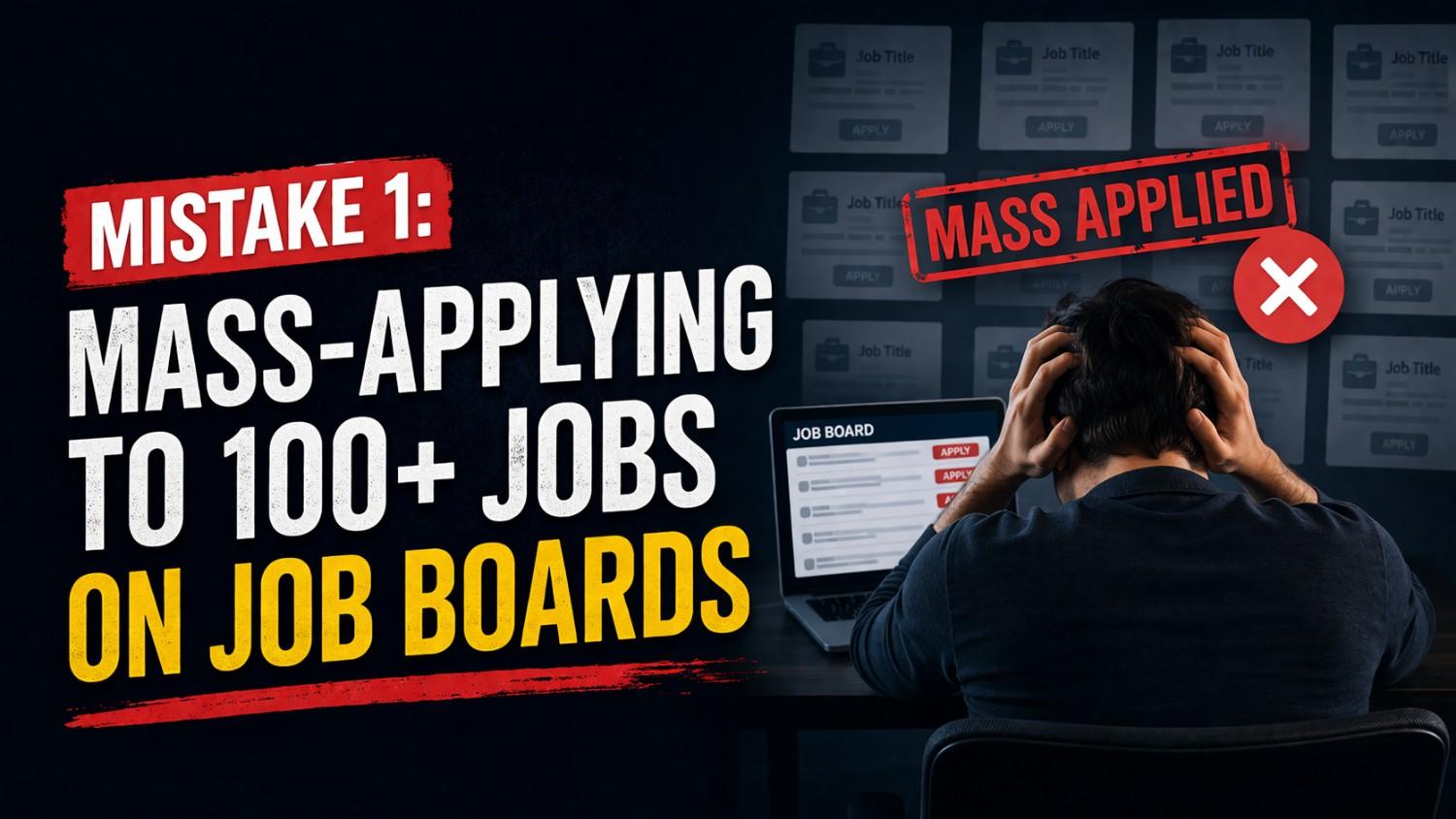
Most beginners think the way to land a tech job is to apply to as many roles as possible. The logic feels right — more applications, more chances. But the data says the exact opposite is true.
Why mass-applying fails in 2026
Three things have changed in the last two years that make this strategy nearly useless:
- Ghost jobs are everywhere. Roughly 27% of US LinkedIn listings have no real hiring intent behind them. Companies post fake jobs to look like they are growing, to collect resumes for future use, or to pretend they are open to outsiders when an internal candidate is already chosen. The Congressional Research Service confirmed this in a 2025 report. Out of every 100 jobs you apply to, around 27 were never going to hire anyone.
- AI rejects untargeted resumes. When you blast the same resume to 100 jobs, the AI screening tool sees you don’t match the specific keywords for any of them. Your resume gets a low score and never reaches a human. According to 2026 industry data, mass-applied generic resumes have around an 8% interview rate. Targeted, keyword-matched resumes hit 35%+.
- The mental cost is brutal. Greenhouse’s 2024 report found 72% of US job seekers say the application process hurts their mental health. Sending 100 cold applications and getting silence breaks people. It also makes you start doubting your skills — when the real problem is the system.
What to do instead
Apply to 10–15 jobs per week, not 100. And actually research each one. Look at the company. Check if the job has been posted for more than 30 days (red flag for ghost jobs). See if anyone in your network knows someone there.
Use referrals as your main strategy. Referred candidates are 4x more likely to get an offer. They also get hired faster. Spend 30 minutes a day on LinkedIn finding people who work at companies you want to join. Send a short, real message asking about their experience. Most people are kind and willing to help newcomers.
Skip listings that look suspicious. Ghost job red flags include: posted for 60+ days with no updates, vague job description, generic title with no team mentioned, salary range too wide ($60K–$200K), and no specific tools or platforms named. If you spot two or more of these, move on.
Lean on smaller companies. Startups and SMBs with 10–100 people are still hiring directly, hiring fast, and giving real interviews. The big enterprise pipeline is the slowest. Focus there only if you have a referral.
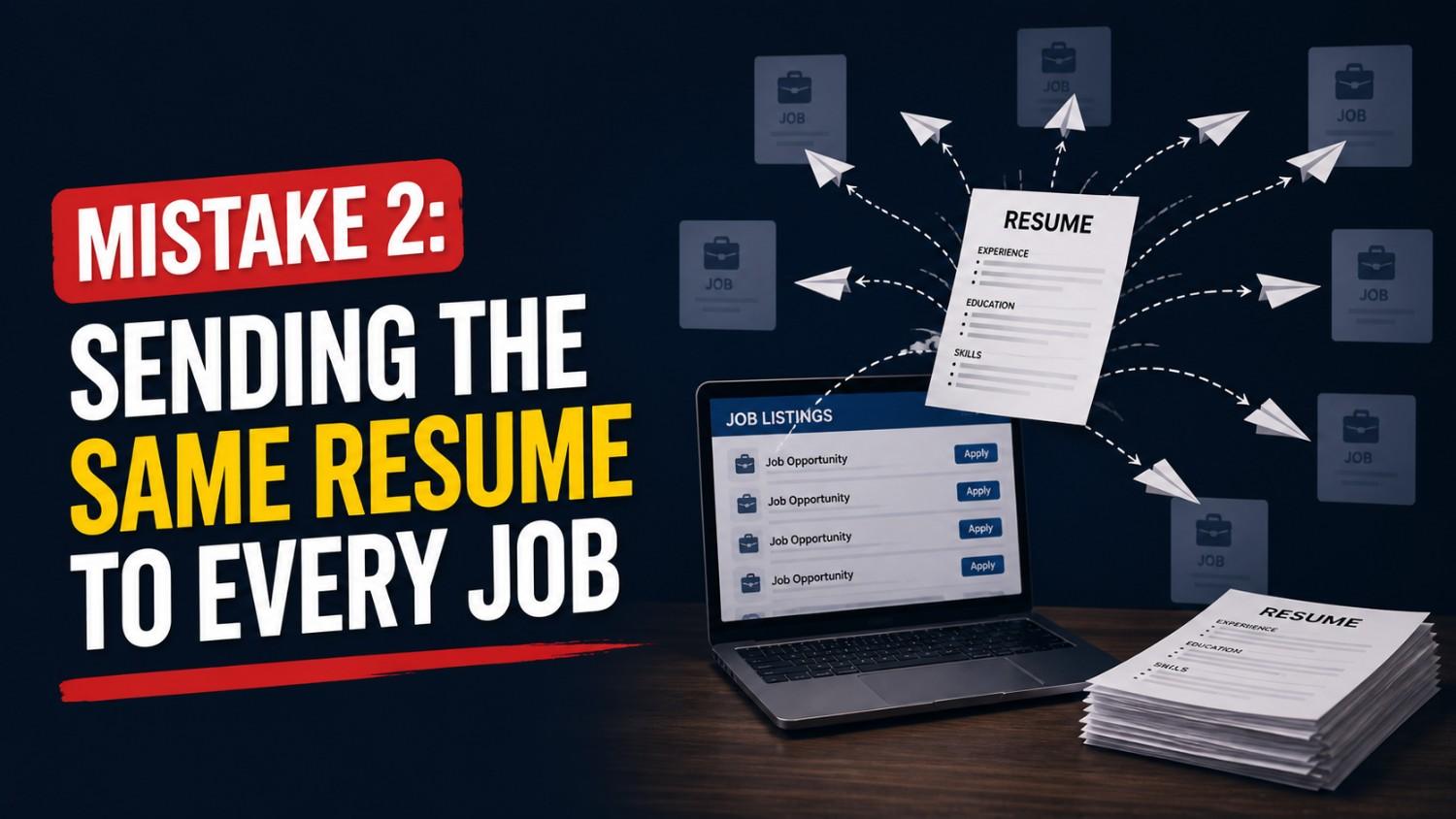
Mistake 2: Sending the Same Resume to Every Job
This single habit gets more good candidates rejected than any other.
In 2026, AI resume screening has become standard. According to BCG’s 2025 survey, 92% of companies use AI in their hiring pipeline. Almost 99% of Fortune 500 companies rely on Applicant Tracking Systems (ATS) to filter resumes.
Here’s what that means for you: a piece of software reads your resume before any human ever does. And that software is looking for very specific things.
How AI screening actually works in 2026
The AI doesn’t read your resume the way a person would.
It scans for:
- Exact keyword matches with the job description
- Standard section headings like “Experience,” “Skills,” “Education”
- Quantified outcomes (percentages, numbers, results)
- Clean formatting with no tables, columns, or graphics
- Common file formats — usually a Word document or simple PDF
If your resume uses creative section titles like “My Journey” or “What I Bring,” the AI may not even know where your work experience is. If you have a beautiful two-column design with icons, the AI might fail to read half your content. Strong candidates get rejected for these reasons every single day.
Why one resume for everything fails
Different jobs use different keywords. A “DevOps Engineer” posting at one company might list Terraform, Jenkins, and AWS. A nearly identical posting at another company might list Ansible, GitLab CI, and Azure. If your resume only says “DevOps experience,” both AI screeners will rank you low.
The fix is not complicated. It just takes 10 extra minutes per application.
What to do instead
Tailor your resume for every single job. Read the job description. Pull out the exact tools, frameworks, and skills mentioned. Make sure those exact terms appear in your resume — naturally, not stuffed.
Mirror the job description language. If the posting says “JavaScript,” don’t write “JS.” If it says “AWS,” don’t write “Amazon Web Services.” The AI is matching strings, not concepts.
Quantify everything you can. “Built API integrations” is weak. “Built API integrations that reduced processing time by 40%” is strong. Numbers prove impact. Even academic projects work — “Built Python script processing 10,000+ data points” is a great line for a fresher resume.
Use simple, standard formatting. One column. Standard fonts (Calibri, Arial, Times New Roman). Headings like “Experience,” “Education,” “Skills,” “Projects.” No tables. No icons. No fancy graphics. Save as a Word document or simple PDF.
Don’t over-rely on AI tools to write your resume. Robert Half’s 2026 hiring report flagged this as one of the top mistakes recruiters now spot. AI-generated resumes feel robotic, repeat the same phrasing, and often hallucinate fake achievements. Use AI to suggest improvements — but make sure the final words are honest and yours.
Mistake 3: Stacking Certifications Without Real Projects
This one hurts because it feels productive. You finish a certification. You feel like you’ve moved forward. But hiring managers see something different.
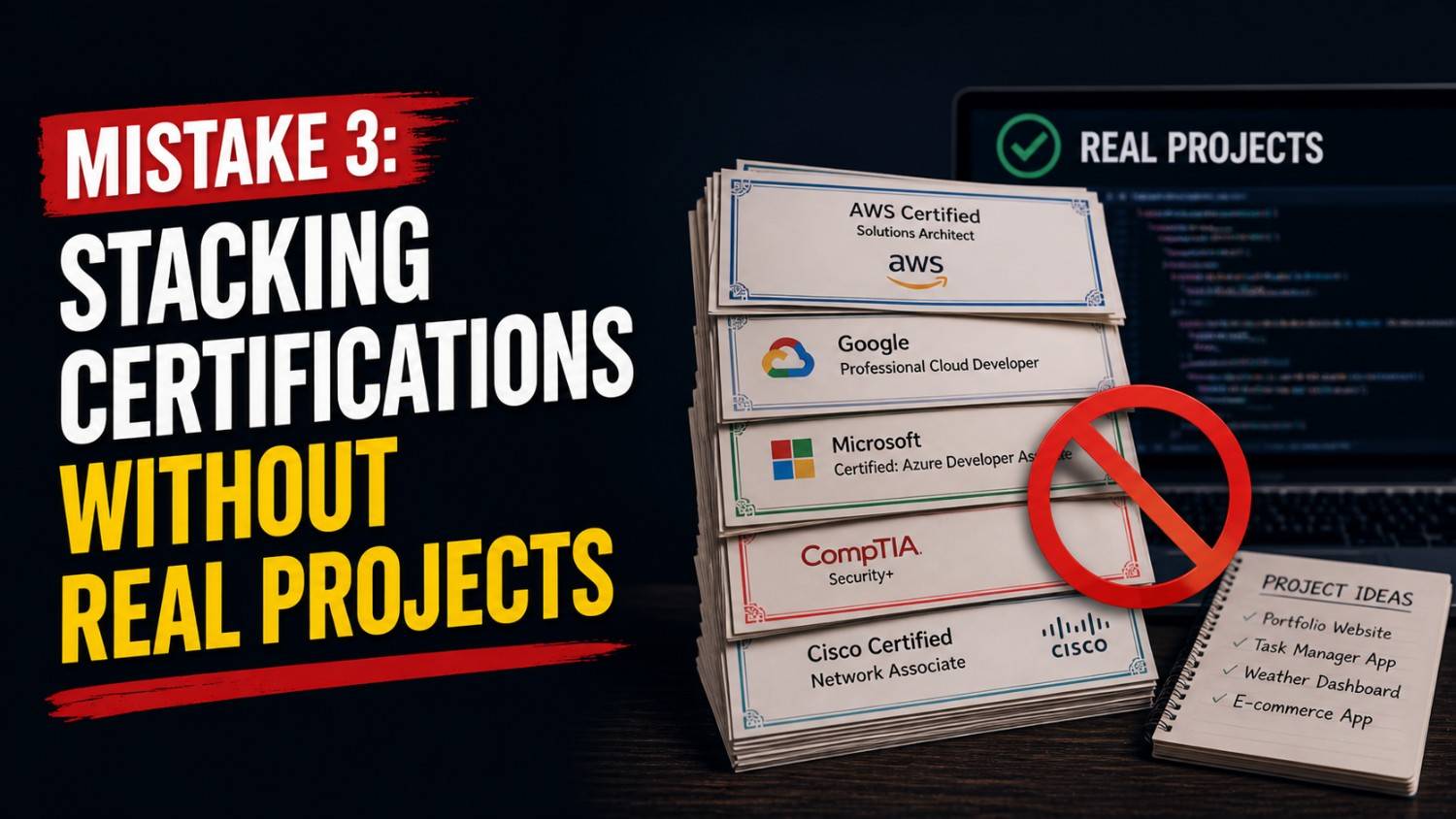
In 2026, certifications alone don’t prove you can do the job. They prove you finished a course. That distinction matters more than ever.
Why certifications without projects don’t get you hired
According to the 2024 Stack Overflow Developer Survey, 73% of hiring managers say a strong portfolio matters more than a perfect resume. For data analyst, developer, and cloud engineer roles, the number is even higher. Hiring managers want to see what you’ve actually built.
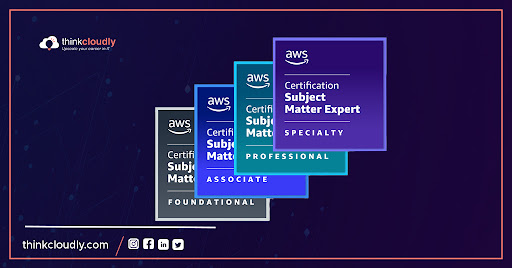
And here’s the painful truth: certifications have become so common that they no longer differentiate you. AWS Certified Solutions Architect Associate, CompTIA Security+, Google Data Analytics Certificate — these are great starting points. But thousands of people now have them. What separates you from those thousands is what you can show.
What hiring managers actually look for
In a 2026 hiring conversation I read from a senior data engineer, the message was clear: “I am looking for engineers who solve problems because they can’t help themselves, not because they are chasing a certificate.”
That’s the bar in 2026. A real portfolio with 3 to 5 well-built projects beats 10 certifications.
Here’s what makes a portfolio actually work:
- Real, original problems — not tutorial copies. Build something that solves an actual issue you noticed.
- Live demos — 84% of employers want to see working applications, not just code in a repo.
- Clean GitHub READMEs — explain what the project does, the problem it solves, and how to run it.
- Documentation of your thinking — what you tried, what failed, what you learned. This shows real problem-solving skill.
- Variety — a mix of simple and complex projects shows range.
What to do instead
Get one solid certification, then stop. Pick the most respected one for your target role — AWS Solutions Architect Associate for cloud, CompTIA Security+ for cybersecurity, Google Data Analytics for data. One cert is plenty. Don’t collect more until you have projects to back the first one up.
Build 3 to 5 real projects. Avoid tutorial follow-alongs (especially the famous Titanic and Iris datasets — recruiters know them by heart). Pick problems from your daily life, public datasets, or company case studies. Build something useful, then write about it.
Document everything on GitHub. Write clear READMEs. Explain the problem. Show the code. Add screenshots or a live demo link. Companies with strong tech cultures look at GitHub more than resumes.
Show your thinking, not just your output. In your README or project page, talk about challenges you faced and how you solved them. This is what separates juniors who get hired from juniors who don’t.
Pin your best work on LinkedIn and GitHub. Make it impossible for a recruiter to miss your best projects. The first 30 seconds of a profile review should show your strongest work.
Quick Summary — The 3 Habits to Drop in 2026
Here’s a quick reference table you can save:
|
Mistake to Stop |
Why It Hurts You | Do This Instead |
|
Mass-applying to 100+ jobs |
27% of listings are ghost jobs; AI rejects untargeted resumes | Apply to 10–15 real jobs with referrals + tailored resumes |
| Sending the same resume everywhere | 76% of recruiters reject formatting errors; AI filters by keywords |
Mirror job description keywords; quantify outcomes |
| Collecting certs without projects | 73% of hiring managers prefer portfolios over resumes |
Build 3–5 real projects; document on GitHub |
What a Smart 2026 IT Job Search Actually Looks Like
So if mass-applying, generic resumes, and cert-stacking are all dead — what does work?
Here’s the actual 2026 playbook:
Week 1–2: Set the foundation. Pick one target role. Build a tailored, ATS-friendly resume. Polish your LinkedIn profile with keywords matching that role. Set up a clean GitHub profile.
Week 3–6: Build 2 real projects. Pick problems from your daily life or the news. Build solutions. Document them. Push to GitHub with strong READMEs and live demos when possible.
Week 7 onwards: Strategic applying. Apply to 10–15 carefully chosen jobs per week. Tailor your resume for each. Use LinkedIn referrals before cold applications. Skip listings older than 30 days unless you have a strong inside contact.
Throughout: Network publicly. Post about what you’re learning. Share a project. Comment on hiring managers’ posts. Most jobs in 2026 are filled through referrals or warm intros — not cold applications.
This approach typically takes 2 to 4 months for a first IT role. That sounds long, but it’s much faster than 12 months of mass-applying with no results.
The Bottom Line
The 2026 IT job market isn’t bad. It’s just different.
There are real jobs out there. There are companies actively hiring. According to CompTIA’s 2025 State of the Tech Workforce report, US tech jobs are projected to grow at roughly twice the rate of the overall workforce over the next decade. Cloud, cybersecurity, AI, and data roles are leading that growth.
The problem is that most job seekers are still using strategies built for a different era. Mass-applying worked when a human read every resume. Certificate-stacking worked when fewer people had them. Generic resumes worked before AI screening became standard.
None of that works now. But the new path is actually simpler. Apply to fewer jobs, but apply better. Tailor every resume. Build real projects, not just collect certificates. Network strategically through referrals.
If you stop doing these three things and start doing the opposite — you will see results within a few weeks. Not because you got luckier. Because you finally started playing the right game.
The IT field still rewards people who do the real work. It just rewards them differently than it used to.
Sources & Further Reading
The data and statistics in this article are drawn from the following sources:
- BCG 2025 AI Recruitment Survey — 92% of companies using AI in hiring; 30% recruiter productivity boost
- Stack Overflow Developer Survey 2024 — 73% of hiring managers prioritize portfolios over resumes
- Greenhouse 2024 State of Job Hunting Report — 72% of job seekers say job search hurts their mental health
- ResumeUp.AI 2025 LinkedIn Analysis — 27.4% of US LinkedIn listings classified as ghost jobs
- MyPerfectResume Survey of 753 Recruiters — 81% of recruiters admit their employer posts ghost jobs
- Congressional Research Service Report — Ghost job posting practices in the US labor market
- Zippia 2026 Employee Referral Statistics — Referred candidates 4x more likely to receive an offer
- US Bureau of Labor Statistics JOLTS Data — 6.9M February 2026 job openings vs. 4.8M actual hires
- CompTIA 2025 State of the Tech Workforce — US tech jobs projected to grow at 2x the overall workforce rate
- IEEE-USA 2026 Tech Hiring Outlook — Robert Half senior recruiter insights on top 2026 hiring mistakes
- Indeed 2026 Tech Skills Report — Python, AWS, APIs, CI/CD, AI as top in-demand skills
- Robert Half 2026 Salary & Hiring Trends Guide — AI resume mistakes and 2026 hiring patterns
Job market data is updated quarterly. AI screening statistics and ghost job percentages reflect 2025–2026 reports across major hiring platforms.
If you’ve been job hunting for months and getting nowhere, the problem isn’t your skills — it’s your strategy. Browse our IT career programs to find the path that matches your timeline, or book a free 1-on-1 consultation with our career advisors. We’ll help you build a portfolio, fix your resume, and map a real job search plan.