

Did you know that 94% of organizations worldwide now use Agile practices in some form—yet most are still measuring performance the wrong way?
Here is the uncomfortable truth: teams are tracking the wrong numbers, celebrating the wrong wins, and missing the signals that actually predict whether a project will succeed or quietly collapse. Agile metrics are not just a reporting exercise—they are the clearest window into how a team truly performs and what needs to change before a small problem grows into a serious one. In the world of agile project management, knowing which numbers to watch is the most underdiscussed leadership skill of 2026. This blog breaks it all down in plain language, backed entirely by 2025–2026 data.
Why Are Most Teams Measuring the Wrong Things?
Here is a situation most managers will recognize. A sprint ends. Everyone marks it green. Velocity is up. The dashboard looks healthy. And yet the product shipped three weeks late, and the customer complained. How does that happen?
It happens because teams default to activity metrics—counting tasks completed, hours logged, and story points burned—rather than outcome metrics that reflect real business value. According to the 2026 State of Agile Report, only 29% of teams are judged by the value they actually deliver, and just 25% measure success through genuine business outcomes. The remaining majority remain anchored to process compliance metrics that tell a comfortable story rather than an accurate one.
The right agile metrics already exist, validated across thousands of teams globally. The following sections cover every category you need to understand.
The Four Categories of Agile Metrics Every Team Should Understand
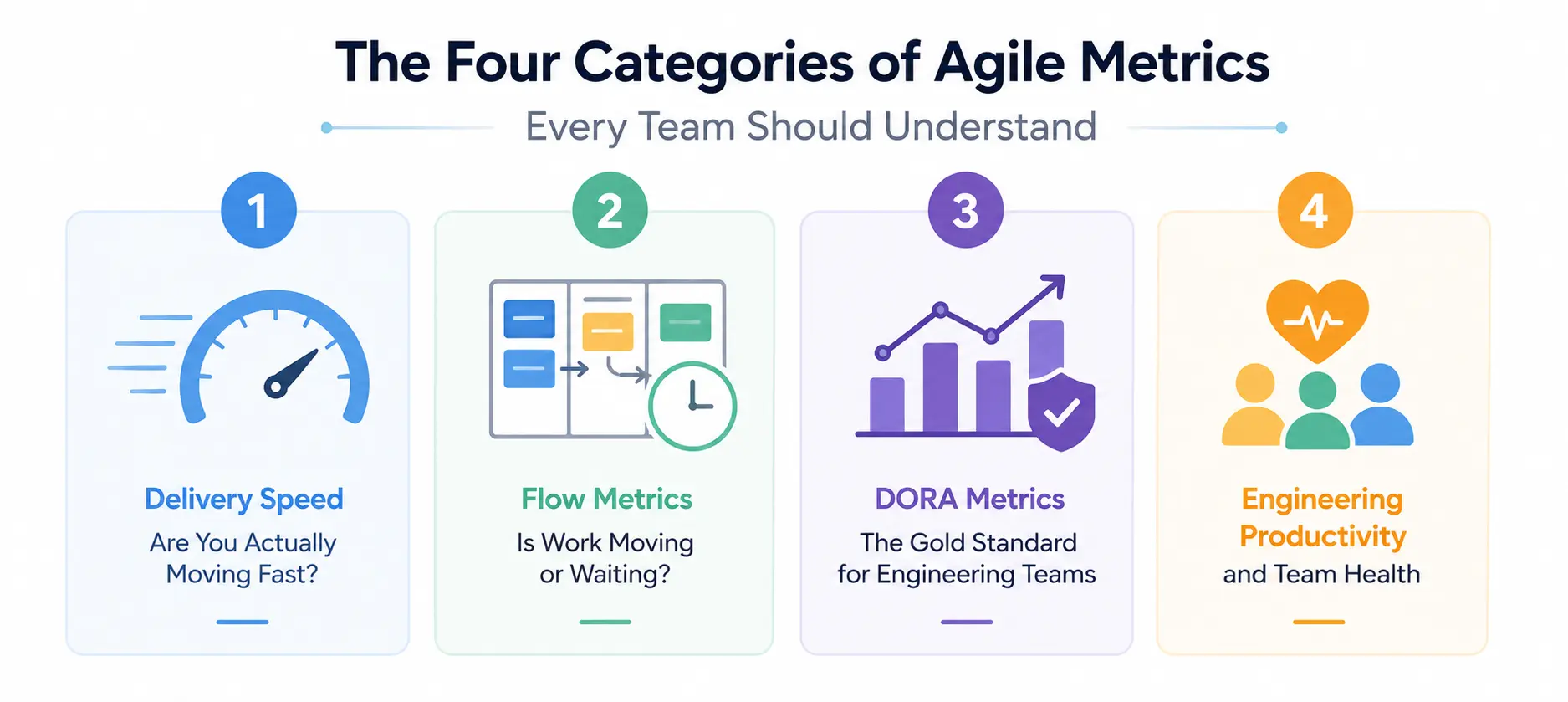
The most effective measurement approach in 2026 spans four interconnected categories. Think of them as lenses—each reveals what the others cannot.
1. Delivery Speed — Are You Actually Moving Fast?
Speed is the metric most teams think they understand and the one they most frequently misread.
Lead time is the clearest indicator here. It measures the total time from when a request enters your system to when the customer actually receives the outcome—not when coding started, not when QA signed off, but when the customer received it. Lead time correlates more directly with customer satisfaction than almost any other single measure because responsiveness is what customers experience most clearly. Closely related is cycle time, which covers only the active work period. If your lead time is twelve days but cycle time is two, ten days of invisible waiting are buried in your process. That gap is precisely where delivery improvements live—and where most reviews should begin.
2. Flow Metrics — Is Work Moving or Waiting?
Flow metrics focus on the movement of work through your system, not simply its output. The distinction matters enormously in any Scrum metrics review.
The core flow metrics are throughput, work in progress (WIP), flow efficiency, and flow distribution. Together they answer a question delivery speed measures cannot: is your process structured for fast output, or are you sprinting on a clogged track? Throughput counts work items completed per period — far less susceptible to manipulation than story points, which teams inflate simply by estimating higher. According to industry data, cycle time (66%) and velocity (61%) remain the most commonly tracked Scrum metrics across teams globally, but these outcome-focused indicators are gaining ground fast as Agile project management maturity improves. High WIP is one of the most reliable warning signs in any workflow. Limiting WIP is a straightforward intervention with outsized impact. Every agile framework expects WIP limits to be set explicitly and reviewed in each retrospective—not discovered retrospectively when delivery is already late.
3. DORA Metrics — The Gold Standard for Engineering Teams
No performance conversation in 2026 is complete without this framework. Developed by Google’s DevOps Research and Assessment team and validated across thousands of organizations globally, DORA Metrics identifies five measures that reliably predict whether an engineering team can deliver software quickly and stably.
The original four are:
- Deployment Frequency — how often code successfully ships to production
- Lead Time for Changes — time from code commit to live in production
- Change Failure Rate — the percentage of deployments that cause incidents
- Mean Time to Recover (MTTR) — how fast a team bounces back from failure
Recently a fifth was added: Rework Rate — measuring how much engineering time goes to reactive, unplanned fixes rather than forward-looking work. Top performers across all five measures are twice as likely to meet organizational goals and consistently achieve faster customer value delivery alongside higher developer satisfaction.
One critical 2026 development reshapes how teams should read these results: AI coding tools. Deployment frequency and change response time have become partially misleading when AI generates 30–70% of committed code. The recommended path: keep the framework as a foundation, extend it with AI attribution tracking and complexity-adjusted throughput.
4. Engineering Productivity and Team Health
Your delivery numbers can look excellent while the team burns out. A burned-out team does not stay productive for long. The 2026 State of Agile Report confirmed that fully Agile teams are six times faster than non-Agile counterparts—but only when psychological safety, satisfaction, and engagement are treated as genuine engineering productivity indicators alongside delivery numbers. Scrum metrics reflecting team health—retrospective participation, voluntary retention, and well-being survey scores—deserve the same rigour as any delivery indicator.
Key Performance Indicators at a Glance
|
Metric |
Type | What It Measures | Why It Matters in 2026 |
Risk if Ignored |
|
Velocity |
Scrum Metrics | Story points completed per sprint | Sprint planning baseline |
Easily gamed; misleads cross-team comparisons |
|
Cycle Time |
Delivery speed | Active work duration per item | Bottleneck identification |
Hides waiting time disguised as activity |
|
Lead Time |
Delivery speed | End-to-end customer response time | Customer satisfaction predictor |
Teams appear fast internally and slow externally |
|
Throughput |
Output measure | Work items completed per period | Real delivery output |
Velocity inflation masks low actual output |
|
Deployment Frequency |
DevOps measure | Code shipped to production | Agile delivery maturity |
Low-frequency signals batch risk |
|
Change Failure Rate |
Quality indicator | % of deployments causing incidents | Release stability |
Rising rate signals hidden technical debt |
|
MTTR |
Resilience | Recovery speed from production failure | System reliability |
Long recovery erodes customer trust rapidly |
|
Rework Rate |
Efficiency | Reactive vs planned engineering effort | Engineering Productivity view |
High rework signals poor planning |
|
WIP |
Flow indicator | Simultaneous active work items | Bottleneck and overload detection |
High WIP predicts delayed delivery |
|
Team Satisfaction |
Health indicator | Morale, engagement, psychological safety | Sustainable long-term performance |
Ignored until turnover spikes |
Four Common Mistakes — Even in Experienced Teams
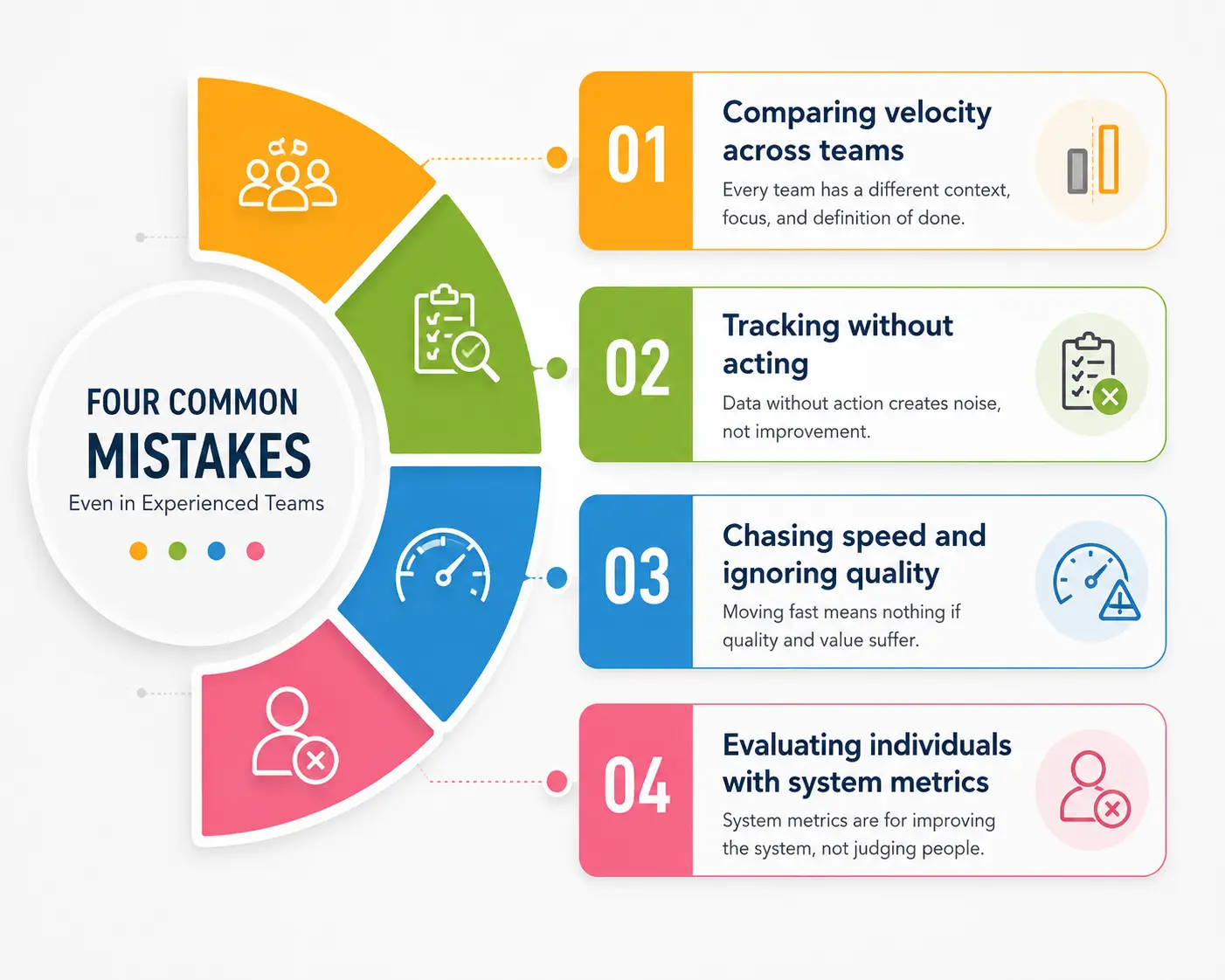
1. Comparing velocity across teams
Velocity in Scrum metrics is a planning tool for one team. It reflects that team’s specific estimation style and working rhythm. Comparing it between teams is meaningless—but it happens constantly in Agile Project Management reporting. Teams using Agile project management tools like JIRA often pull cross-team velocity dashboards that create more confusion than clarity.
2. Tracking without acting
Numbers without response are noise. A retrospective that identifies a rising lead time trend and does nothing about it has wasted the measurement. Every agile framework expects metric signals to trigger real improvement decisions each sprint—not just quarterly reviews.
3. Chasing speed and ignoring quality
The DORA AI research put a price on this: teams that pushed deployment frequency without addressing change failure rate saw CFR rise by 15–25%. Elite performers achieve high speed and low failure rates simultaneously—because the evidence shows these are not a genuine trade-off when the right practices are in place.
4. Evaluating individuals with system metrics
These delivery measures and engineering productivity data are designed for teams and systems—not individuals. Using PR count or deployment count to grade developers incentivizes gaming behavior, damages trust, and destroys the collaborative culture every Agile Framework depends on.
How to Build a Measurement System That Actually Works?
Getting this right does not require a data science team. It requires a clear philosophy and consistent application of a small, well-chosen set of indicators.
Start with no more than four to six measures spanning delivery speed, quality, and team health. A practical starter set: cycle time, throughput, change failure rate, and a brief fortnightly team wellbeing survey. Review inside sprint retrospectives—part of your natural Agile Framework cycle—not in separate reporting meetings. When metrics live inside the team’s working rhythm, they change behavior. When they exist only for management, they get gamed or ignored. Build toward these delivery measures once a baseline is established. Prioritize change speed and MTTR first—these two have the highest correlation with customer satisfaction in engineering productivity research globally. Layer in flow metrics next, focusing on WIP limits and flow efficiency, to diagnose where work stalls rather than moves.
The real-world results are compelling and applied structured measurement across 3,500+ engineers and achieved a 16% throughput gain while maintaining delivery quality. Intercom achieved a 41% time saving through deliberate AI-assisted development measurement.
Conclusion
The most important shift in agile metrics in 2026 is not about discovering new indicators. It is about replacing vanity measures with honest ones. Teams tracking velocity alone are measuring effort. Teams combining flow metrics, delivery benchmarks, and team health data are measuring performance—and using those signals to improve sprint by sprint.
The data is unambiguous: 94% of organizations use Agile, but only a fraction measure it rigorously. That is not a technology gap — it is a clarity gap. The right agile metrics are proven, publicly available, and actionable from your next retrospective. The only step remaining is choosing to apply them honestly—and treating every data point as a starting point for change rather than a destination for a status report.
Pick three measures. Review them transparently. Let the numbers lead you forward.