

In 2024, just 68% of Agile practitioners said they used AI in their daily work. A year later, that number jumped to 84% — the fastest single-year increase ever recorded by the long-running State of Agile survey. That is not a gradual shift. That is a stampede.
If you have noticed your project boards filling up with AI-suggested tickets, your retrospectives summarized by a bot, or your sprint estimates feeling oddly accurate lately, you are not imagining things. Agile teams around the world are reaching for AI tools faster than they reached for Scrum itself two decades ago. And the data from 2025 and 2026 tells a clear, fact-based story about why this is happening, what’s actually working, and where the risks still lie.
This is not a hype piece. It is a grounded look at what’s really going on inside modern agile teams—explained in plain language, for anyone who wants to understand the shift without needing a computer science degree to follow along.
Why Are Agile Teams Turning to AI So Quickly?
The honest answer is pressure. Agile teams today are expected to move faster, prove their value more often, and do more with the same headcount. According to the 2025 State of Agile report, 76% of practitioners now report increased scrutiny on the business value of their agile work—leadership wants proof, not just process. AI has become the fastest available lever to meet that demand.
There’s also a simple practical reason: AI tools have gotten genuinely useful for the unglamorous parts of Agile work. Sprint planning, backlog grooming, retrospective note-taking, and status reporting all involve repetitive pattern recognition — exactly the kind of task modern AI tools handle well, and exactly the kind of task that quietly drains team productivity when done manually, sprint after sprint. A 2026 systematic literature review covering studies from 2022 to 2025 found that AI primarily strengthens three areas of Agile work: predictive analytics for sprint planning, automated prioritization for backlog management, and early risk assessment. The same review found 75% of studies reporting measurable agile team efficiency improvements when AI was introduced into these workflows.
Gartner’s research goes further, predicting that by the end of 2026, more than 70% of agile software teams will be using AI-powered assistants on a daily basis—not occasionally, but as a built-in part of how they work. This isn’t a future trend anymore. It’s already happening across thousands of organizations.
Four Areas Where AI Is Changing Agile Work in 2026
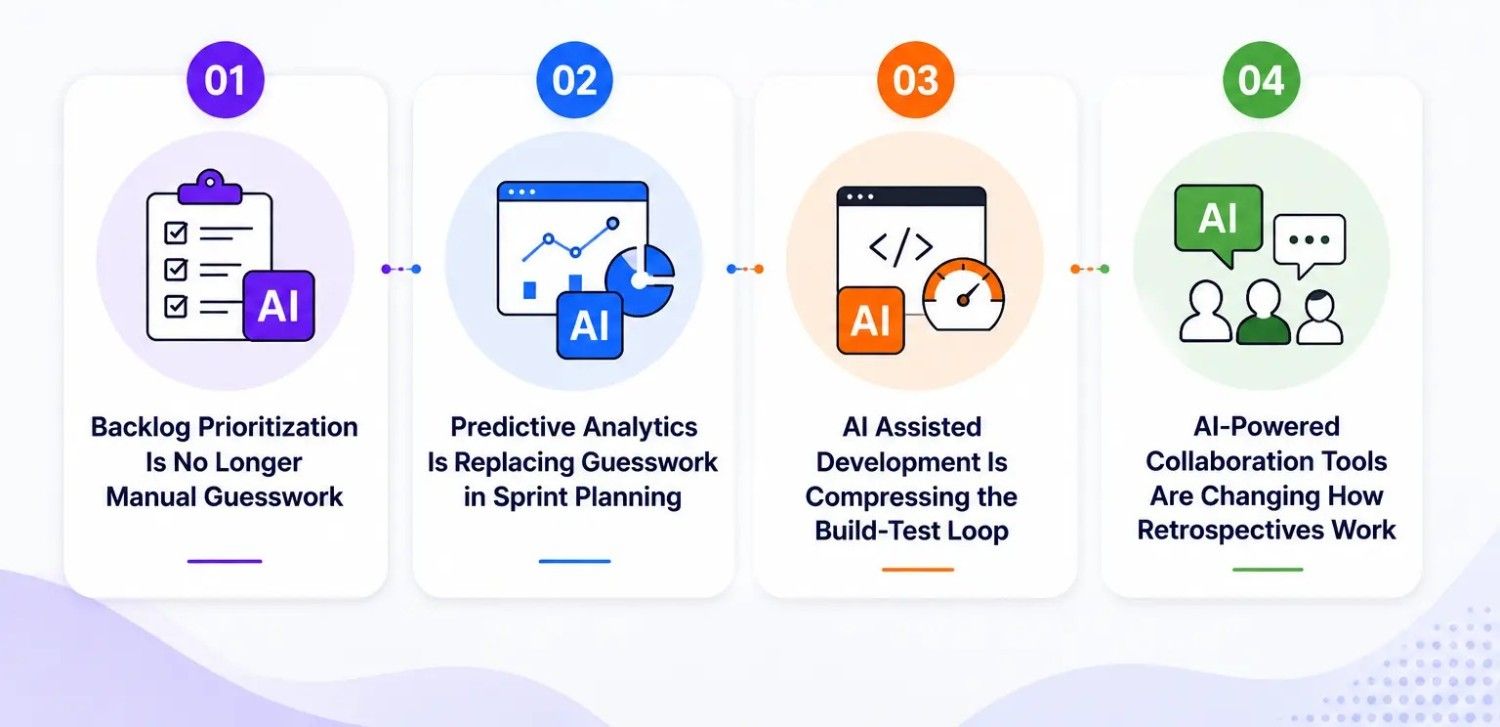
1. Backlog Prioritization Is No Longer Manual Guesswork
For years, deciding what goes into the next sprint was part data, part instinct, and part whoever shouted loudest in the planning meeting. That’s changing. AI tools integrated into platforms like Jira now analyze historical velocity, customer feedback patterns, and business value signals to suggest a priority order before the human planning session even begins. One widely cited case study from a mid-sized product company found that introducing AI-assisted backlog prioritization led to measurably higher agile team efficiency and adaptability, largely because product owners spent less time sorting tickets and more time making judgment calls.
Modern AI tools can also map dependencies automatically—flagging when Task B can’t start until Task A finishes, something that used to require a human spotting the connection manually. For teams managing hundreds of backlog items, this alone saves hours every sprint. Some Product Owners report saving up to 10 hours a week in refinement overhead once AI-assisted prioritization tools are properly configured.
2. Predictive Analytics Is Replacing Guesswork in Sprint Planning
Sprint estimates have always been part science, part hope. AI is closing that gap. By analysing a team’s historical performance — how long similar tasks actually took, where bottlenecks tend to appear, and which types of stories blow past their estimates—AI tools now generate sprint forecasts grounded in real data rather than memory.
The payoff shows up in completion rates. Research from 2026 found that AI-enabled Agile teams demonstrate a 21% higher sprint completion rate compared to teams not using AI-assisted planning, alongside noticeably improved cross-functional AI-powered collaboration. That’s a meaningful number — it means fewer carried-over tickets, fewer awkward “we didn’t finish what we promised” conversations, and more predictable delivery for stakeholders who are, increasingly, asking hard questions about ROI.
3. AI-Assisted Development Is Compressing the Build-Test Loop
This is the most visible shift to anyone working day-to-day inside a development team and the one with the clearest link to team productivity. AI coding assistants are now standard equipment rather than a novelty.
What this means in Agile terms is shorter iteration loops. AI-assisted development compresses the time between writing code and seeing it work: code gets written faster, automated tests get generated alongside the code rather than after it, and bugs surface earlier in the cycle—exactly the kind of fast feedback that iterative development was always designed to chase. But there’s an important caveat worth being honest about: developer trust in AI-generated code has actually declined, not risen, as adoption has grown. Stack Overflow’s year-over-year survey found developer sentiment toward AI tools fell from over 70% positive in 2023 to just 29% positive in 2025. The top complaint, cited by 66% of developers, is dealing with AI output that looks “almost right, but not quite”—and 45% say debugging AI-generated code actually takes longer than writing it from scratch. Speed and trust, it turns out, are not moving in the same direction.
4. AI-Powered Collaboration Tools Are Changing How Retrospectives Work
Retrospectives have always had a quiet failure mode: great insights get discussed on a Friday and quietly forgotten by the next sprint. AI-powered collaboration is starting to fix that by giving retrospectives a memory. Tools can now track which action items from past retrospectives were actually completed, surface recurring blockers across multiple sprints, and flag team health patterns that would take a human Scrum Master months to notice manually.
This shift toward AI-powered collaboration isn’t limited to retrospectives. Distributed and hybrid Agile teams—now the norm rather than the exception—are using AI-powered whiteboards and meeting summarization tools to keep remote workshops as productive as in-person ones. The result is less reliance on someone’s memory of “what we agreed on” and more reliance on a documented, searchable record that the whole team can revisit.
The Numbers at a Glance: AI Adoption Inside Agile Teams (2025–2026)
|
Metric |
2024/Earlier | 2025–2026 |
Source |
|
AI adoption among Agile practitioners |
68% | 84% |
State of Agile Report¹ |
|
Agile teams using AI-powered assistants daily (forecast) |
— | 70%+ by end of 2026 |
Gartner³ |
|
Sprint completion rate improvement with AI |
Baseline | +21% higher |
Unosquare research⁹ |
|
Developer AI tool adoption |
— | 84% use or plan to use |
Industry survey¹⁰ |
|
Developer positive sentiment toward AI tools |
70% (2023) | 29% (2025) |
Stack Overflow¹¹ |
|
Studies reporting efficiency gains from AI in Agile |
— | 75% (18 of 24 studies) |
Systematic literature review² |
|
Organizations with AI governance guardrails in Agile |
— | Only 49% | State of Agile Report¹ |
|
Time saved weekly via AI-assisted backlog refinement |
— | Up to 10 hours |
Industry case data⁷ |
What this table makes clear is that adoption and trust are moving on two different tracks. Agile teams are adopting AI faster than they’re building the guardrails to manage it responsibly—a gap worth taking seriously, not just a footnote.
The Governance Gap Nobody’s Talking About Enough
Here’s the part of this story that doesn’t get nearly enough attention: while AI adoption inside Agile teams jumped from 68% to 84% in a single year, only 49% of organizations have formal governance guardrails in place for how that AI is used. ¹ That’s a 35-percentage-point gap between how fast teams are adopting AI and how fast they’re building the oversight to manage it responsibly.
This matters in practical terms. Without governance, agile process automation spreads unevenly across an organization—you get inconsistent use of AI tools across different squads, unclear accountability when an AI-generated estimate turns out badly wrong, and growing risk around data privacy when sensitive project information gets fed into third-party AI systems without a clear policy. Organizations that are scaling Agile process automation successfully tend to be the ones treating governance as a parallel workstream—not an afterthought bolted on after something goes wrong.
The practical takeaway for any team thinking about expanding AI use: build the guardrails at the same pace you build the adoption. Define what data can and can’t be shared with AI tools. Decide who reviews AI-generated estimates before they go into a sprint commitment.
Where Does This Leave Agile Teams Heading Into the Rest of 2026?
The shift happening inside agile teams right now isn’t really about AI being a flashy new tool—it’s about Agile’s own core philosophy finally catching up with the technology available to support it. Agile has always been about fast feedback, continuous adaptation, and reducing wasted effort. AI just happens to be remarkably good at automating exactly those things at scale, which is why agile team efficiency gains keep showing up across nearly every dataset published in the last year.
But the data is equally clear that speed without oversight creates its own problems. The most successful agile teams in 2025 and 2026 aren’t the ones using the most AI tools—they’re the ones pairing fast adoption with equally fast governance, treating AI as a powerful but supervised teammate rather than an autopilot. For any team productivity looking at this shift and wondering whether to lean in, the honest answer from the data is yes, but build the guardrails as you go, not after something breaks.