
In the UK, the number of Scrum Master job postings dropped from 316 to just 28 in two years. What does that actually mean?
That number comes from job market analysis covering the six months leading up to May 2025, compared with the same window two years earlier (itjobswatch.co.uk). It sounds like the headline writes itself: robots are taking over, Scrum accountabilities masters are obsolete, pack up and go home. But that’s not what the deeper data shows, and the real story is more interesting — and more useful — than a panic headline.
This is the question I want to genuinely answer here: is an AI Scrum Master actually replacing the human role, or is something else going on entirely? To find out, I went looking for the most current numbers available—research, surveys, and labour market reports published specifically in 2025 and 2026, not older studies recycled with a new date stamp. What I found paints a far more nuanced picture than either the “AI will replace everyone” crowd or the “AI changes nothing” crowd would have you believe.
Let’s get into what’s actually happening, sourced from data, not speculation.
Why Are People Even Asking This Question?
It’s a fair question to ask in 2026. AI in project management tools has gotten genuinely good at things that used to require a dedicated human: forecasting sprint velocity, flagging backlog risks, summarizing standups, and even drafting retrospective formats. According to Scrum.org’s AI and Agile Practitioners Report, which surveyed 289 Agile practitioners—including Scrum Masters, Agile leadership, and Product Owners—across more than 20 countries, 83% of respondents already use AI tools in their work, according to a survey that identifies real adoption barriers and shows where AI creates value (scrum.org).
That’s not a fringe number. That’s the overwhelming majority of the profession already hands-on with these tools. So it’s reasonable to wonder: if AI can already draft a retrospective agenda, forecast a sprint, and summarize a standup, what’s left for the human?
Quite a lot, as it turns out — but the role is shifting, and pretending otherwise would be dishonest.
What the 2026 Data Actually Shows About AI and Scrum Masters?
Here’s where the nuance matters. Of that 83% of Agile leadership using AI tools, 55% spend 10% or less of their actual work time with AI, and only 9% exceed 25% of their time using it (scrum.org). In other words, adoption is wide but shallow. People are dipping a toe in, not handing over the keys.
More tellingly, the report found that no respondent reported AI making a strategic product decision, and the consistent pattern across successful use cases was AI saving around 30 minutes of documentation time so the practitioner could spend that time on conversations that actually matter (scrum.org). That distinction is the whole story in one sentence: AI and Agile are taking over the paperwork, not the judgment calls.
This lines up with a widely cited Gartner projection that AI could handle roughly 30% of agile documentation and reporting tasks by 2026—which, as one industry analysis points out, still leaves 70% of the job firmly in human hands (targetagility.com). The same source notes that in an earlier Scrum.org survey, 80% of Scrum Masters believed AI could help them do their job better, while only 12% felt genuinely threatened by it (targetagility.com).
So why did UK job postings for Scrum Masters fall so sharply? Some of that is almost certainly AI absorbing routine coordination work. But a chunk of it also reflects the same broader tech hiring slowdown hitting mid-level coordination roles generally — not a Scrum-specific story. One 2026 labour market analysis specifically flags mid-level management roles whose primary function involves coordination and reporting as a surprisingly vulnerable category, since AI in project management tools can now automate sprint planning, resource allocation, status reporting, and dependency tracking (tech-insider.org). If your entire job were running meetings and updating a board, that’d be genuinely at risk. If your job were coaching people, that’s a different story—and the data backs that up too.
Four Areas Where the AI Scrum Master Conversation Gets Real
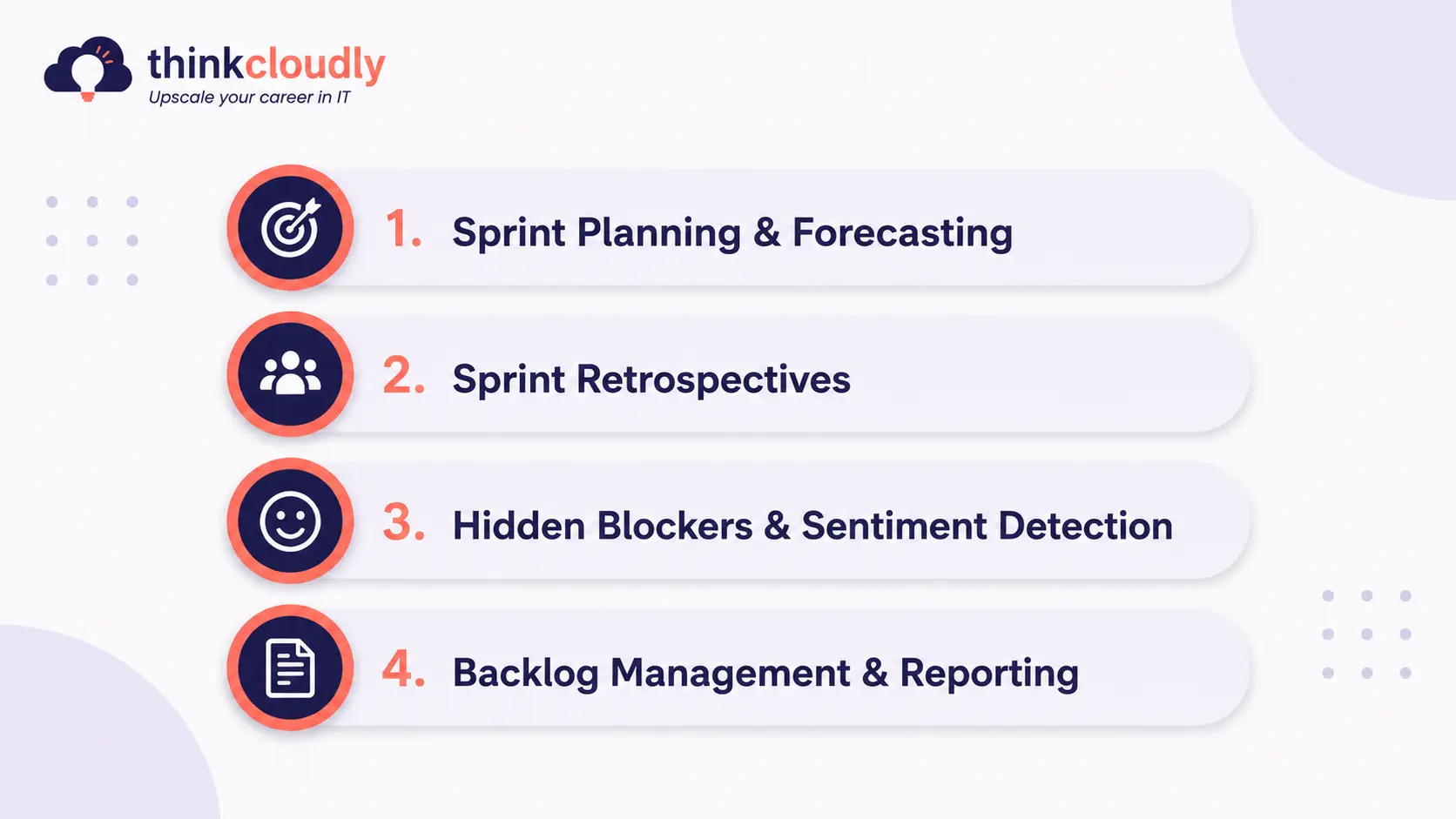
1. Sprint Planning and Forecasting
This is the area where AI has made the most measurable dent. AI-driven dashboards can now analyze historical throughput and team complexity to predict outcomes before a sprint even starts. As one 2026 industry guide describes it, a Scrum Master might use an AI-driven dashboard to predict the team is likely to finish 10% fewer story points next sprint based on current throughput and complexity, then adjust the sprint plan accordingly (refontelearning.com). The same source is careful to frame this correctly: rather than replacing Scrum Masters, these tools augment their capabilities, providing data-driven insights that support planning and retrospectives.
2. Sprint Retrospectives
This is genuinely one of the strongest AI use cases right now. AI tools can cluster qualitative feedback from team members, detect recurring themes across multiple sprint retrospectives, and generate a first-draft agenda tailored to the team’s recent mood or friction points. Parabol, for instance, is described as specializing in AI-enabled retrospectives and team meetings, providing structured facilitation tools that adapt to team dynamics and generate actionable insights (nextagile.ai). But facilitating the actual emotional temperature of a room full of frustrated engineers—reading the silence after someone says “it’s fine, really”—still needs a human who’s paying attention.
3. Hidden Blockers and Sentiment Detection
A more recent and slightly more controversial use case: AI scanning written standup updates or meeting transcripts to flag subtle shifts in tone before a team explicitly raises a concern. One 2026 training resource describes this as analyzing written updates or transcriptions to detect subtle shifts in sentiment, alerting the Scrum Master to potential bottlenecks before the team explicitly raises them. Useful, but it raises fair questions about surveillance and trust that teams will need to navigate carefully.
4. Backlog Management and Reporting
This is the least glamorous but most time-consuming part of the job, and it’s where AI tools are arguably doing the most good. Generating status reports from Jira or Linear, summarizing technical debt, and tracking product backlog management activity automatically frees up hours that used to go into manual report compilation. Stepsize AI, for example, is built specifically to automatically generate clear, data-driven reports from tools like Jira and Linear, highlighting progress, risks, and technical debt so teams can focus on the work itself (nextagile.ai).
A Quick Snapshot: Human Scrum Master vs. AI Scrum Master
|
Capability |
Traditional Scrum Master |
AI Scrum Master Tools |
|
Sprint velocity forecasting |
Manual, experience-based |
Fast, data-driven, pattern-based |
|
Status reporting & documentation |
Time-consuming, manual entry |
Largely automated |
|
Reading team sentiment in real time |
Strong — built on trust and context |
Limited—flags patterns and misses nuance |
|
Conflict resolution & coaching |
Core strength |
Cannot replicate |
|
Strategic prioritisation decisions |
Human judgment required |
Not currently capable (0% per AI4Agile data) |
|
Retrospective facilitation |
Strong, adaptive |
Good for drafts; weak on live facilitation |
|
Time spent on admin tasks |
High |
Reduced by up to 30 minutes per session |
|
Formal AI training received |
N/A |
Only 15% of practitioners have had any |
(Data compiled from Scrum.org‘s AI4Agile Practitioners Report 2026 and Refonte Learning’s 2026 Scrum Master strategy guide.)
Why Has Scrum in Business Become Bigger Than Just Software Teams?
Here’s something that often gets lost in the “AI vs. human” debate: Scrum in business has expanded well beyond its software origins, and that expansion is exactly why the Scrum Master role isn’t disappearing—it’s diversifying. A recent Scrum statistics roundup notes that 86% of marketing organizations planned to transition some or all of their teams to Agile ways of working and that 68% of employees, according to McKinsey survey respondents, should be working in Agile ways, compared with only 44% who currently are (proprofsproject.com).
This matters enormously for the AI replacement question. Scrum in business environments outside of pure software—marketing, operations, HR, even healthcare—typically involves far messier, more political, more relationship-driven dynamics than a software sprint. A Scrum Master coaching a marketing team through their first retrospective is doing fundamentally human work: building psychological safety, managing competing departmental egos, and translating Agile theory into a context nobody on the team studied in a textbook. That’s not a task you hand to a dashboard.
Separately, State of Agile research found that 28% of respondents reported that business operations teams have adopted Agile principles, indicating that Agile and Scrum are increasingly used outside traditional IT and development teams (proprofsproject.com). And it’s not a fringe practice—95% of professionals say Agile and Scrum are critical to their organization’s operational success, while enterprise Agile transformation services are projected to grow from $41.2 billion in 2024 to $96.3 billion by 2029.
As Scrum in business spreads into departments with no prior agile experience, the demand for skilled human facilitation—not automated reporting—is, if anything, growing rather than shrinking.
The Skills That AI Genuinely Cannot Replicate
It’s worth being specific here rather than vague, because “soft skills matter” is the kind of thing everyone says without backing it up.
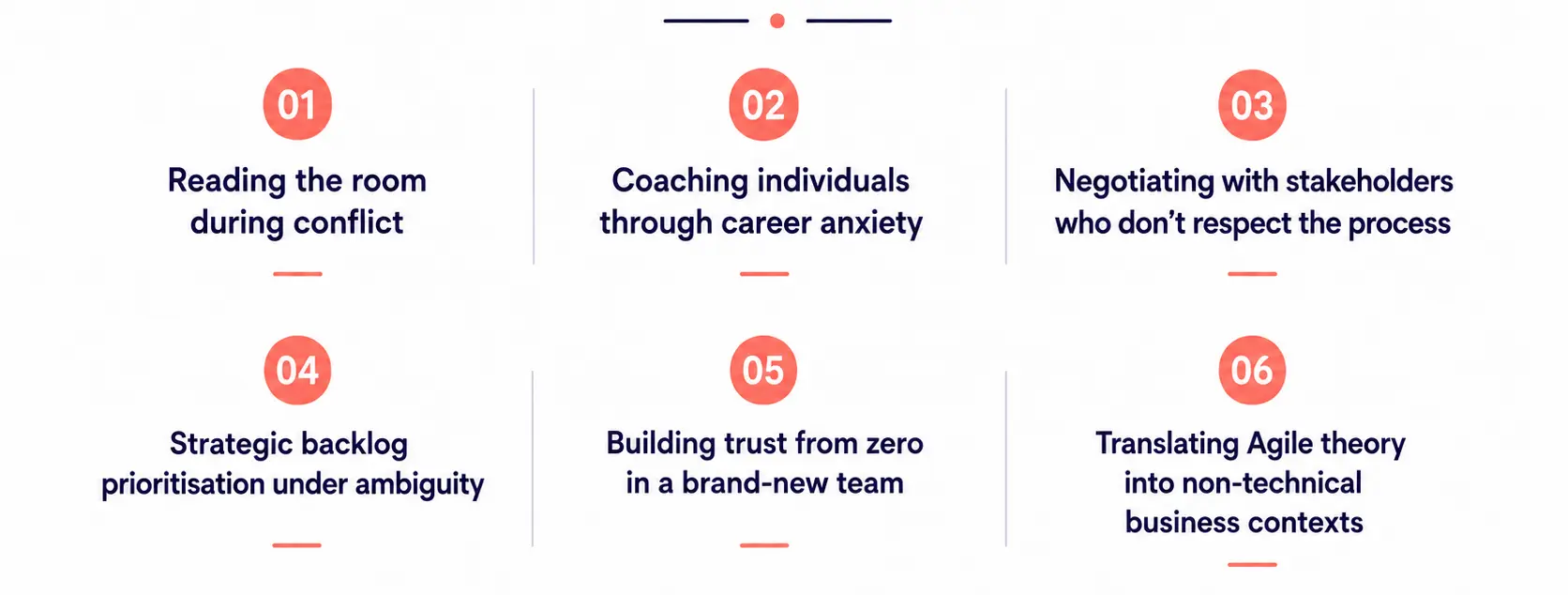
Based on the available 2026 research, here is what consistently shows up as irreplaceable:
- Reading the room during conflict: No tool currently parses the difference between a team member who’s quiet because they’re focused and one who’s quiet because they’ve checked out.
- Coaching individuals through career anxiety: Especially relevant now, as AI anxiety itself has become something Scrum Masters need to manage within their own teams.
- Negotiating with stakeholders who don’t respect the process: This requires organizational politics, credibility, and relationship capital—none of which a dashboard has.
- Strategic backlog prioritization under ambiguity: The AI4Agile report is explicit that no surveyed practitioner has seen AI make this kind of strategic call.
- Building trust from zero in a brand-new team: Trust is built through consistency and vulnerability over time—not something a tool can shortcut.
- Translating Agile theory into non-technical business contexts: As Agile workflow principles spread into HR, finance, and marketing, this translation work becomes the job, not a side task.
How Does This Change Day-to-Day Agile Team Facilitation?
It’s worth stepping back and looking at what actually happens inside a sprint, because Agile team facilitation is where most of this debate plays out in practice. A Scrum Master’s accountabilities under the Scrum framework were never just “run the meetings.” The official Scrum accountabilities—for the Scrum Master, Product Owner, and Developers—are built around removing impediments, protecting focus, and coaching the team toward self-management. AI tools are useful inside that structure, but they don’t sit inside it as a fourth accountability holder. They’re closer to a calculator than a colleague.
Where AI and Agile genuinely intersect well is in cross-functional teams—groups pulling together engineering, design, QA, and sometimes marketing or compliance, all with different vocabularies and different definitions of “done.” In these cross-functional teams, an AI tool can normalize status updates into one shared format, which sounds small but actually solves a real coordination headache. The human Scrum Master still has to interpret what those updates mean for team morale and delivery risk, but the grunt work of collecting and formatting them is exactly the kind of task AI absorbs well.
This is also where Agile frameworks more broadly come into play. Scrum is the most widely used, but plenty of organizations run hybrid setups—Scrumban, Kanban-Scrum blends, or scaled frameworks like SAFe and LeSS—and Scrum implementation in these hybrid environments tends to be messier than textbook Scrum. AI tools trained primarily on clean, idealized sprint retrospective data can struggle with that inconsistency, which is precisely why human judgment remains the deciding factor in how a team actually adapts the framework to its own context.
Iterative Development, Operational Efficiency, and the Bigger Picture
Zooming out further, the case for Scrum in business isn’t only about software velocity—it’s about operational efficiency more broadly. Organizations adopt iterative development because it shortens the feedback loop between building something and learning whether it actually works, and that principle applies just as well to a marketing campaign or an HR onboarding redesign as it does to a codebase. The agile transformation programs spreading through non-software departments in 2025 and 2026 follow that same logic: smaller increments, faster feedback, less wasted effort, and a clearer view of agile project delivery timelines for stakeholders who are used to rigid annual planning cycles.
What AI changes here is the speed of the feedback loop itself — not the underlying philosophy. Operational efficiency gains show up when a team spends less time compiling reports and more time acting on what those reports say. That’s a meaningful improvement, and it’s worth taking seriously. But it’s an improvement to the machinery around Scrum accountabilities, not a replacement for the person steering it.
So, Will AI Replace the Scrum Master?
Based on everything the 2025–2026 data actually shows, the honest answer is not the role as a whole but possibly the version of the role that was already thin to begin with. If your day was mostly updating tickets and reading out status reports, AI in project management tools can now do a meaningful chunk of that—and arguably should, freeing you for higher-value work. If your value came from coaching, conflict resolution, and genuine agile leadership, the data shows no tool currently comes close, and demand for that version of the role is expanding as Scrum in business adoption spreads into new departments.
The practical move isn’t to panic or to dismiss the shift entirely. It’s to get fluent with AI tools for the documentation and forecasting work—since 67% of organizations are already providing employees access to them, according to Scrum.org‘s 2026 survey—while deliberately investing in the facilitation, coaching, and stakeholder management skills that remain stubbornly and valuably human. The Scrum Masters who treat AI as a research assistant rather than a replacement are the ones who’ll come out ahead in 2026 and beyond.