
Here’s a question I get asked at almost every meetup I attend: “There are five different badges I could put after my name, so which one actually matters?” It’s a fair question, because the alphabet soup of CSM, PSM, PMI-ACP, and CSPO can make choosing an agile scrum certification seem more confusing than the job it’s supposed to prepare you for.
I’ve spent years around Scrum teams, and I’ve watched smart people spend money on the wrong credential simply because it was the first one that showed up in a search. This guide walks through how to actually choose, based on your current role, your budget, and where you want your career to go next, rather than which certification happens to be trending this month.
Why Does Choosing the Right Agile Scrum Certification Actually Matter?
Not every credential is built for the same person, and that’s the part most comparison articles skip over. A brand-new team member trying to understand basic scrum roles needs something very different from a project manager who already runs delivery for three departments and has years of agile practices behind them.
According to the 2026 overview of popular Agile certifications, options range from broad, philosophy-level credentials that cover Agile as a whole to Scrum-specific ones to certifications built purely for scaling Agile across large organizations.
Picking blind, without matching the certification to where you actually sit in a team, is the single biggest reason people end up disappointed after spending the money. There’s also a cost angle that’s easy to underestimate. The official CSM certification page notes that scrum master course pricing runs anywhere from $250 to $2,495, depending on the trainer, region, and format.
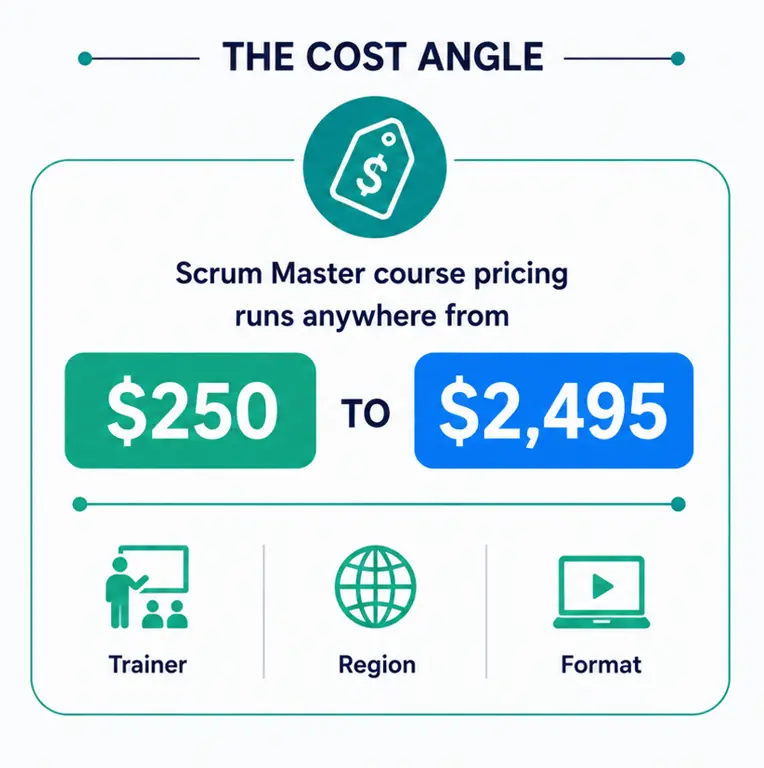
That’s a wide enough range that two people can walk away with the exact same letters after their name and have paid wildly different amounts for it, which is exactly why comparing before enrolling matters more than most people assume.
Popular Certifications Compared
I put this table together the way I’d explain it to a friend over coffee, not the way a marketing page usually lays it out, since the fastest way to compare an agile scrum certification against another one is to see the real numbers side by side.
|
Certification |
Best Suited For | Typical Format |
Approx. Cost (USD) |
|
CSM (Certified ScrumMaster) |
New Scrum Masters, team leads | 2-day live course + exam |
$250 – $2,495 |
|
PSM I (Professional Scrum Master) |
Self-driven learners, exam-only path | Self-study, optional course + exam |
$200 – $500 |
|
CSPO (Certified Scrum Product Owner) |
Product owners, backlog-focused roles | 2-day live course, no exam |
$250 – $2,000 |
|
PMI-ACP |
Traditional project managers moving into Agile | 21 hours training + exam |
$435 – $495 |
The PSM I clearly wins on upfront price for anyone paying out of pocket, but a PMP-style boot camp preparing for the PMI-ACP can run $1,000 to $2,500 once training is included, so the sticker price on a certification page rarely tells the full story.
Scrum Training vs Agile Training: What’s the Difference
This trips people up constantly, and honestly, I didn’t fully understand it myself until I sat through both types of courses. Scrum training is narrow by design. It teaches the specific roles, events, and artifacts inside the scrum framework, and it assumes you’re going to be working on a Scrum team specifically.
Agile training is the wider umbrella. It covers the values and principles behind Agile as a whole, including approaches beyond Scrum like Kanban, Lean, and Extreme Programming, so it suits someone who might work across multiple delivery styles rather than one fixed framework.
If your entire organization runs on Scrum and isn’t planning to change that anytime soon, Scrum training will get you further, faster. If you’re in a hybrid environment or you’re a project manager who touches several methodologies depending on the client, broader agile training tends to pay off more over a full career.
How to Match a Certification to Your Actual Career Goals?
Rather than starting with “which certification is most popular,” I’d suggest starting with where you sit today and where you want to be in two years, since the right agile scrum certification for a beginner rarely overlaps with the right one for someone five years into their career. A few patterns I’ve noticed hold up consistently:
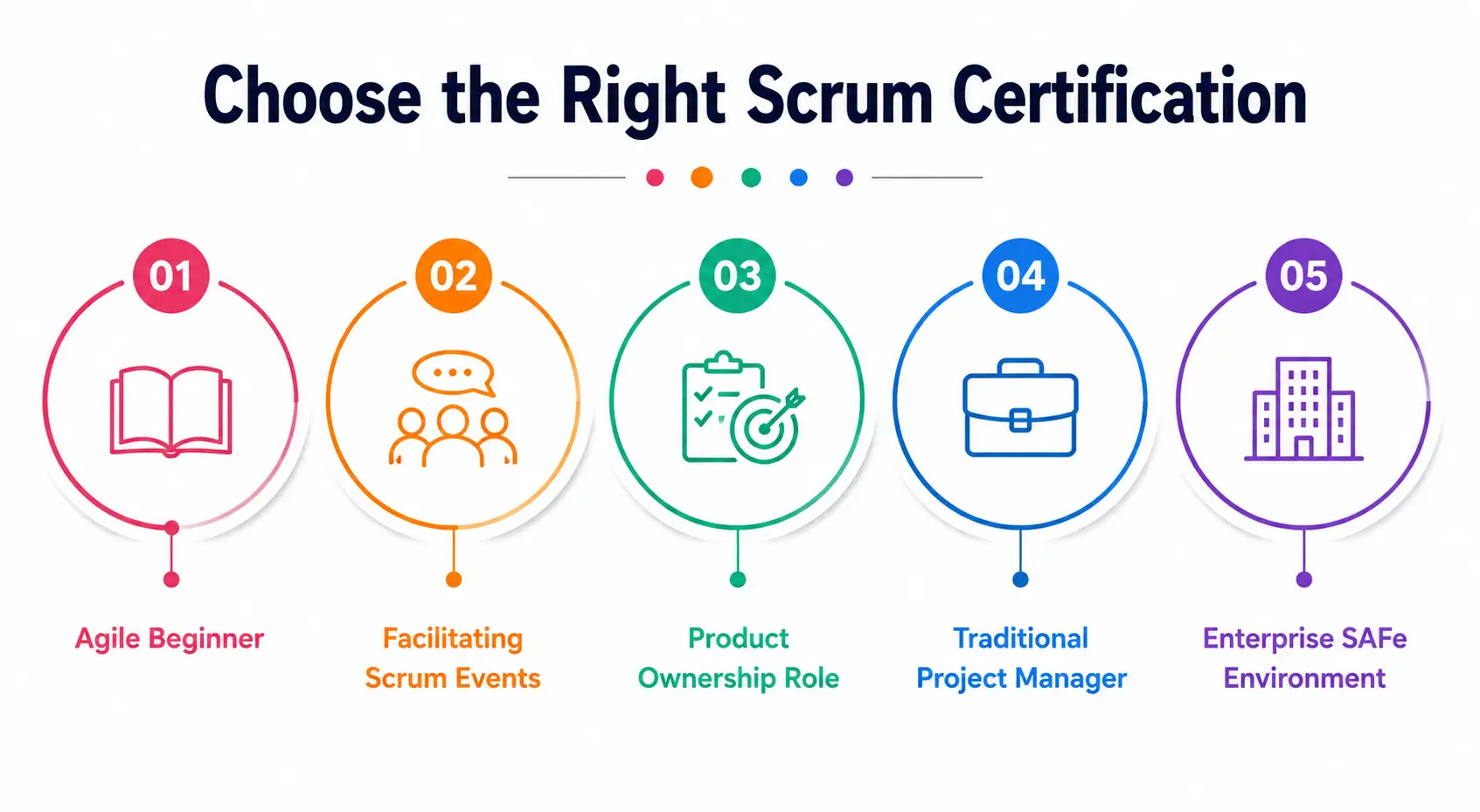
- Brand new to Agile, working as a developer or coordinator: Start with a foundational scrum course before anything scaled or advanced; trying to jump straight to a coaching-level credential without hands-on sprint experience rarely sticks.
- Already facilitating ceremonies informally: CSM or PSM. I will formalize what’s already being done and usually open the door to an official Scrum Master title.
- Managing product decisions, backlog priorities, or stakeholder requests: A product owner certification like CSPO is the more relevant path, since it focuses on value delivery and prioritization rather than team facilitation.
- Coming from a traditional PMO or waterfall background: PMI-ACP tends to translate better on a resume, since it’s recognized by organizations that still use PMI language internally.
- Working inside a large enterprise already using SAFe: A scaled certification will be far more useful than a single-team credential, even if it costs more upfront.
Understanding Scrum Roles Before You Enroll
One thing I always tell people before they enroll in anything: understand the three scrum roles and revisit the core agile principles behind them before you spend money on a badge. The Scrum Master facilitates and removes obstacles; the Product Owner manages the backlog and prioritizes value; and the Developers do the actual delivery work as a self-organizing unit.
If you can’t explain what each of these roles is accountable for in your own words, that’s a sign to spend a week with the free Scrum Guide before booking a paid course, since a lot of the value of certification training gets lost on someone who’s still learning the vocabulary for the first time.
Cost, Time, and Format: What to Expect from a Scrum Course
Budget and schedule usually decide more of this choice than people like to admit. A live, instructor-led scrum course, like the one required for CSM, typically runs two full days and requires you to show up at a fixed time, which works well for people who learn better with a group and real-time discussion.
A self-paced, exam-only path, like PSM I, lets you study on your own schedule and only costs money when you sit the actual test, which suits people who are disciplined self-learners but doesn’t offer the same live Q&A and networking that a classroom format does.
Neither format is objectively better. It comes down to how you personally learn best and whether your employer is reimbursing the cost, since a reimbursed budget changes the calculation entirely compared to paying out of pocket.
Common Mistakes People Make When Choosing an Agile Scrum Certification
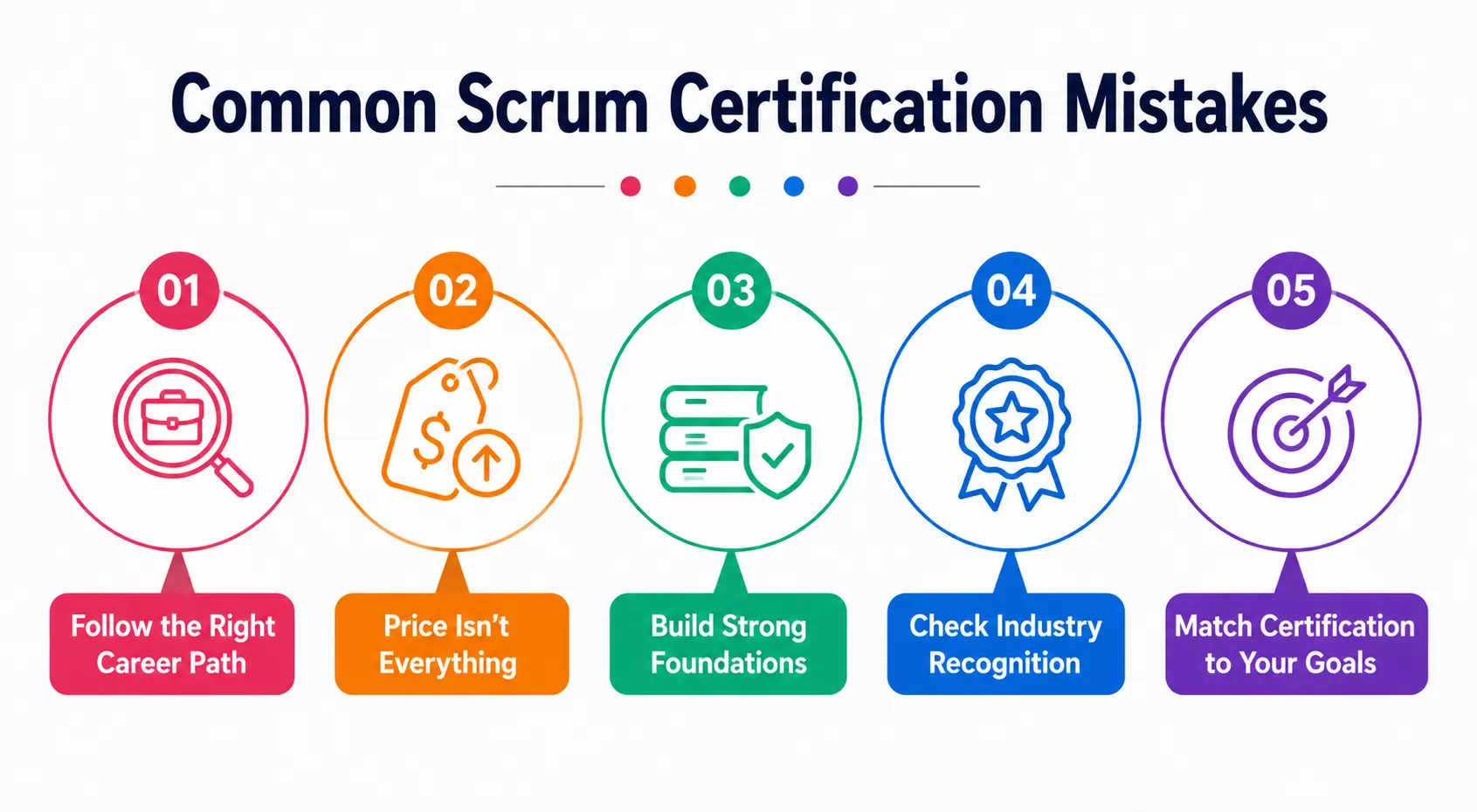
- Chasing the certification with the most job postings mentioning it, without checking whether the role actually matches day-to-day interests.
- Assuming a more expensive course automatically means better instruction; price often reflects trainer reputation and location more than course depth.
- Skipping foundational agile principles and jumping straight into a scaled or advanced credential, which usually shows up as gaps during interviews.
- Ignoring whether the certifying body (Scrum Alliance, Scrum.org, or PMI) is actually respected in the specific industry or region being targeted.
Conclusion
Choosing the right agile scrum certification really comes down to three honest questions: Where are you today? What does your target role actually require? How much time and money can you realistically commit? There’s no single “best” certification, no matter what a comparison chart with a bold green checkmark wants to tell you.
A brand-new team member and a ten-year project manager should almost never be pointed toward the same credential, and the moment a comparison guide tells you otherwise, it’s worth being a little skeptical of it. Take the time to map the certification to the actual work first, and the return on that investment tends to show up fast.
A personal note from the author: I’ll be honest, I didn’t get this right the first time either. My first certification was chosen mostly because a colleague had it, not because it matched what I was actually doing at work, and I ended up re-certifying in something more relevant about a year later.
If there’s one thing I’d want a reader to take away from this piece, it’s that spending an extra weekend researching which credential fits your actual role will save you far more time and money than rushing to sign up for whichever course pops up first in a search.