






I keep getting the same message from readers who are weighing a jump into security work: “Is this just hype, or is there a real job at the end of it?” Fair question, and I’m not going to dodge it. This field is one of the few paths right now where the demand is backed by hard numbers, not just vendor marketing decks.
Every SOC I’ve spoken with in the past year has added some form of AI tooling to its stack, and almost none of them have enough people who know how to actually work with it. That gap is the opportunity, and it’s also the reason this piece exists.
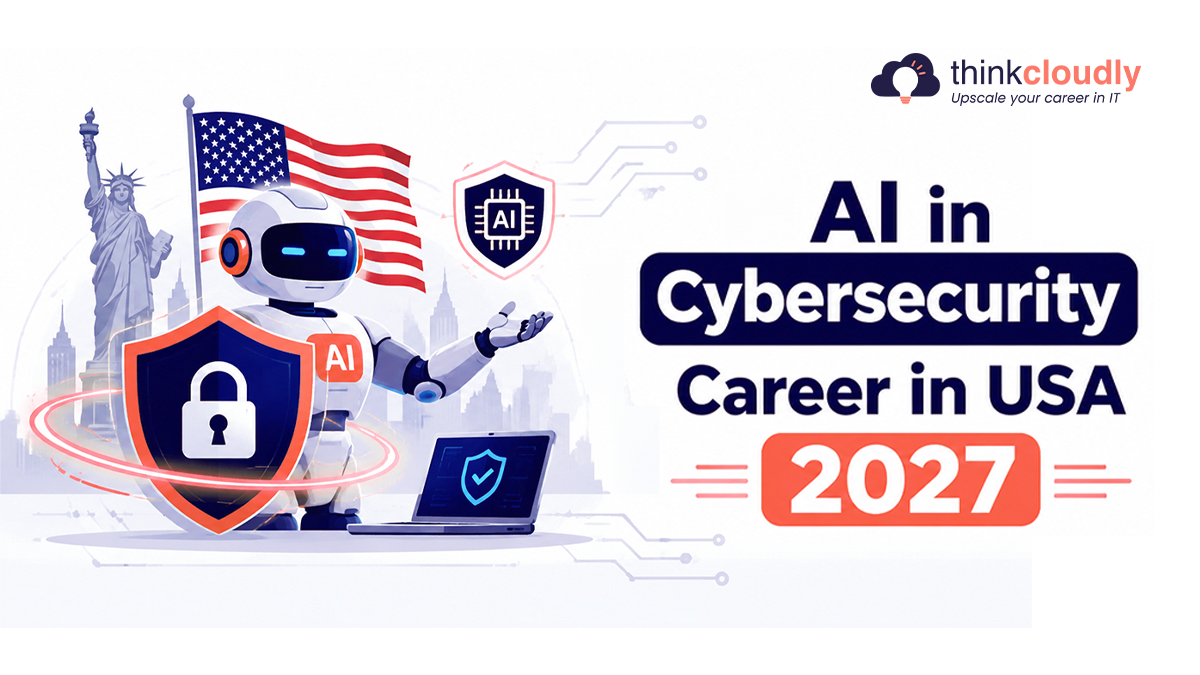
What follows is a plain, no-fluff look at what an AI in cybersecurity career looks like in practice in 2027, what an AI security analyst actually does day to day, where the AI cybersecurity jobs are opening up, and how to build the right skills without wasting a year on an outdated bootcamp.
Why an AI in Cybersecurity Career Is Gaining Momentum for 2027?
Security teams in the USA are not adding AI tools because it’s trendy. They’re adding them because attackers got faster first. According to IBM’s Cost of a Data Breach Report, AI-driven attacks rose 56% over the past year, and organizations that use AI and automation extensively in their security operations save an average of $1.93 million per breach compared to those that don’t. That single number explains why the budget for AI tooling keeps getting approved even in otherwise tight years.
That spending isn’t evenly spread, either. Finance, healthcare, and critical-infrastructure operators are moving fastest, largely because regulators in those sectors are starting to ask pointed questions about how much of the detection pipeline runs on an audited model versus a black box nobody on staff can explain. A hospital network or a regional bank that can’t answer that question in an audit is now treated as a liability, not just a technical gap.
For someone building an AI in a cybersecurity career right now, that spending pattern matters more than it might seem. The budget flows toward tools, and tools need people who understand them.
Employers aren’t hiring purely for firewall knowledge anymore; they want candidates who can sit next to an AI-driven security pipeline—alert triage, model-assisted investigation, automated response playbooks—and make sound calls when the automation gets something wrong. That last part is the actual job. The tool flags; the human decides.
What an AI Security Analyst Does?
The job title sounds futuristic, but the daily work is more grounded than people expect. Here’s a realistic breakdown of what this role spends time on:
- Reviewing AI-flagged alerts and deciding which deserve escalation versus which are noise
- Tuning detection models so they stop crying wolf over routine behavior
- Running automated log and traffic analysis across endpoints and cloud systems to spot patterns a human would miss manually
- Documenting edge cases where the model’s confidence score was wrong so the next training cycle improves
- Translating model output into plain language for incident responders and non-technical stakeholders
- Partnering with data teams on retraining detection models as new attack patterns emerge
Notice what’s missing from that list: blind trust in the dashboard. Every solid professional in this role I’ve talked to treats the model as a very fast, slightly overconfident colleague—useful, but not above being double-checked.
Skills That Matter for an AI in Cybersecurity Career
If you’re mapping out what to actually learn, here’s the skill set that shows up consistently across job postings and hiring-manager conversations right now:
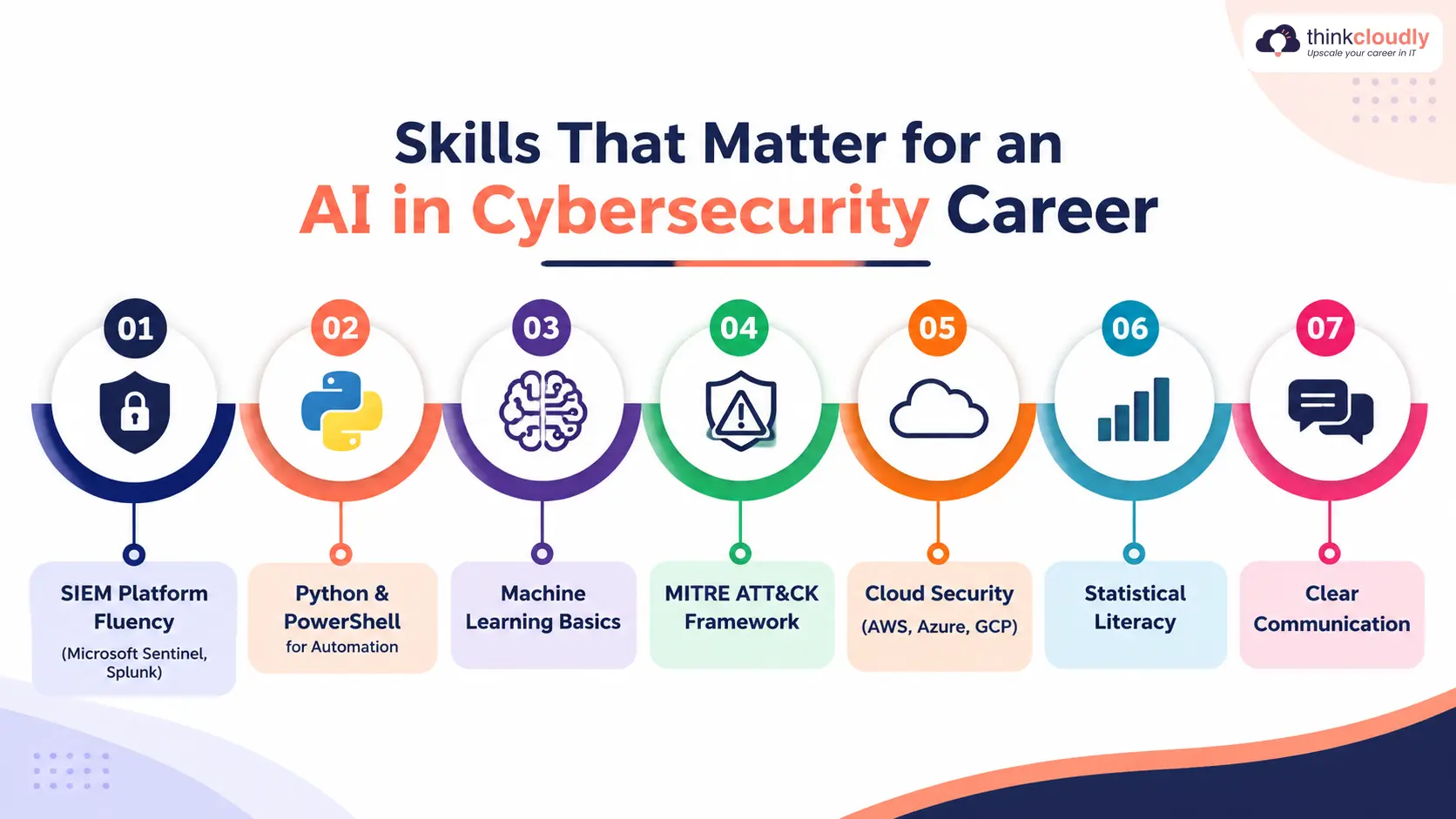
- SIEM platform fluency (Microsoft Sentinel, Splunk, or similar AI-assisted tools)
- Basic Python or PowerShell scripting for automating repetitive detection tasks
- A working grasp of how machine learning in cybersecurity models is trained and where they commonly fail
- MITRE ATT&CK framework mapping for real attack patterns
- Cloud-native security tooling across AWS, Azure, and GCP
- Statistical literacy—enough to question a confidence score instead of accepting it blindly
- Clear written communication for incident reports and model-tuning notes
A program or self-study path that skips the statistical literacy piece is teaching half the job. Knowing which button to click in a dashboard isn’t the same as knowing when the dashboard is wrong.
Machine Learning in Cybersecurity: What It Changes and What It Doesn’t
Machine learning in cybersecurity is genuinely good at one thing: finding patterns across more data than a person could review in a lifetime. It’s still weak in context—knowing whether an unusual login at 2 a.m. is an attacker or just an employee working a late shift in a different time zone. That gap is exactly why human judgment hasn’t become optional.
The SANS Institute’s AI survey found that 63% of security practitioners now report real shortcomings in AI’s detection and response performance, up from 45% a year earlier, even as active AI use in security operations jumped from 50% to 78% over the same stretch. Read that twice: adoption is outrunning trust. That’s not a reason to avoid this field—it’s the reason the humans reviewing automated output are becoming more valuable, not less.
Traditional Detection vs. AI-Assisted Detection: A Side-by-Side Look
|
Aspect |
Traditional Approach |
AI-Assisted Approach |
|
Alert volume handled |
Limited by analyst headcount |
Scales to millions of events per day |
|
Core skill required |
Manual log review, signature matching |
Model interpretation, trained analyst judgment |
|
Detection speed |
Hours to days |
Near real-time via AI-assisted automation |
|
Specialization emerging |
Rare |
Proactive threat hunting teams |
|
Risk of over-reliance |
Low (slow but predictable) |
Moderate—needs trained oversight |
|
Hiring demand |
Flat to declining |
Growing across current job listings |
This table isn’t suggesting traditional skills are worthless. Signature-based detection still catches plenty of known threats cheaply. The point is that a modern AI in a cybersecurity career has to cover both columns, not just the one that used to be standard.
AI-Powered Threat Hunting: The Fastest-Growing Specialization
AI-powered threat hunting is where a lot of the most interesting and best-paid work is heading. Instead of waiting for an alert to fire, threat hunters now use models to proactively search for signs of attackers who are already inside a network but haven’t tripped a traditional detection rule yet—lateral movement, credential misuse, data staging that looks almost normal until you compare it against a behavioral baseline.
This specialization rewards curiosity more than any other part of the field. AI-powered threat hunting teams spend real time asking, “What would an attacker do to stay hidden from this exact model?” then testing that hypothesis against real data.
ISC2’s Cybersecurity Workforce Study found AI is now the single most in-demand skill in the field for the second year running, cited as critical by 41% of the roughly 16,000 professionals surveyed, ahead of cloud security at 36%. Threat hunting roles sit right at the center of that demand curve.
Where AI Cybersecurity Jobs Are Opening Up in the USA?
The titles are evolving faster than most job boards can keep up with, but a few patterns are consistent across current AI cybersecurity job postings:
- SOC analyst roles that now list “AI-assisted SIEM experience” as a requirement, not a bonus
- Detection engineer positions focused on tuning and maintaining machine learning models rather than writing static signatures
- Threat intelligence analysts who correlate AI-flagged indicators with external intelligence feeds
- Security automation engineers building the playbooks that let routine incidents resolve themselves
- AI governance and model-risk roles, a newer category focused on auditing security models for bias and blind spots
- Cloud security specialists who understand both native platform tooling and the AI layered on top of it
None of these AI cybersecurity jobs require a computer science degree as a hard gate. They do require proof that you can work with a model, not just around one—a home-lab project, a documented incident write-up, or a capture-the-flag result goes further than a long list of theory-only courses.
Geography matters less than it used to, too. A large share of these roles are now fully remote or hybrid, which widens the pool of competition but also means someone outside the traditional hubs—Austin, Charlotte, and Northern Virginia—has a genuinely fair shot if the portfolio is strong enough. Recruiters increasingly care more about a documented project than a metro-area address.
How Automated Threat Analysis Is Reshaping Risk Prioritization?
Security risk analysis is used to run on a static matrix, updated quarterly, ranking which vulnerability gets patched first. Automated threat analysis changes the inputs to that process without changing the underlying logic: instead of a quarterly update, risk scores now shift continuously as new threat intelligence and behavioral data come in.
For anyone doing this work, that shift makes the job less about memorizing a checklist and more about judging whether a dynamically generated score actually makes sense given everything else known about the environment.
The U.S. Bureau of Labor Statistics projects information security analyst roles—the category most of these positions fall under—to grow 21% between 2025 and 2035, far faster than the average occupation, with about 14,100 openings projected each year over the decade. Automated threat analysis skills are quickly becoming a baseline expectation inside that growth, not an optional add-on.
Steps to Actually Build an AI in Cybersecurity Career
If you want a realistic sequence rather than a vague “learn AI and cybersecurity” suggestion, here’s one that holds up:
- Build foundational networking and IT knowledge (the CompTIA Network+ level is a reasonable floor)
- Learn one SIEM platform with built-in AI-assisted features, not a legacy log-review-only tool
- Get comfortable with basic Python for automating repetitive detection and reporting tasks
- Study how machine learning in cybersecurity models are trained, including their common failure points
- Practice in a lab environment using realistic, simulated attack scenarios rather than slide decks alone
- Pursue a recognized credential such as CompTIA Security+ or SC-200 to validate the fundamentals
- Build a small portfolio: a documented incident write-up, a home-lab SIEM setup, or a CTF result
- Apply for Tier 1 SOC analyst, detection engineer, or junior detection analyst roles, and treat the first job as further training
This kind of career rarely starts at the top. It starts with someone willing to sit through the boring alert queue long enough to learn which patterns actually matter.
Pay and Outlook for an AI in Cybersecurity Career
The compensation data backs up the time investment. Median pay for information security analyst roles sits at $129,180 annually as of May 2025, per the same BLS projections cited above, and candidates who can show both automated threat analysis skills and AI-tool fluency are the ones landing offers above that median. Candidates relying purely on entry-level certifications, with no exposure to AI-assisted tooling, are increasingly competing for a shrinking pool of manual-review-only roles.
Contract and consulting work is expanding too, particularly for professionals who can walk into a mid-size company for a few months, audit their detection stack, and leave behind a tuned, documented setup. That arrangement suits people who like variety over the comfort of a single employer, and it often pays a premium over a comparable full-time salary once you factor in the shorter commitment.
An AI security analyst with even one documented AI-assisted project on their resume tends to clear interview screens faster than someone with only traditional SIEM experience. That’s not a guess; it’s what recruiters at mid-size security vendors have told me directly over the past year when I’ve asked what actually moves a resume to the top of the pile.
A Personal Note
I want to be straight about something most career-advice pages gloss over: no single course or certificate hands you a finished AI in a cybersecurity career. I’ve watched people complete genuinely good programs and still freeze during their first live incident, because nothing fully replicates the pressure of a real alert with a real stakeholder asking real questions.
What good training does is shrink that adjustment period and give you the instincts to question the model instead of trusting it blindly. If you’re seriously considering this path, build the habit of asking “why did the model flag this” every single time, not just when something goes wrong.
Teams doing proactive, model-assisted threat hunting well are usually the ones who never stopped asking that question, and that habit, more than any single certification, is what actually gets noticed in a performance review.