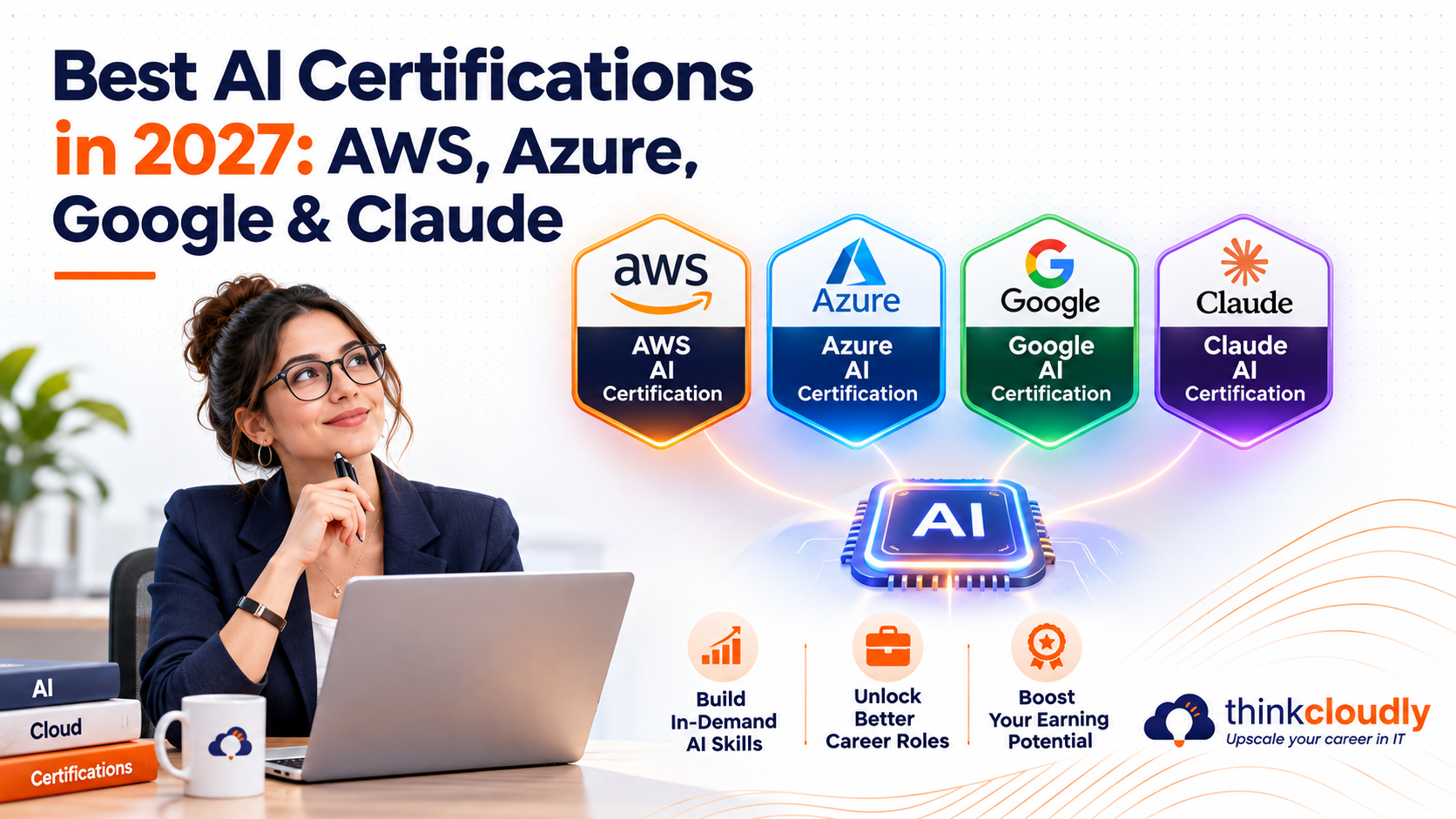






A badge on your LinkedIn profile has never been the hard part. Picking the right one is important. With four major providers—Amazon, Microsoft, Google, and now Anthropic—all running their own training tracks, the real question for 2027 isn’t “should I get certified”; it’s “which of these programs actually gets me hired.”
This guide walks through the AI certifications 2027 landscape across all four providers, what each one is genuinely good for, and how to turn any of them into something an employer takes seriously rather than another line nobody reads.
Most people searching for AI certifications in 2027 options are stuck between two bad extremes: picking the cheapest course available or trying to study for all four providers at once and finishing none of them.
Neither works. What works is understanding what each Artificial Intelligence Certification track is actually built to prove, then matching that to the role you want next—not the role you have now.
Why AI Certifications 2027 Matter More Than They Did a Year Ago?
The AI hiring market has shifted in a way that makes certifications genuinely more useful than they were in 2025. A few things changed:
- Employers moved past the “anyone who can prompt ChatGPT” phase and now expect candidates to show structured, verifiable training behind their claims.
- Cloud providers tightened their exam content to match what companies are actually deploying—retrieval pipelines, agents, model evaluation—instead of generic AI theory.
- Recruiters use certification badges as a fast filter when hundreds of resumes claim “AI experience” with nothing to back it up.
- Anthropic’s own training arm entered the space, giving candidates a credential tied directly to the tools many companies are adopting for agentic workflows.
- Salary data across the US, UK, and other major markets shows a measurable gap between certified and uncertified candidates applying for the same mid-level AI roles, which is exactly where the clearest AI career opportunities are opening up right now.
None of this means a certificate replaces real skill. It means AI certification 2027 programs are now built closer to what the job actually requires, which is why they carry more weight in an interview than they used to.
What Makes an Artificial Intelligence Certification Worth Your Money?
Before comparing providers, it helps to know what separates a genuinely useful credential from a padded resume line. A program worth paying for usually includes:
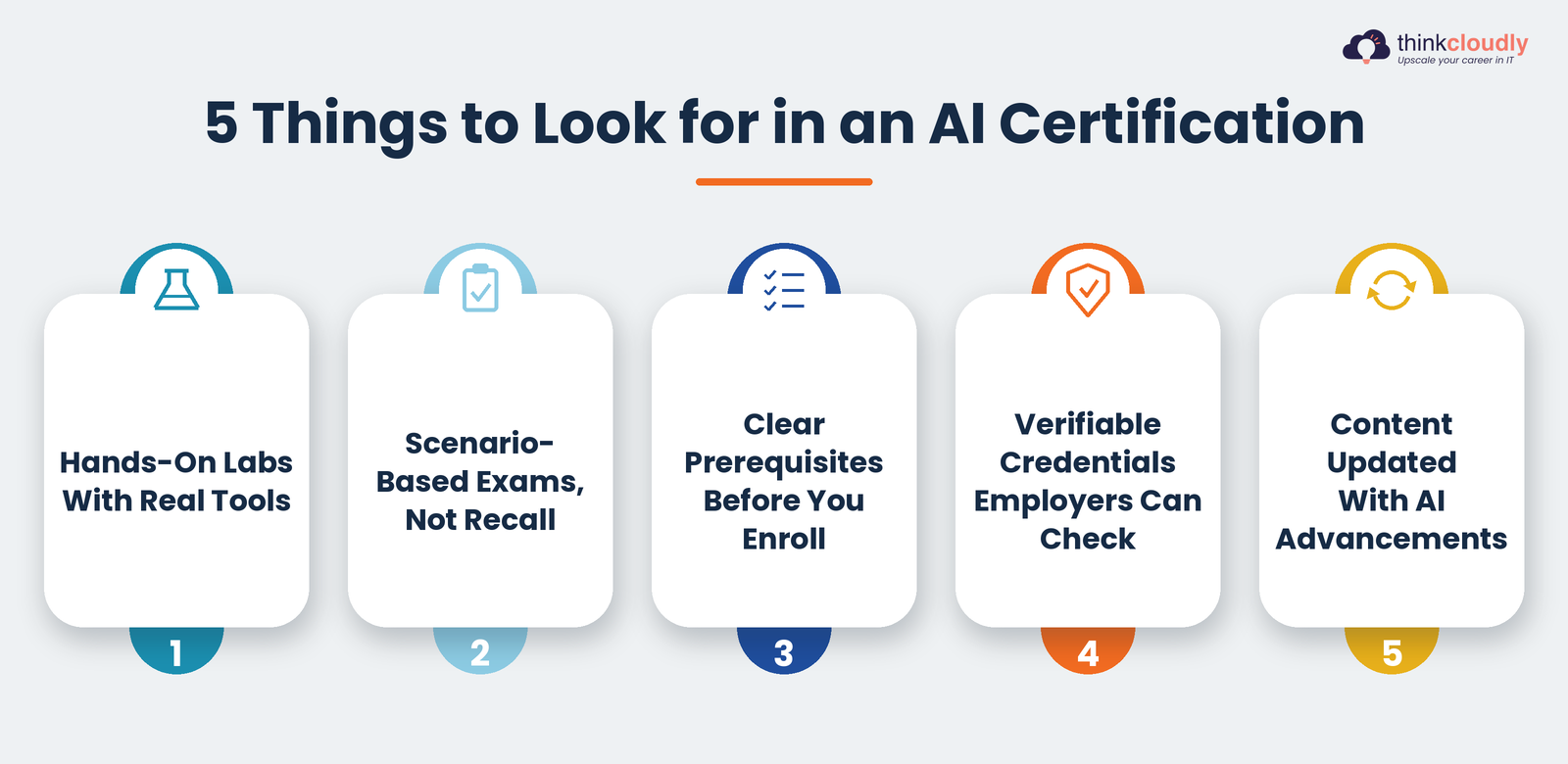
- Hands-on labs using the provider’s real tools, not slide decks describing them
- A scenario-based exam rather than pure recall of definitions
- Clear prerequisites, so you know whether you’re ready before you pay
- A credential that’s verifiable on a public registry an employer can actually check
- Content that gets refreshed at least once a year, since model capabilities move fast
An artificial intelligence certification that skips most of these items might still look fine on paper, but it won’t survive a hiring manager asking one follow-up question about how you’d actually use it.
AWS Certifications: Where the AI Practitioner Track Stands in 2027
Amazon’s AWS Certified AI Practitioner remains the most common starting point for anyone building toward AI certifications in 2027 goals on the cloud side. It’s a foundational exam—no coding required—built around recognizing AI and generative AI use cases, understanding responsible AI practices, and knowing when a managed service like Amazon Bedrock fits a given problem better than building something from scratch.
What makes this one worth the effort is specificity. AWS doesn’t test abstract machine learning theory here; it tests whether you understand AWS’s actual AI stack well enough to make reasonable architecture decisions. That’s a narrower skill than a full machine learning certification, but it’s exactly the skill a lot of entry-level cloud-AI roles are screening for right now.
Microsoft Azure AI Certifications: The Engineer-Track Option
Microsoft’s path sits one level up in technical depth. The Microsoft Certified: Azure AI Engineer Associate credential expects you to actually build solutions using Azure AI services—language understanding, vision, and increasingly, Azure OpenAI integration work.
It’s less about recognizing use cases and more about implementing them, which is why it tends to carry more weight for candidates aiming at engineering or integration roles rather than strategy or analyst positions.
If your target role involves hooking AI services into an existing product rather than just advising on which service to use, this track is usually the better investment of the two major cloud-provider options.
Google Cloud AI Certifications: Leader Track vs. Technical Track
Google splits its offering cleanly in two, which is useful because it forces you to pick a lane early. The Google Cloud Generative AI Leader certification is built for people who need to make decisions about AI adoption—product managers, team leads, and non-engineers who still need fluency in the terminology and trade-offs. It’s not a coding exam, and it’s not trying to be.
On the technical side, Google’s machine learning engineer track goes considerably deeper into building, training, and deploying models on Vertex AI. Someone chasing AI certifications and 2027 credentials purely for an engineering role should skip the Leader track and go straight for the technical one—the Leader badge won’t satisfy a hiring manager looking for someone who can actually ship a model.
Claude and Anthropic Academy: The Newest Name in AI Certifications 2027
The most interesting shift in the AI certifications 2027 landscape isn’t from any of the three cloud giants—it’s Anthropic. Anthropic Academy now runs a set of free, structured courses covering the Claude API, agent building, and the Model Context Protocol, each ending in a completion certificate. These aren’t positioned as a replacement for a cloud provider’s exam; they’re aimed squarely at the growing number of roles built around agentic AI systems rather than traditional model training.
For a beginner trying to decide where to spend a first weekend of study, this track has a real advantage: it’s free, it’s focused on tools companies are actively adopting for internal automation, and it doesn’t require existing cloud experience to get started. It’s a strong complement to an AWS, Azure, or Google credential rather than a replacement for one—most hiring managers still want to see at least one cloud-provider certification alongside it.
AI Certifications 2027 Compared at a Glance
|
Provider & Certification |
Best For | Coding Required |
Typical Study Time |
| Beginners, cloud-AI awareness roles | No | 3–5 weeks | |
| Azure AI Engineer Associate | Engineers integrating AI into products | Yes |
6–8 weeks |
|
Google Cloud Generative AI Leader |
Managers, product, non-technical roles | No | 2–4 weeks |
| Google Cloud ML Engineer | Model building and deployment roles | Yes |
8–10 weeks |
|
Anthropic Academy (Claude) |
Agentic AI, automation-focused roles | Light |
1–3 weeks per course |
A quick read of that table makes one thing obvious: there isn’t a single “best” credential among these four options. There’s a best credential for the specific role you’re trying to land, and picking based on the job description rather than the provider’s marketing is what actually pays off.
AI Certifications for Beginners: Where to Actually Start
If you’re new to this entirely, the AI certifications for beginners should be deliberately narrow. Trying to study for all four providers in the same quarter is how most people end up finishing none of them. A sensible beginner sequence looks like this:
- Start with one foundational, no-code exam—AWS AI Practitioner or Google’s Generative AI Leader are both reasonable entry points for AI certifications for beginners.
- Pair it with one free Anthropic Academy course so you understand how agentic tools work in practice, not just in theory.
- Build one small project using what you learned before moving to the next certification—a resume line without a project behind it rarely survives an interview.
- Only move to an engineer-track exam (Azure AI-102, Google’s ML Engineer path) once you’re comfortable writing basic scripts and reading someone else’s code.
- Resist the urge to collect every badge available; two well-earned credentials with projects attached beat five badges with nothing behind them.
This sequencing matters more than people expect. AI certifications for beginners that skip straight to the hardest engineer-level exam tend to produce candidates who can pass a multiple-choice test but freeze the moment an interviewer asks them to explain their reasoning out loud.
Choosing Among Online AI Certification Courses Without Wasting Money
The number of online AI certification courses available right now is genuinely overwhelming, and not all of them come from the four providers above. Plenty of third-party platforms package their own “AI certification” around content that’s really just a reading of someone else’s documentation.
Before paying for any of the online AI certification courses on your shortlist, check three things: whether the credential is verifiable through a public registry, whether the exam includes any applied or scenario-based component, and whether the syllabus has been updated in the last twelve months.
Free doesn’t automatically mean lower quality here—Anthropic Academy is a good example of free online AI certification courses that are genuinely current, because they’re built by the same company shipping the tool.
Paid doesn’t automatically mean better either; some of the most expensive online AI certification courses on the market are reselling content that cloud providers publish for free in their own documentation.
Turning Any of These Into Real AI Career Opportunities
A certificate by itself rarely opens a door. What it does is get your resume past the first filter, and from there, the AI career opportunities that actually materialize depend on what you can demonstrate beyond the badge. A few patterns show up consistently among people who convert a certification into a real offer:
- They build a small, specific project using the exact tool the certification covered, and they can walk through it in detail.
- They target job postings that explicitly name the certification rather than applying broadly and hoping it helps.
- They treat the first certified role as a stepping stone, not a final destination, and keep stacking skills once they’re in.
- They follow labor-market research rather than guessing — the World Economic Forum’s Future of Jobs Report has repeatedly flagged AI and big-data skills among the fastest-growing competencies employers are hiring for, which is useful context when deciding which certification to prioritize next.
The AI career opportunities tied to these credentials aren’t evenly distributed across roles, either. Cloud-AI implementation and AI-assisted analyst work are hiring the fastest right now, while fully autonomous “AI architect” titles remain rare and usually require years of experience no single certification can substitute for.
Building a Practical AI Certification Roadmap for 2027
A workable AI certification roadmap doesn’t try to cover everything at once — it sequences credentials against a realistic timeline and a specific target role. A reasonable twelve-month plan looks something like this: months one and two for a foundational no-code certification and one small project, months three through five for a second credential aligned to your target role (engineer-track if you’re going technical, leadership-track if you’re not), months six through eight for applying what you learned on a real or volunteer project, and months nine through twelve for a second, more advanced credential once you have actual experience to anchor it to.
What makes this approach different from just “take exams in order” is the project requirement wedged between each credential. Skipping that step is the single most common reason people finish an AI certification roadmap with three badges and still get passed over for a role — the interviewer wants evidence you used what you studied, not proof you passed a test about it.
A Personal Note
I spent most of last year collecting badges before I understood any of this. I had an AWS certificate, a half-finished Azure one, and a strong opinion about which provider’s documentation was better written — and none of it mattered in my first real AI-adjacent interview, because I couldn’t explain, in my own words, a single decision I’d make differently on a real project.
What changed things wasn’t a fifth certification. It was going back and actually building something small with the one credential I already had, badly at first, and being able to talk through why my first version didn’t work.
If you’re mapping out your own AI certification roadmap right now, I’d rather you finish one credential with a real project behind it than start four and finish none. That’s the part nobody tells you when you’re staring at a list of providers trying to decide where to begin, and it’s the part that actually got me taken seriously once I finally did it.