





A client of mine who runs ops for a mid-sized logistics firm in Leeds pulled me aside after a board meeting last month and asked, almost sheepishly, “I keep nodding along when people say agentic AI, but what is agentic AI, actually?” She wasn’t alone. Her CFO had just signed off on a six-figure pilot without anyone in the room being able to explain, in one clear sentence, what the system was going to do differently from the chatbot they already had.
That gap between buying the technology and understanding it is exactly why this piece exists and why the question “What is agentic AI?” deserves a straight answer before anyone spends another budget cycle on it.
By 2027, the UK isn’t asking whether this technology is real anymore—it’s asking whether it can be trusted to run without someone watching every step. This guide walks through what agentic AI actually means in plain English, how agentic AI works under the hood, the benefits of agentic AI UK businesses are actually seeing, and the agentic AI tools worth knowing about before you sit through another vendor pitch.
What Is Agentic AI?
Let’s settle what is agentic AI before anything else, because the term gets stretched to cover almost anything with “AI” in its name. Agentic AI is software built to perceive a situation, decide what to do about it, and act on that decision—repeatedly, without a person typing a new instruction at every step. Give it a goal, not a script, and it figures out the path.
That’s a meaningfully different idea from the AI most people already use. A standard chatbot answers a question and stops. It waits for you. An agentic system, once given a goal like “keep this shipment on schedule,” checks a tracking feed, notices a delay, books an alternative route, and tells the right person—all from a single starting instruction. Once that idea settles in, the distinction between “answering” and “acting” becomes the whole story.
The clearest explanation I’ve come across comes from Tyk’s technical breakdown of agentic systems, which frames agentic AI as a system built from four parts: an agent that reasons and acts, a goal, an environment it operates in, and a set of tools it’s allowed to use. That framing matters because it shows that an agentic AI isn’t a single clever model—it’s an architecture wrapped around a model, with real consequences for who’s accountable when it gets something wrong.
How Agentic AI Works: The Loop Behind the Autonomy
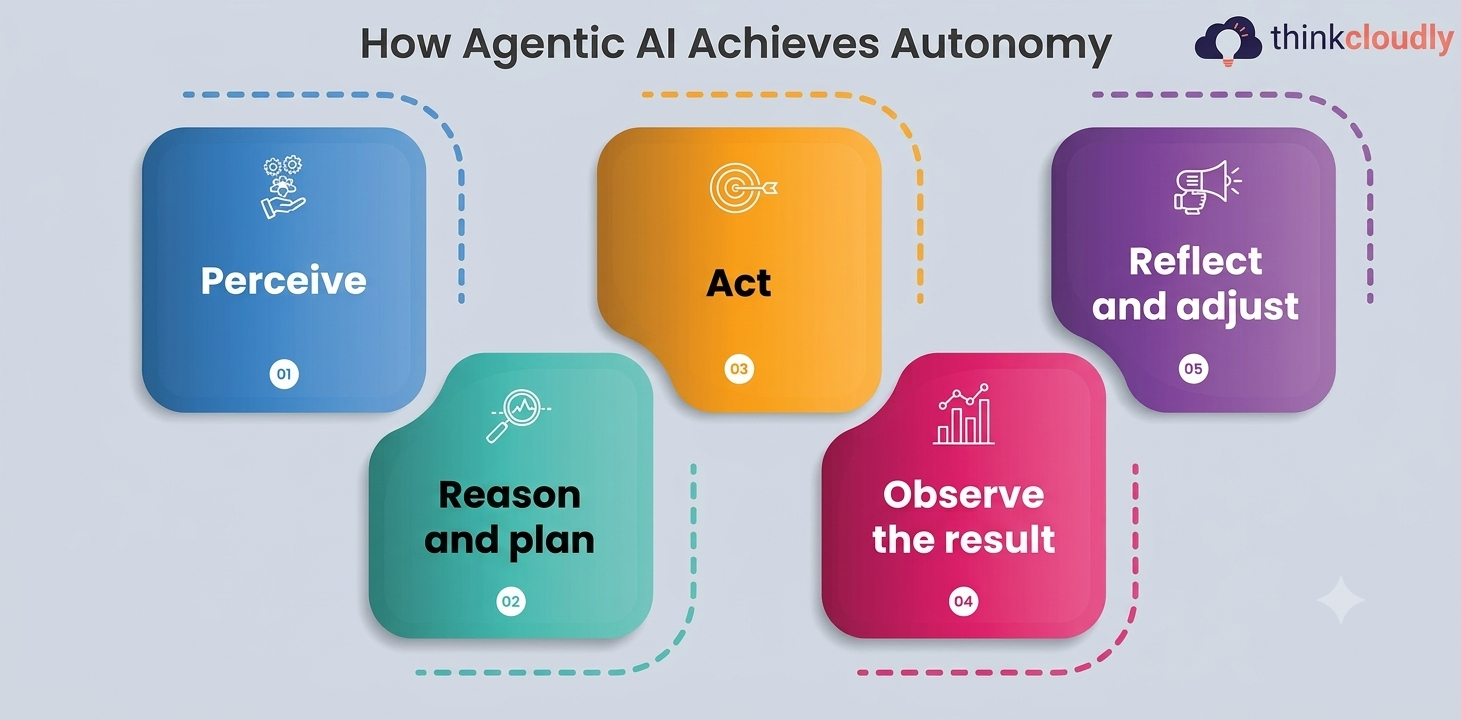
Before going further, it helps to see how agentic AI works in practice rather than taking the autonomy on faith. Here’s how agentic ai works broken into the five stages that repeat in a loop, written so it drops straight into a flowchart or infographic:
-
Perceive—the system takes in fresh information: a customer message, an API response, a sensor reading, or a change in a database.
-
Reason and plan—a large language model acts as the decision-making layer, breaking a broad goal into a concrete, ordered set of steps.
-
Act—the system carries out the plan by calling tools: an email client, a booking system, an internal database, or another piece of software entirely.
-
Observe the result—it checks whether the action actually worked, rather than assuming success and moving on blindly.
-
Reflect and adjust—if something fails, it replans and tries a different route; if it works, it moves to the next step toward the original goal.
Once that loop clicks, the rest of the conversation—benefits, risk, tooling—gets a lot easier to follow, because every feature a vendor demos is really just a variation on one of those five stages. Short-term memory lives in the model’s context window for the task at hand; longer-term memory, where it exists, is usually stored separately so the system can recall past outcomes across sessions rather than starting from zero every time.
Why Does It Matter in the UK in 2027?
Here’s where what is agentic AI stops being an abstract question and becomes a commercial one. UK businesses are no longer treating this as an experiment confined to a lab. Research from Forrester, reported by IT Brief UK, found that three-quarters of enterprise leaders say they’re already adopting agentic AI, yet only a small minority have turned that adoption into meaningful production impact.
Forrester’s Brian Hopkins put it bluntly: “Companies that treat agentic AI as a feature experiment will stay stuck in pilots. ” The gap, he added, “isn’t about models or ambition; it’s about orchestration, control, and trust.”
That tension between appetite and readiness shows up clearly in the numbers. Capgemini research covered by TechRadar Pro estimates AI agents could generate up to $450 billion in economic value globally, with scaled adopters seeing a $382 million boost over three years compared to $76 million for organizations moving more slowly.
Yet only 1% of UK organizations have fully scaled their agent deployments, even though 93% agree that scaling would hand them a real competitive advantage within the year. Trust is the sticking point: confidence in agentic AI among UK respondents fell from 50% to 32% in a single year, mirroring a global drop driven by concerns about data readiness and infrastructure maturity.
It isn’t all caution, though. Separate research from Box found 85% of UK organizations already use AI agents in at least some workflows, and 65% expect headcount to grow over the next three years rather than shrink—with new roles emerging specifically to manage agents, including AI agent operators, workflow automation specialists, and governance leads.
As Box’s EMEA president Samantha Wessels put it, UK firms are “moving beyond AI experimentation and into operationalization.” That’s the real story behind agentic AI’s UK moment right now: less a question of whether to adopt and more a question of whether the controls are ready before the agents are switched on.
The Benefits of Agentic AI for UK Businesses Right Now
The benefits of agentic AI aren’t spread evenly across every department, and pretending otherwise is how pilots end up stalling. Some teams see results within weeks; others are still laying groundwork a year in. The table below breaks down the benefits of agentic AI by function, based on where UK deployments are actually gaining traction rather than where the marketing says they should.
Business Function
What Changes
Typical Agentic AI Benefit
Customer service
Tickets get triaged, researched, and partially resolved before a human sees them
Faster first response, fewer repetitive tickets reaching staff
IT operations
Failures get detected and routine fixes attempted automatically
Reduced downtime, fewer after-hours callouts
Finance and procurement
Invoices get matched against purchase orders without manual cross-checking
Fewer reconciliation errors, faster month-end close
Sales and marketing
Leads get scored and follow-ups timed based on engagement signals
Better-qualified pipeline, less manual lead triage
Compliance and risk
Transactions and cases get flagged against rules continuously, not in batches
Earlier detection of exceptions, clearer audit trail
Table aside, those gains only really materialize once governance is in place—a point every piece of UK research keeps circling back to. Agentic AI benefits show up fastest in operations-heavy teams with clearly bounded, repetitive tasks, which is exactly why customer service and IT operations are leading the pack in most 2027 deployments rather than anything involving sensitive judgment calls.
These agentic AI benefits aren’t theoretical: they’re the same functions showing up repeatedly across Forrester’s and Box’s survey data as the earliest places UK organizations are seeing real returns.
Agentic AI Tools Gaining Ground in UK Workplaces in 2027
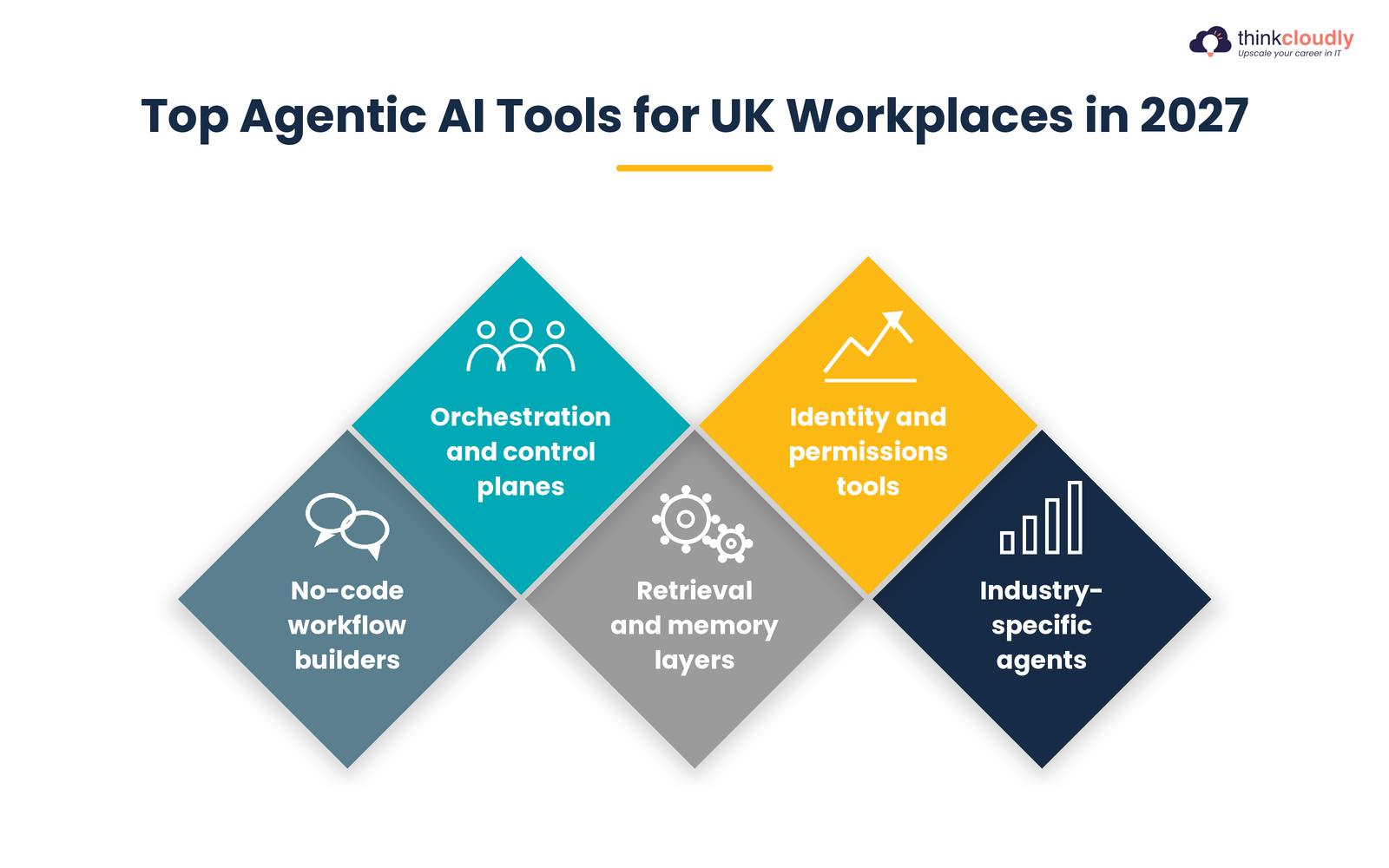
The Agentic AI tools showing up most often in UK deployments right now fall into a handful of broad categories, laid out here so the list works just as well as a slide as it does a paragraph:
-
No-code workflow builders — visual platforms that let a non-developer connect a trigger, a decision, and an action without writing code, useful for a first pilot in customer service or inbox triage.
-
Orchestration and control planes — software that tracks every agent running in an organization, what it’s allowed to touch, and what it’s actually doing, which Forrester flags as the missing piece keeping most firms stuck in pilot mode.
-
Retrieval and memory layers — systems that let an agent recall relevant company knowledge rather than relying purely on what’s in its immediate context window.
-
Identity and permissions tools — frameworks that treat an agent like an employee with its own access rights, so it can only reach the systems and data it’s explicitly been granted.
-
Industry-specific agents — purpose-built tools for financial services onboarding, public-sector case handling, or compliance monitoring, where industry guidance stresses explainability and audit trails above raw capability.
Choosing a platform without mapping it to specific agentic ai benefits is how pilots stall even when the underlying technology works fine. Before picking Agentic AI tools, it’s worth asking what’s already connected to your existing systems rather than buying a platform that demands you rebuild your data plumbing from scratch.
Narrowing your pilot to one well-bounded department, rather than rolling out several tools at once, is consistently the difference between one that earns trust and one that gets quietly switched off after a bad week.
Risks and Governance: The Part Nobody Skips in 2027
No honest answer to what is agentic AI minus a section on governance is complete, because autonomy without oversight is just unmanaged risk wearing a product name. TechUK’s guidance is direct about this: governance has to be operational, not a policy document in a drawer—audit trails, clear escalation routes, and the real ability to pause or override an agent mid-task.
A risk-based approach matters too; an agent routing a marketing email deserves far less scrutiny than one touching healthcare records or financial transactions.
Box’s research backs this up from the inside: 94% of UK IT decision-makers agree that better governance would let them move faster with agentic AI, and 93% say strong governance is necessary to scale it responsibly at all — yet 45% have already had an incident where an AI tool surfaced content a user shouldn’t have had access to agentic ai benefits and agentic ai risk sit on the same ledger, and you can’t responsibly bank one without actively managing the other. The organisations pulling ahead in 2027 aren’t the ones moving fastest; they’re the ones who built the control plane before they needed it rather than after something went wrong.
Getting Started Without Overcommitting
If your organisation is still asking what is Agentic AI in a practical, “where do we even begin” sense, resist the urge to launch five pilots at once. Pick one narrow, well-bounded workflow — something like inbox triage or invoice matching, where the cost of a mistake is low and recoverable — and run it with a human reviewing outputs before anything irreversible happens. Expand the agent’s autonomy only once it’s proven reliable over real runs, not a single clean demo.
Those gains compound once you’ve run one workflow reliably for a month, because that’s when the team actually trusts the system enough to hand it a second task without a meeting about it first. The agentic ai benefits worth chasing first are the boring, measurable ones — fewer repetitive tickets, faster reconciliation, quicker first response — not the ambitious, headline-grabbing use case that looks good in a board deck but has no fallback plan if it fails on a Friday afternoon.
A Personal Note
I used to think how Agentic AI works was purely a technical question, something for engineers to debug and everyone else to nod along with in meetings. Sitting with my client in Leeds, watching her realise she’d approved a six-figure spend without being able to explain what the system would actually do on its own, changed that.
It’s not a technical question at all — it’s a trust question wearing technical clothing. If you take one thing from this piece, let it be this: before you approve the next pilot, make sure someone in the room can explain, in one sentence, what the agent is allowed to do without asking permission first. If nobody can answer that cleanly, you’re not ready to switch it on yet, no matter how good the demo looked.