





A lot of Canadian job postings now list “incident response” as a core skill for a role titled nothing more exciting than “Tier 1 SOC Analyst.” That single line is doing a lot of work. It tells you employers aren’t hiring people to just watch a dashboard anymore—they want someone who can move through a real incident without needing a supervisor standing over their shoulder.
That shift is exactly why SOC incident management training has stopped being a nice-to-have add-on course and started showing up as a baseline hiring filter across Canadian security teams in 2027.
This guide walks through what SOC incident management training should actually teach, how the incident response lifecycle fits into a real SOC shift, which soc analyst skills employers are quietly screening for, and how the main soc analyst certification paths compare once you strip away the marketing language.
Why SOC Incident Management Training Matters More in Canada Right Now?
The shortage behind this isn’t a sales pitch invented by course providers. Canadian employers posted 2,448 unique cybersecurity roles between March 2025 and February 2026, with new openings landing at a steady 180 to 270 a month, against a shortage the same analysis puts at more than 26,000 cybersecurity professionals heading into 2026—a gap that hasn’t closed going into 2027. SOC analyst certification roles sit near the top of that entry-level demand, alongside incident handlers, which is precisely the population incident response training is built for.
Provincial outlook varies more than the national pay figures suggest. Job Bank’s 2025–2027 outlook ratings put Ontario’s near-term prospects as more limited even though it still carries the largest absolute number of postings, while smaller markets like Nova Scotia currently rate a “good” outlook.
That gap matters for anyone weighing where to apply: it’s not just how many jobs exist in a province; it’s how many qualified people are competing for each one, and a thin local market can make demonstrable lab experience the deciding factor over a bare certificate.
Pay has moved in the same direction. National Job Bank figures for security analyst roles run from roughly $62,400 to $150,000 a year, with a median near $103,000, though junior SOC analyst pay lands much closer to the bottom of that range.
PayScale’s Canadian data for junior SOC analyst roles puts the average around $65,000, with a typical spread of roughly $51,000 to $87,000 before incident-handling experience starts pushing it up.
The skills-gap data backs up why training matters more than raw interest right now. The ISC2 Cybersecurity Workforce Study found 59% of security professionals globally report critical or significant skills needs, up sharply from 44% the year before, and 88% said a skills deficiency had already caused a real consequence inside their organization—process oversights, underqualified hires, or no time left to train staff properly.
Digital forensics and incident response specifically was named a skill needed by 22% of respondents. That’s not a huge slice on its own, but it’s a direct, named gap sitting right where structured SOC incident management training is supposed to close it.
Put plainly: the market doesn’t just want more bodies in SOC seats. It wants people who’ve already rehearsed the parts of the job that panic turns into mistakes.
The Incident Response Lifecycle: 6 Stages Every SOC Analyst Should Know Cold
Most incident response training is organized around some version of the same incident response lifecycle, adapted from NIST’s own incident handling guidance. Knowing the names of the stages isn’t the point—being able to say what you’d actually do at each one, under time pressure, is what separates a candidate who’s read about the job from one who can do it.
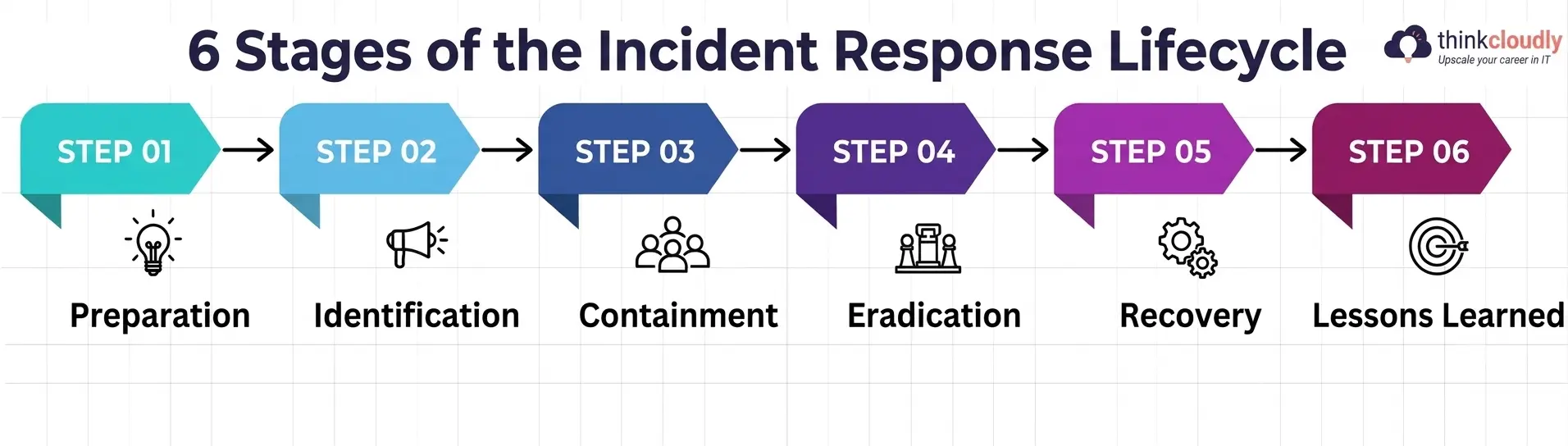
- Preparation—building and testing playbooks, access, and tooling before anything goes wrong, so the first ten minutes of a real incident aren’t spent hunting for logins.
- Identification—recognizing that an alert is a genuine incident rather than noise, and scoping roughly what’s affected before escalating further.
- Containment—isolating affected systems or accounts fast enough to stop lateral movement, without destroying evidence you’ll need later.
- Eradication—removing the actual cause, whether that’s malware, a compromised credential, or a misconfigured service, not just the symptom that triggered the alert.
- Recovery—restoring systems to normal operation carefully, with monitoring turned up, so a half-fixed problem doesn’t quietly resurface a week later.
- Lessons Learned—documenting what happened and what should change, because a SOC that skips this step repeats the same incident with a different name.
A program that only teaches the first two or three stages of the incident response lifecycle and treats the rest as theory leaves graduates able to spot a problem but not actually close it out—which is usually the exact gap a technical interview is designed to expose.
7 SOC Analyst Skills Employers Are Quietly Screening For in 2027
Strip the branding off most job postings, and the SOC analyst skills that actually get someone past a first interview boil down to a short, consistent list:
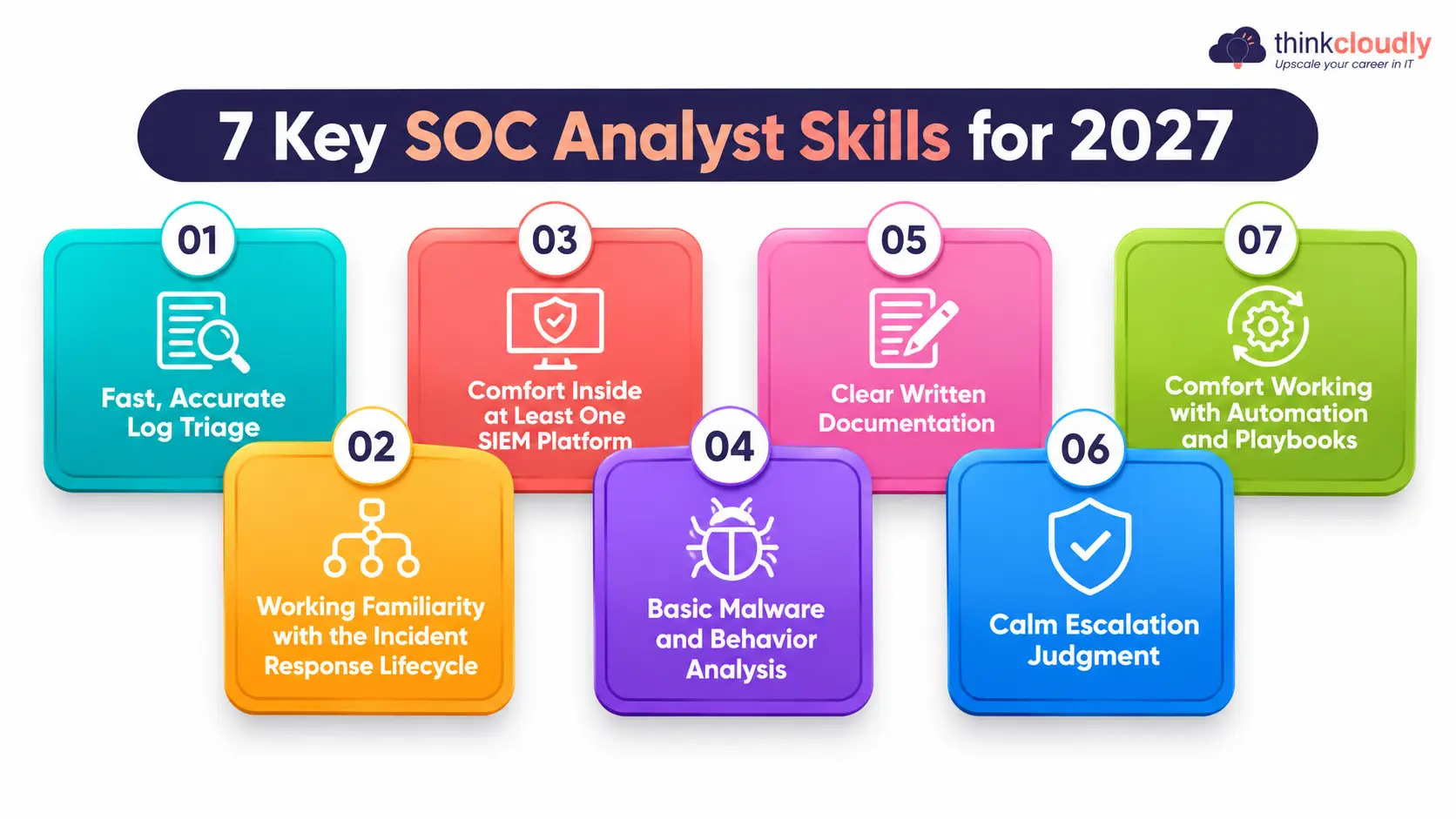
- Fast, accurate log triage—separating a real signal from the noise before the queue backs up behind you.
- Comfort inside at least one SIEM platform, demonstrated through hands-on labs rather than a slide describing what a SIEM does.
- Working familiarity with the incident response lifecycle, including knowing which stage you’re in in the middle of a messy, fast-moving alert.
- Basic malware and behavior analysis—recognizing a suspicious process tree or odd outbound connection without needing a senior analyst to point it out.
- Clear written documentation a Tier 2 analyst or a non-technical manager could pick up without ten follow-up questions.
- Calm escalation judgment—knowing what needs attention right now versus what can wait for shift handoff.
- Comfort working alongside automation and playbooks, since most Canadian SOCs now lean on tooling to clear repetitive triage and expect analysts to supervise it, not fight it.
Interviewers consistently rate someone who can narrate their reasoning out loud higher than someone who can only point at a dashboard and say something looked off. That habit is worth practicing deliberately during soc analyst training, not saved for interview day.
Comparing the Main SOC Analyst Certification Paths in Canada
There isn’t one “correct” soc analyst certification, and most hiring managers care less about the logo on the badge than whether you can demonstrate the skill behind it. Still, the paths differ enough in cost, depth, and recognition that picking blind wastes both time and money.
|
Certification |
Best Suited For | Core Focus | Typical Cost (CAD) |
Hands-On Labs |
|
CompTIA Security+ |
Complete beginners building a foundation | General security concepts, basic threat handling | 450–550 |
Limited |
|
CompTIA CySA+ |
Analysts moving into SOC-specific work | Threat detection, behavioral analytics, incident response | 550–650 |
Moderate |
|
(ISC)² Certified in Cybersecurity (CC) |
Career switchers with no prior IT background | Security fundamentals, including basic incident handling | Entry-level, often free via sponsorship |
Limited |
|
GIAC Certified Incident Handler (GCIH) |
Analysts who want incident response as a specialty | Full incident response lifecycle, hands-on attack simulation | 4,500–8,500 (with training) |
Extensive |
|
EC-Council Certified SOC Analyst (CSA) |
Entry-to-mid-level analysts targeting SOC roles directly | SIEM operations, log analysis, SOC workflows | 1,200–1,800 |
Moderate to extensive |
None of these rows replaces real incident response training on its own. A certification proves you can pass an exam; structured training with lab time proves you can apply the material under something closer to real conditions.
CompTIA itself positions CySA+ as a credential built around incident detection, prevention, and response rather than general security awareness, which is part of why it shows up so often as a preferred line item on Canadian SOC postings.
Still, the strongest Canadian candidates usually pair an entry-level credential with dedicated SOC analyst training rather than treating either one as sufficient by itself—a passed exam and a demonstrated skill set aren’t the same thing to a hiring manager running a real interview.
SOC Analyst Training vs. SOC Incident Management Training: Why the Distinction Matters
These two terms get used almost interchangeably in course marketing, and that’s part of the problem. General SOC analyst training tends to cover the breadth of the role—log sources, SIEM basics, alert triage, shift workflows—which is necessary groundwork but doesn’t go deep on what happens once an alert is confirmed as a genuine incident.
SOC incident management training narrows in on exactly that moment: the handoff from “something looks wrong” to “we are now actively running a response.” It covers containment decisions, evidence handling that survives scrutiny later, communication with stakeholders mid-incident, and the judgment calls that don’t have a clean right answer in a textbook.
A Tier 1 analyst who’s only had general SOC analyst training can usually describe the incident response lifecycle in an interview. One who’s been through proper SOC incident management training can usually walk through what they’d actually do, stage by stage, without freezing on the harder questions.
Employers in 2027 are increasingly specific about which one they’re screening for, especially for roles that sit closer to Tier 2 or that involve rotating on-call incident duty. Reading the posting carefully—and being honest with yourself about which gap you actually have—saves a lot of wasted course fees.
Choosing SOC Incident Management Training That’s Actually Worth Paying For
A handful of practical filters cut through most of the marketing noise when comparing providers:
- Ask for lab hours, not just a course outline. A syllabus heavy on slides and light on simulated incidents leaves you underprepared for a live technical interview.
- Confirm the incident response lifecycle is taught end to end, not just through containment, with recovery and lessons-learned treated as seriously as the dramatic middle stages.
- Check whether the soc analyst certification tied to the course is recognized by employers in your target city, not just globally popular.
- Look for scenario-based assessment, where you’re handed a messy, realistic alert rather than a multiple-choice question about definitions.
- Ask how recently the material was updated. Threat patterns and tooling shift fast enough that a three-year-old course is teaching a version of the job that’s already partly gone.
Good incident response training rarely feels comfortable while you’re in it — it’s supposed to put you in situations where the obvious first instinct is slightly wrong, so you learn to slow down half a second before acting. If a course feels entirely smooth the whole way through, it probably isn’t testing you hard enough.
Final Thoughts
SOC incident management training in Canada isn’t optional reading for anyone serious about security operations heading into 2027. The job postings are there, the pay has moved up meaningfully for people who can prove real skill, and the gap between “took a course” and “can run an incident without supervision” is exactly where most applicants get filtered out before a second interview.
Learn the incident response lifecycle well enough to apply it under pressure, build the soc analyst skills employers are actually screening for, and choose a soc analyst certification that matches where you’re trying to work rather than whichever one has the loudest marketing. Training that skips straight to the credential and skips the lab time is training you for the test, not the job.
A Personal Note
The thing that stood out most while putting this together wasn’t the salary numbers or the certification price tags — it was how many Canadian postings list “incident response experience” as a requirement for a role labelled entry-level.
That’s a frustrating gap if you’re starting from zero, but it’s also exactly why structured training beats self-study here more than in most other IT fields. You can read about the incident response lifecycle for months and still freeze the first time a real alert demands a decision in under five minutes.
The analysts who get hired aren’t the ones with the longest list of completed courses — they’re the ones who can describe one incident they actually worked through, stage by stage, and explain the one call they’d make differently next time. If you’re choosing where to spend your training budget this year, spend it on the course that puts you in that position, not the one with the most impressive certificate at the end.