





Search for SOC monitoring training in Canada right now and you’ll land on a dozen course pages promising a six-figure job in twelve weeks flat. None of them tell you the part that actually matters: which skills turn into an interview call and which ones are padding on a sales page.
This guide covers what good SOC monitoring training should teach in 2027, what the job pays across Canada, where the openings are sitting, and how SIEM monitoring, Splunk monitoring, SOC automation, MITRE ATT&CK, and malware detection fit into a Tier 1 analyst’s actual day.
The short version: Canadian employers are still short-staffed at the entry and mid levels, pay has moved up meaningfully, and the gap between “finished a course” and “can run a shift” is exactly where most self-taught beginners get stuck.
Why Does This Market Reward Structured Training Right Now?
The shortage isn’t a talking point invented by course providers—it’s tracked. Canadian employers posted 2,448 unique cybersecurity roles between March 2025 and February 2026, with new openings landing at a steady 180 to 270 a month, against a shortage estimated at more than 26,000 cybersecurity professionals heading into 2026. That gap hasn’t closed going into 2027, which is the exact opening structured training is built to fill.
Pay reflects the pressure. National Job Bank figures for security analyst roles run from roughly $62,400 to $150,000 a year, median near $103,000, though entry-level pay lands much closer to the bottom. A separate 2026 breakdown of Canadian cybersecurity hiring trends puts typical analyst pay in the mid-80,000s to low 110,000s, with British Columbia, Ontario, and Alberta sitting higher provincially.
Junior SOC analyst roles specifically tend to start lower—PayScale’s Canadian data puts the average around $65,000, with a typical range of roughly $51,000 to $87,000—before climbing with incident-handling experience.
Worth saying plainly: entry-level postings make up only about one in twenty listings, and many still ask for two to three years of experience. The market wants experienced people more than beginners, which makes focused, demonstrable SOC monitoring training the difference between getting screened out and getting a callback.
What a Real SOC Monitoring Training Program Should Teach
A lot of course marketing talks about “becoming a SOC analyst” without specifying what the job does hour to hour. Strip the branding away, and a solid program needs to leave you able to:
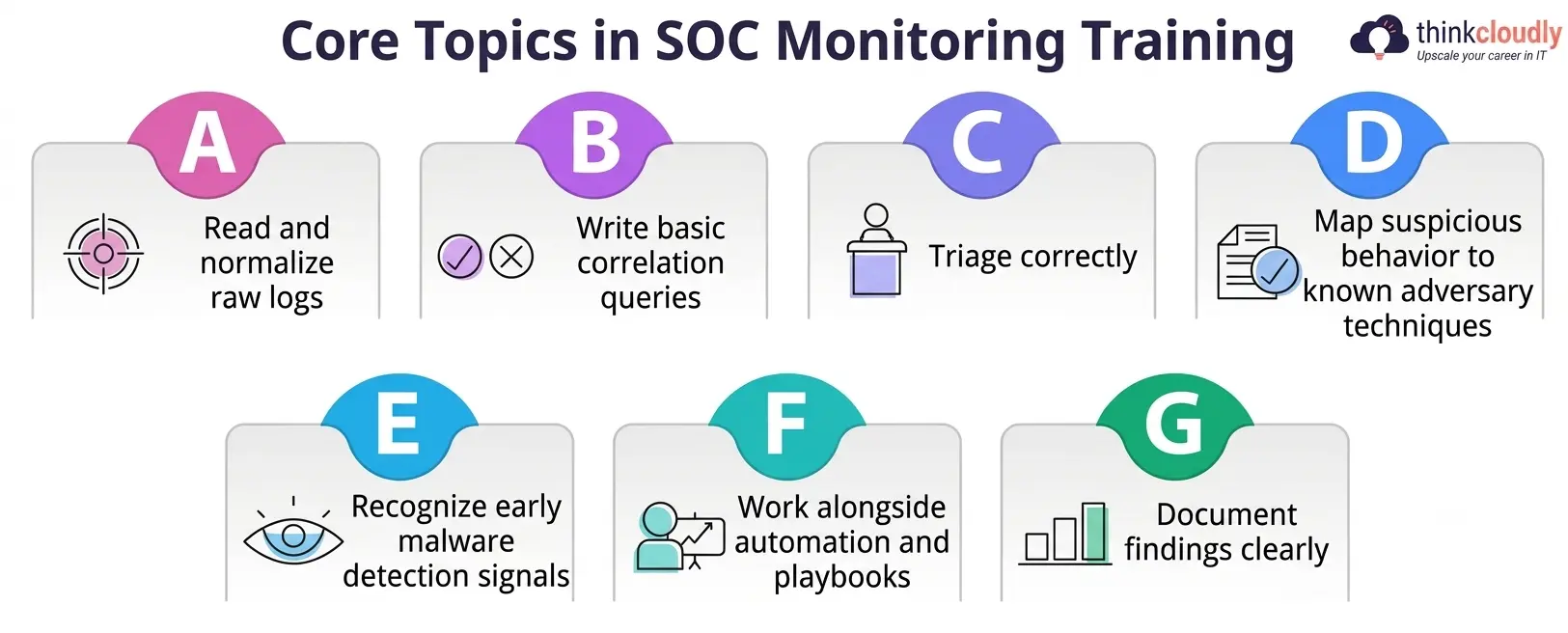
- Read and normalize raw logs from firewalls, endpoints, identity providers, and cloud platforms inside a SIEM monitoring dashboard, not a spreadsheet export.
- Write basic correlation queries in SPL or KQL to pull one meaningful event out of millions of log lines during an active alert.
- Triage correctly—deciding fast whether something is a false positive, a low-priority anomaly, or needs to move up the chain immediately.
- Map suspicious behavior to known adversary techniques instead of reacting to isolated events with no context.
- Recognize early malware detection signals—unusual process trees, odd outbound connections, encoded scripts—before a full investigation opens.
- Work alongside automation and playbooks to clear repetitive triage steps, saving attention for alerts that genuinely need human judgment.
- Document findings clearly so a Tier 2 analyst can pick up a case without ten follow-up questions.
Skip the middle steps and jump straight to dashboards, and you’ll finish being able to click around a product convincingly without explaining why an alert fired. That gap shows up fast in a technical interview, and it’s the biggest reason “completed” certificates still get passed over.
SIEM Monitoring vs. Splunk Monitoring: Two Different Starting Points
Job postings rarely ask for generic “SIEM “experience”—they name a product. Broad SIEM monitoring concepts (ingestion, correlation rules, alert tuning) transfer across platforms, but the muscle memory of querying one specific tool does not, which is why picking a lane early pays off.
Splunk monitoring remains the default inside older, established Canadian employers—finance, insurance, retail, and large enterprises that adopted it years before cloud-native alternatives existed. It centers on SPL queries and correlation searches tuned to the organization’s own log sources. Microsoft Sentinel tends to show up wherever an employer already runs Microsoft 365 or Azure, leaning on KQL instead.
|
Factor |
SIEM Monitoring Fundamentals (General) |
Splunk-Specific Training |
|
Scope |
Concepts common across platforms |
One product’s query language and dashboards |
|
Query skill |
Varies (KQL, SPL, others) |
SPL (Search Processing Language) |
|
Where it shows up |
Entry-level theory, vendor-neutral courses |
Named requirement in many Canadian SOC postings |
|
Best for |
Building foundational monitoring logic |
Employers already running Splunk as their core SIEM |
|
Training signal |
Often bundled into broader SOC courses |
Sometimes priced and certified separately |
Training that only teaches general concepts without ever putting you inside a real product’s query syntax leaves graduates able to describe the job, not do it live in an interview.
SOC Automation Is Changing the Entry-Level Job Itself
Automation isn’t a future trend anymore—it’s already reshaping a Tier 1 shift in 2027. The pressure is simple: a typical SOC processes roughly 11,000 alerts a day, and only about 19% are worth investigating, per SANS SOC Survey data cited in recent industry reporting. No team of humans handles that volume sustainably by hand, which is exactly why SOC automation—playbooks, auto-triage rules, and orchestration—has moved from “nice to have” to baseline expectation.
A separate global survey on security operations found 59% of practitioners say they have too many alerts, 55% struggle with too many false positives, and 46% spend more time maintaining tools than defending the organization, per a recent state-of-security report. The same research found only 11% trust AI completely for mission-critical tasks—most teams lean on automation for the repetitive first pass while keeping a human in the loop for anything ambiguous.
For someone in training right now, that shift matters practically: the job increasingly rewards people who can configure and trust automation appropriately, not people who manually triage every alert by hand. A program that ignores this is teaching a version of the role that’s already partly out of date.
MITRE ATT&CK: The Shared Language Behind Modern Detection
If automation decides what gets filtered out, MITRE ATT&CK decides what the remaining alerts actually mean. The framework organizes known adversary behavior into tactics and techniques—currently 14 tactics, 211 techniques, and 468 sub-techniques across the Enterprise matrix—giving analysts a shared vocabulary instead of reacting to isolated, unlabeled events.
In practice, the framework shows a few concrete ways. Detection engineers map existing SIEM rules against it to find coverage gaps. Analysts tag alerts with technique IDs during triage so the next person understands significance immediately.
Threat hunters search for known technique patterns rather than specific malware signatures, which matters more every year: one recent industry analysis found 81% of interactive intrusions tracked were malware-free, relying on legitimate tools and valid credentials instead of a detectable binary.
That last point reshapes what malware detection means in 2027. It used to mean catching a suspicious file. Increasingly, it means recognizing behavior—a legitimate admin tool running somewhere it shouldn’t, a login pattern that doesn’t match someone’s normal routine—because attackers have gotten better at avoiding anything a signature would flag. A program still framing this purely around file scanning is teaching half the job.
What Employers Actually Screen For?
Strip away the marketing language, and Canadian employers hiring for these roles in 2027 consistently screen for the same short list:
- Log reading speed—separating signal from noise fast enough that the queue doesn’t back up behind you.
- Comfort with at least one SIEM product, ideally demonstrable through hands-on Splunk labs or an equivalent environment.
- Working knowledge of MITRE ATT&CK—enough to describe an alert by tactic and technique, not just “it looked weird.”
- Basic malware detection instincts—recognizing suspicious process behavior and knowing when to escalate rather than dig further alone.
- Comfort working alongside automation—configuring and double-checking playbooks rather than fighting or ignoring them.
- Clear written documentation a Tier 2 analyst or non-technical manager could actually follow.
- Calm escalation judgment—knowing which findings need attention now versus shift handoff.
Interviewers consistently rate a candidate who can narrate their reasoning out loud higher than one who can only point at a dashboard and say something looked suspicious. That habit is worth practicing deliberately, not saving for interview day.
Where the Jobs Actually Are for 2027?
Entry-level demand concentrates around a few titles: Tier 1 SOC analyst, security monitoring analyst, and junior cybersecurity analyst, most commonly inside managed security service providers, financial institutions, telecoms, and government contractors. Toronto, Vancouver, and Ottawa carry the deepest concentration of postings, though a growing share are listed as remote or hybrid, since log analysis and triage don’t require being physically on-site.
Provincial outlooks vary more than national averages suggest. Ontario’s near-term hiring outlook has been rated more cautiously in recent Job Bank data than smaller markets like Nova Scotia. That doesn’t mean Ontario has fewer total jobs—it has far more in absolute terms—it means competition per opening runs higher, which is one more reason a demonstrable lab portfolio matters more in a crowded market.
Managed security service providers deserve a specific mention, since beginners often overlook them chasing in-house roles at recognizable brands. MSSPs monitor several client environments at once, meaning higher alert volume and a faster path to varied attack patterns than a single in-house SOC typically offers a first-year analyst.
A Realistic Path Through SOC Monitoring Training
Trying to absorb SIEM concepts, Splunk queries, ATT&CK mapping, and automation all at once is how most self-taught learners stall within a few weeks. A sequenced approach holds up better:
- Start with networking and log fundamentals before touching a SIEM dashboard — recognize normal traffic before spotting the abnormal kind.
- Pick one platform ecosystem based on what employers in your target city actually run, rather than learning several shallowly.
- Layer in the ATT&CK framework once basic querying feels comfortable, mapping real alerts to specific techniques as practice.
- Practice detection reasoning using simulated environments with live-looking alerts, focusing on behavior patterns over memorized file hashes.
- Get comfortable with playbooks and automation rather than avoiding them, since the job increasingly expects analysts to work alongside it, not around it.
- Document two or three detailed investigation write-ups and start applying before you feel completely ready — waiting for total confidence usually means waiting too long.
Choosing SOC Monitoring Training That’s Actually Worth the Time
A few filters cut through most of the marketing noise when comparing providers:
- Ask for lab hours, not just the course description. Slide-heavy, query-light syllabi leave you under-prepared for a live technical interview.
- Check whether the ATT&CK framework is taught in depth or just mentioned in passing. Treating it as a footnote isn’t teaching current detection practice.
- Confirm the course addresses SOC automation directly, since a program built entirely around manual triage is teaching a shrinking version of the job.
- Look for detection content covering behavior, not just file signatures — reasoning that holds up against malware-free intrusions, not just the obvious cases.
- Match the platform to your target employers. Paying a premium for deep Splunk expertise only helps if the companies you’re applying to actually run Splunk.
Final Thoughts
SOC monitoring training in Canada isn’t optional reading if you’re serious about security operations in 2027 — the postings are there, pay has moved up meaningfully, and the skills gap between “took a course” and “can run a shift” is exactly where most applicants get filtered out.
Get comfortable with SIEM fundamentals, pick a platform and go deep rather than wide, learn the ATT&CK framework well enough to use it during triage, understand how automation is reshaping the entry-level job, and practice malware detection as behavior recognition rather than file-scanning trivia. Document what you build, and apply before you feel fully ready.
A Personal Note
The thing that surprised me most going through Canadian SOC postings for this piece wasn’t the salary numbers — it was how many listings still ask for two to three years of experience on a role labeled “entry-level.” That’s frustrating if you’re starting from zero, but it’s also exactly why generic interest in cybersecurity doesn’t get you through the door anymore.
The candidates who actually land these roles can describe one real alert they investigated, one technique they mapped it to, and one judgment call they made under time pressure — not the ones with the longest list of completed courses. If you’re deciding where to put your hours this year, put them into fewer tools covered more deeply, not more tools covered thinly.