






Most UK organizations don’t find out their incident response plan has gaps during a tabletop exercise. They find out at 2 a.m., mid-breach, when the plan on paper runs into a SOC analyst who’s never actually run the steps under pressure.
That gap between “we have a process” and “we can execute the process” is exactly what security incident response training is supposed to close, and in 2027, with attack volumes and AI-enabled threats both climbing, it’s not optional reading anymore.
If you’re a SOC analyst, a team lead building out a rota, or someone weighing up which course to put budget behind this year, this is a practical look at what security incident response training actually needs to cover, what UK data says about the current skills gap, and how to pick a course that holds up once the alert actually fires.
Why UK SOC Teams Can’t Treat This as a Box-Ticking Exercise?
The UK’s National Cyber Security Centre has been blunt about this for a while: an incident response plan only works if the people running it have rehearsed it, and NCSC’s own guidance on developing an incident response plan is built around the assumption that a plan without practiced people behind it is closer to a wish list than a defense.
That’s the core argument for this kind of training—it turns a document into a reflex, and it’s the reason so many UK boards are now asking their SOC leads to prove readiness rather than just produce a policy binder.
The financial case backs this up. IBM’s 2026 Cost of a Data Breach findings for the UK put the average breach at £3.13 million, with breaches taking an average of 165 days to even identify and a further 60 days to contain. Organizations that took longer than 200 days to contain a breach paid £1.09 million more than those who moved faster.
That gap is where trained analysts earn their keep—not by preventing every attack, but by shortening the window between “something’s wrong” and “it’s handled.” Good incident management isn’t glamorous, but it’s the difference between a contained incident and a six-figure write-off.
There’s also a people problem sitting underneath the money problem. ISC2’s 2025 Cybersecurity Workforce Study found that 59% of security professionals globally report critical or significant skills needs, up sharply from 44% the year before, and nearly nine in ten respondents said skills shortages had already caused a real consequence—oversights, misconfigurations, or roles filled by people who weren’t quite ready.
Digital forensics and incident response specifically was flagged as a skills gap by over one in five respondents. Security incident response training is one of the few levers that moves that number directly, because it’s skills-building aimed at the exact function that’s short-staffed.
The UK Skills Gap
It’s worth being specific about the UK picture rather than waving at “global trends.” The UK government’s own labor market analysis for 2026 found that 57% of cybersecurity businesses reported a basic technical skills gap, up from 49% the year before, and that close to half of the people responsible for cybersecurity at UK organizations said they lacked confidence handling a breach or attack when it actually happened.
At the same time, the UK’s cybersecurity skills in the labor market report notes that incident response appeared as a requested skill in 18% of core cyber job postings—a smaller slice than generic “cyber security,” but one recruiters say is growing fast on the back of high-profile breaches.
Put those together and you get a fairly uncomfortable picture: demand for incident response capability is rising, confidence in handling incidents is falling, and the ISC2 workforce study shows threat intelligence and security operations are exactly where organizations expect AI to change the job fastest.
That’s a lot of change landing on SOC teams at once, which is precisely why structured, repeatable security incident response training matters more now than it did even two or three years ago. A one-off onboarding session doesn’t cut it when the intel feeding your SOC changes shape every quarter.
There’s a regulatory push coming too. The UK’s Cyber Security and Resilience Bill, working through the Lords in late 2026, proposes a tightened breach-reporting window—early drafts floated a 24-hour initial notification deadline for in-scope sectors.
A deadline that tight only works if the team on the receiving end of an alert already knows the first three things to do without opening a manual. That’s not a legal technicality—it’s a direct argument for drilling the response process until it’s automatic, well before the law forces the point.
What Proper Security Incident Response Training Should Actually Cover
A course that’s worth the time off the floor tends to walk through the same core ground, roughly in this order:
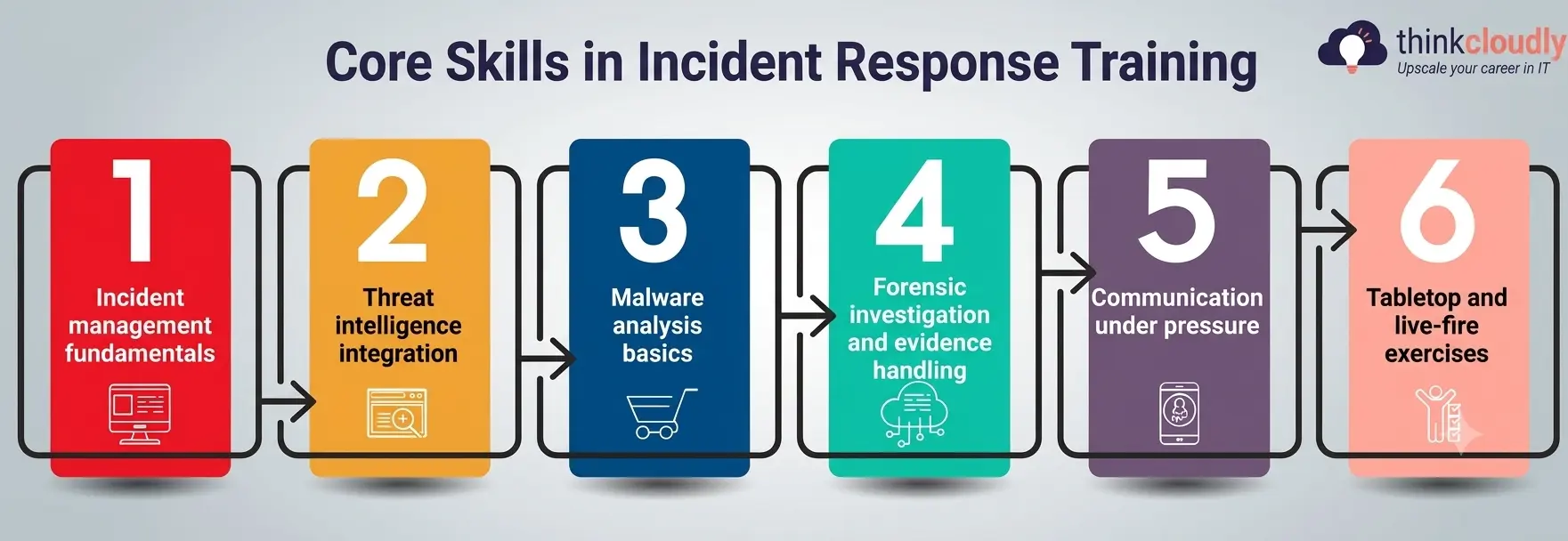
- Incident management fundamentals—the lifecycle from detection through eradication and recovery, who owns each decision, and how escalation actually works when three systems are flagging at once.
- Threat intelligence integration—how to pull in and act on those feeds rather than just read them, including how to tell a relevant indicator from background noise.
- Malware analysis basics—safe handling of suspicious binaries, static and dynamic analysis techniques, and knowing when to escalate a sample rather than dig further yourself.
- Forensic investigation and evidence handling—chain of custody, memory and disk capture, and evidence-handling practices that will survive scrutiny if the incident ends up in a legal or regulatory process.
- Communication under pressure—what to tell leadership, legal, and sometimes customers, and when, without either underselling or overselling the damage.
- Tabletop and live-fire exercises—simulated incidents that force the team to apply the process against the clock, not just describe it in a classroom.
These six areas rarely get equal airtime on a standard course, and that’s worth knowing before you book one. Providers often lean hard into the technical modules—malware labs are popular because they’re visual and satisfying to teach—while communication and legal escalation get a single afternoon slide deck. Ask to see the syllabus breakdown by hours, not just by topic title, before you commit a week of an SOC analyst’s time to it.
Skip any one of those six and you end up with analysts who can define a kill chain on a whiteboard but freeze the first time a real one shows up in their queue. The point of security incident response training isn’t certification for its own sake—it’s muscle memory for a bad night.
Comparing Training Formats Available to UK SOC Teams
|
Training Format |
Best Suited For | Typical Duration | Approx. Cost (GBP) |
Primary Skill Focus |
|
Vendor certification course (e.g., SANS, GIAC-aligned) |
Analysts wanting a recognized credential | 5–6 days intensive | £4,000–£7,000 |
Incident management, forensic investigation |
|
In-house SOC training program |
Teams standardizing playbooks internally | Ongoing, modular | Varies by headcount |
Threat intelligence, malware analysis |
|
Apprenticeship / graduate scheme |
Entry-level hires building a base | 12–18 months | Employer-funded |
Broad foundations, mentored practice |
|
Red team / blue team live exercises |
Teams testing readiness under simulated attack | 1–3 days per exercise | £2,000–£5,000 |
Cyber resilience, decision-making under pressure |
|
Short online modules (self-paced) |
Upskilling on specific tools or techniques | 1–10 hours per module | £0–£500 |
Targeted technical skills |
No single row in that table replaces the others. Most mature UK SOCs blend a baseline certification with recurring live-fire exercises, because reading about evidence handling and actually preserving it under a deadline are different skills entirely.
Budget holders sometimes try to pick one format and call the problem solved; in practice, the certification gives the vocabulary, and the exercises give the reflexes, and you need both before an analyst can be trusted with a live incident unsupervised.
The Core Skills a SOC Analyst Should Walk Away With
Strip away the course branding, and the outcomes that actually matter boil down to a short list:
- Reading logs and alerts fast enough to separate signal from noise before the SOC queue backs up.
- Running or supporting malware analysis on a suspicious file without contaminating the rest of the environment.
- Applying incident management discipline consistently, shift after shift, rather than improvising each time.
- Using threat intelligence to adjust detection rules and priorities, not just filing it away in a report nobody reads.
- Carrying out a forensic investigation that would hold up if a regulator or insurer ever asked for the evidence trail.
- Communicating clearly with non-technical stakeholders mid-incident, which is a skill most technical training skips entirely.
That last point gets underrated constantly. A brilliant piece of evidence that nobody outside the SOC can understand still leaves leadership guessing, and guessing leadership makes bad calls under pressure.
The best analysts translate technical findings into plain consequences—what happened, what’s at risk, what needs deciding in the next hour—and that translation skill is rarely taught alongside the technical content, even though it’s just as decisive when the stakes are high.
Building Cyber Resilience That Outlasts a Single Course
Here’s the honest bit: a five-day course doesn’t make anyone resilient. Cyber resilience is what happens when security incident response training gets reinforced through repetition, after-action reviews, and a culture where admitting “I didn’t recognize that attack pattern” is treated as useful information, not a performance problem.
IBM’s 2026 UK data found organizations with mature security AI and automation averaged £2.26 million per breach against £3.85 million for organizations with none—and that gap tracks closely with how fast the people behind the tools could act once an alert fired. Tools without trained hands behind them only get you partway there.
Cyber resilience in 2027 also has to account for AI-enabled attacks specifically. IBM’s own research found that roughly one in four malicious UK breaches now involve some AI-generated component, whether that’s phishing content, reconnaissance, or obfuscated malware.
Training that’s still teaching 2022-era playbooks without touching this shift is already behind. Analysts need intel sources that flag AI-assisted tactics specifically, and malware analysis habits that account for code generated or modified by an LLM rather than written by hand.
That shift matters more for smaller UK SOCs and managed service providers than it does for the handful of large in-house teams with dedicated threat research units. A five-person SOC covering a mid-sized retailer or a regional NHS trust doesn’t have the luxury of a research arm feeding it bespoke indicators; it’s leaning on whatever intelligence sharing and vendor feeds it can afford, and on analysts who’ve been trained to sanity-check those feeds rather than accept them blindly. That’s a skill, not a tool purchase, and it’s exactly where structured training earns its cost back.
Cyber resilience, in other words, isn’t a certificate on a wall. It’s the sum of a team’s practised decisions, repeated often enough that panic doesn’t get a vote.
Choosing Security Incident Response Training That Actually Fits Your Team
A few practical filters before committing budget:
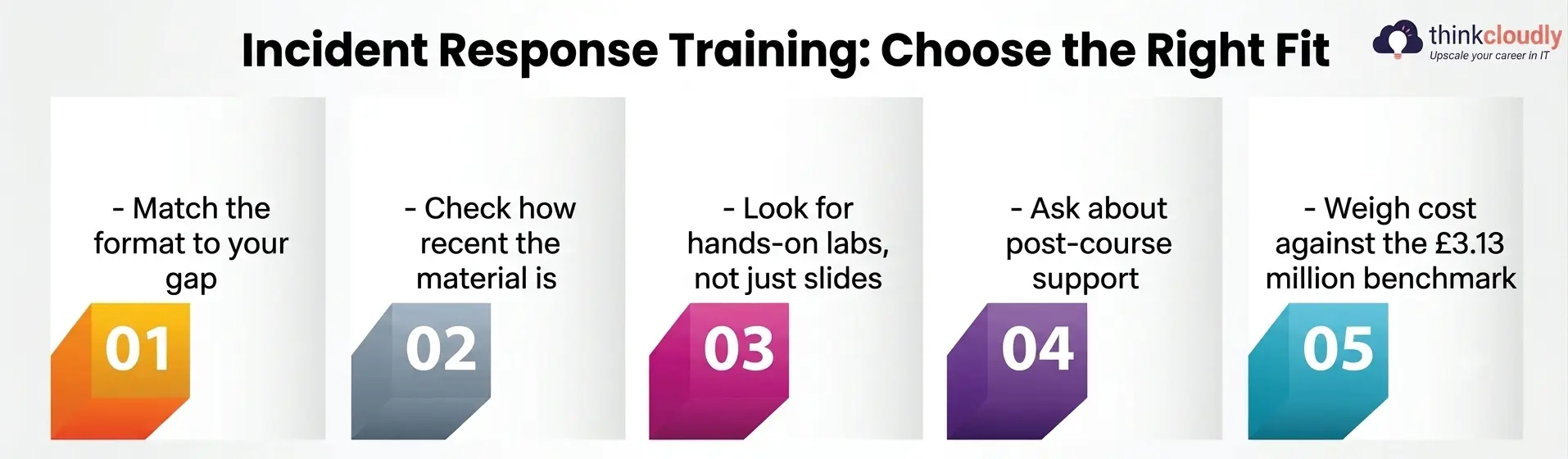
- Match the format to your gap. If your team can already triage but freezes on evidence handling, pick training weighted toward forensic investigation rather than another generalist course.
- Check how recent the material is. Threat intelligence from 2023 is closer to history than guidance at this point — ask providers directly how often their scenarios are refreshed.
- Look for hands-on labs, not just slides. Technical drills and process discipline are both things you learn by doing, not by watching a demo.
- Ask about post-course support. The best courses include some form of follow-up — a refresher session, access to updated materials, or a community to ask questions in six months later.
- Weigh cost against the £3.13 million benchmark. A £5,000 course is a rounding error against the average UK breach cost; treat it as insurance, not overhead.
None of this needs to be complicated, but it does need to be deliberate. Training bought in a hurry to fill a budget line rarely holds up the first time it’s actually needed. It’s also worth asking your provider one blunt question before signing anything: how many of their past attendees have actually used what they learned during a real incident, and what feedback came back afterward? A provider who can’t answer that has probably never asked either, which tells you something about how seriously they take the outcome versus the certificate.
A Personal Note
I’ve sat through SOC shifts where the alert was real and the room went quiet for a beat too long before anyone moved — that pause is exactly what training is meant to erase. No course will make an incident feel routine, and it shouldn’t.
But the teams I’ve seen handle a bad night well weren’t the ones with the fanciest tools; they were the ones who’d rehearsed the ugly version of the scenario often enough that nobody needed to think about what to do next — they just did it. If you’re deciding whether this is worth the budget this year, that’s the question worth sitting with.