





If you’ve started pricing out Splunk SOC analyst training in the UK, you’ve probably noticed the numbers swing wildly depending on who you ask—anywhere from nothing at all to several thousand pounds for a single week. That gap isn’t a pricing error.
It reflects genuinely different products sold under the same label: a self-paced video course is not the same purchase as a three-day instructor-led lab with an exam voucher attached, and the fee you pay should match the outcome you actually need. This guide breaks down what this kind of SOC training really costs in the UK in 2027, where the money goes, and how to avoid paying for more than the job in front of you requires.
Why Splunk SOC Analyst Training Costs What It Does in the UK Right Now?
UK demand for security operations talent is the backdrop behind every price tag in this market. According to ITJobsWatch’s live UK SOC analyst data, the median salary for SOC analyst roles reached £55,000 in the six months to November 2026—up 29.77% year over year from £42,384 the previous year.
That’s not a gentle drift; it’s one of the sharpest single-year salary jumps tracked across any UK security role, and it’s the direct reason training providers can still charge instructor-led premiums while free material sits untouched on the same search results page.
Splunk itself sits behind a meaningful share of that hiring demand. Security operations centers across UK finance, retail, and public-sector employers have run Splunk as their core SIEM for years, which means Splunk certification still shows up as a named requirement—not a “SIEM experience” placeholder—in a large share of Tier 1 and Tier 2 SOC postings.
That specificity is exactly why Splunk SOC analyst training commands a real price in the UK: employers aren’t paying for general security monitoring literacy; they’re paying for someone who can sit down at this particular product on day one.
The other driver is simply how the work itself has changed. A decade ago, log analysis meant scrolling through flat text files by hand. Today it means querying billions of events a day through SPL, tuning correlation rules, and documenting findings fast enough that a Tier 2 analyst doesn’t have to redo the triage.
Cybersecurity courses that skip the hands-on querying and jump straight to theory leave a gap that UK hiring managers notice in the first technical interview, which is why most credible Splunk-based SOC training now bundles live lab time rather than selling slides alone.
What Does a Splunk-Focused SOC Training Package Actually Include?
Before comparing fees, it helps to know what you’re actually buying. A UK course or bootcamp billed as Splunk-focused SOC training typically bundles some combination of the following, and the price moves a great deal depending on which boxes are ticked:
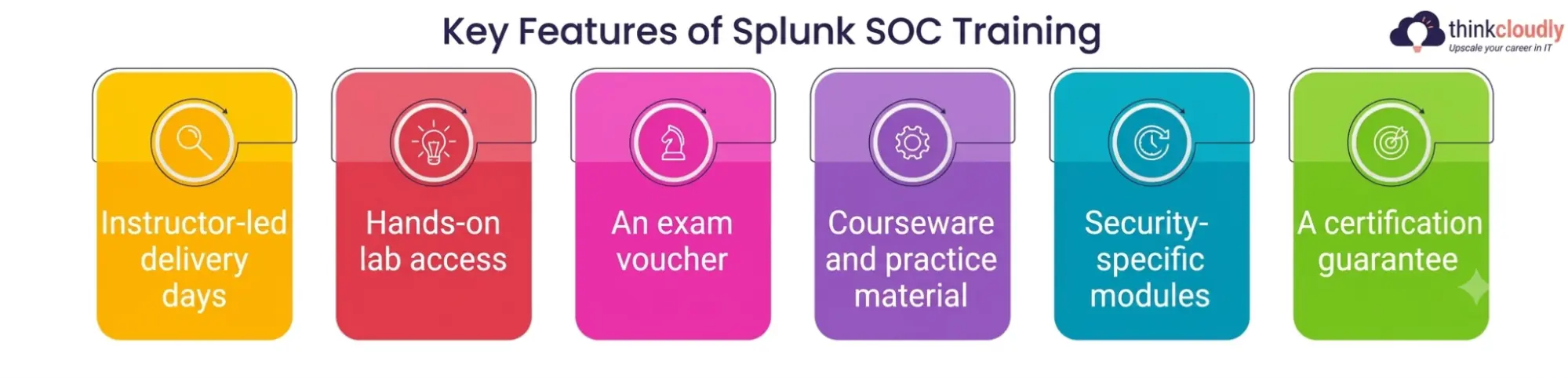
- Instructor-led delivery days—usually 3 to 4 days of live teaching, either in a classroom or online, covering SPL syntax, dashboards, and alert triage.
- Hands-on lab access—a sandboxed Splunk environment, often with 24-hour access included for the duration of the course and sometimes for weeks afterward.
- An exam voucher—a prepaid seat for the certification exam itself, bundled into the course fee rather than billed separately.
- Courseware and practice material—official digital courseware plus practice questions mirroring the real exam’s structure.
- Security-specific modules—dedicated content on security monitoring use cases, correlation searches, and SOC-style investigation work rather than generic Splunk administration.
- A certification guarantee—some UK providers let you retake the course free if you don’t pass the exam on the first attempt, which changes the real cost calculation if you’re not confident going in.
None of those line items are optional extras you can safely skip if your goal is a SOC analyst role specifically. A course that drops the hands-on lab time to cut its sticker price usually produces graduates who can describe log triage in an interview but can’t actually demonstrate it when asked to walk through a dashboard live—which is precisely the gap UK hiring managers are trained to probe for.
UK Splunk SOC Analyst Training Cost Breakdown
Here’s how the main delivery routes compare on price, based on current UK provider listings and Splunk’s own published training rates.
|
Training Route |
Typical UK Cost (excl. VAT) | Duration |
Best Suited For |
|
Free self-paced fundamentals (Splunk’s own catalog) |
£0 | Self-paced, 10–20 hours |
Absolute beginners testing interest before spending |
|
Splunk certification exam only (self-study route) |
Approx. $130 (~£103) per attempt | Exam booked separately |
Learners who already know the material and just need the credential |
|
Online self-paced Splunk course with labs |
Roughly £150–£400 | Self-paced, several weeks |
Working professionals studying around a job |
|
UK instructor-led Power User track (classroom/virtual) |
From £3,335 | 4 days |
Career-switchers wanting structured, guided learning |
|
UK general SOC analyst bootcamp (EC-Council CSA route) |
From £2,995 | 3 days |
Candidates targeting a broader SOC analyst course rather than Splunk specifically |
|
Residential/onsite dedicated Splunk security training |
1,500–24,000 depending on group size and format | 1.5–4.5 days |
Employers upskilling a whole SOC team at once |
The onsite and dedicated-virtual figures come from Splunk’s own published training pricing page, which quotes everything in US dollars rather than sterling—worth checking directly if you’re comparing a UK reseller’s quote against Splunk’s own list price.
Splunk Certification Exam Fees in the UK: The Real Numbers
Separate from course fees, the exam itself carries its own cost—and it’s smaller than most people expect. The entry-level Splunk Core Certified User exam runs $130 USD per attempt (roughly £103 at current exchange rates), payable directly through Pearson VUE regardless of where you studied. That figure holds whether you worked through Splunk’s free material, a paid online course, or a full instructor-led bootcamp; the exam fee doesn’t change based on how you prepared.
Where the real cost difference shows up is in retakes and in the higher-tier exams. Power User and Enterprise Security-track exams typically carry higher individual fees than the entry-level Core User exam, and a failed attempt means paying again in full unless your course included a certification guarantee.
This is the single biggest argument for pairing exam preparation with genuine hands-on log analysis practice beforehand rather than rushing to book the exam the moment the course material is finished—a second attempt at full price erases any saving you made by skipping the paid lab route in the first place.
SOC Analyst Course Fees Compared Across the UK Market
Splunk-specific training is only one slice of a wider market. Here’s how the main fee categories stack up when you widen the lens to the broader SOC analyst course landscape in the UK:
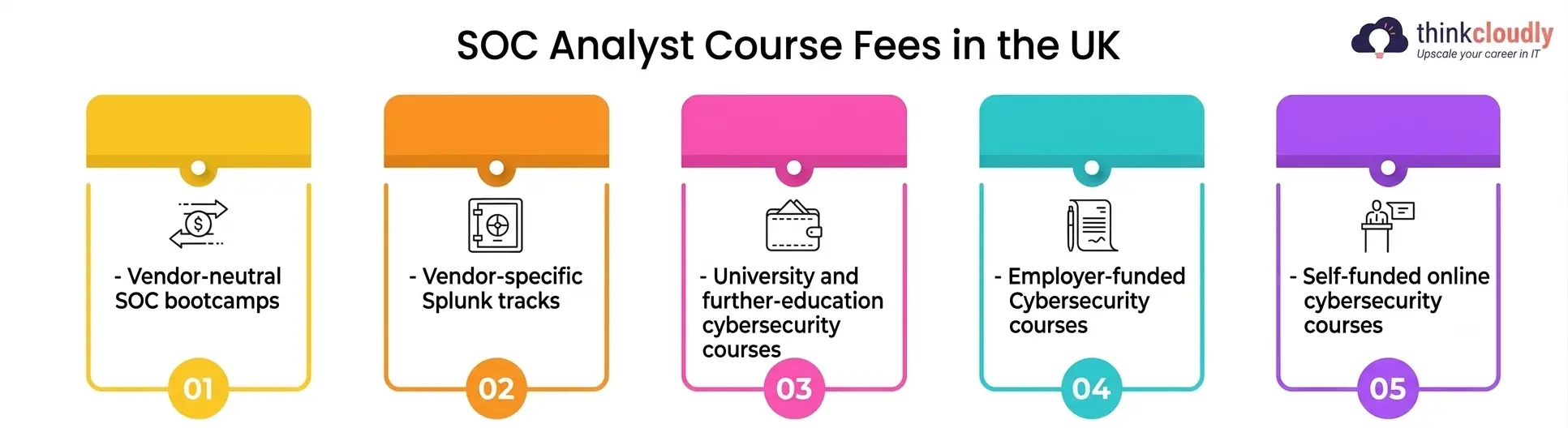
- Vendor-neutral SOC bootcamps (EC-Council CSA and similar) run from roughly £2,995 upward in the UK for a 3-day instructor-led format and are built around general security monitoring concepts rather than one specific SIEM product.
- Vendor-specific Splunk tracks sit a little higher, from around £3,335 for a 4-day Power User course, because the curriculum is denser and the lab environment is product-specific rather than generic.
- University and further-education cybersecurity courses that include a SOC or SIEM module as part of a wider degree or diploma tend to amortize the cost across a full term, making the per-module price harder to isolate but generally cheaper per contact hour than a standalone commercial bootcamp.
- Employer-funded cybersecurity courses remain the most common route for UK professionals already working in IT support or networking—many SOC teams will sponsor the Splunk exam fee and sometimes the full course once a candidate has shown initiative with the free material first.
- Self-funded online cybersecurity courses sitting in the £150–£400 range cover the same SPL and log analysis fundamentals as the expensive instructor-led option, just without live instructor time or a guaranteed retake.
The honest comparison isn’t “cheap versus expensive”—it’s whether the fee buys you supervised lab time and a certification guarantee or whether you’re confident enough in self-directed study to skip paying for both.
Is Splunk SOC Analyst Training Worth the Cost in the UK?
Set against a UK SOC analyst median salary of £55,000 and a year-over-year growth rate approaching 30%, even the higher end of the price range for this kind of training—upwards of £3,000 for a classroom course—pays for itself inside the first few months of a new role for most career-switchers. The calculation looks different depending on where you’re starting from, though.
Someone already working an IT helpdesk or junior networking role, with some exposure to log triage and basic security monitoring fundamentals, often gets a better return from the cheaper exam-only or self-paced route, since they’re filling a narrower knowledge gap.
Someone switching into security entirely from an unrelated field typically needs the structured, instructor-led version precisely because the hands-on lab hours and guided feedback shorten the time it takes to go from “familiar with the dashboard” to “able to run a shift.” Neither path is objectively wrong; the fee only becomes poor value when it doesn’t match how much structure the learner actually needs.
How to Lower Splunk SOC Training Costs Without Cutting Corners?
A few practical moves bring the total bill down without sacrificing the parts that actually matter to employers:
- Start with Splunk’s free fundamentals courses before paying for anything. If the material clicks quickly, you may only need to pay for the $130 exam rather than a full instructor-led package.
- Ask your current employer about sponsorship. Many UK SOC teams will cover the exam voucher fee for an internal candidate showing initiative, even without committing to a full paid bootcamp.
- Check for a certification guarantee before booking. A course that includes a free retake effectively insures you against the cost of a failed first attempt — worth more than it looks on the price sheet.
- Compare vendor-specific and vendor-neutral routes before committing. If your target employers are Microsoft-stack heavy rather than Splunk-heavy, a generic SOC analyst course may serve you better than paying a premium for Splunk-specific depth you won’t use.
- Don’t skip the lab hours to save money. A cheaper course with no hands-on triage practice time routinely costs more in the long run, because it takes longer to become genuinely job-ready and interview-tested.
Common Mistakes That Inflate Splunk SOC Analyst Training Fees
- The most expensive mistake isn’t picking the wrong provider — it’s paying full retake fees because the first exam attempt was rushed straight after finishing the course material, with no independent log analysis practice in between.
- A second, quieter mistake is booking a vendor-specific Splunk course before checking which SIEM your target employers actually run locally; paying a premium for deep Splunk certification only to apply mostly to Microsoft-shop employers wastes the price difference entirely.
- A third is assuming every UK provider’s quoted price includes the exam voucher — some do, some don’t, and the gap is easy to miss until the invoice arrives separately.
- A fourth is treating free and paid cybersecurity courses as interchangeable without checking the syllabus; some free material is genuinely equivalent to paid content, and some paid courses are thinner than the free alternative sitting one search result below it.
Final Thoughts
Splunk SOC analyst training in the UK isn’t priced the way it is by accident — it tracks a security monitoring job market that grew median SOC analyst pay by nearly 30% in a single year, and it reflects the real cost of running hands-on labs rather than slide decks.
The right fee for you depends on how much structure you genuinely need: a $130 exam and free self-study if you’re already close, a few thousand pounds of instructor-led time if you’re starting from further back. Either way, the money is better spent on genuine log analysis practice than on the most expensive certificate on the page.
A Personal Note
The part of this market that surprised me most isn’t the top-end bootcamp pricing — it’s how often a learner pays for the expensive option purely out of nerves, assuming a bigger invoice guarantees a better outcome. It doesn’t.
I’ve watched people pass the Splunk exam comfortably off nothing but the free fundamentals course and a few focused weekends of self-directed hands-on practice, and I’ve watched others fail a £3,000 instructor-led exam attempt because the course covered the theory well but left the actual SPL muscle memory thin.
If you’re budgeting for this in the UK right now, spend the first pound on figuring out honestly how much structure you need — not on whichever course happens to look the most serious on a brochure.