




I get asked some version of the same question almost every week now, usually by someone two or three years into a data role who has hit a plateau: “Which data engineer certification should I actually go get?” The honest answer isn’t one name, and it never has been.
It depends on which cloud your employer runs on, whether you’re trying to prove skills you already have or close a real gap, and how much your existing SQL programming comfort and hands-on ETL processes experience already overlap with what hiring managers in the USA, UK, and Canada are screening resumes for in 2027.
This guide walks through the certifications that are genuinely worth the exam fee right now, what each one tests in practice, and how a certification like this shows up—or quietly doesn’t—in your paycheck. Hiring budgets in all three countries tightened through 2026, which means fewer open requisitions but more scrutiny on each one, and a resume that signals verified skill tends to move faster through that narrower funnel than one that simply lists tool names.
What a Data Engineer Certification Actually Proves
A data engineer certification isn’t a substitute for experience, and no vendor pretends otherwise, whatever the marketing copy implies. What it does is give a recruiter or a hiring panel a standardized signal that you can design pipelines, enforce schema discipline, and keep production-scale data moving without someone standing over your shoulder.
That matters more than it sounds like it should, because most resumes list the same ten tools and the same vague bullet points. A passing score is one of the only things on a resume a hiring manager genuinely can’t argue with—either you cleared the exam under timed, proctored conditions, with real SQL programming and database management questions in front of you, or you didn’t.
What a certification does not prove is judgment under ambiguity: knowing when a slowly changing dimension table is the wrong call or when a nightly batch job should really be an event stream powered by proper ETL processes. That judgment comes from building things that break and fixing them yourself.
So the realistic framing is this—a data engineer certification gets your resume past the first filter and gives you a shared vocabulary in an interview. The project history behind it is what actually gets you hired.
The Top Data Engineer Certification Options in 2027
Here’s where most guides get vague, so let’s be specific about what’s active and worth sitting for right now, rather than programs that have quietly gone stale or retired.
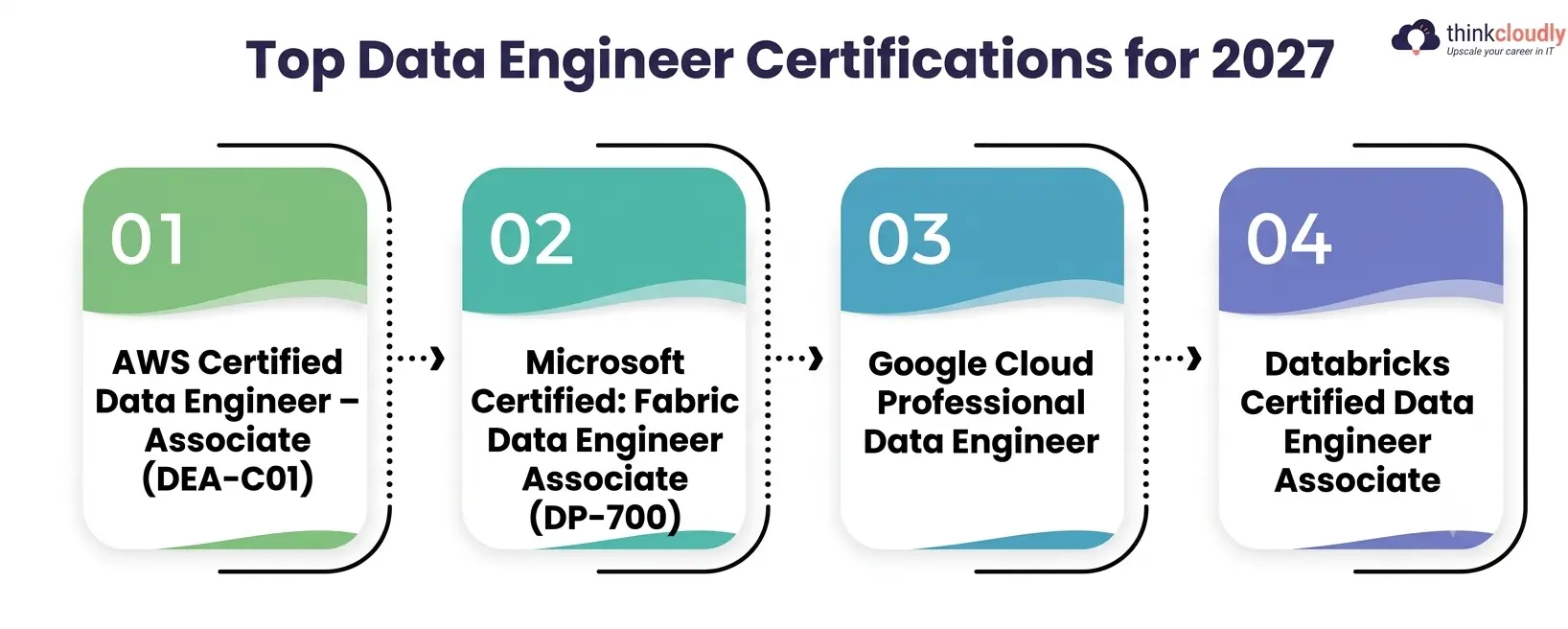
- AWS Certified Data Engineer – Associate (DEA-C01). AWS’s purpose-built credential for the role, replacing the older, more scattered AI and big-data exams it used to offer. It tests data ingestion, transformation, storage, and governance specifically, and it’s the most directly relevant AWS data engineering credential on the market if your stack already includes Glue, Redshift, Kinesis,or Lake Formation.
- Microsoft Certified: Fabric Data Engineer Associate (DP-700). Microsoft retired the long-running DP-203 exam in early 2025 and replaced it with this credential, which centers on building and governing pipelines inside Microsoft Fabric rather than the older, siloed Synapse-only approach. If your organization has moved to Fabric, this is now the current path.
- Google Cloud Professional Data Engineer. Built entirely around Google Cloud services such as BigQuery, Dataflow, and Dataproc, it leans harder on end-to-end system design than the AWS or Microsoft exams do.
- Databricks Certified Data Engineer Associate. Worth naming separately because it’s the one credential built specifically around Apache Spark and the lakehouse pattern, rather than treating Spark as a side topic buried inside a broader cloud exam.
Notice that three of these four map to a specific cloud platform, and the fourth maps to a specific processing engine. There’s no single universal certification the way there’s one CPA exam for accountants—you’re choosing based on what your current or target employer actually runs in production, not based on which badge looks most impressive on a LinkedIn banner.
How the Four Leading Programs Compare
|
Detail |
AWS DEA-C01 | Microsoft DP-700 | Google Cloud PDE |
Databricks DE Associate |
|
Duration |
130 minutes | 100 minutes | 120 minutes |
90 minutes |
|
Approx. questions |
65 | 40–60 | 40–50 |
45 |
|
Cost (USD) |
$150 | $165 | $200 |
$200 |
|
Validity |
3 years | 1 year (renewal) | 2 years |
2 years |
|
Heaviest focus |
Ingestion & transformation | Pipeline implementation | System design |
Spark & Lakehouse |
The gap in validity periods is easy to overlook and worth planning around before you commit. A three-year AWS certification and a one-year Microsoft renewal cycle cost very different amounts of ongoing study time, even when the upfront effort looks similar on paper, so budget for the long game and not just the first exam day. Retake fees add up too—most of these vendors charge the full exam price again on a failed attempt, so a single thorough study pass is cheaper than two rushed ones.
The Skills Every Data Engineer Certification Expects You to Already Have
No exam guide hands you these skills from zero. Every credential above assumes a working baseline, and this is where most candidates either breeze through or get genuinely blindsided on test day:
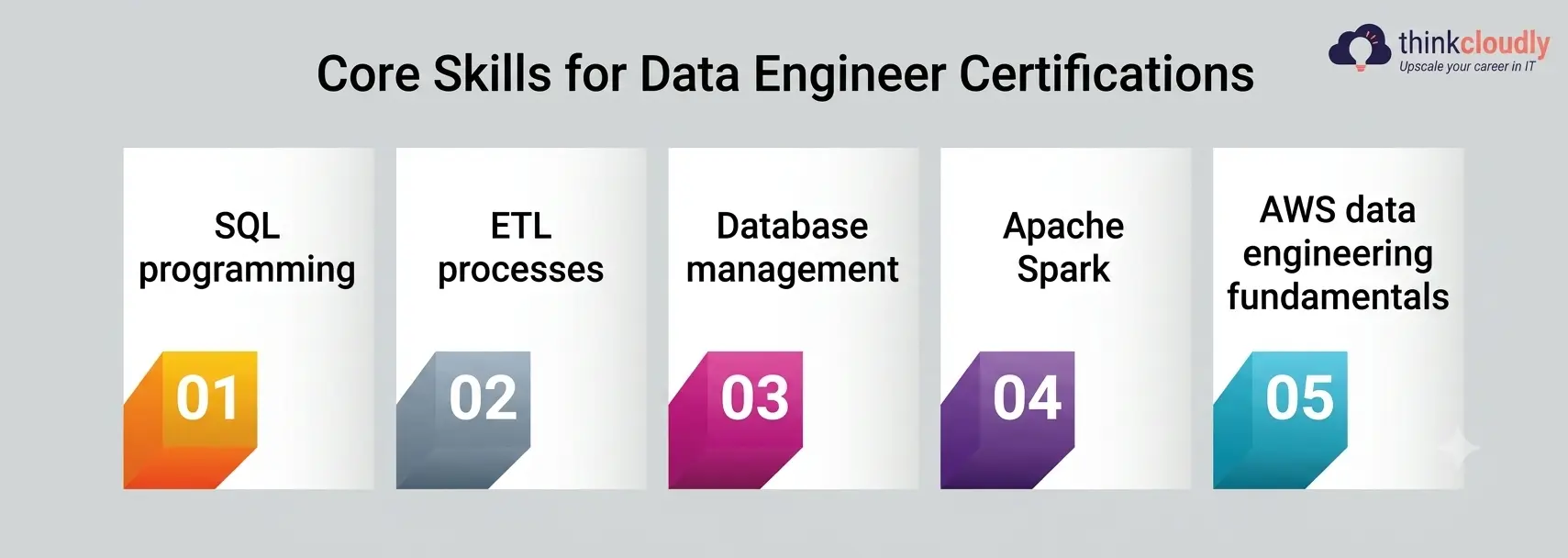
- SQL programming. Every exam leans on solid query-writing ability for joins, window functions, and execution-plan reasoning. If your skills here are rusty, no amount of cloud-service trivia will save you when a scenario question drops a thirty-line query in front of you.
- ETL processes. Understanding how that differs from an ELT approach, when to transform data in-flight versus at rest, and how to handle late-arriving or malformed records is tested directly, not treated as a footnote on any of these exams.
- Database management. Indexing strategy, normalization trade-offs, partitioning, and replication show up constantly, especially on the Google Cloud and AWS exams.
- Apache Spark. Whether you’re sitting the Databricks exam or one of the cloud-specific ones, concepts like lazy evaluation, shuffles, and partition skew come up repeatedly, because nearly every modern platform now runs distributed processing on or alongside it.
- AWS data engineering fundamentals, specifically for the AWS path: IAM scoping, S3 storage-class selection, and event-driven triggers through Lambda are baseline expectations, not advanced topics, on the DEA-C01 exam.
If you can’t comfortably explain that ingestion-to-storage pipeline to a junior teammate, or you’d hesitate writing a window function cold, that’s your actual study gap—not the vendor-specific service names, which are genuinely the easy part to memorize later. Most of the free official sample questions from each vendor will tell you within an hour which category you fall into, so there’s no need to guess before you commit to a study plan.
What a Data Engineer Certification Is Actually Worth in USA, UK, and Canada Salaries
This is the part most certification marketing dances around, so here are real, current numbers rather than vague promises. According to Robert Half’s 2027 salary benchmarks, the national U.S. range for a data engineer sits between $130,500 and $185,500, with a $160,500 midpoint. Robert Half’s parallel UK figures put the range at £57,500 to £79,500, with a £67,000 median, and its Canadian benchmark lists CAD $120,250 to $169,000, with a $146,250 midpoint.
None of those figures are broken out by specific credential, and that’s an honest gap worth naming rather than papering over with marketing language. What a certification reliably does is move a candidate toward the upper half of that band faster, because it shortens the interview process and lowers a hiring manager’s perceived risk.
A candidate who already holds a recognized credential, speaks fluently about real ETL process decisions, and can defend their database management choices under follow-up questions typically skips an entire technical screening round—and in a tight hiring cycle, that time saved matters more to the offer than the certificate itself ever does.
Choosing the Right Path: AWS, Microsoft, Google, or Databricks
Pick based on where you already work or where you’re realistically trying to land, not based on which exam has the flashiest prep course. If your target companies run on AWS—and a large share of mid-size and enterprise U.S. employers still do—the AWS data engineering credential is the more defensible choice, because it maps directly to tools you’ll touch in week one of a new role.
If you’re in a Microsoft-heavy market, particularly in the UK, where Azure and Microsoft 365 integration run deep across financial services and public-sector contracting, the Fabric Data Engineer Associate path is more relevant now than it was even a year ago.
Google Cloud’s Professional Data Engineer tends to suit analytics-heavy and media or ad-tech employers where BigQuery is the default warehouse and strong database management instincts matter as much as pipeline design.
If you genuinely don’t know which cloud you’ll land on next, start with the Databricks exam instead. Apache Spark skills transfer cleanly across all three major clouds, and that portability is worth more early in a job search than platform-specific trivia you might not even use for another year.
This matters particularly in Canada, where Toronto and Vancouver tech hubs regularly post roles spanning two or three cloud providers inside the same mid-size company, and a single-cloud credential can leave real gaps on a resume that a processing-engine-focused one wouldn’t.
A Realistic Study Roadmap and the Mistakes That Waste Your Time
A sensible plan runs six to eight weeks for someone studying part-time around a full-time job. Spend the first two weeks shoring up SQL programming and core database management concepts if either feels shaky—skipping this step is the single most common reason candidates fail on a second attempt.
Spend the middle stretch building one real pipeline end to end on your target platform, covering ingestion, an actual transformation workflow, and storage decisions, rather than only watching video lectures passively. If your path runs through Apache Spark, write real jobs against a real dataset instead of copying notebook examples line for line. Save the final week for timed practice exams, and trace every wrong answer back to a specific weak domain instead of just re-reading old notes.
The mistake I see most often is treating a data engineer certification like a vocabulary test. Candidates memorize service names and exam-dump questions, pass narrowly, and then can’t answer a basic follow-up question about their own “project” in an interview because there was never a real project behind it.
Exam dumps also violate every major vendor’s certification agreement, including AWS data engineering credentials specifically, and can get a result invalidated after the fact — a bigger risk than it sounds like for the few dollars it supposedly saves.
A Personal Note
I’ll be straightforward about something most certification guides gloss over: I don’t think everyone reading this needs a new credential right now. I’ve watched engineers with three solid years of production pipeline work sit an associate-level exam and get almost nothing from it professionally, because their resume already told that story clearly enough on its own without a badge attached.
I’ve also watched a self-taught analyst with no formal data engineering title use a single cloud certification as the exact lever that got her first real interview, because nothing else on her resume signaled that she could be trusted with a production warehouse.
The credential matters most when it’s closing a real, specific gap between what you can actually do and what your resume currently proves — not when it’s just another line competing for attention on an already-strong one.
Know honestly which situation you’re in before you pay the exam fee, because the fee is the cheap part; the study hours are the real cost. If you’re on the fence, ask a manager or senior colleague to look at your resume and tell you, specifically, what’s missing from it — their answer will tell you more than any exam-prep sales page will.