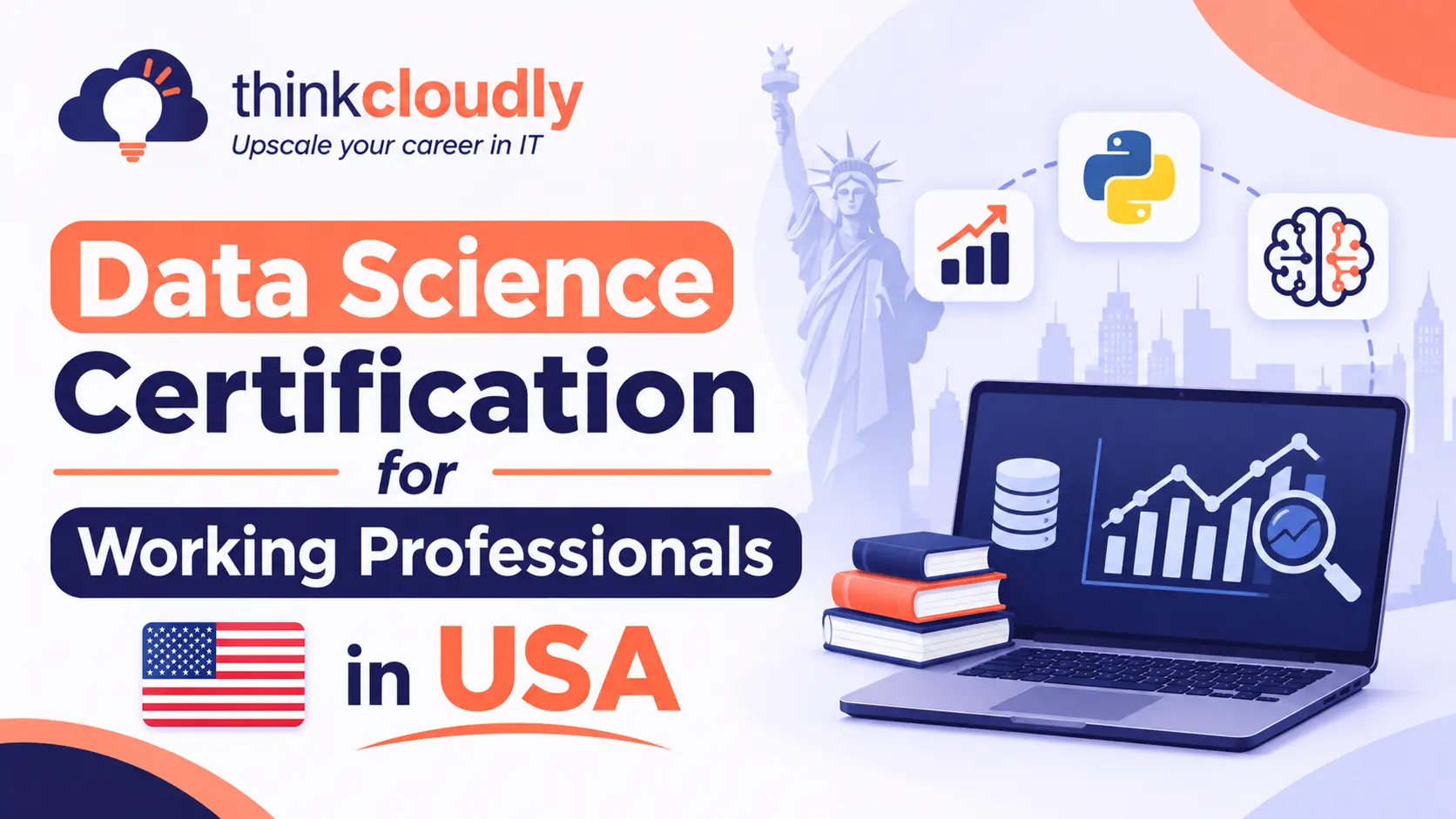





A Tuesday night, a laptop balanced on a kitchen table, and a half-finished online module—that’s what pursuing a data science certification actually looks like for most working adults in the USA right now. Nobody is quitting their job to sit in a classroom for a year; they’re squeezing coursework between meetings, commutes, and whatever energy is left after dinner, because the math on staying still has stopped making sense.
I talk to professionals every month who are mid-career, reasonably comfortable, and quietly worried that their current skill set has a shelf life—marketing managers now expected to defend a campaign with numbers instead of instinct, finance analysts watching entry-level forecasting shift to automated models, and operations leads who keep hearing “can you pull that from the data” and realizing they can’t without asking someone else first. A structured certification has become the practical answer to that unease—not because a certificate alone changes a resume, but because what you earn one forces you to actually learn.
This guide skips the sales pitch. It walks through what this kind of program really teaches, how the leading 2027 options compare, what it costs working adults in time and money, and where the payoff actually shows up in a paycheck.
Why Are Working Professionals Choosing a Data Science Certification in 2027?
The reasons rarely show up as one big dramatic moment. They build quietly, then tip over into action. Here’s what professionals consistently describe when they explain the decision:
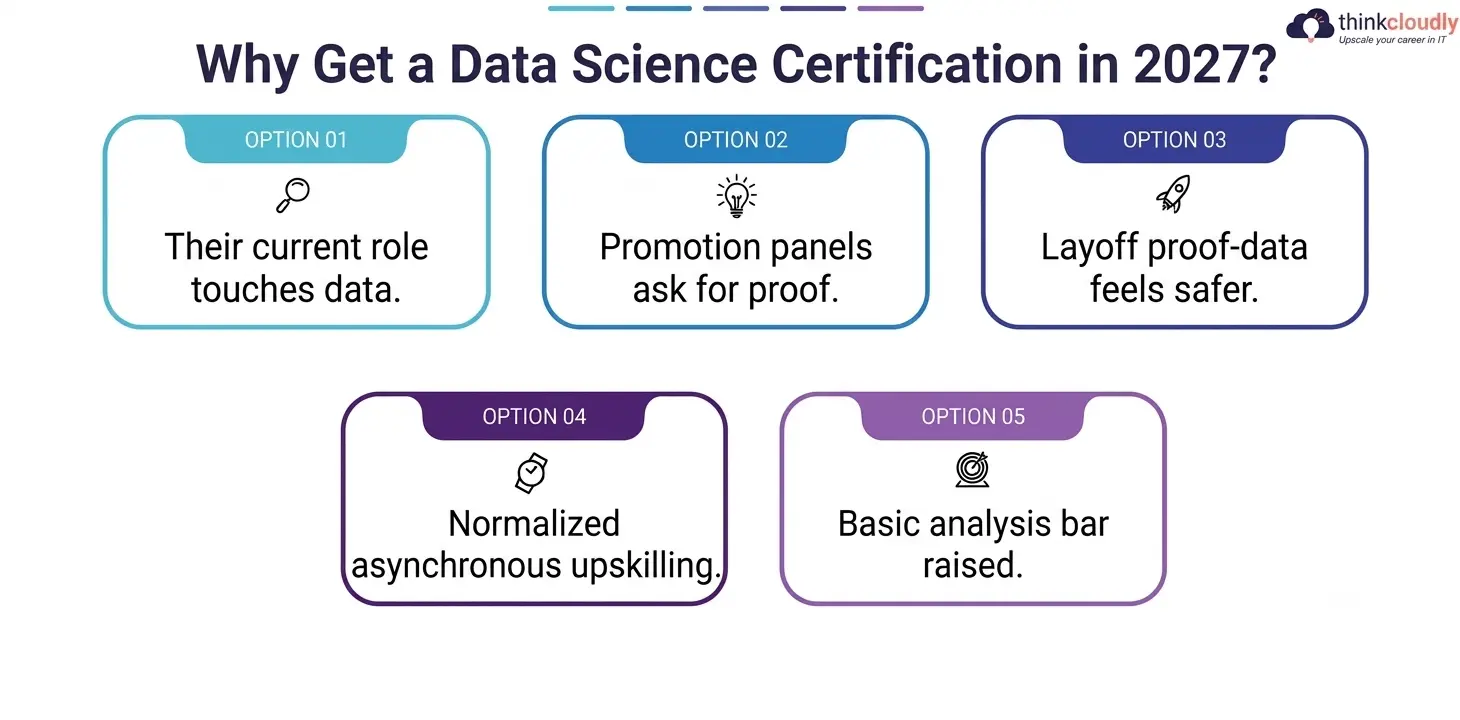
- Their current role already touches data, just informally. They’re pulling numbers into spreadsheets by hand and know a trained person could do it faster and better.
- Promotion panels increasingly ask for proof, not potential. A completed credential gives hiring managers something concrete to point to internally.
- Layoff cycles have made “data-adjacent” feel safer than “data-adjacent and unable to prove it.” Roles that touch forecasting, reporting, and measurement have held up better through recent workforce reductions.
- Remote and hybrid work normalized asynchronous upskilling. Nobody questions a colleague studying during a commute anymore; it’s just how careers move now.
- AI tools raised the bar for what “basic analysis” means. Knowing how to prompt a model is not the same as knowing whether its output is statistically sound, and employers have started noticing the difference.
None of that is hype—it’s an ordinary response to a job market that rewards people who can show their work in numbers, not just talk about outcomes.
What a Data Science Certification Teaches You?
Strip away the marketing language from any program’s landing page, and most legitimate certification tracks converge on the same handful of competencies. The packaging differs; the substance doesn’t move much.
Statistical analysis sits at the foundation of nearly every reputable program, and for good reason: it separates describing a trend from knowing whether that trend is real or just noise. A working professional who can run the numbers correctly stops making decisions based on a chart that looks convincing but means nothing once you check the sample size.
SQL queries come next, and this is the part that surprises people who assumed data science meant exotic machine learning work from day one. In practice, most working data professionals spend far more hours writing SQL queries against a production database than they spend tuning a model.
Structured-data skills like this remain among the most requested technical skills in U.S. job postings outside pure engineering roles. If a program doesn’t make you write real queries against messy, realistic tables, it’s skipping the part of the job you’ll actually do five days a week.
Predictive modeling is where the discipline starts to feel like what people picture when they hear “data science.” Building a predictive modeling workflow—cleaning data, selecting features, training a model, and checking whether it generalizes—teaches judgment no amount of reading about algorithms replaces. A working professional who has built even one real version of that kind of project stops being intimidated by the phrase and starts asking the right follow-up questions in meetings.
Data visualization closes the loop between analysis and decision-making, and it’s chronically underrated by people choosing a program. A sharp model with a confusing chart convinces nobody. Strong data visualization habits—knowing when a line chart lies and a bar chart tells the truth—are often what actually get a recommendation approved in a room full of non-technical stakeholders.
Programming skills, usually in Python or R, tie all of the above together. You don’t need to become a software engineer, just enough of that fluency to automate the parts of your job that eat an afternoon every week.
Most 2027 programs built for working adults have trimmed that content down to exactly what’s needed for real analysis work, rather than a full computer science curriculum nobody asked for. Data interpretation is the skill employers mention least often by name and reward most consistently in practice—running the numbers is only half the job; data interpretation is what turns an output into a decision someone acts on.
A professional with sharp data interpretation instincts catches a flawed assumption before a report reaches a VP’s inbox—that instinct separates a certificate holder from someone who treats the credential as decoration.
Comparing the Leading Data Science Certification Options for 2027
Programs vary widely in pace, cost, and assumed background. Here’s a side-by-side look at where the major current options sit for a working adult weighing one of these programs against schedule and budget.
|
Certification Path |
Typical Duration | Format | Best Fit For |
Approx. Cost (2027) |
|
IBM Data Science Professional Certificate |
3–6 months, self-paced | Fully online, project-based | Career switchers with no coding background |
~$49/month subscription |
|
Google Advanced Data Analytics Certificate |
3–6 months, self-paced | Fully online, applied projects | Professionals wanting a structured, guided path |
~$49/month subscription |
|
Microsoft Certified: Azure Data Scientist Associate |
2–4 months prep | Self-paced plus proctored exam | Professionals already in a Microsoft-based workplace |
~$165 exam fee |
|
University-affiliated professional certificates (e.g., MIT, Cornell) |
4–9 months | Cohort-based, instructor-led | Senior professionals wanting brand recognition |
1,500–4,500 |
|
Data analytics bootcamp certificates |
12–24 weeks, intensive | Live, cohort-based | People able to commit significant weekly hours |
3,000–9,000 |
A few patterns stand out immediately. Self-paced subscription programs cost the least and fit around an existing job the most easily, which is exactly why they dominate among people balancing full-time work with study. University-branded and bootcamp options cost more and demand more structured time, but they carry weight in rooms where a brand name still opens doors faster than a credential nobody on the hiring panel recognizes.
The self-paced, project-based model is the fastest-growing category among adult learners specifically because it respects an already-full calendar, a pattern IBM’s own certificate page confirms among professionals picking the subscription route.
Core Skills Employers Actually Expect From a Certified Candidate
Job postings rarely list every skill a data science certification is supposed to build, but recruiters consistently probe for the same handful in interviews. Check a program against this list before you check its syllabus:
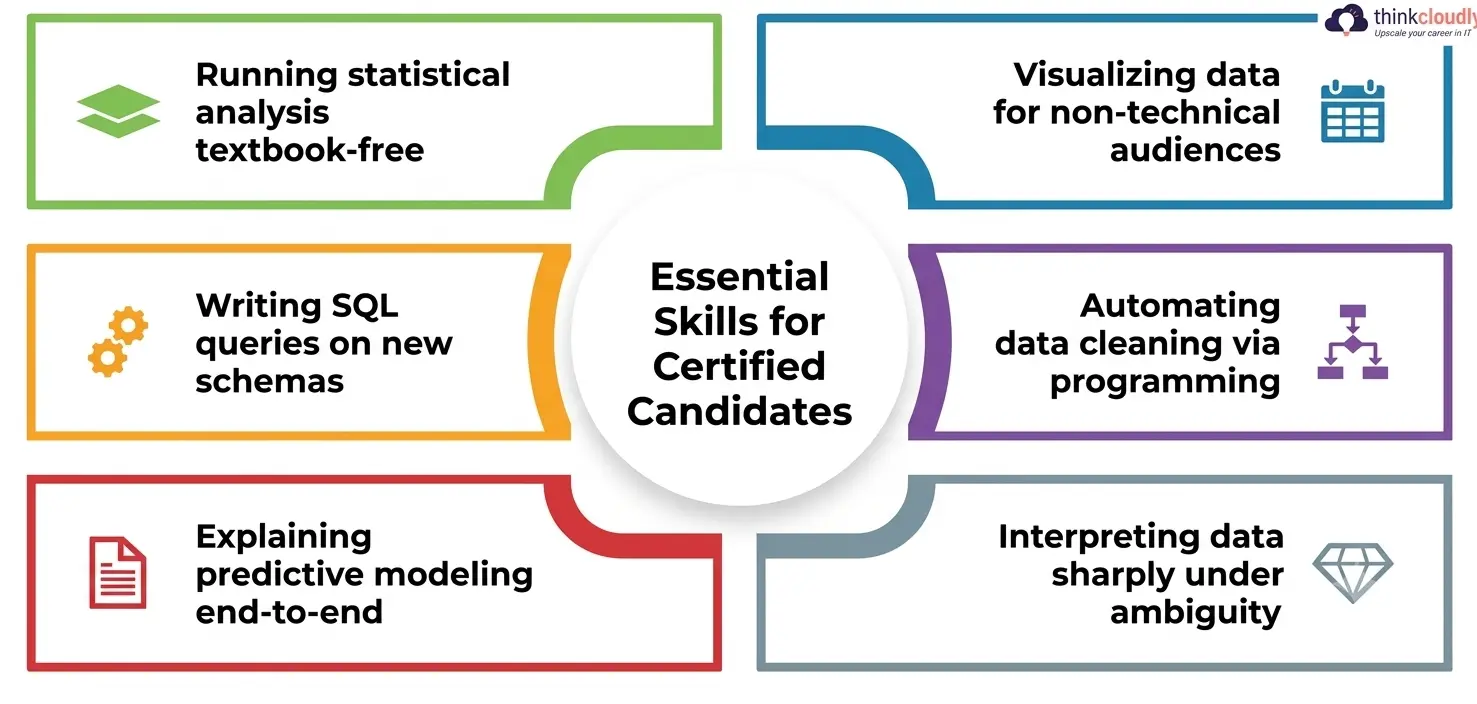
- Comfort running statistical analysis without a textbook open beside you. Interviewers often ask candidates to walk through a hypothesis test out loud, not just define one.
- Confidence writing SQL queries against a schema you’ve never seen before. Most technical screens hand you an unfamiliar database and a time limit, not a clean dataset.
- A working predictive modeling project you can explain end-to-end. “I took a course” lands far weaker than “here’s a model I built, and here’s where it broke.”
- Strong data visualization instincts for non-technical audiences. Being able to simplify a chart for a director is a distinct skill from being able to build one in the first place.
- Enough programming skills to clean and reshape data without manual spreadsheet work. This alone saves teams hours every week, and hiring managers know it.
- Sharp data interpretation under ambiguity. Real business questions rarely come with clean, well-labeled data, and employers notice who can still reason through that mess.
Programs built toward this list tend to produce graduates who interview well; programs that stop at theory produce ones who can define a term but struggle with a messy spreadsheet.
How to Choose the Right Data Science Certification While Working Full-Time?
Fit matters more than prestige for someone already juggling a job, and the wrong fit is usually why people abandon a program around week six. A few things worth checking before enrolling:
Start with your actual weekly bandwidth, not your aspirational version of it. A program advertised as “10 hours a week” that really takes 15 will quietly derail around month two, right when motivation dips and work gets busy again.
Check whether the program builds a portfolio you can actually show someone, not just a certificate PDF. A program that ends in three or four real projects—a cleaned dataset, a predictive modeling notebook, and a dashboard—gives you something to link in an interview. A credential with no artifacts attached is a much harder sell to a skeptical hiring manager.
Confirm the program teaches tools your target employers actually use—if every posting in your market mentions SQL and Python, a program built around a proprietary tool you’ll never touch again is a mismatch.
Look for honest prerequisites rather than “beginner-friendly” marketing that hides a steep first month. According to the National Center for Education Statistics’ adult learner survey, working adults returning to structured learning cite unclear workload expectations as one of the most common reasons for dropping a program early, so a syllabus that spells out week one in detail is doing you a favor.
What the Investment Returns: Salary and Career Signals in 2027?
The honest answer is that a data science certification rarely rewrites a salary on its own. What it reliably does is move a candidate into a different conversation — one where forecasting, reporting, and measurement work is assumed rather than questioned.
According to surveys, data scientist roles carried a median annual wage of $112,590 as of the most recent published data, with the field projected to grow much faster than the average for all occupations through the decade — a projection that matters more than the headline number, since it signals sustained demand rather than a short-lived hiring spike.
For working professionals moving laterally rather than switching careers entirely — a marketing analyst adding real statistical analysis and sharper data visualization to their toolkit, say, or an operations manager who can now build a predictive modeling forecast instead of requesting one from another team — the more common outcome isn’t a brand-new job title. It’s a widened scope inside the role they already hold, often followed by a title change and raise within twelve to eighteen months once the new skills show up consistently in actual deliverables.
Common Mistakes Working Professionals Make Along the Way
A handful of patterns show up repeatedly among people who stall out partway through one of these programs, and none of them are about intelligence or effort.
Treating every module as equally important wastes real time. Some sections exist mainly to build intuition, others mainly to pad the curriculum, and skimming confidently through the weaker ones is a better use of limited hours than grinding through them at the pace of what actually matters for interviews.
Skipping SQL queries practice because it feels less exciting than modeling is one of the most common and costly shortcuts — employers test this constantly precisely because it’s unglamorous and easy to neglect.
Never finishing a project end to end is another frequent trap — half-built notebooks full of promising starts don’t help in an interview, and one finished project, however modest, beats five abandoned ones.
Ignoring data interpretation until the final weeks of a program is a mistake that catches up with people during technical interviews, where the real test usually isn’t “can you run the model” but “can you explain what it means and whether you’d actually trust it.” Underinvesting in data visualization until the last possible moment is a related gap — a technically sound forecast presented through a confusing chart still fails to persuade anyone in the room.
A Personal Note
I’ve watched a lot of working adults start a data science certification at eleven at night out of pure frustration with being the only person in a meeting who couldn’t answer a numbers question directly.
Most don’t finish because they suddenly fall in love with statistics — they finish because somewhere around week four or five, they build one small thing, a query that actually answers a real question, a chart that makes a point they’d been struggling to explain for months, and that tiny win is what keeps them going.
If you’re on the fence, don’t wait for the motivation to feel permanent before you start — it won’t. Start with one real project you actually care about, let that pull you through the boring parts, and the certificate will end up being the least interesting part of what you walk away with.