




I get a version of the same message from developers in Toronto, Vancouver, and Calgary every few weeks: “I can write code, I understand APIs, but every posting now wants AI skills—do I actually need a machine learning certification, or is this just another resume line nobody checks?”
After watching this market shift for two years, I don’t think the answer is a simple yes. A certification won’t turn a backend developer into a research scientist overnight. What it does is give a hiring manager a fast, standardized way to confirm you can do what your resume claims—and in a market where AI-skill job postings in Canada passed six figures in a single year, that shortcut matters more than it used to.
This guide covers what a machine learning certification actually tests in 2027, which options are worth a Canadian developer’s time, and where skills like TensorFlow, predictive analytics, and model deployment techniques fit into a credential landscape that changed more in the last eighteen months than in the five years before it.
Why Are Canadian Developers Looking at Machine Learning Certification Right Now?
Canada’s tech sector isn’t shrinking, and the roles growing fastest inside it aren’t generic software jobs anymore. According to CompTIA’s State of the Tech Workforce Canada report, net tech employment is projected to reach roughly 1.54 million workers in 2026, and data science — the category closest to applied AI work — grew 150% between 2020 and 2025, faster than any other tracked occupation. Job postings explicitly requiring AI skills passed 111,000 in a single year, concentrated heavily in Ontario, home to nearly half the country’s tech workforce.
That growth is exactly why a certification in this space has become a practical signal rather than a vanity credential. A developer who already ships production code has most of the raw material a model-focused role needs—version control habits, testing discipline, deployment pipelines—but a hiring manager scanning hundreds of resumes doesn’t have time to infer that someone can also handle feature engineering or monitor a model after launch. A certification compresses that proof into one line a recruiter can trust without a lengthy technical screen.
It also matters that this isn’t a one-vendor market. Canadian employers hire across AWS, Google Cloud, and Microsoft Azure in roughly equal measure, so choosing a credential means thinking about an employer’s stack before opening a study guide.
Geography shapes this too, more than developers outside the country usually realize. Toronto and the surrounding Waterloo corridor hold the largest concentration of AI-focused roles, partly because of the sheer density of tech employers headquartered there.
Montreal carries its own weight through Mila, one of the world’s larger academic AI research clusters, which has pulled a steady stream of applied research jobs into the city alongside the startups spun out of it.
Vancouver and Calgary trail those two in raw volume but are catching up as remote-friendly hiring policies let companies based in Ontario or Quebec recruit developers anywhere in the country. A developer deciding where to focus their study time should weigh their own city’s hiring base alongside the vendor their current or target employer already runs on.
What are machine learning certification tests?
Every major exam on the market is built around the same rough arc, even where names and vendors differ: prepare the data, choose and train a model, deploy it, then keep it healthy in production. A few themes recur across almost all of them.
Data science fundamentals sit underneath nearly every domain—cleaning data, engineering features, and recognizing when a dataset is biased enough to compromise a model before training even starts. Predictive analytics shows up next, since most exam scenarios revolve around forecasting an outcome, whether that’s churn, fraud, or demand.
Algorithm development is tested conceptually more than mathematically on associate-level exams—you’re rarely asked to derive anything by hand, but you are expected to know which algorithm family fits which problem shape and why. Deployment weighs heavily too: model deployment techniques like containerizing, versioning, and safely rolling back a release now carry real exam marks, not just theory.
Framework skills are assessed differently than they once were. TensorFlow used to have its own standalone credential, but that program closed to new registrations in 2024 with no direct successor announced since. Framework fluency now gets validated indirectly, inside broader platform exams, rather than through a framework-only test.
5 Machine Learning Certification Options Worth a Developer’s Time
Here’s how the field actually breaks down for someone deciding where to spend study hours:
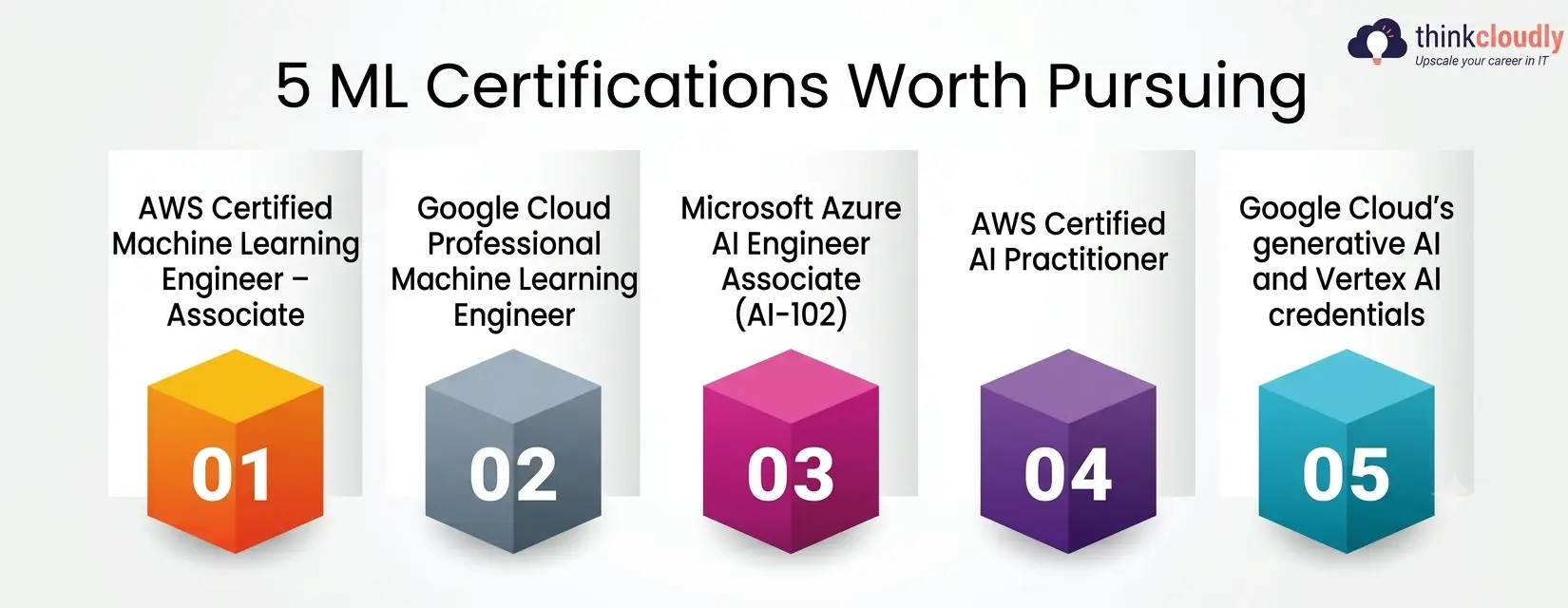
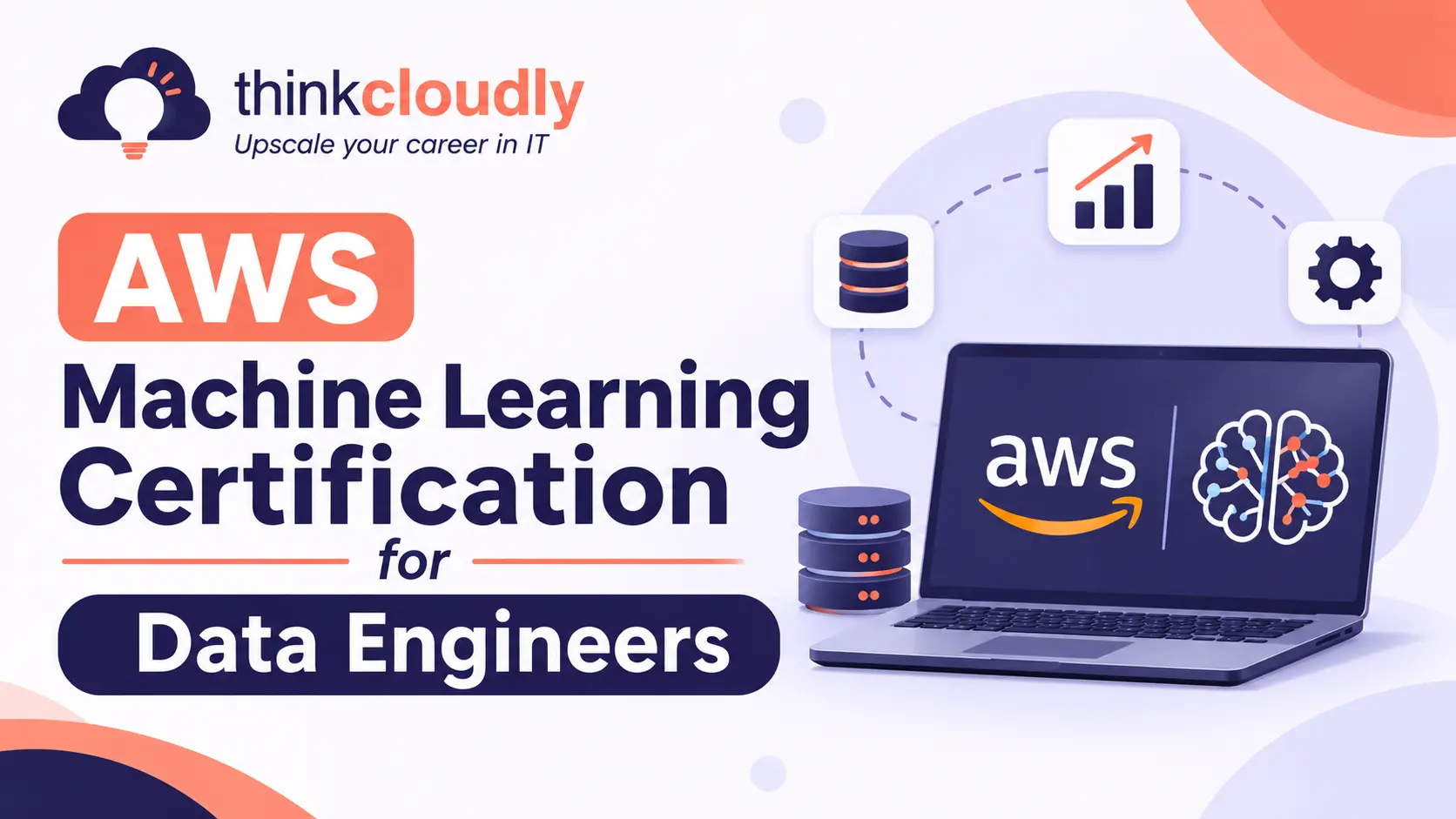
- AWS Certified Machine Learning Engineer – Associate. Built for candidates with roughly a year of hands-on SageMaker experience, this exam weights data preparation above model development, deployment, and monitoring. It rewards developers who already practice algorithm development informally through SQL and pipeline work.
- Google Cloud Professional Machine Learning Engineer. This one leans into the full model lifecycle—framing problems, training deep learning models, and operationalizing them on Vertex AI. It’s a common pick for developers at companies running analytics on Google Cloud’s platform.
- Microsoft Azure AI Engineer Associate (AI-102). Focused more on applied AI services than from-scratch model building—vision, language, and conversational AI on Azure’s cognitive services—making it practical for developers integrating pre-built models rather than training everything themselves.
- AWS Certified AI Practitioner. A lighter, foundational option for conceptual fluency without the full hands-on build requirement, useful if an associate-level exam still feels like a stretch.
- Google Cloud’s generative AI and Vertex AI credentials. Newer, narrower options for developers whose work leans toward large language model integration rather than traditional predictive analytics.
None of these require a computer science degree or years in a dedicated research role. Everyone assumes a working developer, not a PhD, is the typical candidate.
Core Skills a Certification Path Actually Builds
It’s worth separating marketing language from what these exams genuinely teach, because the overlap with everyday development work is bigger than most developers assume.
Algorithm development, in exam terms, mostly means pattern recognition—knowing a classification problem calls for a different family than a regression problem and understanding accuracy-versus-interpretability trade-offs well enough to defend a choice out loud. You’re not inventing new methods; you’re picking the right tool from an established toolbox.
Predictive analytics is the practical output; most of these credentials are really training someone to deliver. Whether the scenario is churn, demand forecasting, or fraud detection, the underlying skill—turning historical data into a model that estimates a future outcome—is the same one a Canadian employer is paying for across finance, retail, and logistics alike.
Model deployment techniques are where developers often have a genuine head start over academically trained data scientists. Anyone who has containerized an app or managed a rollback strategy already understands the mechanics of shipping something safely. What’s newer is the monitoring layer: watching for drift and retraining triggers once a model is running against live traffic rather than a clean training set.
Data science habits round things out—version-controlling datasets, documenting assumptions about data quality, and treating a strong accuracy score with healthy skepticism rather than taking it at face value.
How do the Major Certifications Compare?
|
Certification |
Primary Vendor | Typical Prep Time | Best Fit For |
Core Focus |
|
ML Engineer – Associate |
AWS | 6–10 weeks | Developers on AWS infrastructure |
Data prep, SageMaker, production rollout |
|
Professional ML Engineer |
Google Cloud | 8–12 weeks | Developers building full pipelines |
Vertex AI, deep learning, forecasting workflows |
|
AI Engineer Associate (AI-102) |
Microsoft Azure | 5–8 weeks | Developers integrating pre-built AI services |
Cognitive services, applied AI |
|
AI Practitioner |
AWS | 3–5 weeks | Developers wanting a foundational entry point |
Conceptual fluency, generative AI basics |
|
Generative AI / Vertex AI credentials |
Google Cloud | 4–6 weeks | Developers working on LLM integration |
Model tuning, deployment workflows |
Prep time varies with existing experience, but this is a reasonable baseline for budgeting study hours around a full-time job rather than a student schedule.
6 Steps to Prepare While Working Full-Time
Studying for an exam while holding down a development job needs a plan that respects limited hours, not an open-ended “study whenever” approach:
- Match the certification to your employer’s cloud stack first. Choosing AWS, Google Cloud, or Azure based on what you use at work beats choosing based on which exam looks more impressive on paper.
- Spend the first two weeks on data fundamentals. Data science groundwork carries the heaviest weight on nearly every exam, so front-load it rather than saving it for later.
- Train one real model end to end before touching practice questions. Reading about algorithm development isn’t the same as watching a model underperform and figuring out why.
- Build a small deployment pipeline, even a toy one. Practicing model deployment techniques turns an abstract exam domain into muscle memory.
- Take one full timed practice exam and trace every miss to a domain. This is where most candidates discover they’re strong on forecasting-style questions but weak on monitoring, or the reverse.
- Review the vendor’s current exam guide in the final week. Published guides change year to year, so close gaps against the current version, not an outdated study blog.
A developer working this plan part-time usually needs six to ten weeks, depending on the exam chosen and existing cloud experience.
Where TensorFlow Actually Fits?
TensorFlow deserves its own note because so many developers still search for a standalone credential that no longer exists in its original form. Its dedicated Developer Certificate program stopped accepting registrations in 2024, and nothing has directly replaced it.
For a Canadian developer planning a certification path today, that means the framework isn’t something you certify in on its own — it’s something you demonstrate inside a broader exam.
Google Cloud’s Professional Machine Learning Engineer path still expects comfort building models in that framework on Vertex AI, so developers who already know it have a real head start there. Other exams test concepts that apply whether someone works in that ecosystem, PyTorch, or scikit-learn, rather than framework-specific syntax.
The practical takeaway: keep building with the tools your team already uses, but don’t go looking for a framework-only exam to add to a resume — that door closed, and a broader credential now covers the same ground.
What This Means for Salary and Hiring in Canada?
The financial case for getting certified varies by city and seniority, but the direction is consistent. Toronto-specific compensation data compiled by CareerCheck’s salary research puts junior machine learning engineers in the CAD 90,000–115,000 range, mid-level roles between $130,000 and $175,000, and senior roles climbing toward $220,000 in base salary alone, with total compensation at firms like Cohere and the major cloud research labs reaching well beyond that at the staff level.
No certifying body credits a certification directly for those numbers — the data points to skills like large language model fine-tuning and MLOps fluency instead, the same skills a solid machine learning certification is designed to build and prove.
What it does is get a resume past the initial screen so those underlying data science and deployment skills get evaluated at all, in a hiring climate where six in ten tech managers report offering above their planned range just to secure candidates with the right background.
For developers outside Toronto, the math shifts but the pattern holds. Ontario still carries the largest share of the country’s tech workforce, but Vancouver, Calgary, and Montreal hire for the same roles, usually at ranges adjusted for local cost of living rather than a different skill bar.
A Personal Note
I’ll be direct about something most certification guides dance around: I don’t think a credential is the thing that gets anyone hired. I think it’s the thing that gets an application read instead of skipped, which is a smaller claim but a more honest one.
I’ve watched developers pass an exam after two weeks of cramming and then struggle the moment a real dataset showed up messier than any practice question ever was. I’ve also watched developers spend a quiet month building something small and ugly and working before they opened a study guide at all, and they walked into the exam treating it as a formality because the real learning had already happened.
If you’re choosing between more practice questions and one more weekend training something end to end, pick the second option every time. The certificate proves you showed up. The project proves you can think. So connent with Thinkcloudly today.