




I get the same message almost every week from someone starting out: “I know Python, I’ve taken a machine learning course, so why can’t I land an interview?” The gap almost always comes down to the same thing—they learned to build models, not to run them.
That operational half of the job is exactly what an MLOps engineer roadmap is supposed to teach, and it’s also the half most beginner courses skip entirely. This guide walks through that roadmap from zero, using what’s actually working for people breaking into MLOps roles in the United States right now, not a theoretical checklist copied from a job posting.
What Does an MLOps Engineer Do?
Before chasing tools and certifications, it helps to know what the job is in plain terms. An MLOps engineer sits at the intersection of software engineering, data infrastructure, and machine learning, and the day-to-day work usually breaks down into a short list:
- Building and maintaining data pipelines that feed clean, consistent data into training and inference
- Automating training runs so models can be retrained without a human babysitting every step
- Packaging and shipping models through model deployment pipelines that behave like real software releases
- Setting up model monitoring so a team knows the moment a model’s predictions start drifting
- Managing the infrastructure, often on Kubernetes, that keeps all of the above running reliably at scale
- Documenting model versions, datasets, and approvals so every production model can be traced back to its origin
None of this requires a PhD. It requires comfort with code, patience for infrastructure, and a willingness to learn how machine learning systems fail in production—which is different from how they fail in a notebook.
Why Beginners Are Choosing This MLOps Engineer Roadmap in 2027?
The timing isn’t accidental. According to Gartner’s latest IT spending forecast, worldwide IT spending is projected to grow 15% in 2027 to $7.35 trillion, with AI-related spending accounting for a growing share of that total. Companies aren’t just experimenting with models anymore; they’re budgeting to run them in production, and someone has to own that responsibility.
The job market backs this up. The U.S. Bureau of Labor Statistics projects data scientist employment to grow 35% between 2025 and 2035, adding roughly 95,400 jobs, with a median annual wage of $120,230—and MLOps-adjacent roles sit right next to that growth curve, since every one of those models eventually needs someone to deploy and keep an eye on it.
The salary data puts the average salary for this role in the U.S. at roughly $85,000 a year, with the top 25% of earners clearing $93,500 to $118,000 depending on location and seniority. For a beginner, that’s a realistic, achievable ceiling without needing a research background.
This is why a structured MLOps engineer roadmap matters more than it did even two years ago. The field has moved past “nice to have” and into “someone on this team has to do this job,” and companies are increasingly willing to train a motivated beginner who shows up with the right foundational skills already in place.
Step-by-Step MLOps Engineer Roadmap for Absolute Beginners
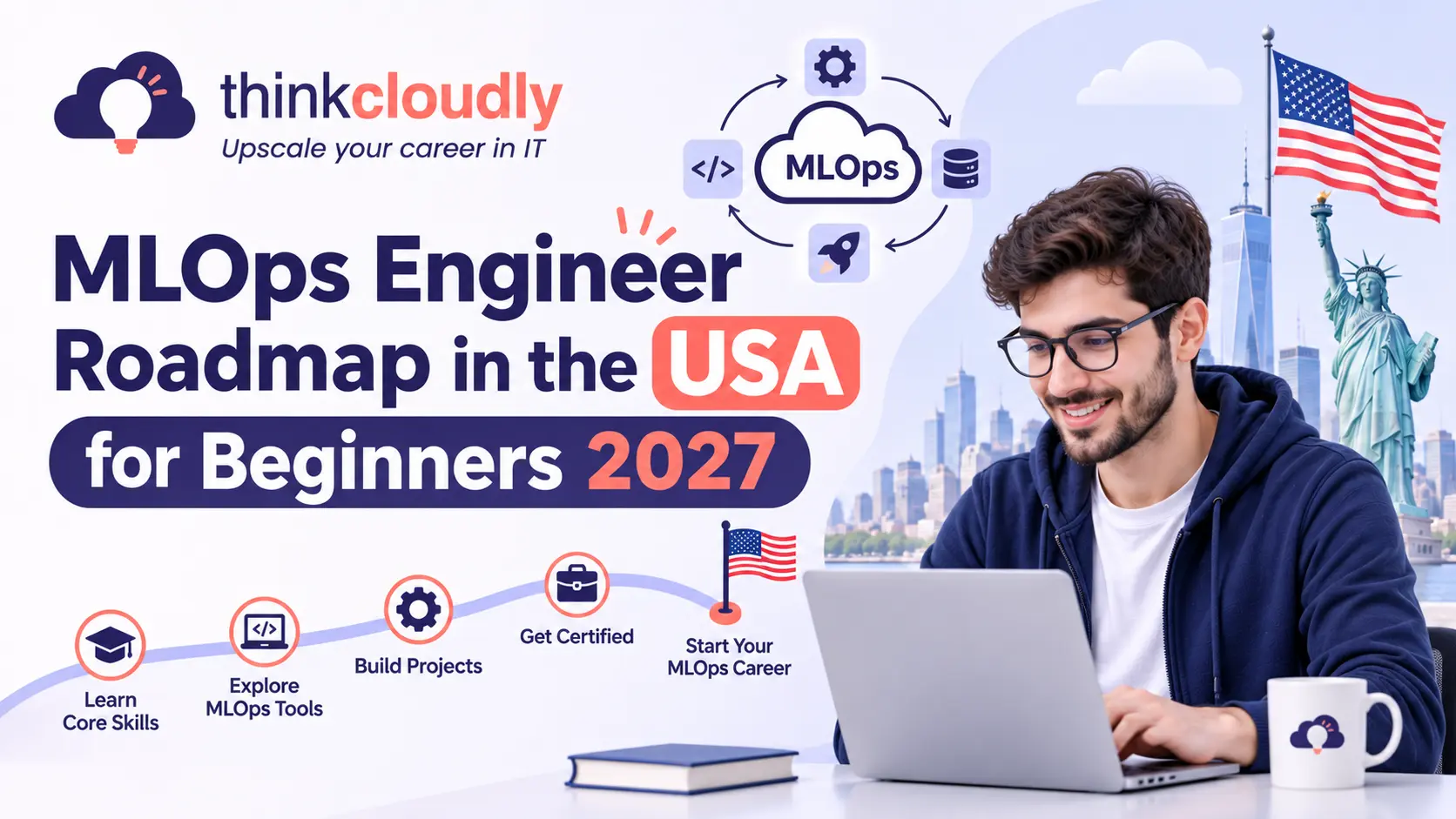
Here’s the sequence I’d actually recommend following, broken into phases rather than a long flat list of topics to cram in all at once:
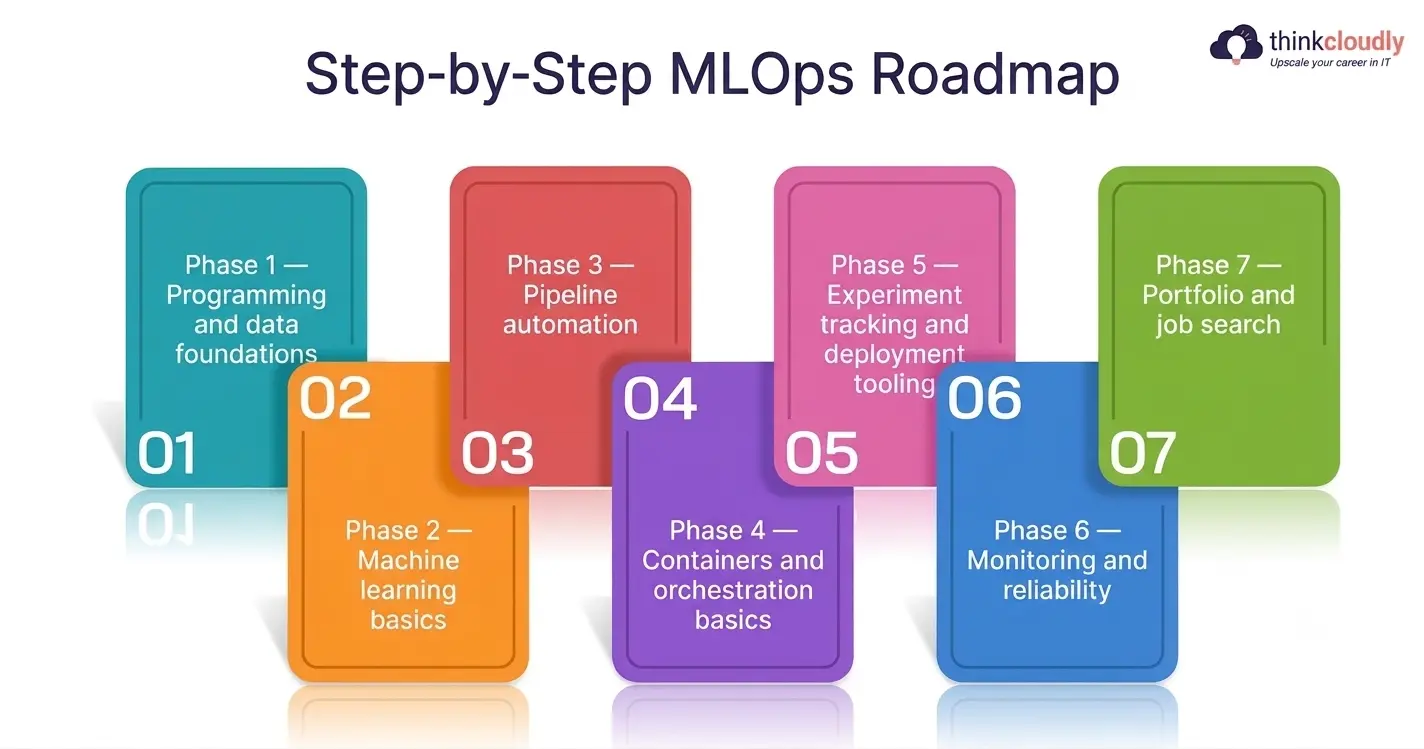
- Phase 1 — Programming and data foundations: Get comfortable with Python, SQL, and basic statistics. You don’t need to be a software architect, but you do need to read and write clean, testable code.
- Phase 2 — Machine learning basics: Learn how models are trained, evaluated, and versioned. Understand overfitting, validation splits, and why a model that looks great in a notebook can still fail in the real world.
- Phase 3 — Pipeline automation: Build a pipeline that cleans, transforms, and moves data on a schedule, using a workflow tool rather than a pile of manual scripts.
- Phase 4 — Containers and orchestration basics: Learn Docker first, then learn pods, deployments, and services, since most production machine learning infrastructure runs this way.
- Phase 5 — Experiment tracking and deployment tooling: Get hands-on with an experiment tracker, then ship one model through a real deployment workflow, end to end.
- Phase 6 — Monitoring and reliability: Add drift checks and basic alerting so you can show, not just claim, that you understand what happens after a model ships.
- Phase 7—Portfolio and job search: Package one or two projects that demonstrate the full loop—data in, model trained, model shipped, model watched—and use those in interviews instead of a list of course certificates.
Following this MLOps engineer roadmap in order matters because each phase depends on the one before it. Skipping straight to advanced orchestration without data pipeline basics, for example, tends to produce engineers who can spin up a cluster but can’t explain why a model’s input data looks different in production than it did in training.
Core MLOps Tools You Need Early On
A common beginner mistake is trying to learn every MLOps tool on the market at once. You don’t need to. A short, well-chosen list of MLOps tools covers almost everything a first production project requires:
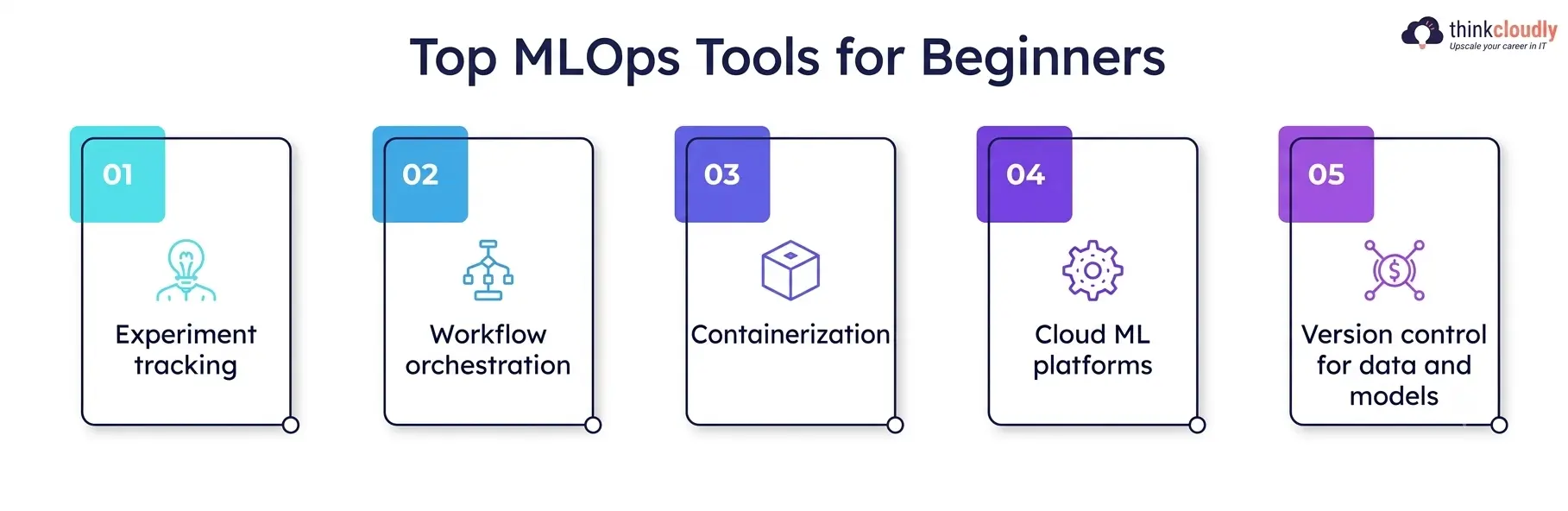
- Experiment tracking: MLflow, which is open-source, cloud-agnostic, and the most common starting point for tracking training runs and model versions.
- Workflow orchestration: A pipeline tool like Kubeflow Pipelines or Apache Airflow, used to automate the scheduling of the pipeline and training jobs you’ll build in Phase 3.
- Containerization: Docker, for packaging a model and its dependencies into something that runs the same way everywhere.
- Cloud ML platforms: A managed platform such as Amazon SageMaker or Google Vertex AI, which handles a lot of the deployment plumbing for you while you’re still learning.
- Version control for data and models: DVC or a feature store, so your training data is as traceable as your code.
As this survey of leading MLOps tools points out, most teams standardize on a small handful rather than chasing every new release, and that’s exactly the approach a beginner should copy. Pick one option per category, finish a real project with it, and only then consider switching.
Data Pipelines: The Unglamorous Skill That Gets You Hired
If there’s one skill beginners underestimate, it’s data pipelines. Models get the attention, but pipeline failures are what actually break things at 3 a.m., and employers know it.
A solid grasp of data pipelines means you can explain how raw data gets cleaned, validated, transformed, and delivered to both a training job and a live model without those two paths quietly drifting apart.
It means knowing how to schedule a job, handle a late or malformed file without crashing the whole pipeline, and version the data itself so a model’s results can be reproduced six months later.
Start small: build one pipeline that pulls data from a public source, cleans it, and stores it somewhere a model can read from. Add scheduling. Add a basic data quality check that fails loudly instead of silently passing bad data downstream. That single project teaches more about real-world data handling than most beginner courses manage in a full semester.
Kubernetes for Beginners: Why It’s Non-Negotiable in This Roadmap
This technology tends to intimidate Kubernetes for beginners more than any other topic on this list, but you don’t need to master it, you need to understand it. Nearly every company running machine learning at any real scale is running it on Kubernetes in some form.
The CNCF’s latest annual cloud native survey found that 82% of container users now run it in production, up from 66% just a couple of years earlier, and about two-thirds of organizations running generative AI models use it for some or all of their inference workloads.
For a beginner, that means container orchestration isn’t an optional advanced topic—it’s close to table stakes. Start with the basics: pods, deployments, services, and how a container actually gets scheduled onto a node.
You don’t need to run your own cluster from scratch on day one; a local setup like Minikube or a managed service from a major cloud provider is enough to learn the concepts that show up in almost every job description in this field. Once you’re comfortable with the fundamentals, deploying a model behind it feels far less mysterious than it did a month earlier.
Model Deployment Basics Every Beginner Must Master
This is where a lot of beginner projects quietly stall, because a model that works in a notebook isn’t automatically something you can call over an API. Model deployment means wrapping a trained model behind a service—often a simple REST or gRPC endpoint—that can handle real requests, scale under load, and roll back safely if the new version performs worse than the old one.
Start with the simplest version possible: deploy one trained model behind a managed endpoint on a cloud provider, send it a handful of test requests, and confirm the predictions match what you got locally.
Then add the pieces that make model deployment production-grade: a staging environment, a basic canary rollout, and a rollback plan you’ve actually tested rather than just written down. Doing this once, end to end, on a small project teaches far more than reading about it ever will.
Model Monitoring: How to Keep a Model Honest After Launch
A model doesn’t fail the way normal software fails. It usually keeps responding, keeps returning predictions, and looks perfectly healthy on an infrastructure dashboard—while quietly getting less accurate every week as the real world shifts away from what it was trained on. That’s exactly what model monitoring is built to catch.
This kind of monitoring tracks at least three things: data drift, where incoming data starts to look statistically different from training data; prediction drift, where the model’s own outputs shift over time; and basic performance metrics, wherever you have the ground truth to measure them.
As a beginner, you can build a simplified version of model monitoring by logging predictions, comparing distributions week over week, and setting a threshold that triggers an alert. It won’t be as sophisticated as what a mature team runs, but it demonstrates exactly the instinct employers are hiring for.
A Beginner’s MLOps Engineer Roadmap Timeline
Here’s a rough breakdown of how long each phase realistically takes for someone studying consistently, alongside the core skill it builds:
|
Phase |
Focus Area | Core Skill Gained |
Typical Time |
|
I |
Python, SQL, statistics | Clean, testable code |
4–6 weeks |
|
II |
ML fundamentals | Training, evaluation, versioning |
4–6 weeks |
| III | Pipeline automation | Scheduled, validated data flow |
3–4 weeks |
|
IV |
Docker and Kubernetes | Containerized, orchestrated deployment | 4–5 weeks |
|
V |
Experiment tracking and deployment | End-to-end shipped model |
3–4 weeks |
|
VI |
Monitoring and reliability | Drift detection, alerting | 2–3 weeks |
Treat this table as a guide, not a deadline. The goal of each phase is a finished piece of work you can talk about in an interview, not just a topic you read about once.
Common Mistakes Beginners Make on This Roadmap
A few patterns show up again and again. Jumping straight into container orchestration before understanding basic data pipelines is one of the most common, and it usually produces someone who can deploy a cluster but can’t explain why a model is failing.
Collecting certificates instead of finishing projects is another — a certificate tells an employer you sat through a course; a deployed, monitored model tells them you can actually do the job. Ignoring this kind of monitoring until “later” is a particularly expensive habit, because retrofitting it onto a model that’s already live is far harder than building it in from the start.
And learning too many MLOps tools before shipping anything is a reliable way to stay a beginner twice as long as necessary.
A Personal Note
I didn’t come from a traditional computer science background, and the thing that actually got me hired wasn’t a certificate — it was one finished project where I could explain, in detail, why I made every decision along the way.
If you’re following this MLOps engineer roadmap and starting to feel behind because someone online has learned six more tools than you, ignore that feeling. Depth on one real, end-to-end project beats breadth across ten half-finished ones every single time. Build the thing, break it, fix it, and then explain what you learned — that’s the entire game.