




Canada’s hiring market for AI talent has changed shape faster than most job seekers have had time to notice. This kind of credential used to be a nice-to-have line on a resume. In 2027, for anyone chasing a prompt engineering role or a seat on an AI product team, a generative AI certification has become one of the few things that actually gets a recruiter to open your profile a second time.
This guide walks through what a generative AI certification actually teaches, which programs are worth your time and money, how Canadian employers are using these credentials to screen candidates, and what a realistic path from “beginner” to “hired” looks like. I wrote it the way I wish someone had written it for me: plainly, with real numbers, and without pretending every certificate on the market is equally useful.
Why Does Generative AI Certification Matter More in Canada Right Now?
Canada’s AI-related job postings grew roughly 15-fold between 2012 and 2024, with the single biggest jump happening between 2023 and 2024, according to PwC’s Global AI Jobs Barometer. By 2024, AI-related skills showed up in 1.8% of all job postings tracked in the country—the highest share on record.
That demand isn’t evenly spread: financial services and insurance, along with information and communication companies, post the largest share of AI-related roles, with education and professional services rising quickly behind them.
This kind of credential won’t manufacture experience you don’t have, but it does two concrete things.
- First, it gives hiring managers a fast, legible signal that you understand how large language models actually behave—their limits, their failure modes, and how to steer them.
- Second, it forces you to practice the one skill almost every posting in this space asks for: writing, testing, and refining prompts under real constraints, not just chatting with a model for fun.
Statistics Canada’s own 2026 labour market analysis frames this directly: the open question for Canadian workers isn’t whether generative AI changes jobs, but which jobs are complementary to it and which are exposed to replacement, based on recent job data. Workers who can demonstrate prompt engineering skills and a working understanding of natural language processing are positioning themselves on the complementary side of that line rather than the exposed side.
The Canadian Job Market for Prompt Engineers in 2027
A few patterns are worth understanding before you pick a program or start applying. Job titles in this space are still inconsistent—”Prompt Engineer,” “AI Workflow Specialist,” “Generative AI Analyst,” and roles built around AI-driven dialogue design often describe overlapping work, so it pays to read the actual job description rather than screen by title alone.
Degree requirements are also loosening. Across highly AI-exposed roles, the share of postings requiring a university degree fell from about 70% in 2019 to roughly 57% in 2024, according to the PwC Canada analysis cited above.
Certifications and demonstrated skill are filling some of that gap, especially for junior and mid-level roles, even though highly exposed jobs still ask for a degree far more often than low-exposure jobs do.
Demand is also concentrated in a handful of occupation types rather than spread evenly across the economy. The OECD’s analysis of Canadian job postings found that specialized demand clusters in data science, cloud engineering, and dedicated AI research roles, with growth in machine learning and natural language processing skills outpacing generic AI mentions.
At the same time, roles where generative AI augments a human worker’s output are growing faster, on average, than roles where it replaces tasks outright—a trend that favors people who can operate the tools well, not just people who built them.
Hiring managers also consistently say they’d rather see a portfolio of tested prompts, a small chatbot project, or a documented prompt optimization case study than a long list of unapplied coursework.
If you’re weighing whether this market has room for a newcomer, the honest answer is yes, but mostly in roles that pair hands-on skill with a specific domain—healthcare documentation, financial analysis, customer support, or content operations—rather than in pure research positions, which still lean heavily on advanced degrees.
Core Skills a Generative AI Certification Should Actually Teach You
Not every program on the market teaches the same things, and plenty are light on substance. Before enrolling, check that the curriculum covers the following:
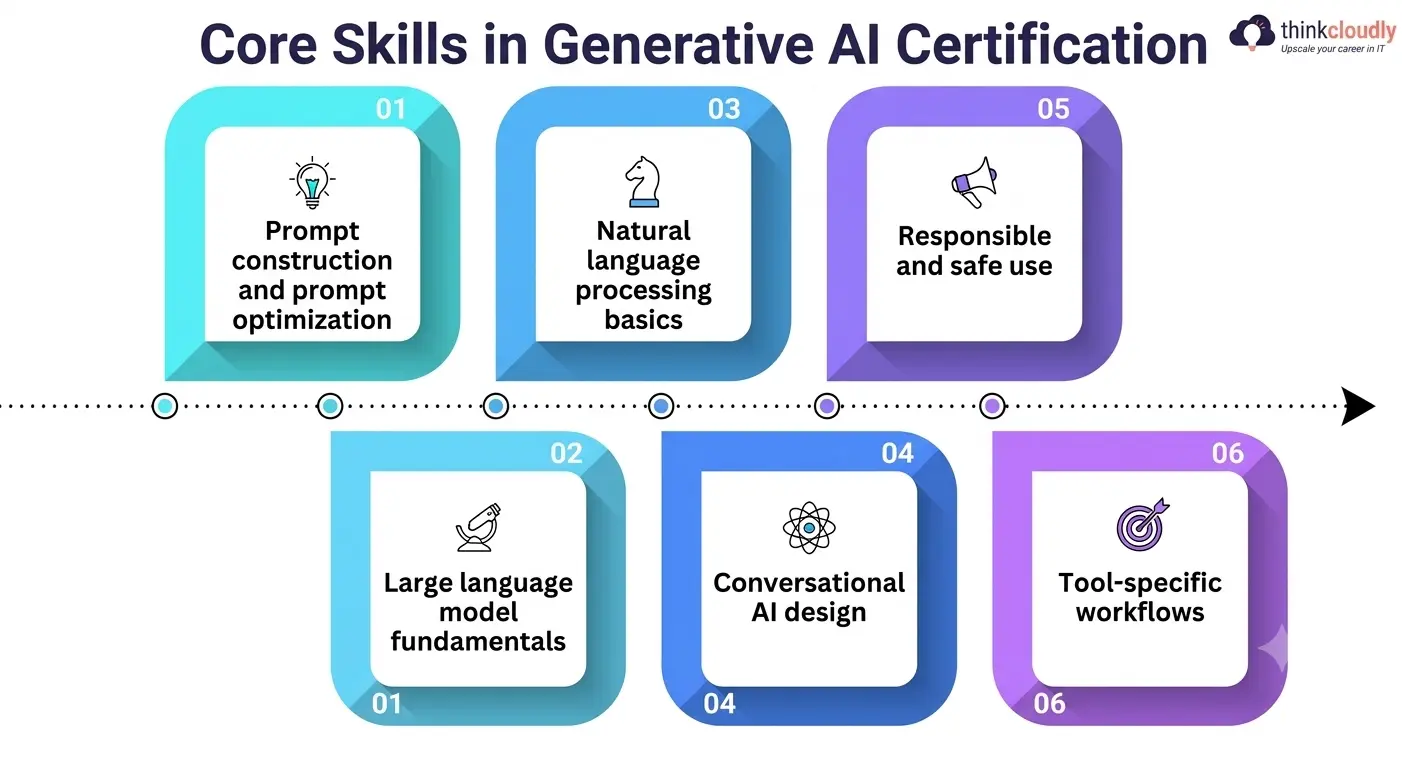
- Prompt construction and prompt optimization. How to write a prompt that’s specific enough to constrain the model’s output, and how to iterate on it when the first version fails.
- Large language model fundamentals. What a transformer-based model is actually doing when it generates text, including context windows, tokens, and why hallucination happens.
- Natural language processing basics. Enough grounding in how machines parse and represent language to understand why certain prompt structures work better than others.
- Conversational AI design. How to build multi-turn interactions that stay on-task, handle ambiguous user input, and hand off gracefully when the model is out of its depth.
- Responsible and safe use. Bias, data privacy, and when not to rely on a generative model’s output without human review.
- Tool-specific workflows. Hands-on practice inside at least one major platform (OpenAI’s tools, Anthropic’s Claude, Google’s Gemini, or an open-source stack), since employers want fluency, not just theory.
A program that skips prompt optimization and conversational AI design in favor of generic “what is AI” content is a weak use of your time, however polished its marketing looks.
Comparing Popular Generative AI Certification Options
Costs, durations, and depth vary a lot across the market. Here’s a snapshot of programs frequently recommended for people targeting prompt engineering or generative AI roles in Canada:
|
Certification |
Provider | Best For | Typical Duration |
Approx. Cost |
|
Google AI Essentials |
Google (via Coursera) | Complete beginners, non-technical roles | ~4 hours, self-paced |
~US$20/month |
|
Prompt Engineering Specialization |
Vanderbilt University (via Coursera) | Intermediate learners wanting structured depth | ~4 weeks, 10 hrs/week |
~US$20/month |
|
Generative AI with LLMs |
Deep Learning. AI & AWS | Technical learners, data/ML backgrounds | ~2 weeks, 10 hrs/week |
~US$31, 6-month access |
|
Generative AI for Data Engineers |
IBM (via Coursera) | Data engineers adding AI skills | ~8 weeks, 2 hrs/week |
~US$20/month |
|
Complete Prompt Engineering Bootcamp |
Udemy (independent instructor) | Project-based learners comfortable with Python | ~22.5 hours of video | ~US$120 (often discounted) |
None of these is a universal “best” choice. A communications professional moving into AI-driven customer experience work will get more out of the Vanderbilt specialization than the AWS-flavored LLM course, while someone aiming at an applied ML role should go the other way. What matters more than the name on the certificate is whether the program forces you to actually practice prompt engineering skills on realistic tasks instead of just watching lecture videos.
Which Canadian Cities Have the Most Opportunity
Opportunity in this field still clusters around Canada’s existing tech and finance hubs rather than spreading evenly nationwide. Toronto, with its concentration of banks, insurers, and a dense startup scene, tends to post the widest range of generative AI and prompt engineering roles, reflecting the sector concentration PwC’s data shows in financial and insurance activities.
Vancouver and Montreal follow closely, both home to established AI research labs and a growing number of applied AI teams inside media, gaming, and e-commerce companies. Waterloo and Ottawa punch above their size thanks to university pipelines and a dense cluster of software firms willing to hire junior talent who can show real prompt engineering skills rather than just a finished certificate.
Remote work has loosened this geography somewhat. A meaningful share of prompt engineering and conversational AI roles posted by Canadian companies are now remote-friendly, since the skill itself doesn’t require being in an office near a specific data center or lab. That said, candidates in major hubs still tend to hear back faster, simply because more recruiters are actively screening local talent pools first before opening a search nationally.
Startups vs. Established Employers: A Different Hiring Bar
The two ends of the Canadian employer spectrum test for different things, and it’s worth knowing which one you’re walking into. Startups and scale-ups building directly on top of large language models tend to move fast: a short take-home prompt-writing exercise, a culture call, and an offer within two to three weeks is common.
They care less about where your credential came from and more about whether you can ship something usable under a tight deadline, so a thin certification backed by a sharp project will often beat a well-known one with no evidence behind it.
Banks, insurers, telecoms, and government-adjacent employers move at a different pace entirely. Expect a longer process — sometimes six to ten weeks — with multiple interview rounds, security clearance checks for some roles, and a stronger preference for recognizable credentials from well-known providers.
These employers also tend to value a demonstrated understanding of responsible AI use and data governance more heavily than startups do, since they’re operating under stricter compliance obligations. Knowing which type of organization you’re applying to should shape how you present your certification and your portfolio, not just where you send your resume.
How Employers in Canada Actually Read Your Certification?
A generative AI certification on its own rarely closes a hiring decision. What tends to move the needle is pairing the credential with visible proof of applied prompt engineering skills: a repository of tested prompts, a short case study on prompt optimization for a specific task, or a side project built on top of a large language model’s API.
Recruiters interviewed in multiple 2026–2027 hiring reports describe the certification as a “credibility filter” — it gets your resume past an initial screen — while the portfolio is what gets you the interview.
This is also where natural language processing fundamentals start to matter beyond the certificate itself. Interviewers increasingly ask candidates to explain why a prompt worked or failed, not just to produce one that works. Understanding how tokenization, embeddings, and context length actually function gives you language to answer that kind of question instead of guessing your way through it.
A Realistic Path From Certification to Hired
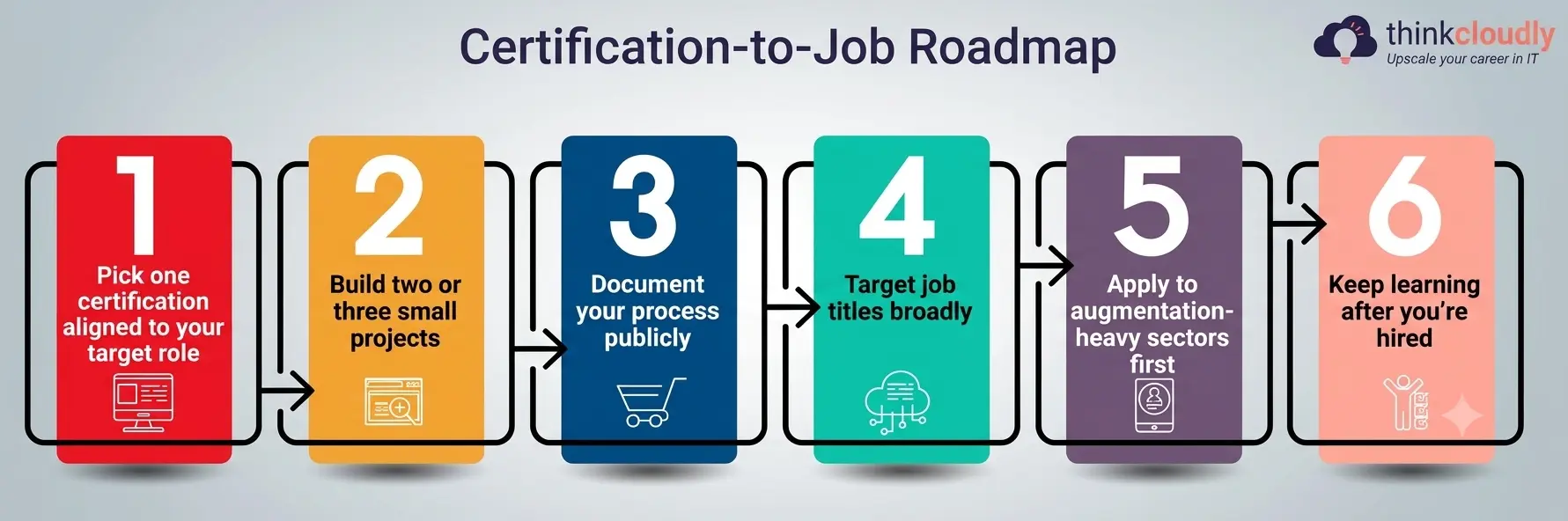
- Pick one certification aligned to your target role, not three unrelated ones. Depth beats breadth at this stage, and a scattered transcript reads as indecision to a hiring manager.
- Build two or three small projects that demonstrate your prompt engineering skills in a real context — a customer-support bot, a document summarizer, or a chatbot prototype for a niche use case.
- Document your process publicly (a blog post, a short video, a well-organized repo) so a hiring manager can see your thinking, not just your finished output.
- Target job titles broadly — Prompt Engineer, AI Specialist, Conversational AI Designer, Applied AI Analyst — since Canadian employers haven’t standardized these labels yet.
- Apply to augmentation-heavy sectors first, including healthcare administration, financial services, and customer operations, where generative AI adoption is accelerating fastest according to the PwC and OECD data cited above.
- Keep learning after you’re hired. The tools and best practices around large language models shift quickly enough that a 2027 certification will need a refresher within a couple of years.
Is a Generative AI Certification Worth It in 2027?
For most job seekers, yes — with a caveat. A generative AI certification is worth the time and modest cost if you treat it as the starting point for a portfolio, not the finished product. It’s not worth it if you expect the badge alone to outcompete a candidate with real, demonstrated skill and a handful of shipped projects.
Canada’s market, per the labour data above, is rewarding applied fluency with large language models over credentials held in isolation — but a solid certification remains the most efficient way to build that fluency in the first place, and it’s still the clearest signal most employers currently know how to screen for.
A Personal Note
I’ve spent the last couple of years watching friends and former colleagues retool for this shift, some successfully and some not. The ones who struggled usually collected certificates the way people once collected gym memberships — with good intentions and little follow-through.
The ones who landed real prompt engineering roles treated their certification as homework, not a trophy: they finished the course, then spent twice as long applying what they’d learned to a project nobody asked them to build. If you take one thing from this guide, take that. The certificate opens a door. What you build after it is what walks you through.