





Every few weeks, another LinkedIn post claims an AI certification turned someone’s career around in six months flat. Some of that is true. Most of it skips the part that actually matters to a beginner: what does the paycheck look like once the badge is on your profile, and does it hold up once a hiring manager starts asking real questions?
An AI certification for beginners is not a lottery ticket, and it is not a scam either—it is a credential that pays off in a specific, measurable way when it is paired with real skill and barely moves the needle when it is not.
This guide walks through what that kind of credential is actually worth in salary terms across the USA and Canada in 2027, which roles it opens up, and what you need to learn alongside it so the number on your offer letter matches the number you saw in someone else’s post.
Most of the confusion around this topic comes from people comparing two very different things: a beginner who paired a certificate with a real project and a beginner who collected a badge and stopped there. The gap between those two outcomes is large, it’s measurable in actual salary data, and it’s almost entirely within your control once you know what to look for before you enroll.
Why Does an AI Certification for Beginners Actually Move the Needle?
The honest answer is that a certificate alone rarely changes a salary offer by much. What changes is what the certificate represents to the person reading your resume. Hiring managers filtering hundreds of applications for one junior AI role use a certification as a filter, not a guarantee—it tells them you understand the vocabulary, you’ve touched the tools, and you didn’t just read a few blog posts and call yourself qualified.
That filtering effect is exactly why the right credential, chosen for the right reasons, still has real salary weight even in a crowded applicant pool.
A handful of reasons explain why 2027 specifically is a good year to get this right:
- Companies that spent 2024 and 2025 experimenting with AI pilots are now hiring permanent staff to run and maintain those systems, and most of those roles are junior by design.
- Budgets for senior AI hires have tightened, while budgets for AI-literate generalists—people who can support a model pipeline without owning the research—have grown.
- Recruiters are explicitly screening for a recognized beginner-level AI certification because it saves them from interviewing candidates who can’t explain the difference between a prompt and a parameter.
- AI-powered authoring and automation tools have made it possible for a beginner with the right training to contribute to real projects within weeks instead of years, which has quietly lowered the experience bar for entry-level AI work.
- Canadian and US employers alike are competing for the same thin pool of credentialed beginners, which is part of why entry salaries in this space have held up better than in general software roles.
None of this means the certification does the work for you. It means it gets your resume read by a person instead of filtered out by a keyword scanner, and that first read is where every salary conversation actually starts.
What a Legitimate Beginner-Level AI Certification Should Cover?
If you’re choosing between programs, this is the checklist worth using before you pay for anything. A program worth your time and money should include:
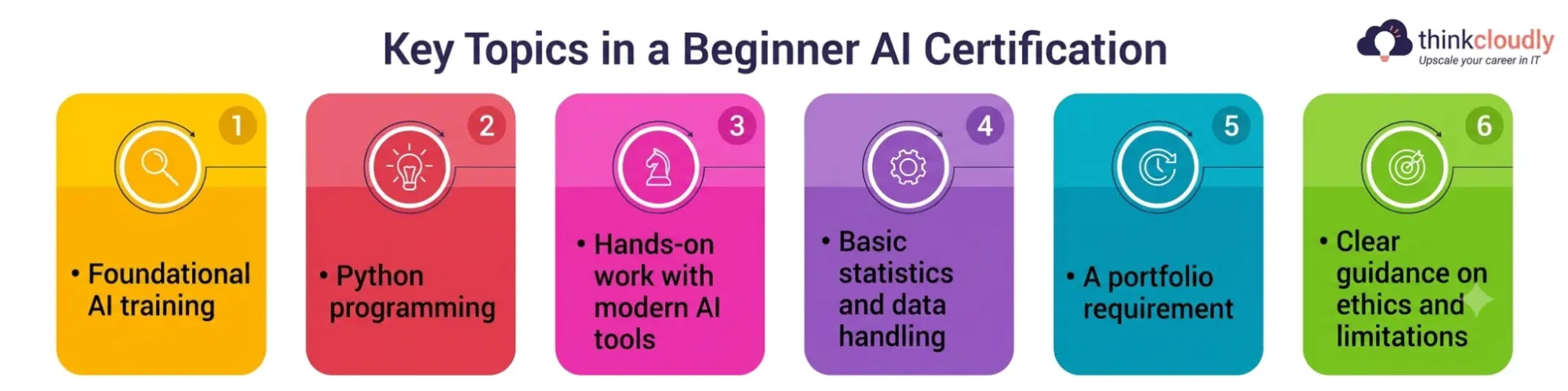
- Foundational AI training that explains how models are built and evaluated, not just how to use a chatbot interface.
- Python programming fundamentals, since nearly every entry-level AI job posting in the USA and Canada lists it as a baseline requirement, not a bonus skill.
- Hands-on work with modern AI tools and APIs, so you can describe a real project in an interview instead of reciting a syllabus.
- Basic statistics and data handling, because most “AI” roles at the entry level are really data-adjacent roles with AI tooling layered on top.
- A portfolio requirement, not just a multiple-choice exam, since employers now routinely ask beginners to walk through something they actually built.
- Clear guidance on ethics and limitations, which sounds soft but comes up constantly in interviews for anyone who’ll be touching customer-facing AI systems.
A program missing most of these items might still look good on a resume line, but it won’t hold up once someone starts asking follow-up questions in an interview—and that’s where this kind of credential either earns its cost back or doesn’t.
AI Certification for Beginners: Salary by Role in the USA and Canada
Here is the number most beginners actually want. These ranges reflect typical 2026 entry-level offers reported across current salary-tracking sources for roles that commonly accept a fresh, beginner-friendly AI credential in place of years of direct experience.
|
Entry-Level Role |
USA Salary Range (USD/year) |
Canada Salary Range (CAD/year) |
|
AI/ML Associate or Analyst |
$65,000 – $85,000 |
$60,000 – $78,000 |
|
Machine Learning Engineer (Entry-Level) |
$85,000 – $105,000 |
$75,000 – $95,000 |
|
Generative AI Specialist / Prompt Engineer |
$70,000 – $95,000 |
$65,000 – $85,000 |
|
AI-Enabled Data Analyst |
$60,000 – $78,000 |
$55,000 – $72,000 |
|
AI Support / Implementation Associate |
$55,000 – $70,000 |
$50,000 – $65,000 |
- A few patterns stand out. First, roles with “machine learning” explicitly in the title pay more than generic “AI” titles, largely because they imply the coding and modeling skills employers can’t easily verify from a certificate alone.
- Second, roles built around generative AI pay a real premium over general data analyst work, even at entry level, because fewer beginners can actually demonstrate hands-on project work with these tools rather than just talking about them.
- Third, the US-to-Canada gap narrows once you convert currency and adjust for the typical cost of living in major Canadian tech hubs like Toronto and Vancouver—the raw number looks smaller in CAD, but the real difference is less dramatic than it appears on paper.
It’s worth being candid about what these figures are and aren’t. They’re a composite of what entry-level roles are currently paying across public salary-tracking sources, not a quote from any single employer, and actual offers will vary by city, company size, and how much of the interview you spend talking about a real project versus a certificate. Treat the ranges as a planning tool for negotiation, not a promise.
Generative AI, AI Training, and the Skills Actually Behind the Paycheck
It’s worth separating the certificate from the skill, because employers increasingly do. A certificate says you completed AI training. Your interview performance says whether that training actually stuck.
Generative AI specifically has reshaped what a beginner is expected to know. Three years ago, entry-level AI roles mostly involved cleaning data and running pre-built models. Now, companies expect beginners to be comfortable working alongside these AI content tools directly—fine-tuning prompts, evaluating model outputs for bias or error, and integrating those AI-generated features into existing products.
InfoWorld’s reporting on whether AI certifications are worth the investment makes a similar point: the credential matters less than being able to show you can actually apply what the AI training covered to a real, messy problem.
Python programming sits underneath almost all of this. You don’t need to be a software engineer to land a junior AI role, but you do need enough scripting comfort to read someone else’s code, modify it, and run a basic analysis without hand-holding.
Most beginner AI programs that skip this step are setting candidates up to pass the exam and fail the interview. The programs that handle it well usually treat scripting as a weekly habit rather than a single module, which is a small distinction that makes a large difference six months later.
Five Signs You’re Ready to Start a Beginner-Level AI Certification
Before spending money on a program, check whether you’re actually starting from a reasonable place:
- You’re comfortable with basic spreadsheet or data logic, even if you’ve never written a line of code.
- You’re willing to commit to Python programming practice outside the certification itself—most programs assume some independent study time.
- You can describe, in plain language, what an AI content-generation tool does differently from a traditional search engine or script.
- You have three to six months you can realistically dedicate before expecting a job-ready result.
- You’re looking for a long-term AI career path, not a one-time credential to add to a resume and forget about.
If most of these are true, the certification will likely pay for itself within a single raise or job change. If none of them are true yet, spend a month on free introductory material first—it will make the paid program worth far more.
Machine Learning Certification vs. a General Beginner AI Credential
These two get confused constantly, and the difference matters for salary. A machine learning certification tends to go deeper into the math and modeling side—regression, classification, model evaluation—and is better suited to someone aiming directly at an engineering-track role. A broader beginner-level AI certification usually covers generative AI tools, basic AI training concepts, and applied use cases without requiring the same depth of statistics.
Neither one is objectively “better.” A machine learning certification tends to open doors to higher-paying, more technical roles faster, but it also demands more up-front math comfort. A general beginner AI certification opens a wider range of entry points—support roles, implementation roles, and AI-adjacent analyst roles—faster, with a gentler learning curve.
Robert Half’s IT and tech salary guide for Canada notes that employers across both tracks are paying competitively for candidates who can demonstrate applied skill, regardless of which certification path got them there—which is a useful reminder that the credential is a door, not a ceiling.
Building a Realistic AI Career Path After Certification
A certificate is a starting point on an AI career path, not the destination. The beginners who see the fastest salary growth after certification tend to follow a similar pattern: they take an entry-level role that’s slightly below what they feel they deserve, build one or two genuinely useful projects inside that role within the first year, and use those projects — not the original certificate — to negotiate their next move.
A realistic AI career path usually looks like junior analyst or associate roles in year one, a title bump with real ownership of a small system or pipeline by year two, and a genuine specialization — applied generative-tooling work, ML engineering, or AI operations — by year three.
Trying to skip straight to a specialized, high-paying title in year one, without the intermediate step, is the single most common reason beginners feel disappointed by their first result from this kind of credential.
None of this is linear in practice. Some beginners move faster because they land in a smaller company willing to hand real ownership to anyone who shows initiative, and some move slower because their first employer never gives them a chance to touch anything beyond routine tasks. Either way, the pattern above is a useful default to plan against rather than a guarantee of what will happen in your specific case.
A Personal Note
I went through this exact decision a couple of years ago, long before “AI certification” was a phrase every job board used. I picked a program mostly because it was cheap and the syllabus looked impressive, and I learned the hard way that neither of those things predicts whether you’ll actually use what you studied.
The certification itself didn’t get me my first offer. The small, unglamorous project I built during the course — a script that cleaned and summarized a messy dataset I genuinely cared about — is what came up in every interview after. Nobody asked to see my certificate.
Everybody asked me to walk through that project, including the parts where my first version of it was wrong and I had to redo it. If you’re about to start an AI certification for beginners and you’re tempted to pick the fastest, cheapest option just to get a credential on paper, slow down and pick the one that makes you build something real instead. That’s the part that actually shows up in your paycheck, and it’s the part I wish someone had told me plainly before I spent my own money finding it out the slow way.