





Career switchers tend to ask the same question in different words: can someone with zero technical background actually land a security job, or is that just marketing copy from a course provider?
The honest answer is that a Google cybersecurity certificate program was built almost entirely for this exact audience—people moving in from retail, teaching, admin work, hospitality, or the military—rather than for computer science graduates polishing an already-technical resume.
This guide breaks down what the certificate covers, which cybersecurity training modules matter most for a total beginner, how the program builds real cybersecurity skills you can describe clearly in an interview, and which entry-level roles are realistic to target once you finish in 2026 or 2027.
Why Are Career Switchers Betting on Google Cybersecurity?
The numbers behind this shift aren’t anecdotal. The U.S. Bureau of Labor Statistics projects information security analyst roles to grow 21% between 2025 and 2035, with a median annual wage of $129,180 as of May 2025 and about 14,100 openings expected every year through the decade.
That growth rate is categorized as “much faster than average,” and it’s one of the clearest signals that a security analyst path is still wide open to newcomers rather than closed off to anyone without a computer science degree.
At the same time, the Cybersecurity Study found that 59% of organizations report a critical or significant skills shortage, and junior-level staff make up only about 5% of the workforce surveyed.
That gap sits exactly where a career switcher is trying to enter, which is why a Google cybersecurity credential keeps showing up as the recommended starting point for people without a technical background—it closes that specific gap instead of competing for senior-level seats that don’t exist for a first-year hire anyway.
There’s one more reason timing matters: most hiring teams have stopped treating a four-year degree as a hard filter for junior security roles. Recruiters increasingly screen for demonstrated cybersecurity skills—a home lab, a documented detection scenario, a Security+ credential—over a transcript, which is precisely the kind of evidence a structured certificate program is designed to produce.
Cost is the other factor career switchers weigh heavily, and it works in their favor here. The program runs on a monthly subscription model through Coursera rather than a large upfront tuition bill, and most learners finish within a few months of steady effort.
Compare that to a four-year degree or even a six-month in-person bootcamp charging five figures upfront, and the math tilts clearly toward a self-paced, affordable certificate for anyone changing careers without a large financial cushion to draw on.
What Does the Google Cybersecurity Certificate Actually Cover?
A lot of career switchers assume this is a generic “intro to security” course that skims the surface. It isn’t. The current Google cybersecurity program runs across roughly eight to nine courses and 130-plus hours of instruction, and the course list reads like a real job description rather than a textbook: security foundations, managing risk, networking fundamentals, Linux and SQL, assets and vulnerabilities, detection and response, Python automation, and job-search preparation.
The middle stretch is where a non-technical switcher usually feels the biggest shift. The networking module builds genuine network security literacy—how traffic moves, where firewalls sit, and what a suspicious pattern actually looks like on a log—without assuming any prior IT exposure.
The detection module is where threat detection stops being an abstract phrase and becomes a hands-on exercise, using SIEM platforms like Chronicle and Splunk alongside the Suricata detection engine to review simulated alerts.
According to Coursera’s own program data, the majority of U.S. graduates report a positive career outcome—a new job, a promotion, or a raise—within six months of finishing, and graduates can apply directly through a network of employer partners.
The program also prepares learners for the CompTIA Security+ exam as a dual credential, which matters more for a career switcher than for a CS graduate, since it stacks two recognizable, employer-trusted signals into a single stretch of cybersecurity training instead of two separate ones.
Core Cybersecurity Skills a Career Switcher Builds From Scratch
Unlike a theory-heavy degree program, this cybersecurity training sequence is built around tasks you’ll actually repeat on the job. Here’s what a typical switcher walks away able to do:
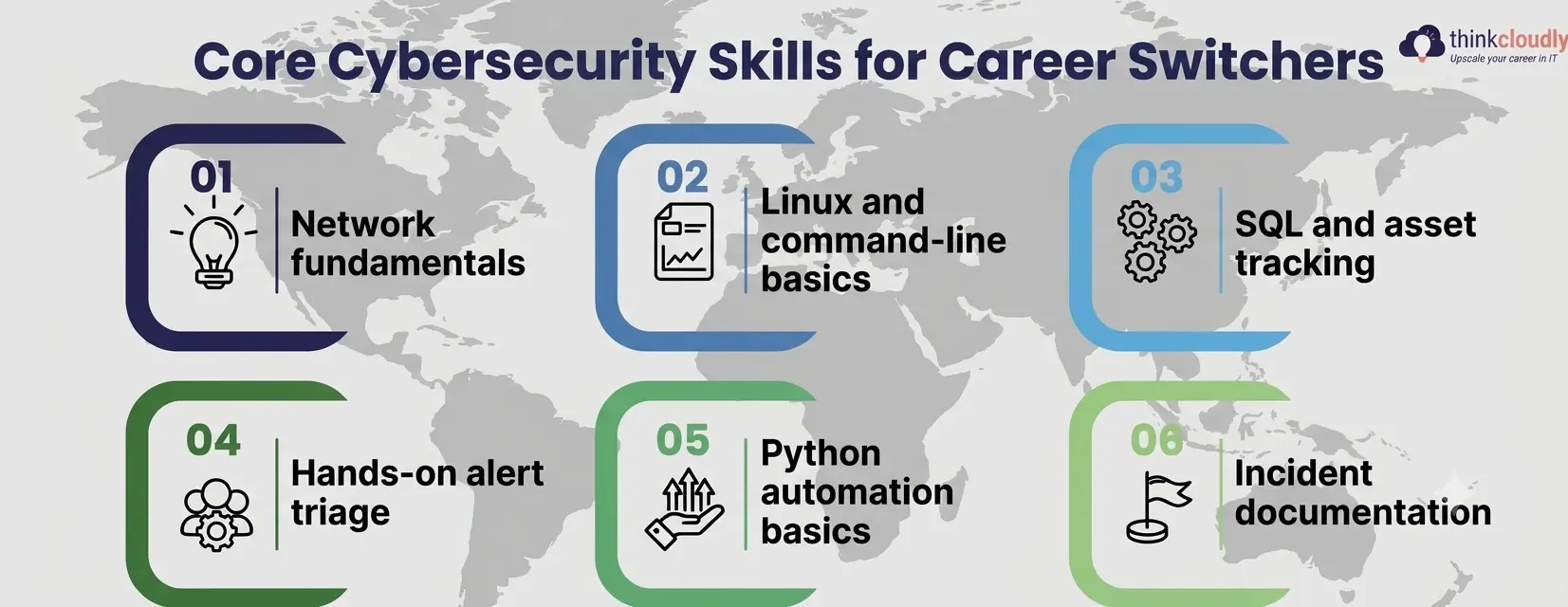
- Network fundamentals—reading traffic patterns and firewall logic well enough to hold a real conversation about network security in an interview, without a networking background going in.
- Linux and command-line basics—navigating file systems, managing permissions, and running basic Bash scripts, usually the single biggest confidence jump for a non-technical switcher.
- SQL and asset tracking—querying databases to track vulnerabilities, a skill most switchers have never touched before enrolling.
- Hands-on alert triage—working inside SIEM tools to practice spotting live intrusions on simulated incidents rather than only reading case studies about them.
- Python automation basics—enough scripting to automate repetitive tasks, not enough to call yourself a developer.
- Incident documentation—writing up and escalating a security event the way a real SOC team expects a Tier 1 hire to.
This matters most for people coming from service, retail, education, or administrative backgrounds, where transferable soft skills—communication, documentation, and staying calm under pressure—are already strong, but the technical vocabulary is completely new.
The program doesn’t assume you already speak that vocabulary; it teaches it from the first module onward, which is exactly why it keeps outperforming generic “learn to code” bootcamps for this particular audience.
Every one of these skills maps to a specific line in an entry-level job posting, which is exactly why switchers gravitate toward this program over a looser, unstructured alternative.
How Career Switchers Should Plan Their First Six Months?
A realistic plan matters more here than raw motivation, because career switchers are often studying around a full-time job and existing financial obligations. A workable sequence looks like this:
- Finish the certificate’s cybersecurity training at a steady pace. Most learners complete the full track in three to six months at five to seven hours a week—rushing it tends to produce certificates without retained skill.
- Build a home lab in parallel, not after. Spin up a free virtual machine and practice basic hardening while the coursework is still fresh in your head.
- Treat the networking and Linux modules as non-negotiable. Skimming them to reach the “exciting” detection content is the single most common regret switchers report later.
- Sit the CompTIA Security+ exam while the material is current, since the program is built to feed directly into it.
- Document one detection scenario in detail. A short written walkthrough of a simulated alert you investigated carries more weight than a resume full of unexplained badge icons.
- Apply to entry-level roles before feeling fully ready. Nobody feels ready; apply once you can talk through your lab work and coursework specifically and confidently.
This sequence works because every stage produces evidence—not just a certificate name, but an actual, specific answer to “walk me through something you investigated.”
Google Cybersecurity Certificate at a Glance for Career Switchers
|
Stage |
Timeframe | What You’re Doing |
Core Skill Built |
|
Orientation |
Weeks 1–3 | Security foundations, risk basics |
Core terminology, risk frameworks |
|
Technical core |
Months 1–4 | Networking, Linux, SQL modules |
Network security, command-line fluency |
|
Applied practice |
Months 2–5 | Detection module, home lab |
Threat detection, log analysis |
|
Credential |
Month 4–6 | CompTIA Security+ exam |
Validated baseline knowledge |
|
Portfolio |
Month 5–6 | Documented lab and detection write-ups |
Interview-ready evidence |
|
Job search |
Month 6–8 | Applications, interviews |
Communication, negotiation |
Nothing in that table assumes prior technical experience. It assumes consistency across roughly six to eight months, which is a realistic estimate for someone balancing coursework with an existing job, rather than an inflated “job-ready in thirty days” claim.
Entry-Level Roles Career Switchers Can Realistically Target
Once the certificate, the lab work, and Security+ are behind you, here’s where this path actually leads. These are the entry-level security analyst roles worth prioritizing over titles you aren’t yet qualified for:
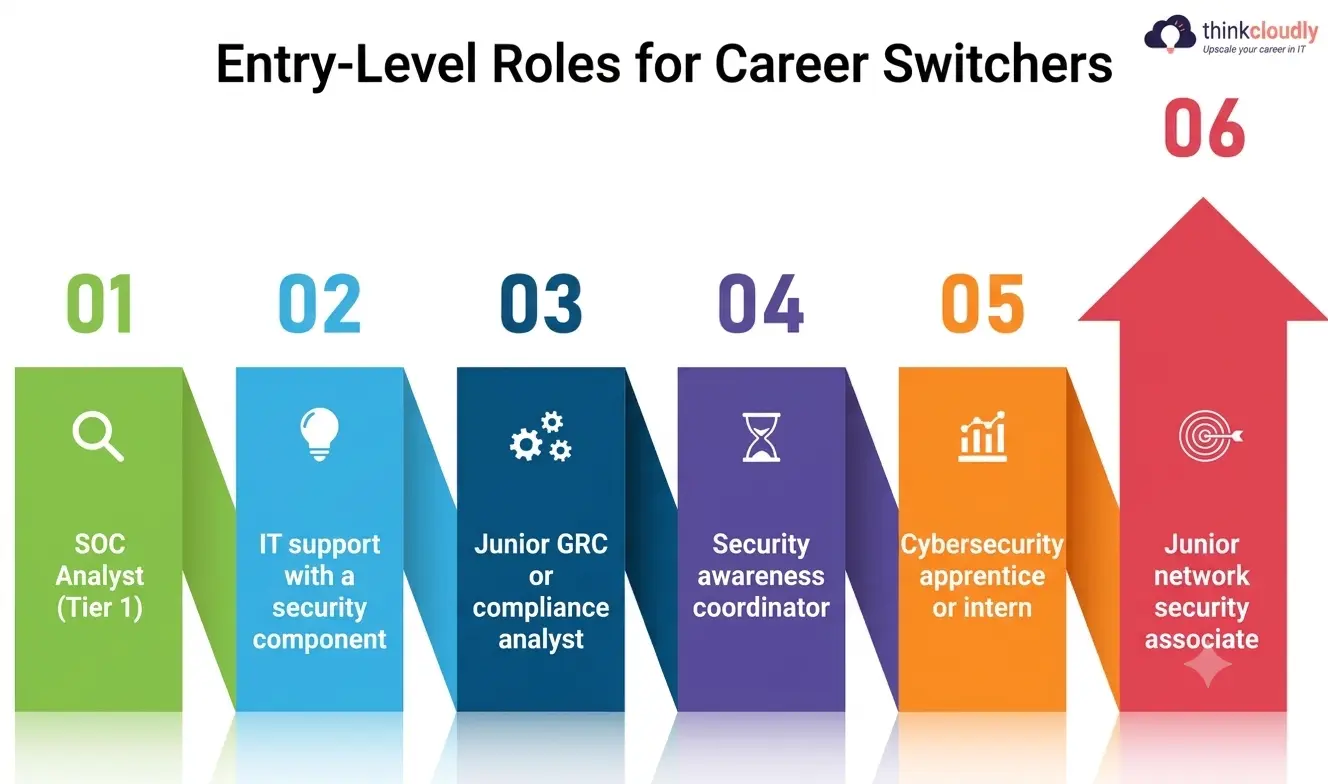
- SOC Analyst (Tier 1): The most direct entry point, built almost entirely on the alert triage and threat detection skills the certificate teaches hands-on.
- IT support with a security component: Less glamorous, but it builds the troubleshooting instincts that transfer directly into later security analyst work.
- Junior GRC or compliance analyst: A strong fit for detail-oriented switchers who are stronger on documentation and frameworks than deep technical depth.
- Security awareness coordinator: Smaller organizations often need someone to run phishing simulations and training programs—an underrated way in for people coming from teaching or communications backgrounds.
- Cybersecurity apprentice or intern: Many mid-size firms and managed security providers now run structured apprenticeship tracks specifically because junior seats keep going unfilled.
- Junior network security associate: As infrastructure keeps shifting toward hybrid and cloud environments, even basic networking literacy on top of the certificate opens doors faster than a generic IT background alone.
Among these, the Tier 1 SOC Analyst seat remains the one most directly built from the certificate’s coursework, which is why it’s worth targeting first even if it isn’t the most exciting title on the list.
Mistakes That Slow Career Switchers Down
Among Google cybersecurity career switchers, the most common failure isn’t a lack of intelligence — it’s sequencing. Switchers rush past networking and Linux straight to flashier topics like malware analysis, then wonder why interviews stall on basic command-line questions.
Others collect three or four overlapping credentials before applying anywhere, mistaking volume for readiness, when one finished certificate paired with real lab evidence consistently beats a stack of half-explained badges.
A second mistake is treating detection work as something to read about rather than practice. You can’t talk convincingly about triaging an alert if you’ve never actually sat in front of one, simulated or not.
A third mistake is applying only to dream titles — penetration tester, red teamer — while ignoring the Tier 1 SOC and GRC analyst seats that are genuinely hiring switchers right now. A fourth, quieter mistake is skipping communication practice entirely: most rejections at this stage come from a candidate who can’t walk an interviewer through their own lab notes clearly, not from a missing technical answer.
A fifth mistake worth naming is underestimating how much cybersecurity training actually requires sustained, boring repetition. Watching a video module once and moving on doesn’t build retained cybersecurity skills — rebuilding a lab environment from memory a second or third time does.
Final Thoughts
There’s no version of this path that skips the unglamorous parts and still works for a career switcher. The sequence that actually gets people hired is boring on paper: finish one certificate instead of starting three different courses, put in real hours on the command line instead of skimming it, practice threat detection until you can describe a scenario out loud without notes, and apply to entry-level roles before you feel completely ready.
Pair the CompTIA Security+ exam with the certificate as your credential, and you have a plan that mirrors how hiring managers actually evaluate junior security analyst candidates in 2026 and 2027, not how a marketing page describes the process.
Anyone weighing a Google cybersecurity credential against a longer, more expensive bootcamp should also look at the CyberSeek career pathway tool, which uses real U.S. labor-market data to show which roles are actually hiring by region rather than which ones simply sound impressive on paper.
A personal note
I’ve walked a handful of friends through this exact switch — one from hospitality management, one from high school teaching — and the pattern repeats every time. The ones who get hired aren’t the ones who finish the certificate fastest.
They’re the ones who keep a messy lab notebook, who can explain one detection scenario out loud without rehearsing it first, and who apply to the unglamorous Tier 1 role instead of waiting for a cooler title to open up. If you’re a few weeks into this switch and feel behind everyone else in your cohort, you’re probably not. You’re just at the part of the process that never makes it onto anyone’s highlight reel.